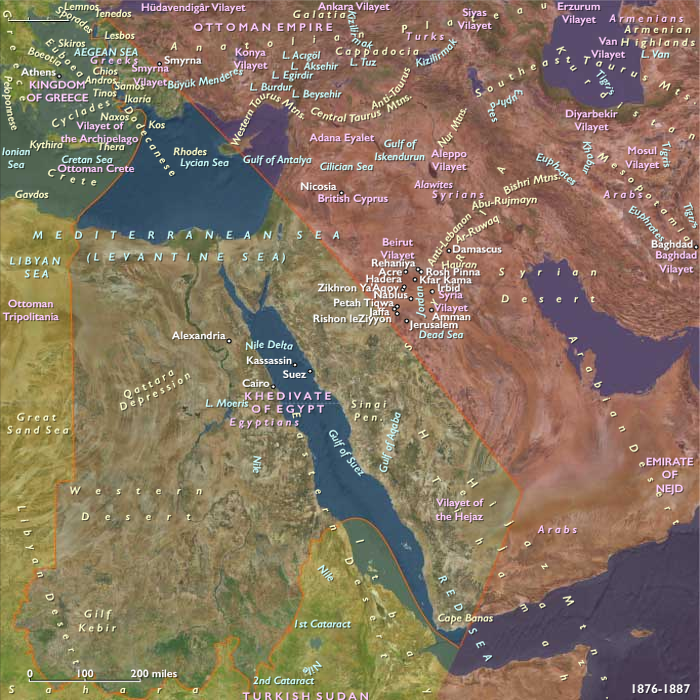
The Mahdi forms a government, with Sudan…
June 1885 CE
The Mahdi forms a government, with Sudan now in Sudanese hands.
The Mahdiyya (Mahdist regime) modifies the Shariah, (Islamic law) which will be implemented by Islamic courts headed by various Islamic imams, in accordance with the view of an Islamic state.
The courts enforce a Sharia law that the Mahdi claims is founded on instructions conveyed to him by God in visions.
According to this doctrine, loyalty to him is essential to true belief.
The recitation of the shahada is modified to include “and Muhammad Ahmad is the Mahdi of God and the representative of His Prophet.”
Among the five pillars, service in the "jihād" replaces the hajj (pilgrimage to Mecca) as a duty incumbent on the faithful (though Jihad-struggle is central to orthodox Islam, it is not considered one of the five pillars of faith).
He has also authorized the burning of lists of pedigrees and books of law and theology because of their association with the old regime and because he believes that they accentuate tribalism at the expense of religious unity.
Muhammad Ahmad dies of typhus six months after the capture of Khartoum.
He is buried in Omdurman near the ruins of Khartoum.
The Mahdi had planned for this eventuality and had chosen three deputies to replace him, in imitation of the Prophet Muhammad.
This leads to a long period of disarray, due to rivalry among the three, each supported, respectively, by people of his native region.
People
Groups
Topics
Regions
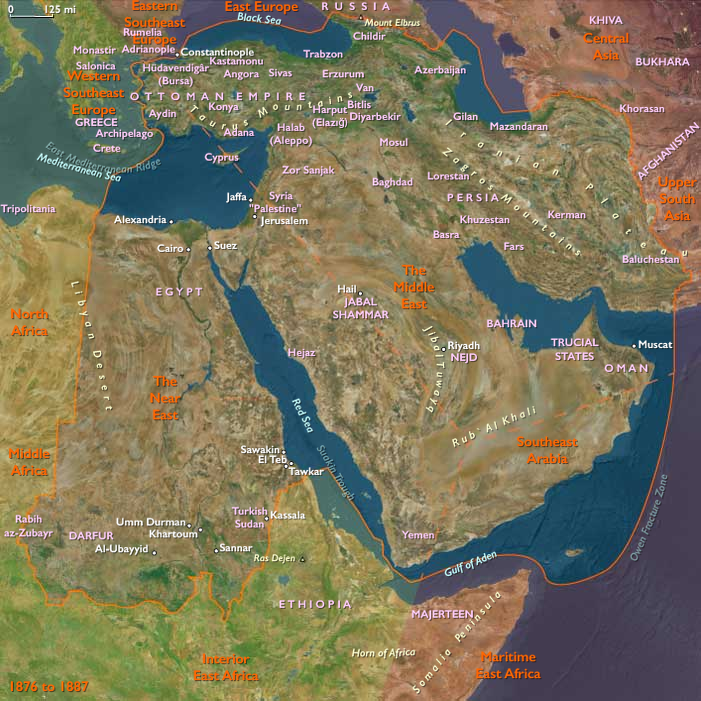
The Near and Middle East
View →Subregions