The easy surface gold of the fields…
December 1854 CE
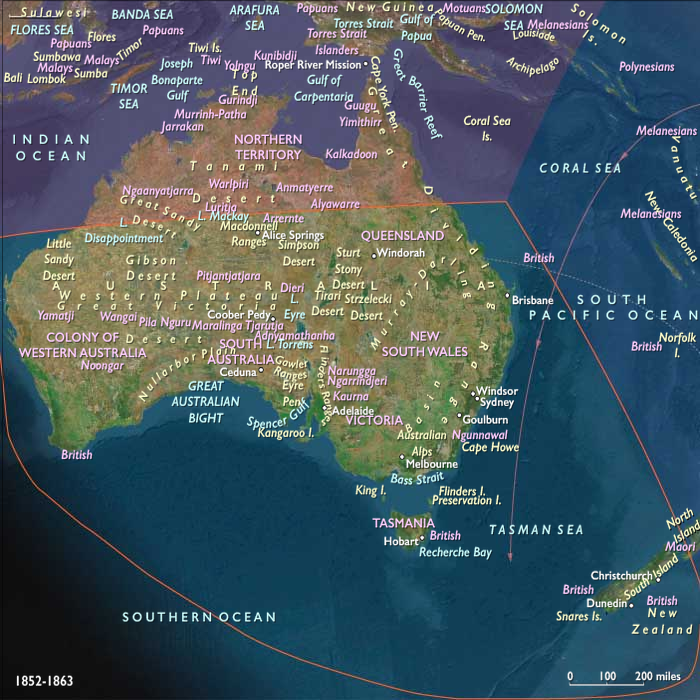
The easy surface gold of the fields at Ballarat, Victoria, had been exhausted within a short time, and gold can now be found only by digging for the deep lead—the veins buried beneath meters of clay and rock.
By 1854, the fields of Ballarat are occupied by roughly twenty-five thousand miners, mostly from Ireland, but also from the United Kingdom, other parts of Europe, China, and North America (many have come to Australia from the California Gold Rush).
The hills for miles around are soon entirely denuded of trees in order to provide timber for the deep shafts being dug.
The miners, irritated with high license fees, heavily priced mining items, and restrictions on exploration, rebel in 1854 at the Eureka stockade against the authoritarianism of the colonial government.
While the events which sparked the rebellion are specific to the Ballarat goldfields, the underlying grievances have been the subject of public meetings, civil disobedience, and deputations across the various Victorian goldfields for almost three years.
The miners' demands include the right to vote and purchase land, and the reduction of Miner’s License fees.
At 3 am on Sunday, December 3, 1854, a party of two hundred and seventy-six police and military personnel under the command of Captain J.W. Thomas approaches the Eureka Stockade and a battle ensues.
There is no agreement as to which side fired first, but the battle is fierce, brief, and terribly one-sided.
The military regiment far outclasses the defense efforts of the ramshackle army of miners, who are quickly routed in about fifteen minutes.
Locations
Groups
Commodities
Regions
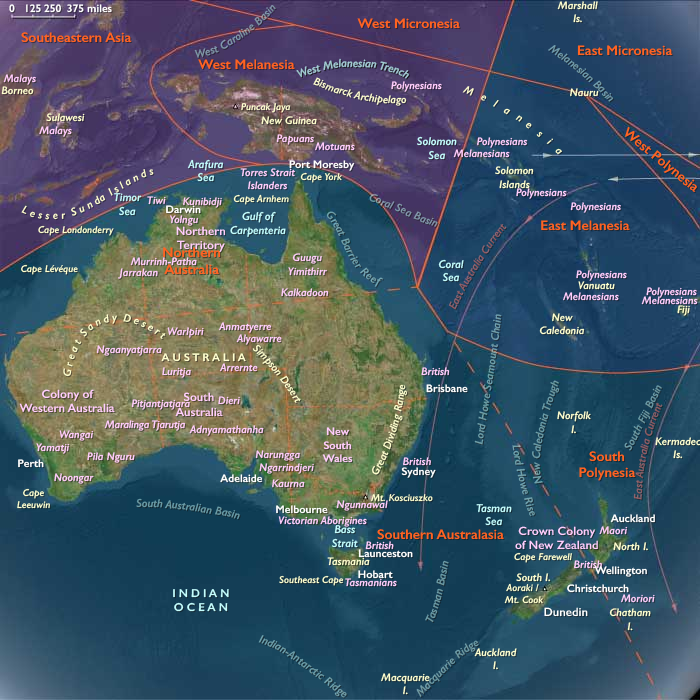
Australasia
View →Subregions