
Xuanzang studies with various monks between 632 …
Years: 632 - 632
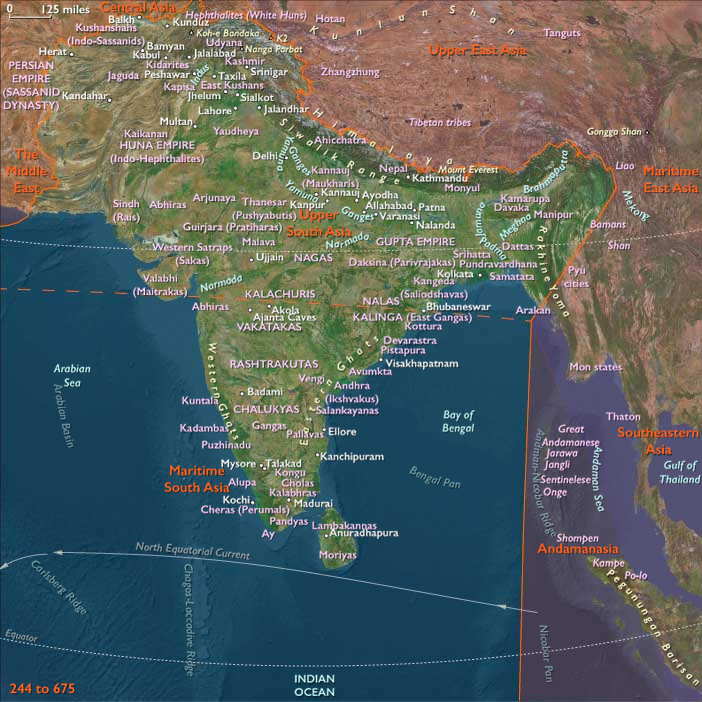
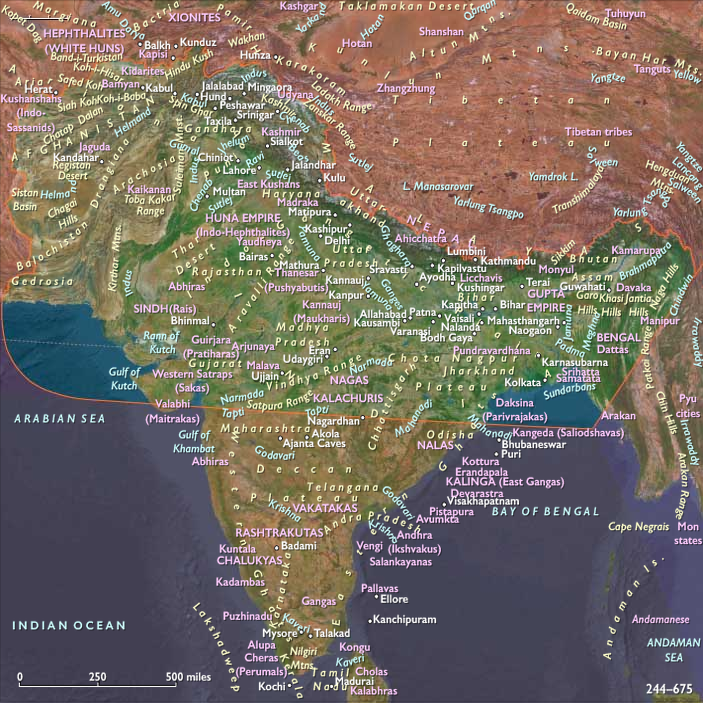
Xuanzang studies with various monks between 632 and early 633, including fourteen months spent with Vinītaprabha, four months with Candravarman, and "a winter and half a spring" with Jayagupta.
During this time, Xuanzang writes about the Fourth Buddhist council that took place nearby in about 100 CE, under the order of King Kanishka of Kushana.
Locations
People
Groups
- Hinduism
- Jainism
- Kashmir, Kingdom of
- Buddhism
- Buddhism, Mahayana
- Western Turkic Khaganate
- Chinese Empire, Tang Dynasty
Topics
Subjects
Regions
Subregions
Related Events
Filter results
Showing 10 events out of 56729 total
King Jinpyeong, having no sons, selects Princess Deokman as his heir.
The act is not unusual within Silla, as women of the period had already had a certain degree of influence as advisors, dowager queens, and regents.
Throughout the kingdom, women are heads of families, since matrilineal lines of inheritance exist alongside patrilineal ones.
During the Silla kingdom, the status of women is relatively high, but there are still restrictions on female behavior and conduct; they ware discouraged from activities considered unwomanly.
Her successful reign will in turn facilitate the acceptance of two more Queens regnant of Silla.
Jinpyeong dies in January 632, in the fifty-fourth year of his reign, and Princess Deokman becomes, as Queen Seondeok, the sole ruler of Silla.
According to the Samguk Sagi, she was the first of King Jinpyeong's daughters.
But according to another historical record, she was the second of King Jinpyeong's daughters and much younger than her elder sister (Princess Cheonmyeong).
Her nephew, Princess Cheonmyeong's son, will eventually become King Muyeol of Silla while Seondeok's other sister, Princess Seonhwa, will eventually marry King Mu of Baekje and become the mother of King Uija of Baekje.
Seonhwa's existence is controversial due to the discovery of evidence in 2009 that points to King Uija's mother as being Queen Sataek, and not Seonhwa as indicated by historical records.
The Great Khan Kubrat (Kurt), of the Dulo clan, leads a successful uprising to end Avar authority over the Pannonian Plain, establishing what the imperial Greeks will call Old Great Bulgaria, roughgly contemporaneous with Samo's realm.
Kubrat's rule stretches from the Danube Delta to the Volga River.
The civil war, possibly a succession struggle in Onoguria between the joint Avar/Kutrigur Bulgar parties and Kubrat's Utigur Bulgar forces, rages from 631-632.
The power of the Avar/Kutrigur forces is shattered, and the Avars come under the control of "Patria Onoguria" ("the homeland of Onogurs"), or Old Great Bulgaria.
Chronicler Fredegarius recorded that nine thousand Bulgars sought asylum and fled to Bavaria, only to be slaughtered by King Dagobert I of the Franks.
Muslim corps commander Ikrimah ibn Abi-Jahl, following the orders of Abu Bakr, marches from Oman to Mahra to join Arfaja bin Harthama.
As Arfaja has not yet arrived, Ikrimah tackles the local rebels on his own instead of waiting for him.
At Jairut, Ikrimah meets two rebel armies preparing for battle and persuades the weaker to embrace Islam, then joins up with them to defeat their opponents.
Having reestablished Islam in Mahra, ...
...Ikrimah moves his corps to Abyan, where he rests his men and awaits further developments.
The words of God, as revealed to Muhammad between about 610 and 632, have coalesced into the Quran (Arabic: “the reading”).
Muhammad continues his political and military involvements, making arrangements with nomad tribes prepared to accept Islam and dispatching expeditions against groups hostile to conversion.
He drives the Jews from the Hejaz, and makes Medina the administrative capital of the new Islamic state.
Islam has spread rapidly throughout Arabia, as military campaigns and marriage pacts among converted tribes forge a united Islamic society.
According to several of the hadiths, Muhammad makes a final pilgrimage in March 632 to Mecca, whose citizens have allowed him to establish as the holy city of Islam.
In his sermon during the pilgrimage, Muhammad testifies that he has fulfilled his mission by leaving behind Allah's (God's) Book: the Quran and the Sunnah (Arabic: ”custom”) of the Prophet.
The Death of Charibert II and the Reabsorption of Aquitaine by Dagobert I (632 CE)
On April 8, 632 CE, Charibert II, the King of Aquitaine, dies at Blaye, possibly assassinated on the orders of his half-brother, Dagobert I. Shortly thereafter, his infant son, Chilperic of Toulouse, is also killed, effectively eliminating his bloodline and bringing an end to the independent rule of Aquitaine.
Following these events, Aquitaine and Gascony are reabsorbed into Dagobert’s realm, making him the most powerful Merovingian king in the West.
1. The Death of Charibert II and His Son
- Charibert dies at Blaye under suspicious circumstances, possibly due to an assassination orchestrated by Dagobert I to remove a rival claimant to power.
- His infant son, Chilperic of Toulouse, is also killed soon after, ensuring that Charibert’s dynasty is completely extinguished.
- Both Charibert and Chilperic are buried in the Basilica of Saint-Romain at Blaye, marking the final end of their short-lived rule over Aquitaine.
2. Dagobert I Becomes the Supreme Merovingian King
- With Charibert’s death and the collapse of his dynasty, Aquitaine and Gascony revert to Dagobert I, who annexes them into his already vast realm.
- This makes Dagobert the most powerful Merovingian ruler of his time, briefly achieving a level of unity not seen since Clovis I.
3. The Legacy of Charibert II’s Reign
- Though short-lived, Charibert’s rule marked the first attempt at establishing an independent Aquitaine within the Frankish kingdom.
- His death reinforces the pattern of brutal Merovingian succession struggles, where assassination and dynastic purges are common tools of power consolidation.
- The temporary unity under Dagobert foreshadows future divisions, as Aquitaine will later regain autonomy under the Carolingians.
Conclusion: The Lasting Impact of Charibert’s Death
The assassination of Charibert II and his son in 632 CE marks a turning point in Merovingian history, as Dagobert I emerges as the most dominant ruler in Western Europe. However, while Aquitaine is reintegrated into the Frankish realm, the region’s independent identity remains strong, setting the stage for future separatist movements in southern Gaul.
Yazdegerd III, who is almost the last living member of the House of Sasan, is the son of the Shahryar who was the son of Khosrau II.
The name of Yazdegerd's mother is unknown but she was from a non-aristocratic family.
The eight-year-old heir is hiding in Estakhr during the civil war in Persia, when on June 16, 632, he is crowned here as Shahanshah.
The Muslim conquest of Persia begins in his first year of reign.
Muslim army commander Usama bin Zayd, adopted son of the late Muhammad, makes his way to Dumat-Al-Jandal (modern Al Jawf, Saudi Arabia).
As a direct result of his operations, several rebel tribes resubmit to Medinan rule and claim that they re-accept Islam.
Muhammad, now ailing, orders a large expedition to be prepared against the empire of Constantinople in about the middle of May 632; three thousand Muslims are to join it.
Usama ibn Zaid, a young man and son of Zayd ibn Harithah, is appointed as commander of this force.
Muhammad falls ill a few months after his farewell pilgrimage to Mecca and dies on June 8 in the presence of Aisha, his third and favorite wife.
He is buried in Medina after the Muslim community elects her father, Muhammad’s closest advisor Abu Bakr, as Islam’s first caliph (“successor”; effectively, viceregent of the messenger of God), and pledges its allegiance, although Muhammad did not create this office or designate its authority.
He establishes the Rashidun Caliphate; it will last until 661.
Abu Bakr now launches a series of military campaigns against rebel Arabian tribes to establish the power of the Rightly Guided Caliphs and to secure Muhammad's legacy.
The rebels, who had submitted to Muhammad as the prophet of God, feel they owe nothing to Abu Bakr.
The army of Usama breaks camp and moves out on June 26, 632.
After leaving Medina, …
...Usama marches to Tabuk.
Most of the tribes in this region oppose him fiercely but are defeated by Abu Bakr's army.
Usama raids far and wide in the region of Northern Arabia, starting with the Khuza’ah.
Years: 632 - 632
Locations
People
Groups
- Hinduism
- Jainism
- Kashmir, Kingdom of
- Buddhism
- Buddhism, Mahayana
- Western Turkic Khaganate
- Chinese Empire, Tang Dynasty
