
Yamana Norikiyo, the shugo daimyo of Mimasaka…
1442 CE
Yamana Norikiyo, the shugo daimyo of Mimasaka Province in western Honshu, had in 1441 ordered his relatives to build a castle in Tsuru mountain in Tsuyama Domain, which lies along the upper Yoshii River, in the center of the Tsuyama basin to build a castle.
However, the castle will be abandoned when the Yamana clan declines after the Onin War.
Locations
Subjects
Regions
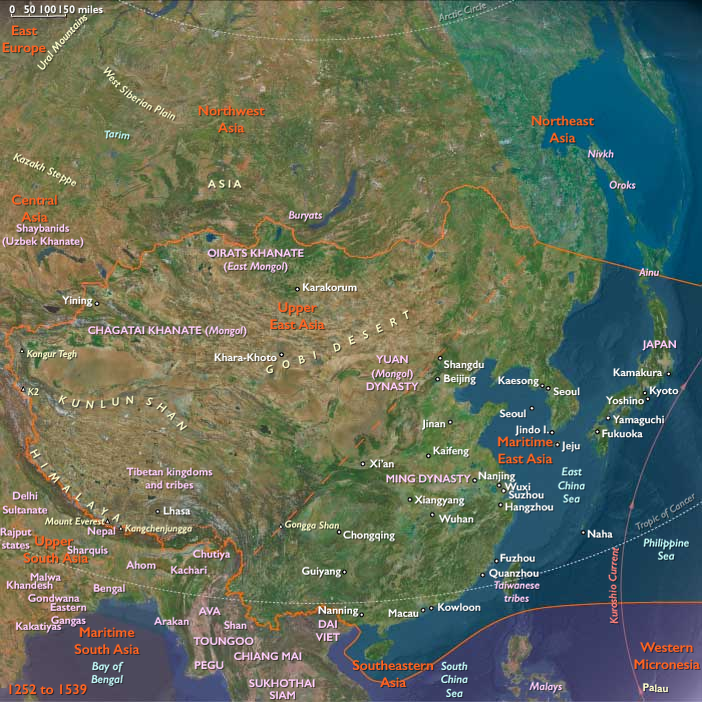
East Asia
View →Subregions
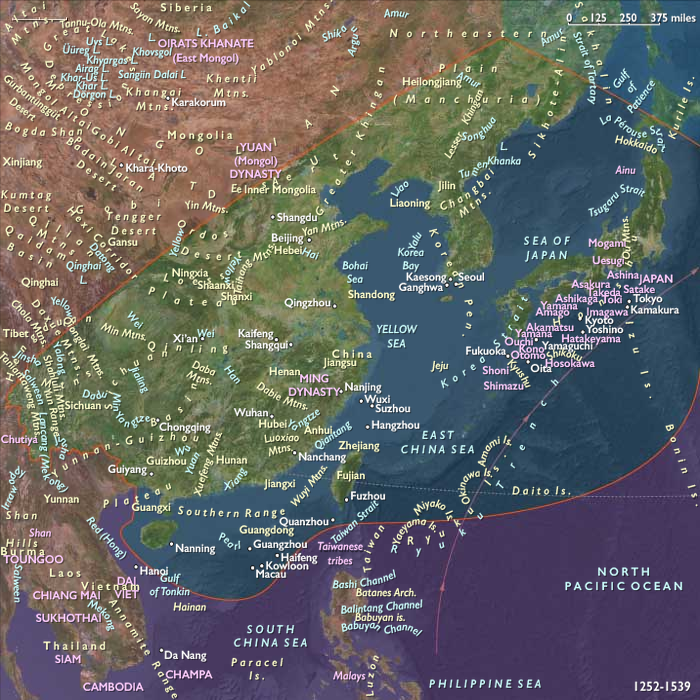
Maritime East Asia
View →Related Events
No active filters.
Showing 10 events out of 41793 total
Chiang Mai’s King Sam Fang Ken is forced in 1442 to abdicate by his sixth son, thirty-one-year-old Prince Chao Lok, who assumes the throne as King Sri Sutham Tilok.
Sam Fang Ken’s tenth son, Prince Chao Joi, refuses to support his brother as king, brings his father to the town of Muang Fang, and initiates a war for the throne of the northern Thai kingdom.
On Sri Sutham Lok’s seizure of Muang Fang, Chao Joi abandons his father and flees to Thoen, there successfully persuading the town’s governor to request support from the southern Thai kingdom of Ayutthaya.
King Wladyslaw of Poland, who also rules Hungary and Bohemia as Ulászló I, to open a full-scale war against the Ottoman Empire.
The alliance having expanded to include German, Polish, and Albanian forces, Wladyslaw musters a large army, moves south across the Danube, and drives the Turks from Semendria.
Murad II wants revenge against Hunyadi, who had attacked the Ottomans in Serbia and gotten the better of Ishak Bey at the Battle of Smederevo, and gives the task to Mesid Bey in Transylvania.
Mesid Bey, whose army numbers seventeen thousand men, is joined by Shehabbedin Beylerbey of Rumelia.
His forces allegedly quadrupled Mesid's army, but may actually have just been equal to Mesid's forces.
Many are presumably not regular forces, but some are janissary and sipahi, or cavalry units.
Hunyadi's forces consist of Hungarian, Transylvanian and Saxon forces, with some Polish and Romanian soldiers.
The commander of the vanguard detachment is bishop György Lépes, who had been responsible for the outbreak of the Transylvanian peasant-revolt in 1437.
Hunyadi's forces number about ten thousand men.
Lépes' two thousand man force clash with Mesid near Sântimbru.
The Ottomans win by forces of numbers and Hunyadi is forced to retreat, but Mesid does not pursue him.
Lépes was taken prisoner and Mesid beheads the bishop.
Hunyadi's army regroups near Hermannstadt.
Simon Kamonyai, who has swapped his armor for Hunyadi's to deceive the Turks, is to execute a head-on attack, while Hunyadi goes around Mesid's army.
Kamonyai is killed in action, but Hunyadi charges Mesid with the Hungarian heavy cavalry and crushes the Turkish line.
Mesid is killed, while Shehabbedin escapes with the remaining Ottoman troops.
Hunyadi is able to ransom Lépes's head vy exchanging it for the heard of Mesid.
Zürich had appealed to the conservative Imperial Diet for succor in 1440.
Stüssi, after eradicating his opposition and securing the general support of his townsmen, concludes an alliance with Austria.
When the archconservative Habsburg ruler Frederick III, Duke of Austria and King of Germany, agrees in 1442 to aid Zurich militarily, the Swiss Confederation demands the abrogation of this agreement.
The landmark Devil's Bridge is built over the Natisone River in the town of Cividale del Friuli, just northeast of Udine, in 1442.
The church of San Francesco is competed in 1442 in Schio, a northern Italian town in the Veneto region, northwest of Vicenza, on the Leogra River, and an important center of prosperous wool manufacturing.
The city, surrounded by the Little Dolomites (Italian Prealps) and Mount Pasubio, was ruled by the Venetian Maltraversi family until 1311.
The church is now part of a complex of buildings, superimposed in time, which were used formerly by the Monastery dei Frati Minori (1437-1806) and then by Schio's civil hospital (the Baratto Institute 1807–1959) and now a home for the elderly.
Castagno travels in 1442 from Florence to Venice to paint frescoes with Francesco de Faenza.
Alfonso, maintaining his alliance with Milan against Angevin Naples, overcomes all opposition—including that of Venice, Florence, and the Pope—to drive René from Naples by 1442; entering the city in triumph on June 2, he ushers in a period of Aragonese rule over the Kingdom of Naples.
Pope Eugene IV issues an edict in 1442 prohibiting Jews from building synagogues, lending money for interest, holding public office, and testifying against Christians.
Following Hunyadi’s victory at Hermannstadt, Eugene had pledged the supporting crusade now joined by Wladyslaw.