André-Hercule de Fleury
French cardinal who serves as the chief minister of Louis XV
Years: 1653 - 1743
André-Hercule de Fleury, Bishop of Fréjus (22 June or 26 June 1653 – 29 January 1743) is a French cardinal who serves as the chief minister of Louis XV.

Related Events
Filter results
Showing 10 events out of 23 total
Fleury has been present at all interviews between Louis XV and his titular first minister, and on Bourbon's attempt to break through this rule, Fleury retires from court.
The king takes no part in the decisions of Bourbon’s government, which is secretly under the influence of a group of speculators and wheeler-dealers such as Étienne Berthelot de Pléneuf and banker J. Pâris-Duverney.
Berthelot’s daughter, Jeanne Agnès, had at the age of fifteen been married to Louis, marquis de Prie, and had gone with him to the court of Savoy at Turin, where he was ambassador.
Twenty-one when she returned to France, she had soon become Bourbon’s declared mistress.
During his ministry, she has in several respects been the real ruler of France.
The king is quite frail, and several alerts have led to concern for his life.
Bourbon is concerned for Louis’s health, less from concern for the monarch or the future of the dynasty and more from a desire to prevent the late regent’s House of Orléans, which Bourbon sees as an enemy camp, from ascending the throne should the king die.
As the Spanish infanta is far too young to produce an heir, Bourbon, hostile also to Spain, sends the infanta home and sets about choosing a European princess old enough to produce an heir.
Eventually, the choice falls on twenty-one-year-old Marie Leszczyńska, daughter of Poland’s deposed King Stanislaus, who is currently residing at Wissembourg in Alsace.
A poor princess who had followed her father's misfortunes, she is nonetheless said to be virtuous, and quite charming.
She is also from a royal family that had never interbred with the French royals, and it is hoped that she will infuse it with vigorous blood.
Her father’s relatively low status will also ensure that the marriage will not cause diplomatic embarrassment to France by having to choose one royal court over another.
The marriage is celebrated in September 1725 and Louis immediately falls in love with Marie, who is seven years his senior.
This union is Madame de Prie’s most notable triumph but most of Europe considers the marriage of its most powerful king with such a low-ranking princess to be improper and lacking in grandeur.
Stanislaus moves to Chateau Chambord, in the Loire valley.
The ministry of the Duke of Bourbon has been marked by several monetary manipulations, the creation of new taxes such as the fiftieth (cinquantième) in 1725, the persecution of Protestants in 1726, and the high price of grain, all of which have created troubles and economic depression.
The king, who is now sixteen, has since his marriage shown a new health and authority noticed by everyone at court.
The extremely unpopular Duke is preparing a war against Spain and Austria, but Louis makes him recall Fleury, who on July 11, 1726, takes affairs into his own hands and secures the exile from court of Bourbon and of his mistress Madame de Prie, who had earlier sought the exile of Fleury.
He continues to refuse the formal title of first minister, but his elevation to cardinal, in 1726, confirms his precedence over any others.
Fleury is the right man for the moment; naturally cool and imperturbable in his demeanor, frugal and prudent, he carries these qualities into the administration.
With the help of the controller-general of finances Michel Robert Le Peletier des Forte, Fleury almost immediately stabilizes the currency and secures French credit by initiating regular payment of interest on the national debt.
Fleury, abroad, seeks peace, averse as he is to wars, basing his policy on an English alliance and the reconciliation with Spain.
Queen Marie, at the end of her third pregnancy, in September 1729 finally gives birth to a male child, Louis, dauphin de France, who immediately becomes heir to the throne.
The birth of a long awaited heir, which ensures the survival of the dynasty for the first time since 1712, is welcomed with tremendous joy and celebrations in all spheres of French society, and indeed in most European courts.
The royal couple is at the time very united and in love with each other, and the young king is extremely popular.
The birth of a male heir also dispels the risks of a succession crisis and the likely war with Spain that would have resulted.
The secret Löwenwolde's Treaty promoting the candidacy of Infante Manuel of Portugal for the Polish throne, signed by Empress Anna of Russia, Holy Roman Emperor Charles VI, and King Frederick William I of Prussia in 1732, reflect their their unwillingness to allow former Polish Stanisław Leszczyński to become king despite their irritation with Augustus II of Saxony.
Stanisław is supported in his bid to regain the throne by his son-in-law, King Louis XV of France, who hopes to renew France's traditional alliance with Poland as a way to balance Russian and Austrian power in northern and eastern Europe.
France's prime minister, Cardinal Fleury, sees the Polish struggle as a chance to strike at Austrian power in the west without seeming to be the aggressor.
While he cares little for who should become King of Poland, the cause of protecting the King's father-in-law is a sympathetic one, and he hopes to use the war as a means of humbling the Austrians, and perhaps securing the long-desired Duchy of Lorraine from its duke, Francis Stephen, who is expected to marry Emperor Charles's daughter Maria Theresa, which will bring Austrian power dangerously close to the French border.
Fleury's diplomatic moves will bring additional powers into the coming war that have no interest in Polish affairs, most notably Spain and Charles Emmanuel, the King of Sardinia, who is also the Duke of Savoy.
Polish kings have been elected by Polish nobility since the death of Sigismund II Augustus in 1572.
The process gives the nobility a great deal of power over the king, but the sejms (meetings of delegates) to elect kings and conduct other business have in latter years been paralyzed by the institution of the Liberum Veto, which gives any individual in the sejm the power to negate its decisions.
As a result, Poland's powerful neighbors have been able to exert significant influence on the decision-making process, and by the early eighteenth century the system had gone into decline.
Stanisław hopes to be elected king once again upon the death of his old adversary, Augustus, who has failed in his attempts to make the Polish crown hereditary within his family.
Stanisław had been installed as king of Poland thirty years earlier by King Charles XII of Sweden during his period of dominance in the early part of the Great Northern War, and had been ousted following the Battle of Poltava by the victorious Russians.
Augustus II the Strong, Imperial Prince-Elector of Saxony and monarch of the Polish–Lithuanian Commonwealth, dies on February 1, 1733.
The Marquis de Monti, France's ambassador in Warsaw, persuades the rival Potocki and Czartoryski families to unite behind Stanisław Leszczyński.
Teodor Potocki, Primate of Poland and interrex following the death of Augustus, calls a convocation sejm in March 1733.
Delegates to this sejm pass a resolution forbidding the candidacy of foreigners; this will explicitly exclude both Emmanuel of Portugal and Augustus II's son, Frederick August II, the Elector of Saxony.
Frederick August, the only legitimate son of Augustus II by his wife, Christiane Eberhardine of Brandenburg-Bayreuth, had been groomed to succeed his father as King of Poland and Grand Duke of Lithuania, and thus, in 1712, had converted to Catholicism.
This had been publicly announced in 1717, to the anger among the nobility in his native Saxony.
France throughout the spring and summer of 1733 begins building up forces along its northern and eastern frontiers, while the emperor masses troops on Polish borders, reducing garrisons in the Duchy of Milan for the purpose.
While the aging Prince Eugene of Savoy had recommended to the emperor a more warlike posture against potential actions by France in the Rhine valley and northern Italy, only minimal steps are taken to improve imperial defenses on the Rhine.
Frederick August negotiates agreements with Austria and Russia in July 1733.
In exchange for Russian support, he agrees to give up any remaining Polish claims to Livonia, and promises to Anna of Russia her choice of successor to the Duchy of Courland, a Polish fief (of which she had been duchess prior to her ascension to the Russian throne) which will otherwise come under direct Polish rule on the death of the current duke, Ferdinand Kettler, who has no heirs.
To the Austrian emperor, he promises recognition of the Pragmatic Sanction of 1713, a document designed to guarantee inheritance of the Austrian throne to Maria Theresa, Charles' oldest child.
Polish nobles gather in August for the election sejm.
Thirty thousand Russian troops under Field Marshal Peter Lascy enter Poland on August 11 in a bid to influence the sejm's decision.
France on September 4, openly declares its support for Leszczyński, who on September 12 is elected king by a sejm of twelve thousand delegates.
A group of nobles, led by Lithuanian magnates including Duke Michael Wiśniowiecki (the former Lithuanian grand chancellor nominated by Augustus II), crosses the Vistula River to Praga and the protection of Russian troops.
This group, numbering about three thousand, on October 5 elects Frederick August II King of Poland as Augustus III.
Despite the fact that this group is a minority, Russia and Austria, intent on maintaining their influence within Poland, recognize Augustus as king.
France on October 10 declares war on Austria and Saxony.
Louis XV is later joined by his uncle, King Philip V of Spain, who hopes to secure territories in Italy for his sons by his second marriage to Elizabeth Farnese.
Specifically, he hopes to secure Mantua for the elder son, Don Carlos, who is already Duke of Parma and has the expectation of the Grand Duchy of Tuscany, and the Kingdoms of Naples and Sicily for the younger son, Don Felipe.
The two Bourbon monarchs are also joined by Charles Emmanuel of Savoy, who hopes to secure gains from the Austrian Duchies of Milan and Mantua.
The Polish throne, vacant upon the death of Augustus II of Saxony on February 1, 1733, is claimed by both his son, Augustus III, and by Stanisław Leszczyński, father in law of King Louis XV of France.While a body double ostensibly leaves Brest by sea, Stanisław crosses Germany incognito to arrives at Warsaw on September 8.
Stanislas is elected king of Poland by the diet on September 12.
Russia and Austria, both of whom back Augustus III, immediately invade Poland.
Stanisław, who does not have a proper army, has to take refuge by September 22 in Danzig (now known as Gdansk), there to await the French help he has been promised.
Augustus III, protected by Russian forces at Warsaw, is proclaimed king on October 5.
Great Britain, the Dutch Republic, Sweden, Denmark and the Republic of Venice, recognizing that Austro-Russian aggression against Poland is the casus belli, pledge to remain neutral.
Spain, coveting the Kingdom of Naples and Sardinia, which the Duke of Milan wants, sides with France.
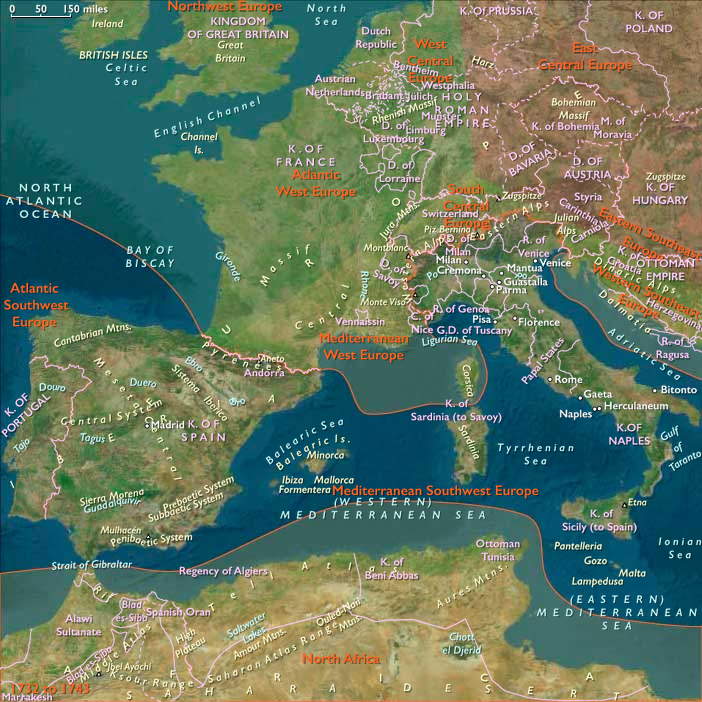
French and Savoyard troops numbering over fifty thousand under the command of Charles Emmanuel enters Milanese territory as early as October 24, against minimal resistance, as the Austrian forces in the duchy number only about twelve thousand.
The city of Milan itself has by November 3 surrendered, although the Austrian governor, Count Wirich Philipp von Daun, still holds the fortress.
France's great general, the Duke de Villars, joins Charles Emmanuel in Milan on November 11.
While Villars wants to immediately move to secure the Alpine passes against Austrian reinforcements by moving against Mantua, Charles Emmanuel, mistrustful of his French allies and their dealings with Spain, seeks to secure Milan.
The army will spend the next three months eliminating Austrian opposition from the remaining fortified towns in the duchy.
Villars attempts to interest Don Carlos of Parma in joining the expedition against Mantua, but Carlos is focused on the campaign into Naples.
Villars begins to move against Mantua, but Charles Emmanuel resists, and the army makes little progress.
In early May, an Austrian army of forty thousand under Count Claude Florimond de Mercy crosses the Alps and threatens to close in on the French army's rear by a flanking maneuver.
Villars responds by retreating from Mantua and attempts without success to interrupt the Austrian army's crossing of the Po River.
Villars, frustrated by Charles Emmanuel's delaying tactics, quits the army on May 27. (He will fall ill on the way back to France and on June 17 will die in Turin.)
The Austrians, choosing a strategy of defending a large number of fortresses, are soundly defeated in southern Italy.
Don Carlos has assembled an army composed primarily of Spaniards, but also including some troops from France and Savoy.
Moving south through the Papal States, his army had flanked the frontline Austrian defense at Mignano, forcing them to retreat into the fortress at Capua.
He was then practically welcomed into Naples by the city fathers, as the Austrian viceroy had fled toward Bari, and the fortresses held by the Austrians in the city were quickly captured.
While maintaining a blockade of the largest Austrian holdings at Capua and Gaeta, a large portion of the allied army had given chase to the remaining Austrian forces.
These finally attempt a stand in late May, and are defeated at Bitonto.
Mercy's forces make repeated attempts to cross the Parma River in June, but it is not until late in this month that they are able to cross the river and approach the city of Parma, where the allied forces, now under the command of French marshals de Broglie and Coigny, are entrenched.
In a bloody battle near the village of Crocetta on June 29, the Austrians are beaten back, Mercy is killed, and Frederick of Württemberg, his second, is wounded.
Charles Emmanuel returns the next day to retake command, and resumes his delaying tactics by failing to immediately pursue the retreating Austrians.
The Austrians retreate to the Po, where they are reinforced by additional troops and placed under the command of Field Marshal Königsegg.