Anne of France
Duchess of Bourbon
Years: 1461 - 1522
Anne of France (or Anne de Beaujeu) (April 3, 1461 – November 14, 1522) is the eldest daughter of Louis XI of France and his second wife, Charlotte of Savoy.
Anne is the sister of King Charles VIII of France, for whom she acts as regent during his minority; and of Joan of France, who is briefly queen consort to Louis XII.
As regent of France, Anneis one of the most powerful women of late fifteenth-century Europe and is referred to as "Madame la Grande".


Related Events
Filter results
Showing 7 events out of 7 total
Atlantic West Europe: Consolidation of French Power and the Habsburg Inheritance (1480–1491)
Between 1480 and 1491, Atlantic West Europe undergoes significant transformations, defined by the ongoing consolidation of French royal authority, the Habsburg acquisition of the wealthy Burgundian Low Countries, and notable cultural advancements influenced by the early Renaissance. This era sets the stage for the power dynamics that will shape the continent for generations, notably the emergence of the Habsburg dynasty as a dominant European power, alongside France's continuing internal unification and expansion.
Political and Military Developments
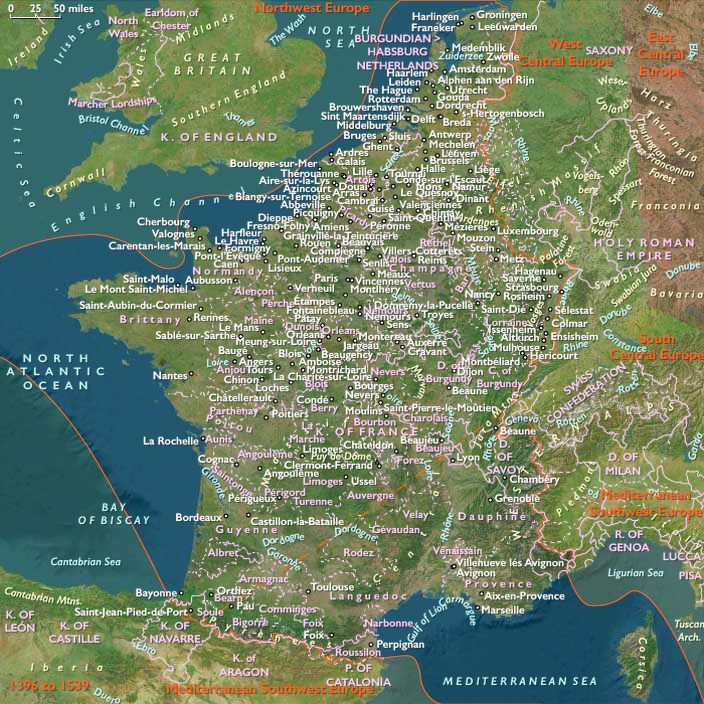
The aftermath of Burgundy's collapse remains the defining political narrative of this period. The Treaty of Arras (1482) solidifies France’s gains, notably incorporating Burgundy proper, Picardy, and other strategic regions, significantly strengthening Louis XI’s control over the kingdom. Upon Louis XI’s death in 1483, France enters a regency period under Anne of Beaujeu, who skillfully navigates internal challenges and further consolidates royal authority.
Simultaneously, the Low Countries pass into Habsburg hands through the marriage of Mary of Burgundy to Maximilian I of Austria, future Holy Roman Emperor. Mary’s sudden death in 1482 leaves Maximilian as regent for their young son, Philip the Handsome, embedding the region firmly within the Habsburg sphere and laying foundations for centuries of Habsburg-French rivalry. Maximilian’s rule faces local resistance, particularly from Flemish cities eager to maintain autonomy.
Economic Developments
Economic prosperity continues in the Low Countries under Habsburg oversight, with Antwerp rising rapidly as an international trading hub. As Bruges slowly declines due to silting waterways, Antwerp thrives by attracting merchants from across Europe. The increasing involvement of the Habsburgs enhances trade networks linking Germany, Italy, and Iberia through Atlantic West Europe, laying a foundation for sustained economic growth into the next century.
In France, Louis XI’s policies encourage internal trade, market growth, and urban prosperity, though significant taxation and royal control are imposed to support centralization and military expenditures.
Cultural and Artistic Flourishing
This era witnesses continued flowering of the Northern Renaissance, particularly in the Burgundian-Habsburg Low Countries. Artists such as Hans Memling and Gerard David produce masterpieces celebrated for their detailed realism, vibrant color, and emotional depth, emblematic of Flemish art. Manuscript illumination, fine tapestries, and courtly pageantry remain prominent expressions of wealth and power, reflecting a high level of cultural sophistication and artistic patronage, increasingly under Habsburg direction.
Technological and Societal Shifts
Artillery and military engineering continue to evolve significantly during these years, transforming the nature of warfare, siege operations, and defense strategies. Societal structures experience gradual shifts, especially as towns grow in economic importance and urban merchants increasingly demand political rights and autonomy, challenging traditional feudal hierarchies.
Long-term Consequences and Significance
The period from 1480 to 1491 decisively shapes the political future of Atlantic West Europe. The permanent division of former Burgundian lands between France and Habsburg Austria creates rivalries and geopolitical tensions that will persist for centuries, particularly driving conflicts like the Italian Wars and later wars between France and Spain. The solidification of royal power in France paves the way for a centralized monarchy under the Valois dynasty, defining French politics into the early modern period. Economically and culturally, this era firmly establishes the Low Countries as a dynamic commercial region, central to European trade and artistic innovation, significantly influencing European history well beyond the medieval age.
The Mad War and Brittany's Integration into France (1485–1491)
Following the death of King Louis XI in 1483, his thirteen-year-old son Charles VIII inherited a French kingdom fraught with instability. Initially governed by his elder sister, the intelligent and capable Anne of Beaujeu, and her husband, Pierre de Beaujeu, the French crown faced immediate challenges as influential princes sought to reverse Louis XI’s centralizing policies. This confrontation escalated into the conflict known as the Mad War (1485–1488), profoundly shaping French territorial integrity, most notably leading to the absorption of the fiercely independent Duchy of Brittany into France.
Regency and Early Instability (1483–1484)
Anne and Pierre skillfully maintained custody of the young king, significantly reducing unpopular taxes and employing diplomatic finesse at the States General of 1484 to pacify noble opposition. Despite their success, disgruntled powerful nobles soon rose in open rebellion, attempting to exploit the king's minority and regain feudal autonomy curtailed by Louis XI.
Outbreak of the Mad War (1485–1488)
Known as the Mad War (Guerre folle) (1485–1488), the rebellion was led principally by Louis II, Duke of Orléans(future King Louis XII), supported by Francis II, Duke of Brittany, René II of Lorraine, and other powerful nobles, such as Alain d'Albret. These princes, emboldened by Louis XI’s death, opposed Anne’s centralized governance and allied themselves with France’s foreign rivals, notably England, Spain, and Austria.
Principal Conflict and Alliances
The rebellion of 1485–1488 escalated rapidly into an international conflict, driven largely by the struggle for control over the strategically significant Duchy of Brittany. Francis II of Brittany’s participation was pivotal, as Brittany remained one of the last independent duchies within the French sphere, fiercely guarding its autonomy against royal centralization efforts.
Decisive Outcomes: Brittany’s Integration into France
The war’s most enduring outcome was Brittany’s absorption into France. Although Brittany initially supported the princes’ rebellion against the French crown, Francis II’s defeat at the pivotal Battle of Saint-Aubin-du-Cormier(1488) ended Breton hopes of maintaining independence. Francis died shortly afterward, leaving his young daughter, Anne of Brittany, as the duchy’s heiress.
In 1491, in a decisive political move to secure Brittany permanently, King Charles VIII married fourteen-year-old Anne of Brittany. This marriage, initially driven by political necessity and strategic advantage, effectively integrated Brittany into the French kingdom, significantly expanding royal authority and bringing a lasting end to Brittany’s historical independence.
Diplomatic and Political Consequences
The defeat of the rebellious princes and the decisive incorporation of Brittany into France demonstrated the crown's determination to maintain and strengthen central authority. Anne of Beaujeu’s astute handling of opposition, combined with strategic diplomacy and military victories, reinforced royal supremacy and weakened noble opposition for generations.
Economic and Cultural Implications
Integrating Brittany into France had profound economic and cultural consequences. Brittany’s considerable economic resources, notably its prosperous maritime trade and distinctive artistic heritage, significantly enriched the kingdom. However, it also triggered a prolonged period of cultural and administrative assimilation, reshaping Brittany’s regional identity within the French nation-state.
Historical Significance
The Mad War (1485–1488) marked a critical transition period in late medieval French history, consolidating the kingdom’s territorial integrity and reinforcing the centralized monarchy established by Louis XI. Brittany’s incorporation into France marked a decisive endpoint to the independence of France’s major feudal principalities, symbolizing the irreversible rise of a centralized state that would dominate French political history well into the modern era. This pivotal development profoundly influenced European politics, as France’s territorial cohesion and royal authority grew significantly, reshaping diplomatic alliances and intensifying rivalries across Atlantic West Europe in subsequent centuries.
The Estates General of Tours: Shaping the Future of the French Monarchy (1484)
The convening of the Estates General of 1484, held in Tours, marked a critical moment in late medieval French history. Triggered by uncertainty following the death of King Louis XI in August 1483, this gathering represented France's attempt to set clear political directions during the regency of the young king Charles VIII, overseen by his capable elder sister, Anne of France (Anne of Beaujeu). Although many of the Estates General’s proposed reforms were not enacted immediately, they profoundly influenced the political landscape, setting a precedent that shaped governance until the transformative Estates General of 1789.
Context and Convocation (October 1483–January 1484)
Given uncertainties about the kingdom's direction under Anne’s regency, a royal summons for a national assembly was issued on October 24, 1483. Deputies from across France, representing three distinct societal orders or “estates”, arrived in Tours beginning in January 1484. These deputies aimed to present grievances and recommendations that could potentially influence royal policy.
The Composition of the Estates General
The Estates General represented the hierarchical societal structure of late medieval France:
- First Estate: the clergy, predominantly the Roman Catholic Church.
- Second Estate: nobility and members of the royal family, including figures such as Louis, Duke of Orléans (the future King Louis XII).
- Third Estate: commoners, notably merchants, traders, artisans, and the burgeoning middle classes of French towns.
Each estate brought forth distinct grievances, seeking to shape royal policies favorably.
Key Demands and Proposed Reforms
First Estate (The Church): Pragmatic Sanction
Representatives of the clergy called for the restoration of the Pragmatic Sanction established by Charles VII(grandfather of the current young king, Charles VIII). This sanction would significantly reduce papal authority within France, allowing cathedral and monastic chapters, as well as the king himself, to appoint bishops and abbots without papal intervention.
Second Estate (The Nobility): Military Sovereignty
The nobility, represented notably by Louis of Orléans, demanded restrictions against foreign commanders occupying leadership roles within the French military. This request reflected longstanding concerns over foreign influence in French military affairs and the nobility’s desire to preserve their own authority and traditional privileges.
Third Estate (Merchants and Traders): Fiscal Reform
The commoners called for drastic reductions in taxation, arguing that the royal treasury’s needs should be met by curtailing the number of costly royal pensions and unnecessary offices. Such fiscal discipline would relieve ordinary citizens and commercial interests from oppressive financial burdens.
Unified Demand: End the Sale of Offices
All three estates unanimously demanded an immediate end to the widespread practice of selling royal and governmental offices. Such sales had generated corruption, inefficiency, and resentment, undermining public trust in governance and royal administration.
Conclusion and Immediate Aftermath
Despite its significance, the Estates General concluded abruptly in March 1484 after King Charles VIII announced he was departing Tours due to ill health. Soon after, deputies were informed that funds for their salaries were exhausted, prompting an inconclusive dissolution. Although immediate results were limited, the Estates General highlighted clearly articulated desires for reforms that would later be adopted, particularly under the reign of Louis XII.
Historical and Long-Term Significance
Historians regard the Estates General of 1484 as the most significant assembly of its kind prior to the revolutionary Estates General of 1789. Its importance lay not in immediate reforms but in clearly defining widespread dissatisfaction with royal administration, taxation, and papal influence. Many proposed reforms, especially those concerning fiscal discipline, governmental accountability, and national sovereignty, significantly influenced future policy.
Under Louis XII, many recommendations were revisited and adopted, contributing to more streamlined governance, reduced papal interference, and improved public finances. Thus, the Estates General of 1484 helped shape governance practices that anticipated modern notions of statecraft, centralized administration, and fiscal reform, presaging dramatic transformations in France’s political landscape over the next three centuries.
The Breton Crisis and the Battle of Saint-Aubin-du-Cormier (1488)
By 1488, the fiercely independent Duchy of Brittany, at this time strategically aligned with England, faced imminent threat from the French crown, which sought its annexation. Brittany, ruled by Duke Francis II, had long resisted absorption into the French kingdom, preserving autonomy through shifting alliances—most notably with Henry VII of England. The prospect of Brittany falling permanently into French hands provoked intense anxiety and popular sympathy across England, motivating the English crown to support Brittany militarily.
English Intervention and Diplomatic Maneuvering (1488)
Responding to rising English popular sentiment supporting Brittany’s independence against France’s encroachments, King Henry VII secured parliamentary funding in 1488, enabling him to dispatch three warships and a contingent of English volunteer troops to Brittany. Although a relatively modest force, this deployment represented a symbolic commitment by England to uphold Breton independence, challenging France’s ambitions to incorporate the duchy directly under royal rule.
This English intervention reflected broader geopolitical interests, as Henry VII aimed to prevent a unified French coastline opposite England, safeguarding English trade and maritime influence in Atlantic West Europe.
Anne of France and the Battle of Saint-Aubin-du-Cormier
Within France, the regency government, led by the astute Anne of France (Anne of Beaujeu), acting on behalf of her younger brother, the teenage King Charles VIII, aggressively pursued the subjugation of Brittany. Breton nobles opposed the French crown and had openly supported Louis, Duke of Orléans, who sought greater power as regent during Charles VIII’s minority, triggering the conflict known as the Mad War (1485–1488).
The decisive encounter of this conflict occurred at the Battle of Saint-Aubin-du-Cormier, fought on July 28, 1488, where French royal forces decisively crushed the Breton forces, which included Breton loyalists and their noble allies who backed Duke Louis of Orléans’ claim to the regency. The battle marked a critical French victory that permanently weakened Breton autonomy and reinforced royal authority within Brittany.
Defeat and Consequences for Brittany
The defeat at Saint-Aubin-du-Cormier severely curtailed Brittany's autonomy, significantly undermining its independent political aspirations. Duke Francis II, Breton leader, died shortly after the battle, leaving his young daughter, Anne of Brittany, in a precarious position. The subsequent Treaty of Sablé (1488) restricted Brittany's ability to conduct independent diplomacy, forcing Anne of Brittany into marriage alliances acceptable to the French crown.
Geopolitical Consequences and Long-term Significance
This decisive battle significantly reshaped Western Europe's political landscape. Brittany’s defeat at Saint-Aubin-du-Cormier led directly to its eventual annexation into France, completed through the marriage of Anne of Brittany to King Charles VIII of France in 1491. This union effectively extinguished Brittany’s long-held independence, absorbing the duchy permanently into France and reshaping the geopolitical balance in the region.
For England, the outcome represented a major diplomatic setback, demonstrating the limitations of Henry VII's cautious foreign policy and setting the stage for renewed rivalry between France and England in the coming decades.
Historical Impact
The Breton Crisis and the Battle of Saint-Aubin-du-Cormier marked a decisive turning point in late medieval European history, symbolizing the growing power of centralized monarchies over regional autonomy. Brittany’s loss of independence exemplified the ongoing consolidation of royal authority, while simultaneously highlighting the emerging framework of early modern state diplomacy and international alliances in Atlantic West Europe.
Maximilian of Austria, Margaret’s Betrothal, and the Treaty of Arras (1482–1492)
In 1482, Archduke Maximilian of Austria strategically betrothed his young daughter, Margaret of Austria, to the Dauphin of France (later Charles VIII) as part of the Treaty of Arras. This diplomatic arrangement—intended to ease tensions following the Burgundian succession crisis—would significantly impact relations between the Habsburgs and the French crown, shaping regional politics in Atlantic West Europe.
Diplomatic Context of Margaret’s Betrothal (1482)
The Treaty of Arras (1482) was negotiated in response to intense pressure from King Louis XI of France, Maximilian’s persistent adversary who contested the Burgundian inheritance following the death of Charles the Bold. Under the treaty’s terms, the three-year-old Margaret was engaged to Louis XI's young son, Charles, as part of an agreement intended to confirm peace between France and the Burgundian Netherlands.
In exchange, Maximilian reluctantly offered a substantial dowry: the territories of Burgundy, Artois, and Franche-Comté. These concessions significantly strengthened France’s territorial position in Atlantic West Europe.
Changing Fortunes and the Breton Marriage Crisis (1491)
Initially, Margaret remained at the French court awaiting her marriage to Charles VIII. However, circumstances dramatically shifted with the death of Francis II, Duke of Brittany, in 1488, leaving his duchy to his young daughter, Anne of Brittany. With the French crown eager to secure control of Brittany, the regent, Anne of France—Charles VIII’s elder sister—maneuvered to end Charles’s betrothal to Margaret.
In 1491, taking advantage of Maximilian’s distraction by dynastic disputes in Central Europe, Charles VIII decisively repudiated his earlier engagement to Margaret, compelled Anne of Brittany to repudiate her unconsummated marriage to Maximilian, and instead married Anne himself. Margaret, humiliated and left politically isolated, nevertheless remained at the French court.
Diplomatic Repercussions and Margaret’s Continued Residence in France
Margaret’s continued presence in France from 1482 to 1493, despite the repudiation of her betrothal, effectively rendered her a political hostage, ensuring Maximilian’s cooperation or at least restraint in matters involving France. Margaret’s detention at the French court symbolized ongoing diplomatic tensions, underscoring both her father's tenuous position and the complicated relations between France and the Habsburgs.
Resolution with the Treaty of Senlis (1493)
The situation was resolved only after Maximilian regained the upper hand militarily and diplomatically in 1493. The subsequent Treaty of Senlis on May 23, 1493, restored a measure of equilibrium. Margaret finally returned to her father, and the treaty adjusted territorial claims: Maximilian retained the Franche-Comté and Artois, while France held the Duchy of Burgundy itself, stabilizing the fragile Franco-Habsburg balance of power—albeit temporarily.
Long-Term Consequences and Historical Significance
The repudiation of Margaret’s betrothal had lasting diplomatic and dynastic implications. It deepened antagonisms between the French crown and the Habsburgs, tensions that would fuel future geopolitical rivalries. Margaret herself emerged as a prominent figure, notably as a capable governor of the Netherlands in later years, and became instrumental in subsequent Habsburg diplomatic negotiations. Meanwhile, Brittany's annexation reshaped French territorial integrity, permanently integrating the duchy into the French kingdom and symbolizing the royal drive towards centralized monarchy in late medieval Atlantic West Europe.
Thus, the complicated diplomatic maneuvers surrounding Margaret’s betrothal and its subsequent repudiation underscore the interplay of personal, dynastic, and political ambitions in shaping the geopolitics of late medieval Europe.
Jean Hey's Madonna in Glory with Saints and Donors (c. 1498)
In 1498, French painter Jean Hey, later known as the Master of Moulins, created his renowned masterpiece, the monumental Triptych of Moulins, for the Cathedral of Moulins. This remarkable altarpiece, celebrated for its exquisite technique and sophisticated realism, portrays Peter II, Duke of Bourbon, and his wife, Anne of France, alongside their daughter, Suzanne, offering a profound meditation on piety, family legacy, and political symbolism.
Historical Context: The Bourbons and the Crown
The commission emerged amid significant political transformations in late 15th-century France. Peter II had risen to prominence under King Louis XI, whose careful manipulation of noble alliances reshaped the balance of power among France's greatest houses. Initially betrothed to Marie d'Orléans—a union opposed by Louis XI to limit noble power—Peter was instead married to the king's daughter, Anne of France, on November 3, 1473, binding the Bourbon family firmly to the crown.
Under Louis XI, Peter's loyalty and reliability earned him substantial rewards, including a seat on the royal council and the fief of Bourbonnais. By the time Louis XI died in 1483, Peter was one of the few nobles who had consistently maintained royal favor, entrusted even on the king's deathbed with safeguarding royal interests. Subsequently, he and Anne guided young Charles VIII's early reign (1483–1491), influencing royal policies and strengthening their power base within the Bourbonnais region.
By 1488, the couple had consolidated significant territorial power. Peter, initially Count of Clermont and Beaujeu, inherited the substantial domains of his family, including the Duchy of Bourbon and the Counties of Forez and La Marche, following the death of his elder brother. Together, Peter and Anne strategically expanded their territories, acquiring Bourbon-Lancy in December 1488 and conducting territorial exchanges, such as trading l'Isle-en-Jordain with the Armagnacs in 1489. Significantly, these newly acquired domains were granted with the remarkable freedom to designate inheritance as they pleased, outside customary feudal restrictions.
The birth of their daughter, Suzanne, on May 10, 1491, secured their lineage, though earlier reports of an heir born in 1476 remain contradictory, suggesting either a miscarriage or stillbirth. Suzanne's eventual inheritance became a critical dynastic issue.
However, by 1491, their influence over French politics waned as Charles VIII reached maturity and began making independent—and sometimes controversial—decisions, such as marrying Anne, Duchess of Brittany, despite Peter and Anne's objections. Charles's untimely death in 1498 and Louis XII's succession saw Peter withdraw from active court politics, choosing instead to dedicate his remaining years to family, notably his cherished daughter Suzanne.
Cultural and Artistic Significance
The Triptych of Moulins symbolizes both personal piety and the assertion of dynastic prestige. Jean Hey (the Master of Moulins) infused the altarpiece with richly symbolic details, combining northern Renaissance realism with Burgundian elegance. The central panel, portraying the Virgin and Child in majesty, and side panels featuring Peter and Anne in devotional poses, subtly reinforce themes of dynastic continuity, moral virtue, and divine favor. The altarpiece thus embodies the intertwined political ambitions and devotional culture characteristic of late medieval nobility, marking a high point in artistic patronage within Atlantic West Europe.
Culturally and artistically, Jean Hey's work at Moulins epitomizes the transition from the Late Gothic to early Renaissance aesthetics, influencing later artistic developments in France and the Low Countries. Politically, the altarpiece memorializes the height of Bourbon influence, preceding their gradual political decline at the French royal court.
This period thus marks a notable intersection of artistic brilliance, political symbolism, and shifting noble fortunes in Atlantic West Europe.
Birth of Charles III, Duke of Bourbon, and Dynastic Consolidation (1490)
Charles of Bourbon, born at Montpensier as the second son of Gilbert, Count of Montpensier, and Clara Gonzaga(daughter of Federico I Gonzaga, Marquess of Mantua, and Margaret of Bavaria), emerges as a pivotal figure in Bourbon dynastic history. Following the death of his father, Gilbert, in 1496, Charles inherits a significant dynastic responsibility. His mother, Clara Gonzaga, provides him an illustrious lineage linking French nobility to the influential Italian House of Gonzaga.
In 1501, upon the death of his elder brother Louis, Charles becomes heir to the Montpensier estates. His dynastic importance heightens dramatically due to the lack of male heirs in the senior Bourbon line following the death of Peter II, Duke of Bourbon, whose daughter, Suzanne, represents the last of the senior Bourbon lineage.
To definitively resolve succession questions regarding the extensive Bourbon estates, a strategic marriage is arranged between Charles and Suzanne de Bourbon, daughter of Peter II and his wife Anne of France. Their union, solemnized in a dynastic match, ensures the consolidation of Bourbon territories and definitively settles questions regarding rightful inheritance and continuity of the Bourbon lineage.
Marriage and Dynastic Significance (1505):
On May 10, 1505, Charles marries Suzanne, thus uniting the "heir male" line, represented by Charles, with the "heir general" line, embodied by Suzanne. With this marriage, Charles becomes the undisputed Duke of Bourbon, cementing his status and effectively ensuring the continuity and unity of Bourbon lands, especially in Auvergne.
Moreover, this union carries profound political significance beyond Bourbon estates. As head of the House of Bourbon—now recognized as the senior-most cadet branch of the royal House of Valois—Charles and his descendants occupy a crucial position in French royal succession. The marriage solidifies the House of Bourbon's future claim to the French throne, positioning the dynasty as direct successors should the Valois male lineage fail—a scenario eventually realized in 1589 when the Bourbon dynasty ascends the throne.
Consequences and Legacy:
The marriage of Charles III and Suzanne stabilizes Bourbon territories, laying the groundwork for the Bourbon family's ascendancy to the French throne at the end of the 16th century. Charles's elevation thus shapes the political trajectory of Atlantic West Europe, underscoring the interplay between marriage alliances, dynastic inheritance, and political power during the late medieval and early modern periods.