Anne of Kiev
Queen of France
Years: 1027 - 1075
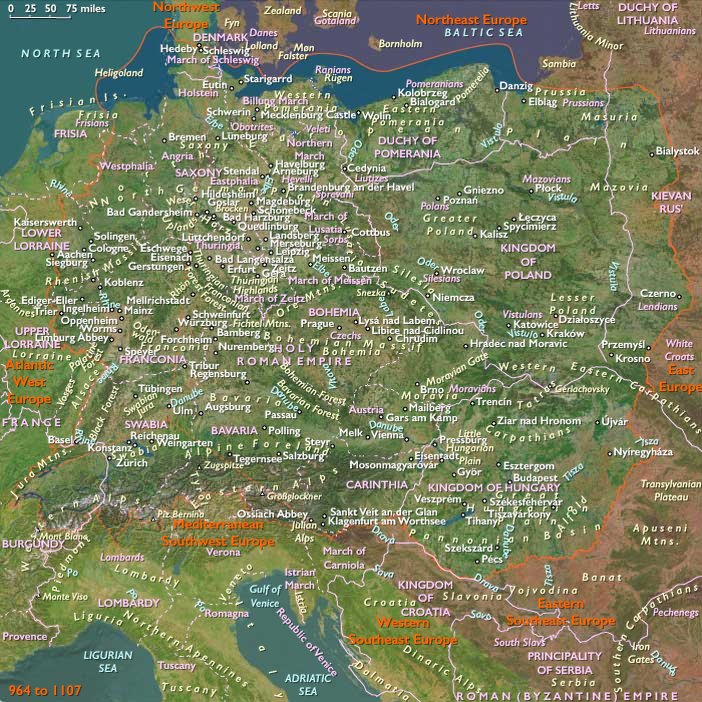
Anne of Kiev (or Anna Yaroslavna also called Agnes or Anne of Rus') wis the Ruthenian queen consort of Henry I, and regent for her son Philip I.
Her parents are Yaroslav I the Wise, the Grand Prince of Kiev and Novgorod, and princess Ingegerd Olofsdotter of Sweden, his second wife.
She was born in Kiev, Rus' between 1024 and 1032 and is the queen of France from 1051 to 1060.
Anne is the founder of the St. Vincent Abbey.

Related Events
Filter results
Showing 7 events out of 7 total
The Marriage of King Henry I of France and Anna of Kiev (1051)
After the death of his first wife, Matilda of Frisia, King Henry I of France faced significant difficulty in finding a suitable bride. The European noble courts were densely intermarried, and the Church’s strict consanguinity lawsmade it nearly impossible to locate a non-related princess within legal degrees of kinship.
Ultimately, Henry turned to the Kievan Rus', sending an embassy to Kiev, which returned with Anna (or Agnes) of Kiev, daughter of Grand Prince Yaroslav the Wise. Their marriage, which took place on May 19, 1051, at the Cathedral of Reims, was a historic union that bridged Western and Eastern Europe.
The Wedding and Coronation of Anna of Kiev
- The wedding and coronation ceremony were conducted by Archbishop Guy de Châtillon at Reims Cathedral, the traditional site for French royal anointings.
- During the ceremony, Anna swore her oath by placing her hand on a Gospel she had brought from Kiev, written in Old Church Slavonic.
- This sacred text would go on to be used in the coronation ceremonies of French kings, with the tradition lasting until Charles X in 1824.
Anna's Impressions of France
- Anna of Kiev was highly educated, able to read and write in at least five languages, including Greek and Latin.
- She was shocked by the lack of literacy at the French court, where even Henry I and his nobles were illiterate, signing their names with simple crosses.
- In a letter to her father, Grand Prince Yaroslav, she described France as a barbaric country, complaining that:
- The houses were dark and gloomy.
- The churches were crude and lacked the grandeur of Kievan cathedrals.
- The French aristocracy lacked proper hygiene and did not bathe regularly.
- At her wedding banquet, Anna was shocked by the simplicity of the French court, having only three dishes at the feast, whereas in Kievan Rus', she was accustomed to five different dinner dishes every day.
Significance of the Marriage
- Anna’s arrival brought cultural and intellectual influences from Kievan Rus’, one of the most sophisticated and literate courts of medieval Europe.
- As Queen of France, she played an important role in royal administration, signing charters in her own name, something uncommon for medieval queens.
- Her marriage strengthened ties between France and Kievan Rus', showing the expanding diplomatic reach of both realms.
Legacy
- The Gospel of Reims, used at Anna’s coronation, remained a symbolic artifact in French royal ceremonies for centuries.
- Anna's shock at the state of France reflected the cultural divide between the Slavic East and the Latin West, highlighting how Kievan Rus' was, in many ways, more advanced than 11th-century France.
- She would go on to become one of the most influential queens of her time, playing a key role in the Capetian court and securing her son Philip I’s succession.
Though initially unimpressed by her new home, Anna of Kiev left a lasting mark on France, bringing literacy, diplomacy, and cultural refinement to the early Capetian monarchy.
Yaroslav, during his long reign as Grand Prince, has consolidated the power of Kievan Rus', codified laws, encouraged the spread of Christianity, and beautified Kiev with new edifices, including the Cathedral of Saint Sophia at Kiev.
Yaroslav had In 1019 married Ingegerd Olofsdotter, daughter of the king of Sweden, and had given her Ladoga as a marriage gift.
The Saint Sophia Cathedral houses a fresco representing the whole family: Yaroslav, Irene (as Ingegerd is known in Rus), their five daughters and five sons.
Yaroslav has had three of his daughters married to foreign princes who lived in exile at his court: Elizabeth of Kiev to Harald III of Norway (who attained her hand by his military exploits on behalf of Constantinople; Anastasia of Kiev to the future Andrew I of Hungary; Anne of Kiev to Henry I of France; she was the regent of France during their son's minority; (possibly) Agatha, to Edward the Exile, of the royal family of England; she is the mother of Edgar Ætheling and St. Margaret of Scotland.
Yaroslav has one son from the first marriage (his Christian name was Ilya (?-1020)), and six sons from his second marriage.
The eldest of these, Vladimir of Novgorod, best remembered for building the Saint Sophia Cathedral in Novgorod, has predeceased his father.
Apprehending the danger that could ensue from divisions between brothers, he exhorted them to live in peace with each other.
Following his death in 1054, the three older sons—Iziaslav, Sviatoslav, and Vsevolod—will reign in Kiev one after another.
The youngest children of Yaroslav are Igor (1036–1060) of Volyn and Vyacheslav (1036–1057) of Smolensk.
About the last there is almost no information.
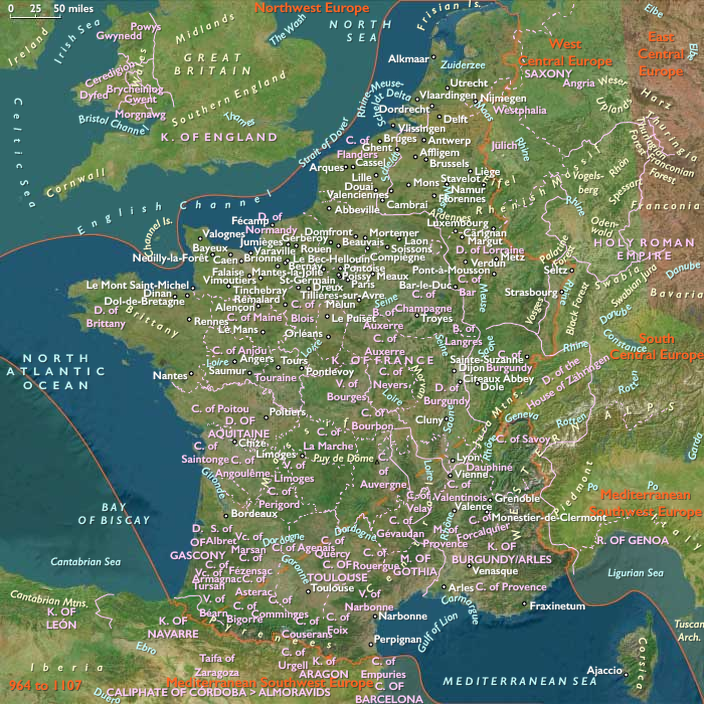
Atlantic West Europe (1060–1071): Norman Conquest, Capetian Consolidation, and Ecclesiastical Influence
The era 1060–1071 in Atlantic West Europe—including the Low Countries, Normandy, Brittany, Aquitaine, the Duchy of Burgundy, the Franche-Comté (County of Burgundy), Alsace, and central France—was marked by significant territorial conquests, especially the Norman conquest of England, the Capetian dynasty’s attempts at internal stabilization, and the continuing influence of ecclesiastical reform movements.
Political and Military Developments
-
Normandy: William’s Conquest of England
- William II of Normandy (William the Conqueror, r. 1035–1087) decisively conquered England at the Battle of Hastings (1066), profoundly reshaping political alliances and dramatically expanding Norman influence beyond continental Europe. Normandy thus became a powerful cross-Channel duchy with vast resources.
-
France: Transition and Stabilization under Philip I
- King Henry I died in 1060, succeeded by his son, Philip I (r. 1060–1108). The young king’s minority initially saw his mother, Anne of Kyiv, and the powerful Count Baldwin V of Flanders acting as regents. Philip’s reign marked cautious royal consolidation, maintaining peace internally while acknowledging regional autonomy.
-
Aquitaine: Strengthening Ducal Authority
- William VIII of Aquitaine (Guy-Geoffrey, r. 1058–1086) actively defended and expanded Aquitanian interests, solidifying control over local nobility and enhancing regional stability.
-
Brittany: Navigating Between Powers
- Conan II (r. 1040–1066) and subsequently Hawise of Brittany and her husband, Hoël II (r. 1066–1084), navigated the delicate political balance between powerful neighbors Normandy and Anjou, preserving Breton autonomy amidst shifting alliances.
-
Burgundy: Stable Ducal Rule
- Robert I of Burgundy (r. 1032–1076) maintained stable governance, enhancing ducal authority, building internal cohesion, and remaining relatively independent from royal intervention.
-
County of Burgundy (Franche-Comté) and Alsace
- William I the Great (r. 1057–1087) in the Franche-Comté deepened ties with the Holy Roman Empire, reinforcing its separate identity from the Duchy of Burgundy.
- Alsace maintained its strategic position as an economic bridge, prospering under imperial protection.
-
Flanders and the Low Countries
- Count Baldwin V (r. 1035–1067) continued to fortify Flanders as a commercial powerhouse. His death in 1067 led to Baldwin VI’s short reign (r. 1067–1070), followed by succession disputes briefly destabilizing the region.
Economic and Social Developments
-
Urban and Commercial Expansion
- Flemish textile cities (Bruges, Ghent, Ypres) thrived as prominent commercial hubs, linking Atlantic trade with the wider European economy.
- Normandy and Aquitaine benefited economically from increased trade with newly conquered English territories.
-
Feudal Consolidation
- Feudal relationships crystallized further, with powerful regional lords consolidating their territories, enhancing local autonomy yet limiting centralized royal authority.
Religious and Cultural Developments
-
Ecclesiastical Reform Movement
- Cluniac monasteries continued expanding their influence, championing ecclesiastical reform and spiritual renewal, reshaping religious life across the region.
- Gregorian Reform ideals, advocating Church independence from secular authority, gained momentum, particularly affecting relationships between secular rulers and religious institutions.
-
Norman Cultural Influence
- Following William’s conquest, cultural and ecclesiastical exchanges intensified between Normandy, England, and continental Europe, significantly influencing architecture, governance, and language.
Legacy and Long-term Significance
The period 1060–1071 was transformative:
- The Norman conquest of England significantly redefined Normandy’s geopolitical influence, positioning it among the most influential powers of Western Europe.
- Philip I’s accession marked a period of cautious royal strengthening, though decentralized governance remained dominant.
- Continued ecclesiastical reform efforts, particularly from Cluny and the Gregorian movement, influenced political dynamics and church-state relationships.
This era laid critical groundwork for future conflicts and alliances, setting the stage for centralization efforts, cross-channel politics, and deepened cultural and economic ties across Atlantic West Europe.
The Death of King Henry I and the Regency of Anne of Kiev (1060–1066)
On August 4, 1060, King Henry I of France died in Vitry-en-Brie and was interred in the Basilica of Saint-Denis, the traditional burial site of French monarchs. His death marked the beginning of a new era for the Capetian dynasty, as his young son, Philip I, ascended to the throne at just seven years old.
Philip I: A Young King with a Greek Name
- Philip I, Henry’s son by Anne of Kiev, inherited the throne upon his father’s death.
- His name, unusual for Western Europe, was of Greek origin, likely chosen by Anne, reflecting the Byzantine and Eastern Christian influence in Kievan Rus'.
- This was the first time a French king bore the name Philip, which would become a defining name of the Capetian dynasty in later centuries.
The First Queen Regent of France: Anne of Kiev
- Since Philip was only seven years old, Anne of Kiev became regent, making her the first queen of France to rule as regent in her own right.
- Her regency lasted until Philip turned fourteen in 1066, when he began ruling independently.
- Her role as regent was unprecedented, as medieval queens rarely held direct political power, yet she acted as the de facto ruler of France during her son’s minority.
Baldwin V of Flanders as Co-Regent
- Baldwin V, Count of Flanders, Philip’s paternal uncle, was appointed co-regent alongside Anne.
- Baldwin was an experienced ruler, having been a powerful and influential figure in northern France and the Low Countries.
- His involvement ensured stability and protection for the young king, particularly against the Normans, the Angevins, and rebellious French nobles.
Significance of the Transition
- Philip I’s coronation at such a young age reinforced the Capetian tradition of hereditary succession, securing dynastic continuity.
- Anne’s regency marked a major moment in medieval French history, demonstrating that foreign-born queens could wield political power in France.
- Baldwin’s role as co-regent strengthened ties between Flanders and the French monarchy, setting the stage for future Capetian-Flemish alliances and conflicts.
Although Philip I would not rule independently until 1066, his ascension under Anne of Kiev’s regency and Baldwin’s co-rule ensured that France remained stable in the face of growing external threats, particularly from Normandy under Duke William, who was preparing for his own historic conquest of England in 1066.
Baldwin V of Flanders: Power Broker of France and England (1060–1067)
By the 1060s, Baldwin V of Flanders had risen to prominence as one of the most influential political figures in Western Europe, playing a crucial role in French, English, and Norman affairs. His position as co-regent of France, Count of Maine, and father-in-law to William of Normandy placed him at the center of major geopolitical events leading up to the Norman Conquest of England.
Baldwin as Co-Regent of France (1060–1066)
- Upon the death of King Henry I of France in 1060, Baldwin was appointed co-regent alongside Queen Anne of Kiev, for the young Philip I of France.
- His selection as regent highlights his diplomatic influence and the strategic importance of Flanders in Capetian politics.
- While Baldwin generally supported the Capetian crown, his position was complicated by his close ties to William of Normandy, who had married Baldwin’s daughter, Matilda of Flanders.
Baldwin’s Influence on English Affairs
- Flanders played a key role in Edward the Confessor’s foreign policy, as Edward had familial and diplomatic ties to Baldwin’s court.
- Harold Godwinson may have passed through Flanders on his way to Germany in 1064, possibly to negotiate the return of Edward the Atheling from Hungary.
- Baldwin’s half-sister had married Tostig Godwinson, further intertwining Flemish and Anglo-Saxon noble families.
Baldwin’s Position on the Norman Conquest of England (1066)
- Despite his close connections to both England and Normandy, Baldwin did not intervene to stop William’s invasion in 1066.
- This was likely because Baldwin had lost control of Ponthieu, making it less feasible to challenge William militarily.
- By 1066, Baldwin was aging, and his diplomatic influence was waning, though his alliances still shaped the political landscape of the era.
Death and Legacy (1067)
- Baldwin V died in 1067, shortly after William’s victory at the Battle of Hastings (1066).
- His daughter, Matilda, became Queen of England, strengthening Norman-Flemish ties.
- His role as regent of France, supporter of Edward the Confessor, and father-in-law to William of Normandy made him a key player in 11th-century European politics.
Baldwin V’s political maneuvering, strategic marriages, and influence in France, England, and Normandy secured his legacy as a kingmaker, helping to shape the power struggles that culminated in the Norman Conquest of England.
The Flemish Succession Crisis: Robert the Frisian vs. Richilde and Arnulf III (1067–1071)
Following the death of Baldwin VI of Flanders in 1070, a succession crisis erupted, pitting Robert the Frisian, Baldwin’s younger brother, against Richilde of Hainaut, Baldwin’s widow and regent for their young son, Arnulf III. The conflict would draw in France, Normandy, and other regional powers, culminating in a major battle for control of Flanders.
Robert the Frisian’s Background and Early Career
- Robert was the younger son of Baldwin V of Flanders and Adèle of France, making him the brother of Baldwin VI and the brother-in-law of William the Conqueror through their sister, Queen Matilda of England.
- In 1063, Robert had married Gertrude of Saxony, the widow of Floris I, Count of Holland, becoming stepfather to Dirk V, Count of Holland.
- His nickname, "the Frisian," stemmed from his role as regent for Dirk V, as Holland was then commonly referred to as Frisia.
Baldwin VI’s Succession Plan and Robert’s Betrayal (1067–1070)
- On his deathbed in 1067, Baldwin VI entrusted Flanders to his son, Arnulf III, with Hainaut assigned to his younger son, Baldwin II.
- Baldwin also made Robert the guardian of Arnulf, expecting him to protect his young nephew’s inheritance.
- However, Robert soon betrayed this agreement, rejecting his oath of homage and invading Ghent in 1070, declaring himself Count of Flanders.
Richilde Appeals to France and Normandy (1070–1071)
- Richilde of Hainaut, Arnulf’s mother, sought aid from King Philip I of France, who summoned Robert to appear before him.
- Robert refused, instead continuing his military campaign to claim Flanders for himself.
- In response, Philip I led an army into Flanders, aiming to restore Arnulf III’s rule.
- Richilde secured further military support from Normandy, with Queen Matilda (Robert’s sister) sending Norman knights to support Philip I and Arnulf III.
- The Norman forces were led by William FitzOsbern, a trusted ally of William the Conqueror, who had also accepted a marriage proposal from Richilde.
The War for Flanders: The Road to Cassel (1071)
- The confrontation between Robert and Richilde’s forces, now backed by France and Normandy, would culminate in the Battle of Cassel (1071).
- Count Eustace II of Boulogne and other pro-Capetian nobles also joined Arnulf’s side, making this a significant war over Flemish succession.
- The outcome of the battle would determine the future ruler of Flanders, deciding whether Baldwin VI’s son or his brother Robert would control the county.
The Flemish succession war (1070–1071) was one of the most significant power struggles of 11th-century France, shaping the political future of Flanders and its relationship with both France and Normandy.
The Battle of Cassel (February 2, 1071) and the Flemish Succession War
The Battle of Cassel on February 2, 1071, was the decisive confrontation in the Flemish succession war, where Robert the Frisian emerged victorious over Countess Richilde of Hainaut and her allies, including King Philip I of France and Norman forces led by William FitzOsbern. The battle reshaped the political landscape of Flanders and northern France, weakening Norman and Capetian influence on the continent.
The Course of the Battle
- William FitzOsbern, Earl of Hereford, a close ally of King William I of England, fought on behalf of Richilde and her son Baldwin II of Hainaut, as part of a pro-Capetian and Norman coalition.
- During the battle, FitzOsbern was killed in action, ending his ambitions of marrying Countess Richilde and securing a foothold in Flanders.
- Robert the Frisian’s forces ultimately triumphed, but Robert himself was briefly captured.
- Meanwhile, Richilde was also taken prisoner, leading to a temporary halt in the fighting while both captives were exchanged for one another.
- The battle resumed, culminating in a major victory for Robert.
The Death of Arnulf III and the Fate of Gerbod the Fleming
- Arnulf III of Flanders, Richilde’s son and rightful heir, was killed during the battle, reportedly by Gerbod the Fleming, the first Earl of Chester.
- Gerbod, though a Flemish noble, fought for Robert, suggesting that he had either switched sides or acted independently.
- The killing of Arnulf III—possibly an accident—shocked the Flemish nobility, as Gerbod had effectively slain his own liege lord.
Consequences of the Battle
- With Arnulf dead, Robert the Frisian claimed the Countship of Flanders, solidifying his rule over the county.
- Richilde and Baldwin II fled back to Hainaut, where they continued to resist Robert, though with diminished power.
- King William I of England lost an important continental ally, as Robert was hostile to Norman influence in Flanders and northern France.
- The battle shifted the balance of power, weakening Norman expansion in Flanders while strengthening Robert’s independent rule.
Gerbod the Fleming’s Fate: A Life of Penance
- After killing Arnulf III, Gerbod reportedly fled to Rome, seeking papal forgiveness for the sin of killing his rightful lord.
- Pope Gregory VII granted Gerbod absolution but ordered him to enter monastic life, sending him to Hugh, Abbot of Cluny.
- Gerbod became a monk at Cluny, where he lived out his days in religious devotion.
- English and Norman chroniclers (Orderic Vitalis and the Hyde Chronicle) mistakenly recorded that Gerbod had been captured and imprisoned, unaware of his self-imposed exile and monastic life.
Legacy of the Battle of Cassel
- Flanders emerged as a dominant power under Robert the Frisian, marking the decline of Capetian and Norman influence in the region.
- The death of Arnulf III and the exile of Gerbod reinforced the final shift in Flemish leadership, ending Richilde’s hopes of restoring her son to power.
- The battle marked one of the last major setbacks for King William I’s continental ambitions, as Robert’s hostility toward Normandy made further expansion difficult.
The Battle of Cassel in 1071 had far-reaching consequences for Flanders, Normandy, and England, shaping the power struggles of northern France for years to come.