Cartimandua
queen of the Brigantes
Years: 10 - 75
Cartimandua or Cartismandua (ruled c. 43 – 69) is a queen of the Brigantes, a Celtic people in what is now Northern England, in the 1st century.
She comes to power around the time of the Roman conquest of Britain, and forms a large tribal agglomeration that becomes loyal to Rome.
She is known exclusively from the work of a single Roman historian, Tacitus, though she appears to have been widely influential in early Roman Britain.
Her name may be a compound of the Common Celtic roots *carti- "chase, expel, send" and *mandu-, "pony".




Related Events
Filter results
Showing 10 events out of 12 total
The most far-reaching of Claudius’s expansions of imperial territory is the conquest of Britannia.
Claudius in 43 sends Aulus Plautius with four legions to Britain (Britannia) after an appeal from an ousted tribal ally.
Britain is an attractive target for Rome because of its material wealth—particularly mines and slaves.
It is also a haven for Gallic rebels and the like, and so could not be left alone much longer.
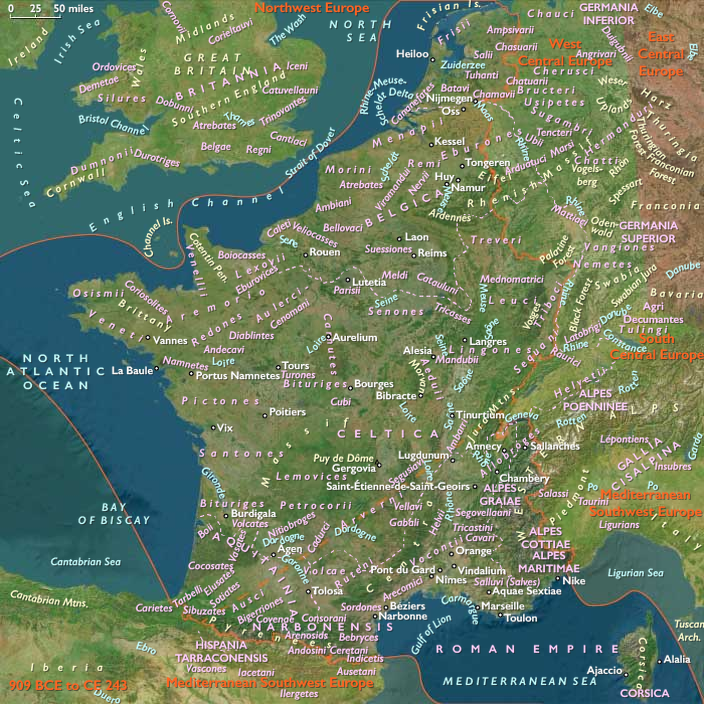
Aulus Plautius, aiming to subdue the intransigent tribal kingdoms, invades with an army of twenty thousand, crossing the English Channel to land at Rutupioae (present Richborough, Kent), an important natural harbor.
The Catuvellauni and Trinovantes warriors, surprised and defeated, retreat toward …
…the region of present London but suffer a second defeat near Durobrivae (present Rochester).
Cunobelinus, Catuvellauni overlord of southeastern England, had died prior to the Roman invasion under Aulus Plautius in 43; his sons Caratacus and Togodumnus lead the British defense, using guerilla tactics against an estimated forty thousand troops.
They lose much of the southeast after being defeated in two crucial battles on the rivers Medway and Thames.
The Roman commander then secures a crossing point of the River Thames, halts, and sends word for Claudius to join him for the final march on the Catuvellaunian capital, Camulodunum (Colchester).
Dio says that this was because the resistance became fiercer as the Britons tried to avenge Togodumnus, and Plautius needed the emperor's help to complete the conquest; however, as Claudius was no military man and in the end spent only sixteen days in Britain, it is likely the Britons were already as good as beaten.
Claudius arrives with reinforcements, including artillery and elephants, which must have made an impression on the Britons when they were displayed in the large tribal center of Camulodunum.
As Suetonius and Claudius' triumphal arch state, the British kings surrendered without further bloodshed.
An alternative reading of Dio's history of the invasion suggests that Togodumnus may actually have been acting in support of the Roman troops, against his brother Caratacus, and that he survived the battles of the River Thames, providing the later Roman administration with valued assistance.
Dr. Miles Russell of Bournemouth University has further suggested that Togodumnus and Tiberius Claudius Cogidubnus, whose original name may have been Togidubnus or Togodumnus, postulated resident of the late first century CE palace at Fishbourne may well have been one and the same.
Claudius is present in August when his legions march into Camulodunum (Colchester), the capital of the Catuvellauni, but Caratacus survives and carries on the resistance further west.
Caractacus rallies the Silures and Ordovices to the cause, but separate Roman expeditions crush the rebels, and other tribes readily accede to Roman sovereignty; he will remain at large until 51.
Caratacus, whose tribe, the Catuvellauni, had been defeated in the first phase of the conquest, has reemerged as a leader of the Silures of south east Wales and Gloucestershire.
Their rising is controlled by a program of legionary fortress construction, driving Caratacus north into the lands of the Ordovices.
Ostorius manages to force him into an open conflict, after several years of guerrilla war.
Tacitus's Annals has Caratacus leading the Silures and Ordovices of Roman Wales against Ostorius, who in 50 finally manages to defeat Caratacus in a set-piece battle somewhere in Ordovician territory, capturing Caratacus' wife and daughter and receiving the surrender of his brother.
Caratacus himself escapes.
The site of the battle is unknown.
The hill fort on Caer Caradoc Hill in Shropshire is connected with the battle by virtue of its name.
Local legend places it at British Camp in the Malvern Hills.
However, the Severn, though visible from this location, is too distant to fit Tacitus's description of the site.
A position just west of Caersws, where the remains of earthworks still stand, has also been suggested, as has a location near Brampton Bryan.
Claudius, according to the biographer Suetonius, during a period of troubles expelled the Jews from Rome for a short time; the Christian sect may be involved.
Elsewhere he confirms existing Jewish rights and privileges, and in Alexandria, he tries to protect the Jews without provoking Egyptian nationalism.
In a surviving letter addressed to the city of Alexandria, he asks Jews and non-Jews ”to stop this destructive and obstinate mutual enmity”.
Caractus, although a captive, is allowed to speak to the Roman senate.
Tacitus records a version of his speech in which he says that his stubborn resistance made Rome's glory in defeating him all the greater:
“If the degree of my nobility and fortune had been matched by moderation in success, I would have come to this City as a friend rather than a captive, nor would you have disdained to receive with a treaty of peace one sprung from brilliant ancestors and commanding a great many nations.
But my present lot, disfiguring as it is for me, is magnificent for you.
I had horses, men, arms, and wealth: what wonder if I was unwilling to lose them?
If you wish to command everyone, does it really follow that everyone should accept your slavery?
If I were now being handed over as one who had surrendered immediately, neither my fortune nor your glory would have achieved brilliance.
It is also true that in my case any reprisal will be followed by oblivion.
On the other hand, if you preserve me safe and sound, I shall be an eternal example of your clemency.” (Tacitus, The, translated by A. J. Woodman, 2004) He made such an impression that he was pardoned and allowed to live in peace in Rome.
After his liberation, according to Dio Cassius, Caratacus was so impressed by the city of Rome that he said "And can you, then, who have got such possessions and so many of them, covet our poor tents?" (Dio Cassius, Roman History, Epitome of Book LXI, 33:3)
Queen Cartimandua is first mentioned by Tacitus in CE 51, but her rule over the Brigantes may have already been established in 43 when Claudius began the organized conquest of Britain: she may have been one of the eleven "kings" who Claudius' triumphal arch says surrendered without a fight.
If not, she may have come to power after a revolt of a faction of the Brigantes was defeated in 48 by Ostorius.
Of "illustrious birth" according to Tacitus, she has probably inherited her power as she appears to have ruled by right rather than through marriage.
She and her husband, Venutius, are described by Tacitus as loyal to Rome and "defended by our [Roman] arms".
Caractacus, his forces defeated by Ostorius in North Wales, flees to Cartimanduas, but in 51 she turns him over, in chains, to the Romans, who have supported her in a number of anti-Roman revolts among her subjects.
Caratacus is sent to Rome as a war prize, presumably to be killed after a triumphal parade.
Ostorius is honored with triumphal insignia but his victory over Caratacus has not entirely quelled resistance in the Welsh borders.
The Silures especially continue to harass Roman troops, supposedly after Ostorius had publicly said that they posed such a danger that they should be either exterminated or transplanted.
A large legionary force occupied in building forts in Siluran territory is surrounded and attacked and only rescued with difficulty and considerable loss.
This violent desperation on the part of the Silures can be attributed to their reaction to what Peter Salway, author of Roman Britain (1981), a volume in the Oxford History of England series, calls Ostorius' lack of political judgment.
The Silures, galvanized by Ostorius' ill-thought out threats to destroy them, begin taking Roman prisoners as hostages and distributing them among their neighboring tribes.
This has the effect of binding them all together and creating a new resistance movement.
According to Tacitus's biography of Agricola, the Silures usually had a dark complexion and curly hair.
Due to their appearance, Tacitus hinted that they may have crossed over from Spain at an earlier date.
The Iron Age hillfort at Llanmelin near Caerwent has sometimes been suggested as a pre-Roman tribal center, but the view of most archaeologists is that the people who became known as the Silures were a loose network of groups with some shared cultural values, rather than a centralized society.
Although the most obvious physical remains of the Silures are hillforts such as those at Llanmelin and Sudbrook, there is also archaeological evidence of roundhouses at Gwehelog, Thornwell (Chepstow) and elsewhere, and evidence of lowland occupation notably at Goldcliff.
Ostorius dies unexpectedly in 52, supposedly "worn out with care" as Tacitus puts it, leaving Rome with a growing problem on its British frontiers.
It has been claimed that his final resting place is in Clawdd Coch in the Vale of Glamorgan, southeast Wales.
Silurian raids continue, defeating a legion led by Gaius Manlius Valens, before Aulus Didius Gallus arrives as replacement governor.
The complete pacification of the area will be achieved only twenty-five years later by Sextus Julius Frontinus in a series of campaigns ending about 78 CE.
Tacitus wrote of the Silures: non atrocitate, non clementia mutabatur — "changed neither by cruelty nor by clemency".
The Brigantes are nominally an independent kingdom, but the Roman historian Tacitus says the rulers Cartimandua and Venutius were loyal to Rome and "defended by Roman power".
Cartimandua, having given Claudius the greatest exhibit of his triumph, in the person of the resistance leader Caratacus, has been rewarded with great wealth.
Venutius has now become the most prominent leader of resistance to the Roman occupation, however: Cartimandua had apparently tired of him and married his armor-bearer, Vellocatus, whom she has elevated to the kingship in Venutius's place.
Venutius initially seeks only to overthrow his ex-wife, and will only later turn his attention to her Roman protectors.