Charles Leclerc
French Army general and husband to Pauline Bonaparte
Years: 1772 - 1802
Charles Victoire Emmanuel Leclerc (17 March 1772, Pontoise – 2 November 1802) is a French Army general and husband to Pauline Bonaparte, sister to Napoleon Bonaparte.

Related Events
Filter results
Showing 10 events out of 24 total
The French Revolution had led to serious social upheavals on Saint-Domingue, of which the most important was the slave revolt that led to the abolition of slavery in 1793 by the civil commissioners Sonthonax and Polverel, in a decision endorsed and spread to all the French colonies by the National Convention six months later.
Toussaint Louverture, a black former slave who had been made Governor by France, had re-established peace, fought off Spanish and British attempts to capture the island, and reestablished prosperity by daring measures.
However, he goes too far in hunting down governor Don Joaquín García y Moreno (January 27, 1801), who has remained in what had been the Spanish part of the island following the 1795 Peace of Basel.
Toussaint also challenges French imperial interests by promulgating a self-rule constitution on July 12, 1801, which declares him governor for life.
On February 9, 1801, after their defeat at Marengo, the Austrians split off from the Second Coalition and sign the Treaty of Lunéville with France.
Naples now signs a peace treaty with the French at Florence and Russia under Paul I distances itself from the coalition, with his successor Alexander I finally concludes a secret peace with Bonaparte on October 10, 1801.
Britain is thus isolated and, after the first ministry of William Pitt the Younger falls on March 13, 1801, the new government begins to consider making peace.
Napoleon Bonaparte (now First Consul) can thus concentrate on internal problems within France and its empire.
His troops are idle and his officers eager for a chance for glory.
In early 1801, Bonaparte had decided to appoint his sister Pauline's husband, general Charles Leclerc, as head of a military expedition to reassert French authority over Saint-Domingue.
Initially, Bonaparte had planned to confirm the military ranks and lands acquired by Toussaint's officers, offer Toussaint the rôle of lieutenant of France, and guarantee freedom to the former slaves, while re-establishing Paris's authority over the island in the person of its capitaine général.
Toussaint's two sons are being educated in France and, as proof to Toussaint of the French government's goodwill, Bonaparte sends them back to their father with their tutor.
By October, however, Bonaparte's opinion has shifted, as he interprets Toussaint's July constitution as an unacceptable offense to French imperial authority.
Henceforth, Bonaparte secretly directs Leclerc to disarm Toussaint's black-controlled government and deport his military officers to France.
Bonaparte foresees that Toussaint will probably put up resistance and so takes all necessary measures to defeat him should this occur—Toussaint has over sixteen thousand men available, so Leclerc is put in command of thirty thousand men drawn from nearly all the French Revolutionary Armies as well as the disciplinary corps.
Several aspects of the constitution are damaging to France: the absence of provision for French government officials, the lack of advantages to France in trade with its own colony, and Toussaint's breach of protocol in publishing the constitution before submitting it to the French government.
Despite his disapproval, Vincent had attempted to submit the constitution to Napoleon in a positive light, but is briefly exiled to Elba for his pains.
Toussaint professes himself a Frenchman and strives to convince Bonaparte of his loyalty.
He writes to Napoleon but receives no reply.
Napoleon eventually decides to send an expedition of twenty thousand men to Saint-Domingue to restore French authority, and possibly to restore slavery as well.
Meanwhile, Toussaint is preparing for defense and ensuring discipline.
This may have contributed to a rebellion against forced labor led by his nephew and top general, Moïse, in October 1801.
It is violently repressed with the result that not all of Saint-Domingue will automatically be on Toussaint's side when the French ships arrive.
Peace had not yet been conclusively signed with Britain (the Peace of Amiens will finally be signed on March 25, 1802) when, on December 14, 1801, a French fleet of twenty-one frigates and thirty-five ships of the line (with one one hundred and twenty-gun ship) had left Brest under Villaret de Joyeuse carrying seven thousand to eight thousand troops.
This fleet is followed by the squadron under contre-amiral Ganteaume, which leaves Toulon on February 14 with forty-two hundred troops, then by that under contre-amiral Linois, which leaves Cadiz on February 17 with twenty-four hundred troops.
In the following months even more ships leave France with fresh troops, including over four thousand men from the artillerie de marine, a Dutch division and the Polish Danube Legion.
Also included are a Spanish fleet of seven ships under Admiral Federico Gravina as well as large financial and material aid coming from Spanish Cuba.
In total, thirty-one thousand one hundred and thirty-one troops are landed on Saint-Domingue, including some black figures such as André Rigaud and future Haitian president Alexandre Pétion, both of whom Toussaint had expelled from the colony two years earlier in the War of Knives (after the Saint-Domingue expedition's failure, Rigaud will be imprisoned at fort de Joux by Napoleon, a few cells away from Toussaint himself).
The ships are due to join up in the Bay of Samaná, which Villaret de Joyeuse reaches on January 29, closely followed by Latouche-Tréville.
Without waiting for Ganteaume and Linois, these two admirals divide up their combined fleets to arrive at different ports in order to surprise Toussaint.
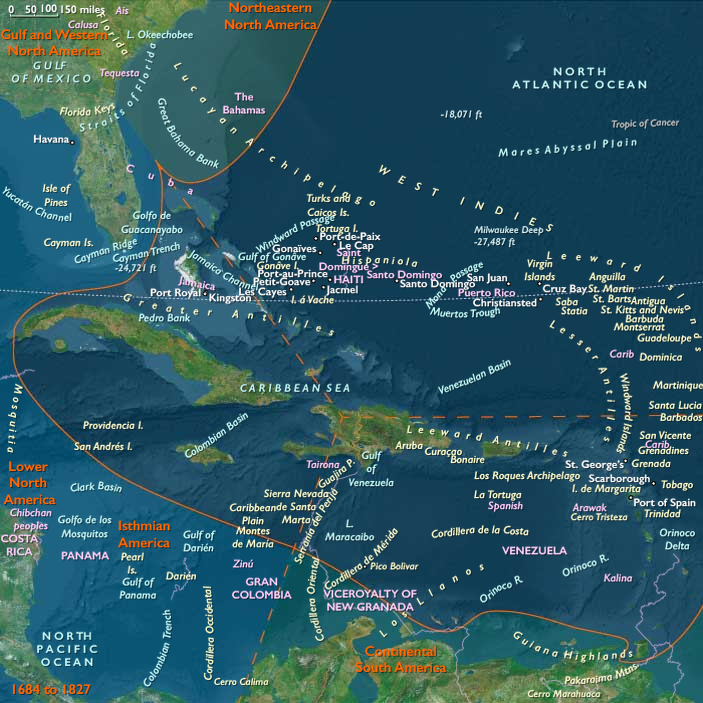
General Kerverseau is to land at Santo Domingo in the Spanish part of the island, General Jean Boudet is sent to take Port-au-Prince in ships under Latouche-Tréville and Leclerc; Villaret de Joyeuse and Gravina sail towards to Cap-Haïtien.
When Toussaint discovers the French ships in the bay of Samaná, he orders Henri Christophe (head of the island's northern département), Jean-Jacques Dessalines (head of the western département) and Laplume (head of the southern département) to obey the squadrons' summons to a parley, to insist on a parley if none is offered, and (if a landing should occur) to threaten to destroy the towns and massacre the white inhabitants before retreating into the mountains.
While General Charles Leclerc (Bonaparte's brother-in-law), heading the French expedition to restore colonial rule, seeks permission in late January 1802 to land at Cap-Français and Henri Christophe holds him off, ...
Leclerc begins his invasion on February 3 with approximately seventeen thousand troops, landing the first five thousand at several points on the north coast; with him is Alexandre Pétion.
Villaret had arrived before Cap-Haïtien on February 3 and an attack by land and sea begins two days later.
General Henri Christophe carries out his orders, setting light to the town and slitting the throats of part of the white population.
Toussaint, with approximately twenty thousand men under his command, orders the black generals to raze the coast towns and retreat into the interior, but because of either disloyalty or poor communications the order is not universally followed.
Christophe burns Le Cap to ashes for the second time in ten years, but the French occupy Port-au-Prince before Jean-Jacques Dessalines can destroy it.
Rochambeau on the left sets out from Fort-Dauphin towards Saint-Michel, while Hardy marches on Marmelade and Desfourneaux on Plaisance.
At the same time general Humbert is to land at Port-de-Paix to climb up the Trois-Rivières gorge, and Boudet to move up from south to north.
The aim is to surprise the enemy, force him to retreat to Les Gonaïves and there encircle him.
Despite the difficulties of the terrain and Maurepas's resistance, the plan works well.
Putting out the fires and putting up defensive works, Leclerc sets up his main headquarters at Cap-Haïtien before sending ships towards North America to resupply.
During this time Latouche-Tréville and Boudet take Port-au-Prince and Léogâne and obtains Laplume's surrender.
General Kerverseau, landing at Santo Domingo with two thousand men, takes possession of a large part of the Spanish area of the island, at this time headed by Toussaint's brother Paul Louverture.
General Boudet occupied Saint-Marc, also on fire and filled with the blood of the throats cut on the orders of Dessalines, who managed to escape the trap.
Maurepas and his two thousand troops continue to resist but finally have to surrender to Humbert.
The French forces besieging fort de la Crête-à-Pierrot are attacked in the rear by Dessalines, then by Toussaint, as they attempt to bring relief to the besieged, but the fort is finally forced to surrender and inside it are found large amounts of arms and munitions as well as many assassinated white residents.
At Les Verrettes the French forces find a horrible spectacle.
No longer able to follow the rebel forces' march, eight hundred men, women, children and old people had been killed, and the rebels there had also killed any prisoners they had taken.