Charles V of France
King of France
Years: 1338 - 1380
Charles V (January (21, 1338 – September 116, 380), called the Wise, is King of France from 1364 to his death in 1380 and a member of the House of Valois.
His reign marks a high point for France during the Hundred Years' War, with his armies recovering much of the territory ceded to England at the Treaty of Brétigny.

Related Events
Filter results
Showing 10 events out of 72 total
Atlantic West Europe (1108 – 1251 CE): The Angevin Empire, Champagne–Flanders Circuits, and Aquitaine under the English Crown
Geographic and Environmental Context
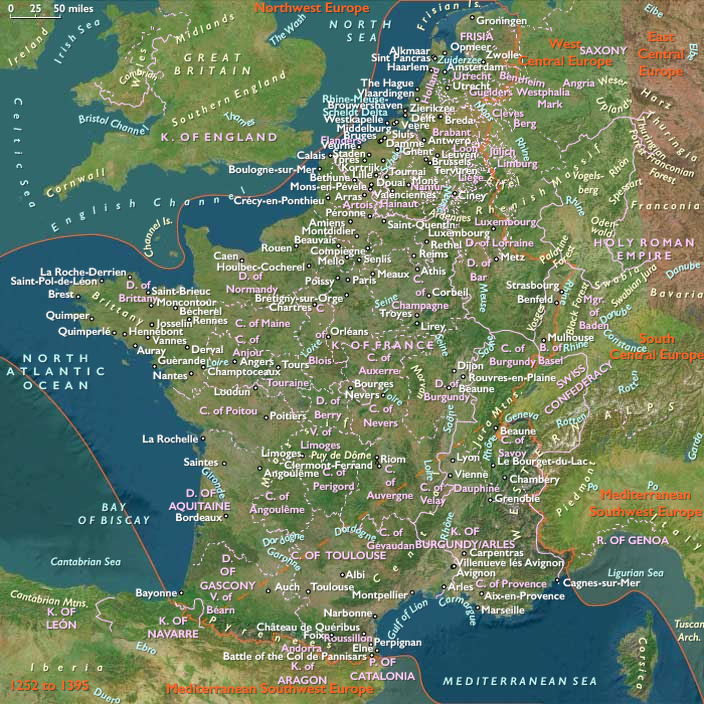
Atlantic West Europe spans northern France and the Low Countries.
-
Anchors: Paris–Seine–Reims, Upper Loire (Orléans–Blois–Tours), Anjou/Angers–Maine–Le Mans, Poitou/Poitiers–La Rochelle–Saintes, Bordeaux–Gironde–Bayonne, Flanders/Bruges–Ghent–Ypres, Low Countries delta.
Climate and Environmental Shifts
-
High-medieval peak supported population and urbanization; river improvements eased up-country grain and wine traffic.
Societies and Political Developments
-
Eleanor of Aquitaine married Louis VII (1137), annulled (1152), then married Henry II Plantagenet (1152)—creating the Angevin Empire (from Anjou/Normandy to Aquitaine).
-
Capetian–Angevin rivalry dominated: Philip II conquered Normandy (1204), but Aquitaine/Guyenne largely remained under English suzerainty; La Rochelle and Bordeaux became Angevin pillars.
-
Flanders and Champagne fairs integrated Mediterranean–northern circuits; communes of Bruges, Ghent, Ypres asserted charters.
-
Brittany navigated between Plantagenets and Capetians.
Economy and Trade
-
Bordeaux claret exports to England boomed; La Rochelle shipped salt and wine; Nantes handled salt fish and grain.
-
Flanders/Champagne fairs: Italian capital met northern cloth; Bruges emerged as a banking mart.
-
Upper Loire and Anjou–Touraine supplied wine/grain to Paris and ports.
Belief and Symbolism
-
Gothic beginnings in Chartres, Paris; pilgrimage roads of Poitou–Bordeaux remained crowded.
Long-Term Significance
By 1251, Aquitaine was England’s continental anchor; Flanders the cloth workshop; Paris–Loire the Capetian core—poised for 13th–14th-century contests.
Guillaume de Machaut: Poet, Composer, and Courtly Patronage
Guillaume de Machaut (c. 1300–1377), one of the most accomplished and versatile composers and poets of the 14th century, found patrons among the highest ranks of European nobility, including Charles of Navarre and King Charles V of France. His artistic output, shaped by his extensive travels and courtly experiences, reflects the richness and diversity of medieval literary and musical traditions.
A Fusion of Poetry and Music
Machaut’s expansive collections of poetry, often accompanied by musical compositions, display his mastery of courtly love themes, philosophical reflection, and personal lyricism. His works include:
- Narrative poems (dits), blending allegory and autobiography, such as Le Voir Dit (The True Tale).
- Lyric poetry, including ballades, rondeaux, and virelais, many of which he set to music.
- Sacred music, most notably the Messe de Nostre Dame, the first known complete polyphonic mass by a single composer.
Illuminated Manuscripts and Royal Patronage
Machaut oversaw the production of richly illuminated manuscripts of his works, ensuring their artistic refinement and textual integrity for his noble patrons. These lavish books, adorned with elegant miniatures and decorative script, were prepared for the French court and powerful aristocrats, securing his legacy as both a poet and composer.
His influence extended far beyond his lifetime, shaping the development of French poetry and polyphonic music, and positioning him as one of the most influential cultural figures of the late Middle Ages.
The Black Prince’s Chevauchée and the Lead-Up to the Battle of Poitiers (August–September 1356)
By 1356, after years of war, Edward III of England sought a diplomatic resolution, proposing that France permanently cede Aquitaine in exchange for peace. However, French King John II ("the Good") rejected the proposal, prompting Edward’s eldest son, Edward, Prince of Wales (later known as the Black Prince), to launch a massive chevauchée (scorched-earth raid) deep into central France.
The Chevauchée of August 1356: Raiding Across Central France
- On August 8, 1356, the Black Prince’s army began its devastating march northward from English-held Aquitaine, carrying out a chevauchée designed to weaken France’s economy, demoralize the population, and provoke the French army into battle.
- His fast-moving English and Gascon force, composed of mounted knights, men-at-arms, and archers, met little resistance and proceeded to burn numerous towns and villages to the ground, pillaging the countryside for supplies.
- The English lived off the land, creating havoc in French territories and stripping central France of valuable resources.
The Loire River and the Delay at Tours
- By early September 1356, the Black Prince’s army reached the Loire River at Tours, a key crossing point in central France.
- He attempted to capture the castle and sack the town, but was unable to breach its defenses due to a heavy rainstorm, which prevented his troops from setting fires.
- This delay at Tours proved costly, as it allowed John II of France to close in with a large army, finally putting the English force in jeopardy.
John II’s Response: The Pursuit Begins
- King John II had been assembling a powerful army to intercept the English raiders and prevent their retreat back to Aquitaine.
- The delay at Tours gave him the time he needed to maneuver into position, forcing the Black Prince’s army into a dangerous situation.
- Now, instead of freely raiding French lands, Edward’s force had to plan a strategic retreat southward, knowing that a major confrontation was inevitable.
The Path to the Battle of Poitiers
- The Black Prince’s chevauchée had succeeded in devastating central France, but his army was now being pursued by a superior French force.
- This set the stage for the decisive Battle of Poitiers (September 19, 1356), one of the most significant English victories of the Hundred Years’ War, where John II would be captured, throwing France into crisis.
Edward’s brutal chevauchée of 1356, though initially an overwhelming success, ultimately led to the climactic confrontation at Poitiers, shaping the course of the Hundred Years’ War for years to come.
King John II’s Pursuit of the Black Prince and the Mobilization at Chartres (September 1356)
As the Black Prince’s army conducted its scorched-earth chevauchée through central France in August–September 1356, King John II of France abandoned his siege of Breteuil in Normandy to intercept the English forces before they could retreat back to English-held Aquitaine.
John II’s Strategic Mobilization at Chartres
- To increase the speed and mobility of his advancing army, John II gathered his forces at Chartres, north of Tours, where the English were stalled due to weather.
- He made the critical decision to dismiss approximately 15,000 to 20,000 lower-quality infantry, allowing his main force to move faster.
- This maneuver allowed him to close in on the Black Prince’s army, preventing them from escaping unchallenged.
French Tactical Adjustments and the Road to Poitiers
- By reducing the size of his army, John hoped to force the Black Prince into a decisive engagement before he could reach safety.
- With his elite knights, men-at-arms, and cavalry, John II prepared for a major confrontation with the English.
- His strategy set the stage for the Battle of Poitiers (September 19, 1356), a catastrophic defeat for the French, in which John II was captured by the English, leading to a national crisis in France.
Significance
- John’s decision to trim his forces for mobility was a bold but ultimately flawed maneuver, as the remaining troops would still suffer a crushing defeat at Poitiers.
- His attempt to cut off the Black Prince ultimately led to his own capture, worsening France’s position in the Hundred Years’ War.
King John II’s mobilization at Chartres and pursuit of the Black Prince was a decisive moment leading up to Poitiers, marking one of the most significant turning points of the Hundred Years’ War.
The Battle of Poitiers (September 19, 1356): A Decisive English Victory and the Capture of King John II
The Battle of Poitiers, fought on September 19, 1356, was one of the greatest English victories of the Hundred Years' War, resulting in the capture of the French king, John II ("the Good"), and his youngest son, Philip. The battle marked a major turning point in the war, leaving France leaderless and in chaos while Edward III of England and his son, the Black Prince, strengthened their control over large parts of the kingdom.
Negotiations Before the Battle: A Failed Attempt at Peace
- Confident of victory, John II commanded an army twice the size of the English force but hesitated to attack immediately.
- As the two armies faced off a few miles southeast of Poitiers, a papal legate attempted to broker a truce, carrying proposals between the two camps.
- There is debate over whether the Black Prince even wanted to fight, as he:
- Offered to surrender his heavily loaded wagon train, filled with loot from his chevauchée across France.
- Promised not to fight against France for seven years.
- Some sources claim he even offered to return Calais to the French Crown.
John II’s Counteroffer and the Collapse of Talks
- King John refused to accept these terms, demanding instead that:
- One hundred of the Prince’s best knights surrender as hostages.
- The Black Prince himself be taken prisoner.
- With neither side willing to compromise, negotiations collapsed, and both armies prepared for battle.
The Battle of Poitiers: English Longbows vs. French Chivalry
- John II adopted the English tactic of fighting dismounted, hoping that crossbowmen could weaken the English ranks.
- However, the English longbows devastated the French forces, riddling their crossbowmen and men-at-arms with arrows before they could close in for hand-to-hand combat.
- The French cavalry charges failed, and when the Black Prince counterattacked, the French army collapsed in total defeat.
The Flight of the Dauphin and the Capture of King John II
- John’s second son, Louis, fought under his older brother, Charles, the Dauphin, but their battalion hardly engaged in the fight.
- Seeing the battle turning against them, they fled the battlefield, avoiding capture but leaving their father to fight on alone.
- Though humiliating, their flight ensured the survival of the Valois dynasty, allowing Charles to rule as regent in his father’s absence.
The Final Stand of King John II
- John II fought bravely with a large battleaxe, but was ultimately surrounded.
- To prevent the enemy from easily identifying him, he and nineteen of his personal guard dressed identically, yet this failed to protect him.
- His helmet was knocked off, yet he continued fighting until surrounded.
The Moment of Surrender
- Denis de Morbecque, a French exile fighting for England, approached John and said:
- "Sire, I am a knight of Artois. Yield yourself to me and I will lead you to the Prince of Wales."
- John surrendered by handing over his glove, officially becoming an English prisoner.
Aftermath: John II’s Captivity in England
- That night, the Black Prince personally attended to King John, hosting him in a red silk tent in chivalric tradition.
- John was then taken to Bordeaux, and later to England, where he was held for ransom in London.
- The ransom was set at three million gold crowns, an enormous sum that would cripple France financially.
- While John remained in captivity, his son Charles (the Dauphin) ruled France as regent, struggling to maintain order in a leaderless kingdom.
- No known efforts were made by French nobles or peasants to rescue John, reflecting the disillusionment with his leadership.
Significance of the Battle of Poitiers
- The French army suffered a humiliating defeat, mirroring the disaster at Crécy (1346).
- The capture of King John II left France in chaos, leading to:
- Increased English control over France.
- The Estates General of 1357, where French nobles and commoners tried to exert more control over the monarchy.
- The Jacquerie Peasant Revolt of 1358, as taxes were raised to pay John’s ransom.
The Battle of Poitiers (1356) was one of the greatest English victories of the Hundred Years' War, securing the capture of the French king, deepening France’s political instability, and further demonstrating the dominance of English longbow tactics.
The Aftermath of Poitiers and the Causes of the Jacquerie Revolt (1356–1358)
Following the Battle of Poitiers (September 1356) and the capture of King John II ("the Good"), France descended into chaos, plagued by political instability, economic collapse, and social unrest. The chronicler Jean de Venette, a Carmelite friar, vividly describes the period as one of lawlessness, corruption, and suffering, blaming both the French nobility and the roaming mercenary bands known as the "Companies" (routiers).
Jean de Venette’s Account: France in Ruins
Jean de Venette provides a firsthand account of the devastation, writing:
"...From that time on all went wrong with the Kingdom and the state was undone.
Thieves and robbers rose up everywhere in the land.
The nobles despised and hated all others and took no thought for the mutual usefulness and profit of lord and men.
They subjected and despoiled the peasants and the men of the villages.
In no wise did they defend their country from enemies.
Rather did they trample it underfoot, robbing and pillaging the peasants' goods."
- His criticism is directed not only at the nobility, who exploited and abandoned their subjects, but also at the routiers—mercenary bands left unchecked in the wake of the war.
- With the monarchy leaderless, local warlords and nobles took advantage, taxing the peasants heavily while failing to provide protection from external threats.
Political Instability and the Estates-General’s Failure
- With King John II in captivity, power fractured between:
- The Estates-General, which proved too divided to govern effectively.
- Charles II of Navarre, who sought his own advantage.
- The Dauphin, later Charles V, who struggled to assert control.
- This lack of leadership left France vulnerable, as nobles pursued their own interests rather than defending the country.
- The prestige of the nobility, already tarnished by defeats at Courtrai (1302) and Crécy (1346), reached a new low after they failed to protect France at Poitiers.
Economic Hardships and the Peasantry’s Growing Resentment
- To fund ransoms, military campaigns, and personal expenses, the privileged classes (nobles, clergy, and merchants) increased taxes on peasants.
- The taille (a direct land tax) was raised to unbearable levels, while the corvée (forced labor) forced peasants to rebuild war-damaged noble estates—without pay.
- A new law requiring peasants to defend châteaux (noble castles) became the final spark that ignited the Jacquerie rebellion.
- Many commoners already blamed the nobility for their failures at Poitiers and now questioned why they should continue working for a ruling class that could not even provide protection.
Mercenaries and the Breakdown of Order
- The countryside was overrun by routiers (unemployed mercenaries and brigands)—including English, Gascon, German, and Spanish troops, many of whom had fought for the English before being left without pay or leadership.
- These roving bands looted, raped, and burned villages, pillaging the land almost at will, while the Estates-General proved powerless to stop them.
- Many peasants faced a double threat:
- Noble exploitation through high taxes and forced labor.
- Uncontrolled mercenary violence that the nobility failed to suppress.
The Jacquerie Revolt (1358): A Violent Peasant Uprising
- In May 1358, these tensions erupted into the Jacquerie, a violent peasant rebellion in northern France.
- The revolt was short-lived but extremely bloody, with peasant mobs attacking nobles, burning estates, and killing aristocrats.
- Although the Jacquerie was brutally crushed by June 1358, it left a lasting impact, exposing deep class tensions that would continue to shape France’s social and political struggles.
Long-Term Consequences
- The failure of the nobility to defend France and its people in the 1350s permanently damaged the feudal system.
- The Jacquerie foreshadowed later peasant revolts, including:
- The English Peasants' Revolt (1381).
- The French Revolution (1789).
- France’s internal divisions further weakened the country’s ability to resist English advances in the Hundred Years’ War.
The years after Poitiers (1356–1358) were among the darkest in medieval France, as the absence of strong leadership, economic suffering, and unchecked mercenaries led to mass discontent and violent peasant uprisings.
The Jacquerie Uprising (May–June 1358): A Peasant Revolt Against the Nobility
The Jacquerie, a brutal peasant revolt that erupted in May 1358, was fueled by widespread suffering, economic hardship, and resentment toward the nobility following the devastation of the French countryside during the Hundred Years’ War. The rebellion was centered in northern France, with peasants taking violent revenge on knights, noble families, and their castles.
Origins of the Jacquerie: Discontent in the Countryside
- The uprising began in the village of St. Leu, near the Oise River, where a group of peasants gathered in a cemetery after vespers to discuss their grievances.
- The peasants, outraged by the nobility’s failure to defend France, believed that the lords had abandoned King John II at the Battle of Poitiers (1356), leaving the kingdom leaderless and vulnerable.
- France’s rural population had already suffered immensely:
- English soldiers plundered the countryside, demanding money and food on pain of death.
- French nobles imposed excessive taxes, claiming they needed money for ransoms and to recover losses from the Black Death.
- Peasants were forced to sleep in forests, caves, and marshes to avoid pillaging armies and roaming mercenaries (routiers).
- Even basic agricultural work was impossible without sentinels watching for attacks.
The Outbreak of Revolt: Guillaume Cale’s Leadership
- On May 21, 1358, the rebellion spread near Compiègne, northeast of Paris, under the leadership of Guillaume Cale (also called Carle).
- The revolt was known as the Jacquerie, named after the derogatory term "Jacques Bonhomme" used by nobles to refer to peasants.
- The rebels sought justice and vengeance, launching a wave of destruction against noble estates.
- Castles were stormed, burned, and looted, and the nobility were killed without mercy.
The Extreme Violence of the Jacquerie
Contemporary chroniclers describe atrocities committed by the peasants, often in gruesome detail.
-
Jean le Bel recounts one of the most infamous acts:
- Peasants captured a knight, roasted him alive on a spit, and forced his wife and children to watch.
- After raping the lady, they attempted to force her and her children to eat the roasted flesh of her husband before killing them all.
-
Even Jean de Venette, who was generally sympathetic to the peasants, recorded horrific scenes of slaughter and destruction.
-
Jean Froissart, an aristocrat who despised the peasants, portrayed them as savages, recounting numerous acts of mass murder, rape, and looting.
-
The only chronicler openly sympathetic to the peasants was the anonymous monk who continued the chronicle of Guillaume de Nangis, recognizing the deep suffering that had fueled the uprising.
Impact of the Revolt
- The Jacquerie’s brutal violence horrified the nobility, leading to harsh reprisals against the surviving rebels.
- Though the revolt was eventually crushed within weeks, it revealed the depth of peasant resentment toward the feudal system and noble exploitation.
- The uprising, though short-lived, left a lasting impression on France, foreshadowing future peasant rebellions and further destabilizing the already fragile French monarchy.
The Jacquerie of 1358 was not just a violent peasant uprising—it was an explosive reaction to years of suffering, injustice, and noble indifference, marking a turning point in medieval social unrest.
The Jacquerie of 1358: A Spontaneous and Disorganized Revolt Amidst French Chaos
The Jacquerie of 1358 was a spontaneous, unstructured peasant uprising, fueled by anger toward the nobility, economic hardship, and the general collapse of law and order in France following the capture of King John II at Poitiers (1356). Lacking central leadership or coordination, the revolt spread from village to village, igniting a wave of destruction across northern France.
Origins and Spread of the Revolt
- Jean le Bel speculated that governors and tax collectors may have deliberately spread word of rebellion to inspire peasant uprisings against the nobility.
- Many peasants joined simply because they saw others doing so, suggesting that the movement was more spontaneous than ideologically driven.
- However, some rebels expressed the radical belief that it was possible to rid the world of nobles entirely, reflecting deep resentment toward the feudal system.
Uncoordinated Violence and Regional Outbreaks
- The revolt lacked central leadership, with local peasant bands acting independently in different regions.
- The peasant army sacked Senlis and Montdidier, while outbreaks occurred in Rouen and Reims.
- In cities like Beauvais, Senlis, Paris, Amiens, and Meaux, the urban underclass and sections of the bourgeoisie sympathized with the peasants, as they too were suffering under the corrupt noble elite.
Froissart’s Account: A Noble Perspective on the Violence
- Jean Froissart, an aristocratic chronicler, portrays the rebels as "mindless savages," indiscriminately murdering noble families and destroying over 150 castles and manor houses.
- Some horrific episodes of violence were recorded, including the gruesome torture and execution of knights and their families.
Noble and Bourgeoisie Involvement
- Although a peasant uprising, a small number of knights and squires were involved, possibly out of personal grievances against certain lords.
- However, many later claimed (through letters of pardon) that they had been forced to participate, distancing themselves from the revolt after it was crushed.
Internal Instability: The Broader Context
- France was in deep crisis following King John II’s capture at Poitiers, with power devolving to the Dauphin Charles (later Charles V).
- The Dauphin faced multiple threats:
- The routiers (free companies)—mercenary bands looting the countryside.
- The plotting of Charles the Bad of Navarre, a dangerous rival.
- The continued threat of an English invasion.
- The Dauphin only consolidated power in July 1358, after Paris fell under the control of Étienne Marcel, a high bourgeois merchant leader, who had briefly aligned with the Jacquerie.