Charles VII of France
King of France
Years: 1403 - 1461
Charles VII (22 February 1403 – 22 July 1461), called the Victorious (French: le Victorieux) or the Well-Served (French: le Bien-Servi) is King of France from 1422 to his death, though he is initially opposed by Henry VI of England, whose Regent, the Duke of Bedford, rules much of France from Paris.
He is a member of the House of Valois, the son of Charles VI, but his succession to the throne is left questionable by the English occupation of northern France.
He is, however, famously crowned in Reims in 1429 through the endeavors of Joan of Arc to free France from the English.
His later reign is marked by struggles with his son, the eventual Louis XI.

Related Events
Filter results
Showing 10 events out of 113 total
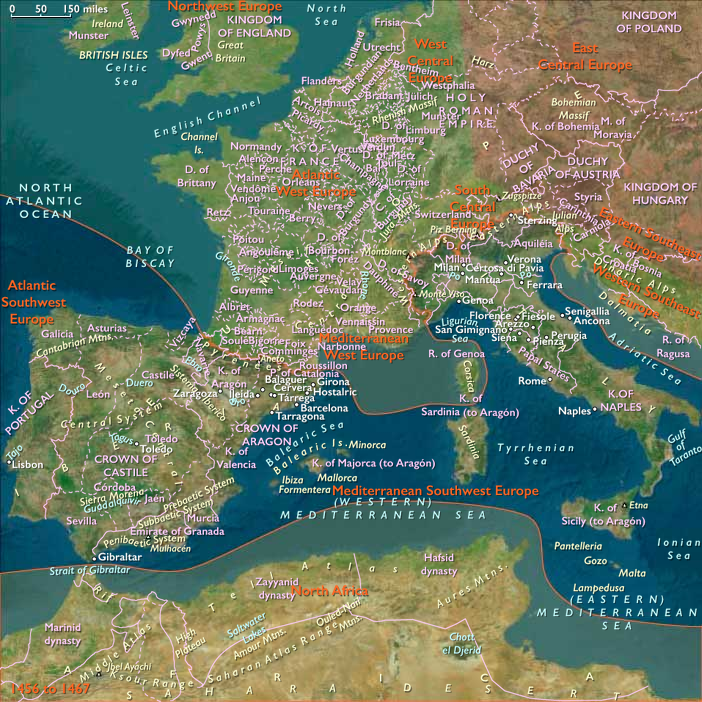
Mediterranean West Europe (1396–1539 CE): Dynastic Struggles, Maritime Republics, and Reformation Currents
Geographic & Environmental Context
The subregion of Mediterranean West Europe includes southern France (Languedoc, Provence, the Rhône valley, the French Pyrenees), Monaco, and Corsica. Anchors comprised the Provençal coast (Marseille, Nice, Monaco), the Rhône valley with Avignon, Arles, and Lyon’s southern approaches, the Pyrenean uplands of Roussillon, and Corsica’s mountainous heartland and coastal citadels. These were frontier lands bridging France, Italy, and Iberia, tied to both Mediterranean seafaring and continental politics.
Climate & Environmental Shifts
The Little Ice Age brought cooler winters and occasional crop failures:
-
Languedoc & Provence: Vineyards and olive groves endured frost damage in hard winters.
-
Rhône valley: Floods and droughts alternated, reshaping grain yields.
-
Corsica & Pyrenees: Heavy snows delayed planting; pastoralists shifted grazing between valleys and uplands.
-
Mediterranean coasts: Storms battered ports; fisheries remained abundant but vulnerable to seasonal variability.
Subsistence & Settlement
-
Agriculture: Mixed farming of wheat, barley, rye, and legumes in valleys; vineyards and olives on coastal terraces; chestnuts in Corsican uplands.
-
Pastoralism: Sheep and goats grazed Pyrenean and Corsican highlands; wool and cheese fed urban markets.
-
Towns: Marseille, Avignon, Montpellier, Nice, and Ajaccio thrived as mercantile and cultural centers; fortified citadels dominated Corsican coasts.
-
Trade staples: Salt from Aigues-Mortes, wine and grain from Languedoc, olive oil from Provence, and Corsican timber and cheese.
Technology & Material Culture
-
Agricultural tools: Wooden plows, iron sickles, and watermills; terracing in Corsica and Provence.
-
Maritime craft: Galleys, cogs, and early caravels linked coasts to Italy and Iberia.
-
Architecture: Flamboyant Gothic cathedrals in Narbonne and Montpellier; papal palaces at Avignon; Corsican Genoese towers along coasts.
-
Print & learning: Lyon became a printing hub in the late 15th century; Avignon and Montpellier hosted universities and humanist circles.
Movement & Interaction Corridors
-
Mediterranean sealanes: Marseille and Monaco tied France to Genoa, Naples, and Barcelona. Corsica lay on routes between Italy, Iberia, and the Maghreb.
-
Rhône corridor: Moved wine, grain, and salt north to Lyon and the rest of France.
-
Pilgrimage routes: Linked Roussillon and Provence into Santiago de Compostela and Rome networks.
-
Military frontiers: Provence and Roussillon sat at the hinge of French, Aragonese, and later Habsburg ambitions.
Cultural & Symbolic Expressions
-
Catholic orthodoxy: Monastic houses and churches structured devotion; papal influence at Avignon lingered.
-
Humanism: Lyon and Avignon hosted scholars and presses; Montpellier’s medical school became renowned.
-
Art: Frescoes, sculpture, and illuminated manuscripts in Provence; troubadour legacies continued in lyric poetry.
-
Corsican identity: Clan-based traditions blended with Genoese and Pisan legacies.
Environmental Adaptation & Resilience
-
Farmers: Diversified crops to hedge against frost and drought; stored grain in communal barns.
-
Pastoralists: Practiced transhumance, moving flocks from coast to uplands.
-
Villages: Built terraces and dikes to manage fragile soils and flood risks.
-
Urban resilience: Imported grain during shortages; salt trade stabilized food supply.
Technology & Power Shifts (Conflict Dynamics)
-
Hundred Years’ War (to 1453): Though largely fought north of this subregion, it disrupted Languedoc and Provence, causing raids and instability.
-
Aragonese vs. French rivalry: Roussillon shifted between French and Aragonese control, contested in repeated campaigns.
-
Italian Wars (1494–1559): Drew Provence and Corsica into major clashes between Valois France and Habsburg Spain, allied with Genoa.
-
Battle of Fornovo (1495) and later campaigns in Naples echoed into Provençal ports.
-
1524–1525: Francis I’s campaign in Italy ended in disaster at the Battle of Pavia, weakening French claims and exposing Provence to Habsburg pressure.
-
Corsica: Fought over by Genoa and Aragon; Genoa reasserted control by early 16th century, fortifying coasts against Barbary corsairs.
-
Naval warfare: Mediterranean galley clashes involved French, Genoese, and Ottoman squadrons; Marseille’s shipyards expanded.
Transition
By 1539 CE, Mediterranean West Europe was a frontier of empires. France under Francis I had suffered setbacks in Italy but consolidated Provence and Roussillon. Genoa controlled Corsica, bracing against French and Ottoman threats. Marseille and Monaco thrived as mercantile and naval hubs, yet faced corsair raids. Alpine valleys and Rhône grain routes sustained populations despite climate stress. Humanism flourished in Lyon and Avignon, even as confessional tensions loomed. The stage was set for deeper entanglement in Habsburg–Valois wars and the Reformation’s southward sweep.
His reign is to be marked by constant turmoil due to his political weaknesses.
While he is growing up, England is ruled by the Regency government.
The Regency Council attempts to install Henry VI as the King of France, as provided by the Treaty of Troyes signed by his father Henry V, and leads English forces to take over areas of France.
It appears they might succeed due to the poor political position of the son of King Charles VI, who has claimed to be the rightful king as King Charles VII of France.
However, in 1429, Joan of Arc begins to lead a military effort by the French to prevent the English from gaining control of France.
With her help, the French forces are able to push the English forces back and to regain control of French territory.
The Armagnac-Burgundian Civil War: France's Internal Struggle Amidst the Hundred Years' War (1407–1435)
As France was already devastated by the Hundred Years' War (1337–1453) and the conflicts surrounding the Western Schism (1378–1417), a civil war erupted between two rival factions of the French royal family, further weakening the kingdom and inviting English intervention. This conflict, known as the Armagnac-Burgundian Civil War (1407–1435), pitted the House of Orléans (the Armagnacs) against the House of Burgundy, creating internal chaos at a critical moment in France’s history.
I. Origins of the Conflict: The Murder of Louis of Orléans (1407)
- King Charles VI of France suffered from recurring bouts of insanity, rendering him unable to govern effectively.
- This left power in the hands of rival noble factions:
- The Burgundians, led by John the Fearless, Duke of Burgundy, who sought to dominate the French court.
- The Orléanists (later the Armagnacs), led by Louis I, Duke of Orléans, the king’s ambitious younger brother.
- On November 23, 1407, John the Fearless orchestrated the assassination of Louis of Orléans in Paris, triggering open war between the two factions.
II. The Armagnacs vs. The Burgundians
- The Armagnacs, named after Bernard VII, Count of Armagnac, who led the Orléanist faction, were supported by:
- The Dauphin (the future Charles VII).
- Southern and central France.
- Pro-Valois nobles who opposed Burgundian influence.
- The Burgundians, led by John the Fearless, drew support from:
- Northern France, including Paris.
- The powerful Burgundian Netherlands.
- Merchants and factions favoring English alliances.
III. English Involvement and the Treaty of Troyes (1420)
- The conflict further destabilized France, allowing England to expand its conquests.
- In 1419, John the Fearless was assassinated by the Dauphin’s supporters, escalating the war.
- In 1420, the Treaty of Troyes, signed between the Burgundians and the English, disinherited the Dauphin and recognized England’s Henry V as heir to the French throne.
IV. Resolution: The Treaty of Arras (1435)
- The civil war dragged on for years, preventing France from effectively resisting English occupation.
- In 1435, the Burgundians, under Philip the Good, switched sides, signing the Treaty of Arras with Charles VII.
- This allowed France to unite against England, leading to the eventual expulsion of the English from France by 1453.
V. Impact and Legacy
- The Armagnac-Burgundian Civil War (1407–1435) was one of the most destructive internal conflicts in French history, delaying France’s recovery from English invasions.
- It permanently shaped French politics, reinforcing the importance of Burgundian power in European affairs.
- The Burgundian betrayal of the English in 1435 ultimately helped France regain the upper hand in the Hundred Years' War.
This civil war within a war deepened France’s crisis, allowing English expansion, but its resolution in 1435 marked the beginning of France’s resurgence and ultimate victory in the Hundred Years' War.
Bernard, Count of Armagnac and the Rise of the Armagnac Faction (1407–1418)
Bernard VII, Count of Armagnac (1360–1418), a Gascon magnate, first gained influence at the French courtthrough his family’s ties to the House of Visconti in Milan. His sister, Béatrice d'Armagnac, married Carlo Visconti, while Louis, Duke of Orléans, married Valentina Visconti, creating a strong political alliance between the Armagnacs and the Orléanists.
After Louis of Orléans was assassinated in 1407 on the orders of John the Fearless, Duke of Burgundy, Bernard became the leader of the anti-Burgundian faction, which soon became known as the Armagnacs.
I. The Assassination of Louis of Orléans and the Formation of the Armagnac Party
- In 1407, John the Fearless had Louis of Orléans murdered, triggering open conflict between Burgundians and Orléanists.
- As a key Orléanist supporter, Bernard assumed leadership of the faction, which began rallying opposition against the Burgundians.
- Over time, the anti-Burgundian coalition became known as the "Armagnacs," named after Bernard’s dominant role in leading the movement.
II. The Armagnacs vs. the Burgundians: Civil War in France
- The rivalry escalated into a full-scale civil war (1407–1435) between:
- The Armagnacs, led by Bernard VII and later by Charles d'Orléans and the Dauphin (future Charles VII).
- The Burgundians, led by John the Fearless and later Philip the Good, supported by Parisian merchants and later allied with the English.
- In 1410, Bernard married his daughter Bonne d'Armagnac to Charles, Duke of Orléans, further strengthening his ties to the Orléanist cause.
III. Bernard’s Leadership and Influence in France
- By 1413, Bernard had secured control of the French government as Constable of France, effectively ruling in the name of the Dauphin (future Charles VII).
- His rule was marked by brutal repression of Burgundian supporters, particularly after the Cabochien Revolt in Paris (1413).
- His leadership ended tragically in 1418, when the Burgundians stormed Paris, massacred Armagnac supporters, and executed Bernard.
IV. Long-Term Impact and Legacy
- Bernard’s leadership cemented the lasting division between the Armagnacs and Burgundians, a rift that destabilized France for decades.
- His violent feud with the Burgundians allowed England to exploit France’s internal chaos, culminating in the Treaty of Troyes (1420), which nearly disinherited the Valois dynasty.
- Even after Bernard’s death, the Armagnac faction remained a powerful force, ultimately leading the resistance against English rule under Charles VII and Joan of Arc.
The rise of Bernard, Count of Armagnac, as leader of the anti-Burgundian faction (1407–1418) was a defining moment in French history, as his conflict with Burgundy fueled civil war and weakened France during the Hundred Years' War.
The Formation of the Armagnac League and the Renewed Civil War (1410)
By 1410, Charles, Duke of Orléans, still seeking to avenge the assassination of his father, Louis of Orléans (murdered in 1407 on the orders of John the Fearless, Duke of Burgundy), had begun actively opposing Burgundian power. Although the Peace of Chartres (1409) had briefly halted hostilities, tensions quickly reignited following Charles’ marriage to Bonne d’Armagnac on April 15, 1410, at Gien.
The marriage solidified a powerful anti-Burgundian alliance, formally uniting Charles with his father-in-law, Bernard VII, Count of Armagnac, who became the leader of the anti-Burgundian faction, now known as the Armagnac party.
I. The Formation of the Armagnac League (April 1410)
- At the wedding of Charles of Orléans and Bonne d’Armagnac, prominent noblemen gathered to form a league against John the Fearless and his Burgundian allies.
- This coalition provided the Orléanist faction with a new leader, as Bernard VII of Armagnac assumed the role of protector of Charles of Orléans and his mother, Valentina Visconti.
- With a new figurehead and a unified cause, the faction rebranded itself as the "Armagnac party."
II. Key Members of the Armagnac Alliance
- Charles, Duke of Orléans – The son of the murdered Louis, seeking revenge against Burgundy.
- Bernard VII, Count of Armagnac – The father-in-law of Charles, assuming leadership of the faction.
- John, Duke of Berry – The uncle of both Charles VI and Charles of Orléans, serving as a mediator turned ally of the Armagnacs.
- Louis II, Duke of Bourbon – A longtime opponent of Burgundian influence.
- John V, Duke of Brittany – Bringing Brittany’s considerable military strength to the faction.
- John I, Count of Alençon – Another key supporter opposing Burgundian control.
- Charles, Count of Clermont (later Charles I, Duke of Bourbon) – Son of the Duke of Bourbon, committed to resisting John the Fearless.
III. Renewed Civil War: The Armagnacs vs. the Burgundians
- With the formation of the Armagnac League, open war resumed between:
- The Armagnacs, supporting Charles VI’s son, the Dauphin, and the Orléanist cause.
- The Burgundians, led by John the Fearless, who controlled Paris and much of northern France.
- The conflict paralyzed France, leading to:
- Further foreign intervention, particularly from England, which exploited French divisions during the Hundred Years' War.
- A bloody civil war that would last until 1435, exacerbating the weakness of the French monarchy.
IV. Impact and Legacy
- The creation of the Armagnac party in 1410 ensured that the civil war would not be resolved peacefully.
- The feud between the Houses of Orléans and Burgundy would define French politics for the next 25 years, weakening the kingdom during a crucial period in the Hundred Years' War.
- The internal strife allowed England to advance, culminating in Henry V’s victory at Agincourt (1415) and the Treaty of Troyes (1420), which disinherited the Dauphin in favor of the English king.
The Armagnac-Burgundian conflict, which began in earnest with the marriage alliance of 1410, tore France apart, paving the way for English dominance and further political instability in the early 15th century.
Henry V and the Restoration of English as an Official Language (1415–1417)
During his military campaigns in France, King Henry V of England (r. 1413–1422) began using English in official correspondence—a significant linguistic shift that marked the revival of English as an official language for the first time since the Norman Conquest (1066), over 350 years earlier.
I. The Use of English in Henry V’s Correspondence
- While on campaign in France (1415–1420), Henry wrote letters back to England in English, rather than in Latin or Anglo-Norman French, which had been the dominant languages of government and administration.
- This was a deliberate political and cultural statement, emphasizing national unity and reinforcing the legitimacy of the English monarchy.
- His use of English signified a turning point in the gradual decline of French as the language of English governance.
II. The Long Decline of French in England (1066–1415)
- After the Norman Conquest (1066), Anglo-Norman French became the dominant language of the English court, law, and government.
- Latin remained the language of the Church and formal records, while English was largely confined to the lower classes.
- By the 14th century, English was slowly re-emerging:
- The Statute of Pleading (1362) allowed English to be spoken in courts, though legal documents remained in French or Latin.
- Geoffrey Chaucer (c. 1343–1400) had popularized Middle English in literature, demonstrating its richness and adaptability.
III. The Lasting Impact of Henry V’s Use of English
- By the end of Henry V’s reign, English had become the primary language of administration and government, replacing French in royal and official documents.
- This shift laid the foundation for:
- The first official use of English in Parliament.
- The transition to Middle English as the standard written language.
- The eventual translation of legal and governmental records into English.
IV. Conclusion: The Restoration of English in Official Use
Henry V’s use of English in correspondence marked a major turning point in England’s linguistic history, restoring English as the primary language of governance for the first time since 1066. His efforts helped solidify English national identity, ensuring its permanent place in royal administration, law, and diplomacy.
Charles, Dauphin of France (1417) and the Reunification of Poitou
By 1417, Charles, the fifth son of Isabella of Bavaria and King Charles VI of France, became Dauphin and heir to the French throne following the deaths of his elder brothers. His position, however, was far from secure, as France was embroiled in the Armagnac-Burgundian Civil War and facing renewed English aggression under Henry V.
At the same time, Poitou was formally reunited with the French crown, reinforcing royal control over a strategic region in western France.
I. The Deaths of Charles’ Brothers and His Rise as Dauphin (1417)
- Charles was the fifth son of Charles VI and Queen Isabella of Bavaria, born in 1403.
- His four elder brothers all predeceased him, making him the last surviving male heir:
- Louis, Dauphin of France (d. 1415)
- Jean, Dauphin of France (d. 1417)
- Two other brothers had died in infancy.
- Upon Jean de Touraine’s death in April 1417, Charles, at just 14 years old, became Dauphin and heir to the French throne.
II. Poitou Reunited with the French Crown
- Poitou, a historically contested region, had seen fluctuating control between France and its vassals over the centuries.
- By 1417, Poitou was firmly reunited with the French Crown, reinforcing royal authority in western France.
- This strengthened Charles' position, providing a key base of support in the ongoing war against England and Burgundy.
III. Charles’ Struggle as Heir in a Divided Kingdom
- Despite being the rightful heir, Charles faced serious challenges to his authority:
- The English, under Henry V, had invaded Normandy and were advancing into France.
- John the Fearless, Duke of Burgundy, controlled Paris and was allied with the English, limiting Charles’ influence.
- The Armagnac-Burgundian Civil War weakened the monarchy, as Charles' own authority was contested by rival factions.
- In 1418, the Burgundians seized Paris, forcing Charles to flee south to Bourges, where he would remain a disputed Dauphin, controlling only part of France.
IV. Consequences and Legacy
- Charles’ position as heir to the throne remained precarious until:
- The Treaty of Troyes (1420) disinherited him in favor of Henry V of England, leading to further conflict.
- His later alliance with Joan of Arc (1429) helped restore his legitimacy and secure his eventual coronation as Charles VII.
The death of his elder brothers in 1417 made Charles the Dauphin of France, but his claim was contested, and he faced enormous political and military challenges, setting the stage for the final phase of the Hundred Years’ War.
The Assassination of Bernard VII, the Burgundian Seizure of Paris, and the Path to the Meeting at Montereau (1418–1419)
On June 12, 1418, Bernard VII, Count of Armagnac, and other key members of the Armagnac faction were slaughtered by a Parisian mob during a violent uprising. With their deaths, John the Fearless, Duke of Burgundy, once again seized control of Paris, consolidating his political and military dominance in France.
John's capture of the capital allowed him to negotiate with the English, even appearing willing to recognize Henry V of England’s claim to the French throne. This forced Dauphin Charles (the future Charles VII of France) to seek a rapprochement with the Burgundians, hoping to prevent an Anglo-Burgundian alliance.
I. The Paris Massacre and Burgundian Triumph (June 1418)
- Following an internal coup in Paris, Burgundian-aligned mobs revolted against the Armagnacs, whom they saw as oppressive rulers.
- Bernard VII, leader of the Armagnac faction, was brutally murdered, along with other high-ranking members of the Dauphin’s party.
- The Burgundians effectively seized control of Paris, making John the Fearless the most powerful man in France.
II. John the Fearless’ Position and Negotiations with England
- With Paris under his control, John:
- Entered into negotiations with the English, signaling a willingness to support Henry V’s claim to the French throne.
- Expanded Burgundian control over large portions of the kingdom, though his financial situation remained dire.
- The possibility of a Burgundian-English alliance alarmed the Dauphin Charles, who remained in exile in Bourges, controlling only parts of central France.
III. The Dauphin’s Efforts to Reconcile with Burgundy
- To prevent an Anglo-Burgundian alliance, the Dauphin opened secret negotiations with John the Fearless.
- John, despite his dominance over France, faced severe financial difficulties and saw an opportunity for a political settlement.
- Several meetings were arranged between the two sides, aiming for a mutually advantageous peace agreement.
IV. The Path to the Meeting at Montereau (1419)
- As negotiations continued, both sides recognized the need for a diplomatic resolution to avoid complete English domination of France.
- These efforts culminated in a planned meeting at Montereau on September 10, 1419, which would ultimately lead to John the Fearless’ assassination.
V. Consequences and the Ongoing Civil War
- While the Paris massacre of 1418 cemented Burgundian control, it also escalated tensions with the Dauphin’s supporters, ensuring that peace would be difficult to achieve.
- The negotiations between Burgundy and the Dauphin proved to be fragile and ultimately doomed, as mistrust between the factions remained high.
- The French civil war continued, allowing England to further advance its conquest of France under Henry V.
The murder of Bernard VII and the Burgundian capture of Paris in 1418 gave John the Fearless immense power, but also forced a desperate reconciliation attempt with the Dauphin, setting the stage for the fateful meeting at Montereau and the continued fragmentation of France.
The Siege of Rouen (1418–1419): A Pivotal Battle in the Normandy Campaign
At the time of the English invasion, Rouen had a population of approximately seventy thousand, making it one of the largest and most strategically significant cities in France. Its capture was crucial to the success of Henry V’s Normandy campaign during the Hundred Years’ War.
Since 1415, the French had heavily fortified and reinforced Rouen, making it the most formidable stronghold the English had yet faced.
I. The Defenses of Rouen
- As the English army approached, they encountered a city with well-defended walls, numerous towers, and artillery positions.
- The French garrison, commanded by Guy Le Bouteiller, was determined to resist the siege.
- Alain Blanchard, commander of the city’s crossbowmen (arbalétriers), led a disciplined defense, organizing resistance along the walls.
II. The English Strategy: A War of Attrition
- Due to a lack of manpower, the English were unable to launch a direct assault on the heavily fortified city.
- Instead, Henry V completely surrounded Rouen, initiating a blockade designed to starve out the defenders.
- The siege tactics involved:
- Cutting off all supply lines, forcing the population into severe deprivation.
- Preventing reinforcements from entering, ensuring that the French could not break the encirclement.
III. The Significance of the Siege
- The fall of Rouen would mark the completion of Henry V’s conquest of Normandy, securing a vital foothold in northern France.
- The city’s resistance under Blanchard and Le Bouteiller demonstrated the determination of the French defenders, but the siege’s brutality foreshadowed the eventual collapse of French resistance in Normandy.
The siege of Rouen (1418–1419) was one of the most critical moments in Henry V’s campaign, as the English blockade and starvation tactics forced one of France’s largest and best-defended cities to surrender, cementing English rule over Normandy.
The Starvation of Rouen During the Siege (December 1418)
By December 1418, after months under English blockade, the people of Rouen were reduced to eating cats, dogs, horseflesh, and even mice as famine ravaged the city. The streets were filled with starving citizens, their bodies weakened by hunger and disease, as the relentless siege took its toll.
I. The Expulsion of the Poor and Henry V’s Ruthless Strategy
- As food supplies dwindled, the city’s authorities made the grim decision to expel more than twelve thousand of the poor, hoping to preserve scarce resources for the defenders.
- However, King Henry V refused to allow the expelled civilians to leave the siege lines, ensuring that they could not find relief elsewhere.
- Trapped between the walls of Rouen and the English lines, the starving people were forced to live in a protective ditch dug around the city, where they slowly perished from hunger and exposure.
II. Christmas Day 1418: A Brief Moment of Mercy
- Even the English troops, witnessing the suffering, began to pity the starving people.
- On Christmas Day 1418, King Henry V granted a brief act of clemency, allowing two priests to distribute food to the famished populace.
- However, the charity lasted only for the day, and once Christmas ended, the people returned to their suffering, dying in the ditch outside Rouen’s walls.
III. The Siege Tightens: A City on the Brink of Collapse
- By the end of 1418, Rouen’s defenders and civilians alike were at the breaking point, facing one of the most brutal sieges of the Hundred Years’ War.
- Henry’s deliberate starvation tactics demonstrated his ruthless determination to break the city’s resistance, forcing Rouen to surrender in January 1419.
The starvation and suffering of Rouen’s civilians in December 1418 remains one of the most harrowing episodes of medieval siege warfare, showcasing both the brutality of war and the limits of human endurance.