East Asia (1252–1395 CE): State Transitions, Frontier Realignments, and Maritime–Continental Networks
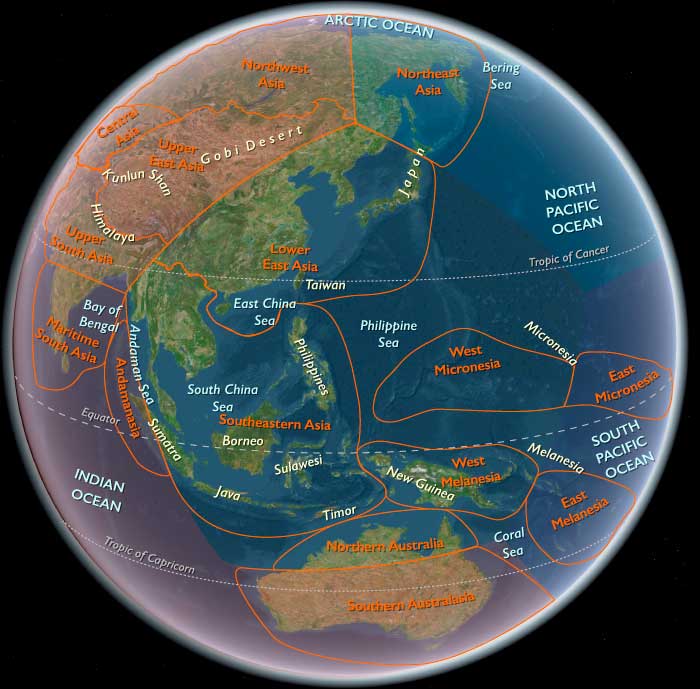
From the coasts of Fujian and Kyūshū to the high passes of Tibet and the grasslands of Mongolia, East Asia in the Lower Late Medieval Age was a landscape of transition and renewal. Empires fractured and recomposed; faiths and artistic schools crossed linguistic and political frontiers; and the rhythms of monsoon trade and steppe migration bound mountains, river basins, and seas into a single, evolving system.
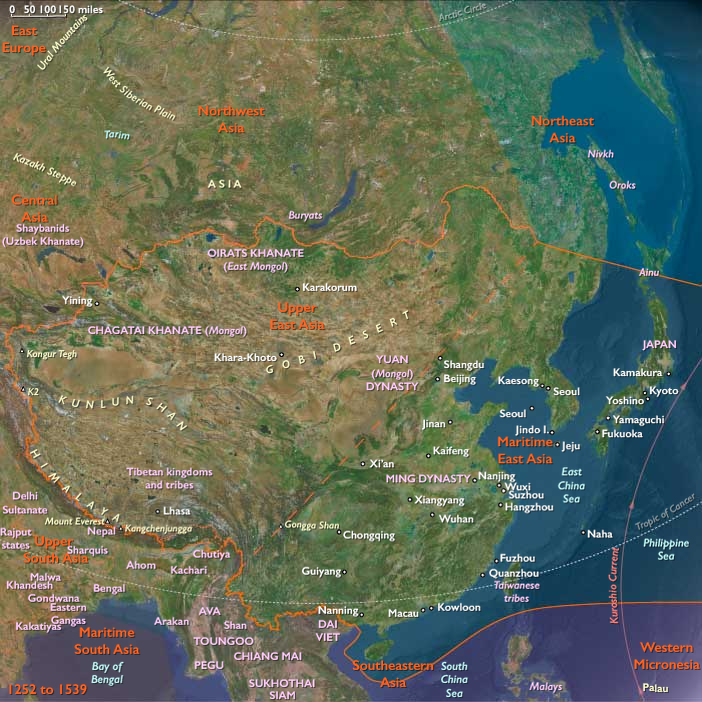
The late thirteenth century brought the consolidation of Mongol rule. The Yuan dynasty (1271–1368) unified northern and southern China, established provincial administrations, and incorporated Yunnan and Guizhou through tusichieftaincies that tied mountain societies to imperial administration. Mongol garrisons in Liaodong and the Amur basin secured tribute from Jurchen and Tungusic groups, while the maritime ports of Fujian—particularly Quanzhou (Zaitun)—flourished as global entrepôts, handling aromatics, spices, and porcelains bound for India, Arabia, and the Red Sea. In the fertile south, double-cropped rice, tea, silk, and cotton sustained population growth, and the Sichuan Basin thrived on its rice–mulberry economy and salt industries. Yet by the mid-fourteenth century, a conjunction of floods, famine, inflation, and rebellion eroded Mongol control. The Yellow River repeatedly changed course, epidemics spread, and the Red Turban uprisings swept the Lower Yangtze. From these convulsions arose Zhu Yuanzhang, who in 1368 founded the Ming dynasty, restoring Chinese governance on Confucian foundations and re-establishing hydraulic, fiscal, and agrarian order by century’s end.
Across the Korean Peninsula, the Goryeo kingdom endured decades of Mongol invasion and suzerainty, its royal house intermarried with Yuan princesses and its provinces dotted with garrisons. Despite political strain, Seon (Zen) monasteries prospered, celadon ceramics achieved luminous refinement, and the Tripitaka Koreana—a carved woodblock canon—stood as both spiritual and cultural monument. By the late fourteenth century, reformist scholars such as Jeong Do-jeon joined General Yi Seong-gye in overthrowing the dynasty. The founding of Joseon in 1392 signaled a decisive turn toward Neo-Confucian governance, rationalized land tenure, and meritocratic examinations—institutions that would define Korea for centuries.
Across the sea, Japan followed its own arc of upheaval. The Kamakura bakufu, having repelled the Mongol invasions of 1274 and 1281, emerged victorious but fiscally weakened. Imperial restoration under Emperor Go-Daigo (1333–1336) collapsed within three years, giving way to the Ashikaga (Muromachi) shogunate. The subsequent Nanboku-chō dual-court era fragmented authority, yet provincial shugo and rising daimyō consolidated local power, forming the foundations of later feudal domains. Despite turbulence, Zen monasteries flourished; Nō theater, ink painting, and garden design flowered under warrior patronage; and maritime trade, mingled with wakō piracy, tied Kyūshū and the Inland Sea to the coasts of Korea and China.
Beyond the agrarian cores, frontier worlds underwent their own transformations. In Mongolia, the fall of the Yuan drove the imperial court northward, forming the Northern Yuan under descendants of Kublai. Karakorum remained a sacred center, yet steppe authority splintered among rival lineages and the rising Oirat confederations. In Xinjiang, the Chagatai Khanate fractured; out of its eastern reaches arose Moghulistan, founded by Tughluq Temür in 1347, which embraced Islam and forged an enduring Turko-Mongol synthesis. Oasis cities such as Kashgar, Yarkand, and Turfan prospered on caravan trade, exporting jade, cotton, and felt while importing silk, tea, and metal goods from China.
Farther south, the high plateaus of Tibet passed from the Mongol-backed Sakya hierarchy to a revival of indigenous rule under the Phagmo Drupa in the 1350s. The lama–patron system established by the Yuan endured in modified form as monasteries managed estates, bridges, and granaries linking religious and economic authority. In Amdo and Kham, the Tea–Horse routes between Chengdu, Kangding, and Lhasa moved Chinese tea and cloth in exchange for ponies, wool, and salt, while reformist teaching by Tsongkhapa (b. 1357) began to shape the intellectual currents that would crystallize the Geluk school. Along the Hexi Corridor, the Yuan postal system connected Dadu (Beijing) to Dunhuang, with way-stations guarding the Silk Road’s last continental trunk; the early Ming rebuilt these fortresses, establishing beacon towers and grain garrisons that anchored the empire’s western frontier.
Across this immense region, technological and cultural innovations paralleled political change. The Yuan expanded the use of gunpowder in siege craft and field warfare; the Ming standardized artillery and rebuilt river defenses. In Korea, metal movable type produced the Jikji (1377), while in China blue-and-white porcelain and Longquan celadon reached new heights. Japan’s Zen gardens and Nō theater transformed aesthetic restraint into spiritual expression. Neo-Confucian scholarship revived across China and Korea; Chan/Zen meditation reshaped samurai ethics; and Tibetan monasteries integrated scholasticism with ritual authority. Commerce and culture thrived together: the Grand Canalmoved grain and manufactures north–south, Sichuan’s salt and tea funded state revenues, and the maritime Silk Road carried goods from the Lower Yangtze to Kyūshū and Goryeo ports. Even the Austronesian communities of Taiwanremained intermittently connected, trading deer hides and hemp cloth to visiting Fujian sailors who mapped these littoral margins.
The fourteenth century’s climatic cooling and political violence tested every institution, yet East Asia adapted through hydraulic renewal, market resilience, and intellectual synthesis. The Ming re-centralized China on stable agrarian and fiscal foundations; Joseon codified Confucian bureaucracy and scholarship; and Muromachi Japan balanced warrior rule with a flowering of Zen culture. On the steppe and in the highlands, Northern Yuan, Moghulistan, and Phagmo Drupa Tibet reconstituted power through mobility, trade, and faith.
By 1395 CE, the region stood reorganized yet interconnected—a constellation of agrarian monarchies and frontier polities linked by caravans, sea lanes, and shared technologies. The systems rebuilt in these decades—irrigation, bureaucracy, Buddhist and Confucian learning, and maritime enterprise—formed the durable scaffolding upon which the early modern East Asian world would rise.