Clovis I
king of the Salian Franks
Years: 466 - 511
Clovis (c. 466–511) (Ch-)Leuthwig (Ludwig, Louis) is the first King of the Franks to unite all the Frankish tribes under one ruler.
He is also the first Catholic King to rule over Gaul (France).
He is the son of Childeric I and Basina.
In 481, when he is fifteen, he succeeds his father.
The Salian Franks are one of two Frankish tribes who are at this time occupying the area west of the lower Rhine, with their center in an area known as Toxandria, between the Meuse and Scheldt (in what is now the Netherlands and Belgium).
Clovis' power base is to the southwest of this, around Tournai and Cambrai along the modern frontier between France and Belgium.
Clovis conquers the neighboring Salian Frankish kingdoms and establishea himself as sole king of the Salian Franks before his death.
The small church in which he was baptized is now named Saint-Remi, and a statue of him being baptized by Saint Remigius can be seen there.
Clovis and his wife Clotilde are buried in the St. Genevieve church (St. Pierre) in Paris.
An important part of Clovis' legacy is that he reduced the power of the Romans in 486 by beating the Roman ruler Syagrius in the battle of Soissons.
Clovis was converted to Catholicism, as opposed to the Arian Christianity common among the Goths who ruled most of Gaul at the time, at the instigation of his wife, Clotilde, a Burgundian Gothic princess who was a Catholic in spite of the Arianism which surrounded her at court.
He was baptized in a small church which was on or near the site of the Cathedral of Rheims, where most future French kings would be crowned.
This act was of immense importance in the subsequent history of Western and Central Europe in general, for Clovis expanded his dominion over almost all of the old Roman province of Gaul (roughly modern France).
He is considered the founder of the Merovingian dynasty which ruled the Franks for the next two centuries.


Related Events
Filter results
Showing 10 events out of 50 total
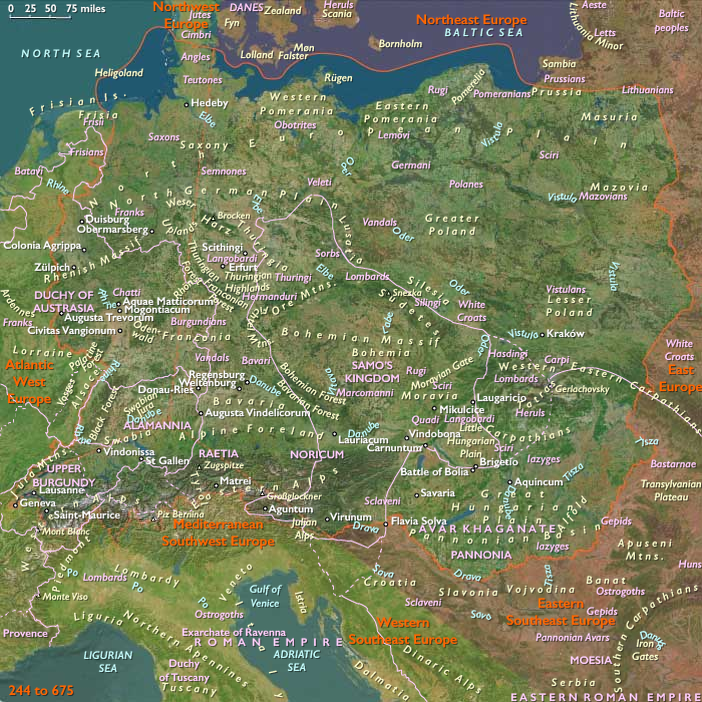
The Alemanni settle the Swiss plateau in the fifth century and will settle the valleys of the Alps in the eighth century, forming Alemannia.
Modern-day Switzerland is therefore then divided between the kingdoms of Alemannia and Burgundy.
The entire region becomes part of the expanding Frankish Empire in the sixth century, following Clovis I's victory over the Alemanni at Tolbiac in 504, and later Frankish domination of the Burgundians.
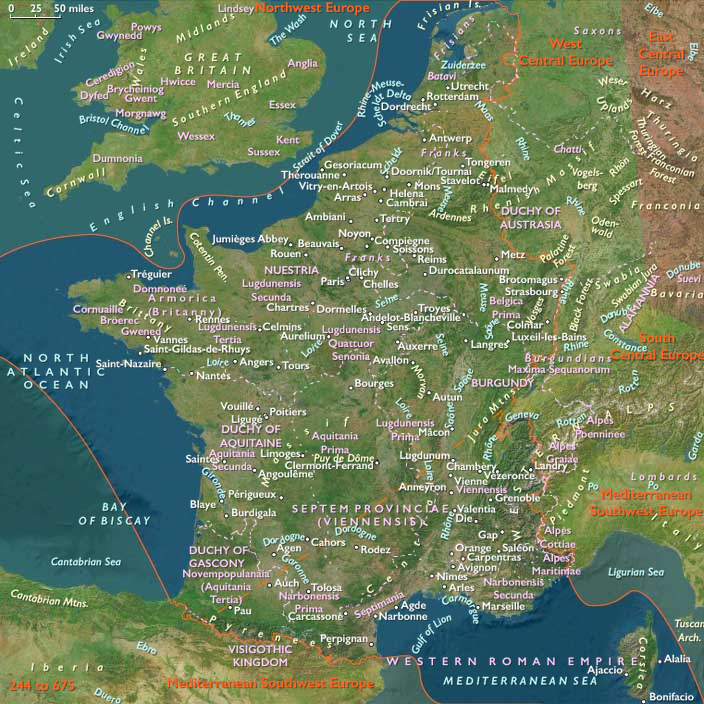
At the end of the Antiquity period, ancient Gaul is divided into several Germanic kingdoms and a remaining Gallo-Roman territory, known as the Kingdom of Soissons, also known as the Domain of Syagrius.
Simultaneously, Celtic Britons, fleeing the Anglo-Saxon settlement of Britain, settle the western part of Armorica.
As a result, the Armorican peninsula will be renamed Brittany, Celtic culture is revived and independent petty kingdoms arise in this region.
The pagan Franks, from whom the ancient name of "Francie" is derived, originally settle the north part of Gaul, but under Clovis I conquer most of the other kingdoms in northern and central Gaul.
In 498, Clovis I is the first Germanic conqueror after the fall of the Roman Empire to convert to Catholic Christianity, rather than Arianism; thus France is given the title "Eldest daughter of the Church" (French: La fille aînée de l'Église) by the papacy, and French kings will be called "the Most Christian Kings of France" (Rex Christianissimus).
The Franks embrace the Christian Gallo-Roman culture and ancient Gaul s eventually renamed Francia ("Land of the Franks").
The Germanic Franks adopt Romanic languages, except in northern Gaul where Roman settlements are less dense and where Germanic languages emerge.
Clovis makes Paris his capital and establishes the Merovingian dynasty, but his kingdom does not survive his death.
The Franks treat land purely as a private possession and divide it among their heirs, so four kingdoms emerge from Clovis's: Paris, Orléans, Soissons, and Rheims.
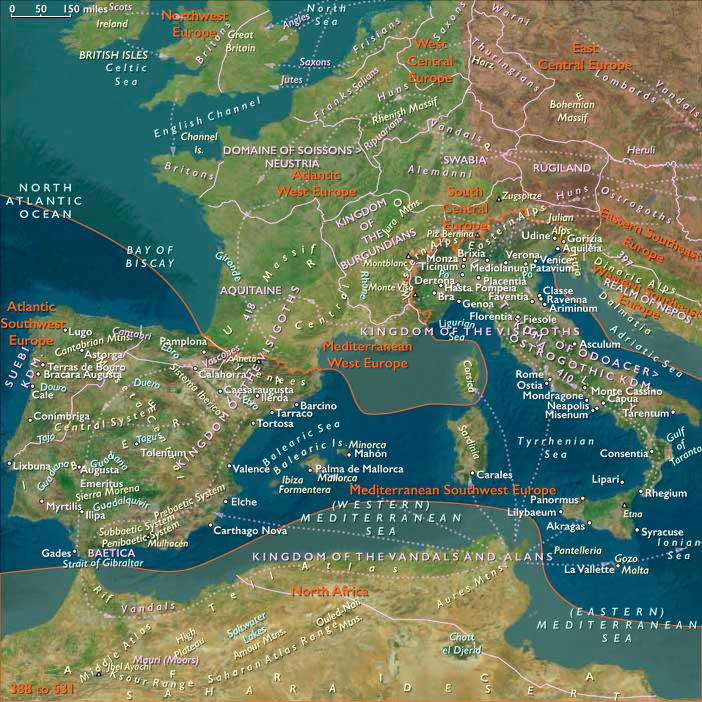
Atlantic West Europe (388–531): From Roman Gaul to Frankish Dominance
Between 388 and 531, Atlantic West Europe—covering the regions of northern and central France, including Aquitaine, Burgundy, Alsace, the Low Countries, and the Franche-Comté—underwent profound transformations. This period marked the decline of Roman authority, the migration and settlement of Germanic peoples, the rise of powerful Frankish kingdoms, and the increasing influence of the Catholic Church.
Political and Military Transformations
-
Late Roman Authority (388–410)
-
Stability under Emperor Theodosius I (r. 379–395) gave way to political uncertainty following his death.
-
The usurper Constantine III temporarily seized control of Gaul, leading to weakened Roman defenses and vulnerability to barbarian incursions.
-
-
Barbarian Migrations and Kingdoms (411–450)
-
Visigoths, Burgundians, and Franks established independent realms within former Roman territories.
-
The Visigoths, granted territory as Roman foederati, expanded into Aquitaine and established Toulouse as their capital.
-
The Burgundians established themselves along the Rhône Valley, creating a kingdom centered at Lyon.
-
-
The Rise of the Merovingians (451–481)
-
The Battle of the Catalaunian Plains (451), led by Roman general Aetius with Visigothic and Frankish allies, halted Attila the Hun’s westward advance.
-
Merovingian Franks under Childeric I consolidated power around Tournai, laying the groundwork for Frankish dominance.
-
-
Frankish Consolidation under Clovis (482–511)
-
Clovis united the Frankish tribes, defeated Syagrius, the last Roman ruler in Gaul (486), and expanded his territory significantly.
-
His conversion to Catholicism (c. 496) secured the support of the Gallo-Roman populace and the Catholic Church.
-
The decisive defeat of the Visigoths at Vouillé (507) significantly expanded Frankish control into Aquitaine.
-
-
Division and Expansion (512–531)
-
Upon Clovis’s death in 511, his sons—Theuderic, Chlodomer, Childebert, and Chlothar—divided the Frankish kingdom, each ruling semi-autonomous territories.
-
Continued Frankish expansion culminated in the conquest and integration of Burgundy by 534.
-
Economic and Social Developments
-
Decline and Transformation of Urban Life
-
Roman urban centers deteriorated; trade networks weakened as imperial structures collapsed.
-
Increasing ruralization occurred, with populations moving toward countryside estates and fortifications, heralding medieval rural feudal society.
-
-
Shifts in Economic Foundations
-
A transition from Roman monetary economy to more localized, agrarian economies took place, emphasizing landholdings and agricultural production.
-
The foundation for medieval manorial systems was established as local elites consolidated rural power.
-
Religious and Cultural Developments
-
Growth of Ecclesiastical Authority
-
Bishops, notably figures like Sidonius Apollinaris (bishop of Clermont), assumed greater civil and religious authority, managing civic affairs amid declining Roman administration.
-
Councils, such as the Council of Agde (506), standardized ecclesiastical practices and reinforced Catholic dominance in the region.
-
-
Spread and Consolidation of Catholicism
-
The collapse of Arian Visigothic power in Gaul solidified Catholicism’s religious supremacy.
-
Monasticism expanded, preserving classical texts and cultural traditions, laying foundations for medieval intellectual life.
-
Legacy and Significance
By 531, Atlantic West Europe had fundamentally shifted from Roman governance to fragmented barbarian kingdoms and ultimately to consolidated Frankish rule under the Merovingians. Clovis's unification efforts and strategic religious alignment firmly established the Catholic Frankish kingdom as the predominant power, creating cultural and political legacies that defined medieval European history.
The Frankish Expansion and the Unification of the Low Countries
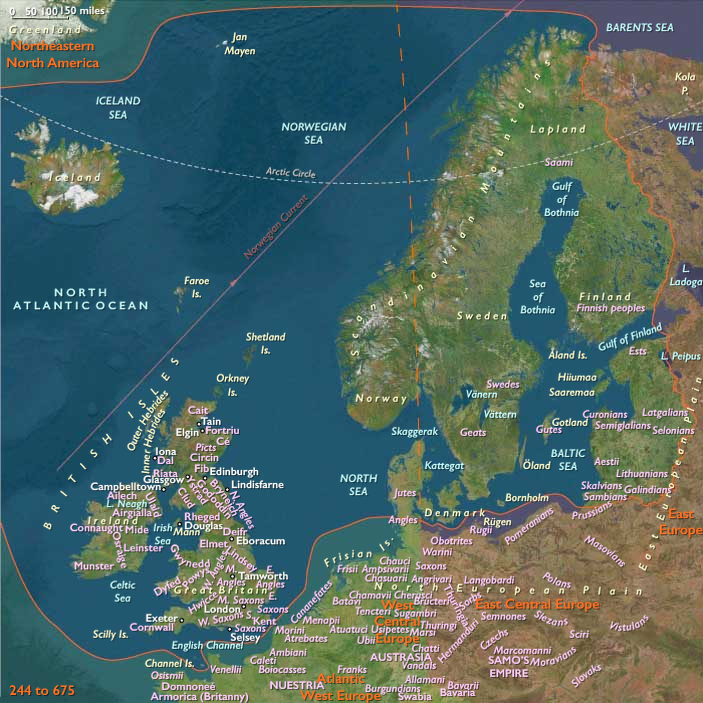
With the collapse of Roman rule in the Low Countries, the Franks expand their influence, establishing multiple small kingdoms across the region.
By the 490s, Clovis I consolidates these territories in the southern Netherlands, forging a single Frankish kingdom. From this stronghold, he launches further conquests into Gaul, laying the foundations for what will become the Frankish dominion over much of Western Europe.
As the Franks migrate southward, many gradually adopt the Vulgar Latin spoken by the local Gallo-Roman population, a linguistic shift that will contribute to the emergence of early Romance languages in the region.
The Frankish Expansion and the Unification of the Low Countries
With the collapse of Roman rule in the Low Countries, the Franks expand their influence, establishing multiple small kingdoms across the region.
By the 490s, Clovis I consolidates these territories in the southern Netherlands, forging a single Frankish kingdom. From this stronghold, he launches further conquests into Gaul, laying the foundations for what will become the Frankish dominion over much of Western Europe.
As the Franks migrate southward, many gradually adopt the Vulgar Latin spoken by the local Gallo-Roman population, a linguistic shift that will contribute to the emergence of early Romance languages in the region.
The Frankish Expansion and the Birth of a Kingdom
Following the collapse of Roman rule in the Low Countries, the Franks assert their dominance, expanding into a patchwork of small, independent kingdoms. These early Frankish realms emerge as a mixture of Romanized and Germanic influences, shaped by both lingering imperial structures and the tribal traditions of their rulers.
By the 490s, Clovis I consolidates these territories in the southern Netherlands, forging a single Frankish kingdom. From this strategic base, he embarks on an ambitious campaign into Gaul, defeating rival Germanic rulers and absorbing Roman remnants into his growing domain. His conquests, culminating in the defeat of the Visigoths at Vouillé (507 CE), will establish the Franks as the dominant power in what becomes medieval France.
As the Franks migrate southward, those settling in formerly Roman territories gradually adopt Vulgar Latin, the common tongue of the Gallo-Roman population. This linguistic shift, combined with their political unification under Clovis, helps lay the groundwork for the later evolution of Old French, while those remaining in the north retain and develop what will become Old Dutch.
The Burgundians, whose realm covers much of eastern Gaul and has two capitals, at Lyon and Geneva, rule much of the Rhône valley, but their influence over the empire seems to have ended in 474.
After Glycerius was deposed in favor of Julius Nepos, and Gundobad had returned to Burgundy, presumably at the death of his father Gundioc, the Burgundian kingdom was divided between Gundobad and his brothers, Godigisel, Chilperic II, and Gundomar I.
(Gregory, II, 28) According to Gregory of Tours, the years following Gundobad's return to Burgundy saw a bloody consolidation of power.
Gregory states that Gundobad murdered his brother Chilperic, drowning his wife and exiling their daughters to Godigesel, in Geneva (one of whom was to become the wife of Clovis the Frank, and was reputedly responsible for his conversion).
This is contested by, e.g., Bury, who points out problems in much of Gregory's chronology for the events.
The Rise of Clovis and the Frankish Conquest of Gaul (481 CE Onward)
In 481 CE, Clovis, son of Childeric I and Basina of Thuringia, ascends as ruler of the Salian Franks based in Tournai, in the former Roman province of Gallia Belgica. Though initially controlling only a small Frankish realm, Clovis embarks on a relentless campaign of expansion, laying the foundations for what will become the Frankish Kingdom and, ultimately, medieval France.
Clovis’ Early Rule and the Consolidation of the Franks
- Clovis inherits a fragmented collection of Frankish tribes, including the Salians and parts of the Ripuarian Franks, who live along the Rhine River.
- Unlike previous Frankish reguli, who ruled as local chieftains, Clovis moves toward centralized kingship, asserting dominance over rival Frankish warlords.
- His capital at Tournai serves as the starting point for the Frankish conquest of Gaul.
The Frankish Conquest of Central and Southern Gaul
Under Clovis, the Franks push southward, expanding into Roman-held and Visigothic-controlled territories:
1. Defeat of Syagrius and the End of Roman Gaul (486 CE)
- Clovis first targets the last Roman stronghold in northern Gaul—the Domain of Soissons, ruled by Syagrius, the last Roman dux.
- At the Battle of Soissons (486 CE), Clovis defeats Syagrius, marking the final collapse of Roman rule in Gaul.
- With Syagrius eliminated, Clovis absorbs the former Roman territories in northern Gaul, strengthening his control.
2. Expansion Against the Alemanni (496 CE)
- Clovis then turns eastward to face the Alemanni, who threaten Frankish lands.
- At the Battle of Tolbiac (496 CE), Clovis achieves a decisive victory, securing eastern Gaul and gaining control over parts of the Rhine Valley.
- This battle is also a turning point for Clovis’ religious identity—according to tradition, he converts to Christianity (Catholic Nicene, not Arian) after his victory, an event that will transform the Franks into champions of Catholicism in the West.
3. Conquest of the Burgundians and Visigoths
- By the early sixth century, Clovis moves against the Burgundians, gradually bringing them under Frankish influence.
- In 507 CE, he wages war against the Visigothic Kingdom of Toulouse, defeating King Alaric II at the Battle of Vouillé.
- With this victory, Clovis annexes Aquitaine, securing central and southern Gaul for the Franks.
The Emergence of the Frankish Kingdom
By the time of Clovis’ death in 511 CE, the Franks have transformed from a loose tribal confederation into the most powerful kingdom in Western Europe:
- Clovis unites northern, central, and much of southern Gaul, creating a new Frankish political and military order.
- His conversion to Catholic Christianity, rather than Arianism (which was practiced by most Germanic rulers), wins him the support of the Roman Catholic Church and the Gallo-Roman aristocracy.
- The Frankish Kingdom emerges as the dominant successor to the Western Roman Empire, replacing Visigothic and Burgundian power in Gaul.
This marks the beginning of the Merovingian dynasty, which will shape the early medieval history of Francia and Western Europe.
Clovis I and the Consolidation of Frankish Power in Northern Gaul
Following his accession in 481 CE, Clovis I, king of the Salian Franks, embarks on a campaign of territorial expansion and consolidation, transforming the Franks from a loose tribal confederation into the dominant power in northern Gaul.
Key Steps in Clovis’ Consolidation of Power
1. The Defeat of Syagrius and the End of Roman Gaul (486 CE)
- Clovis’ first major target is Syagrius, ruler of the last Roman enclave in Gaul, based in Soissons.
- At the Battle of Soissons (486 CE), Clovis decisively defeats Syagrius, absorbing his territories into the Frankish realm.
- With this victory, Roman rule in Gaul comes to an end, leaving Clovis as the most powerful ruler in the north.
2. Subjugation of Rival Frankish Leaders
- Northern Gaul is still fragmented among various Frankish "reguli", ruling cities like Cambrai and Thérouanne.
- Clovis systematically defeats and absorbs these local leaders, asserting his supremacy over all Frankish groups in the region.
- By eliminating rivals, he unifies the Franks under his centralized rule, an essential step in building a long-lasting kingdom.
3. Expansion Against the Alemanni (496 CE)
- The Alemanni, a powerful Germanic confederation, continue to threaten eastern Frankish lands.
- At the Battle of Tolbiac (496 CE), Clovis defeats the Alemanni, securing his eastern borders.
- This victory is also a turning point for Clovis’ religious identity, as he embraces Catholic Christianity, winning the support of the Gallo-Roman aristocracy and clergy.
The Foundations of the Frankish Kingdom
By the late fifth century, Clovis has:
- United northern Gaul under Frankish rule, eliminating rival leaders.
- Crushed the last remnants of Roman power, absorbing former imperial lands.
- Defeated external threats, such as the Alemanni, securing his borders.
This consolidation allows him to turn his attention southward, setting the stage for his future wars against the Burgundians and Visigoths, which will ultimately bring most of Gaul under Frankish control.
Atlantic West Europe (484–495): Visigothic and Burgundian Consolidation Amid Frankish Ambitions
Between 484 and 495, Atlantic West Europe saw the Visigothic and Burgundian kingdoms solidify their territorial control, while the Salian Franks emerged as a significant new force. This era witnessed growing stability in the Visigothic territories, internal consolidation under Burgundian King Gundobad, and the rise of Clovis I, whose ambitions foreshadowed the eventual reshaping of the region.
Political and Military Developments
-
Visigothic Kingdom under Alaric II (r. 484–507):
-
After Euric's death in 484, his son Alaric II inherited a vast kingdom extending from Aquitaine across the southern and western regions of Gaul.
-
Alaric II maintained diplomatic relations with neighboring kingdoms and strengthened governance by codifying laws, balancing Visigothic authority and Roman legal traditions.
-
-
Burgundian Kingdom’s Internal Stability:
-
King Gundobad (r. 473–516) solidified control in Burgundy, quelling internal rivalries through diplomacy and force, centralizing governance around Lyon and Geneva.
-
Gundobad issued the Lex Burgundionum (c. late 5th century), codifying laws for his kingdom that balanced Germanic and Roman elements, securing internal cohesion.
-
-
Rise of the Salian Franks under Clovis I (r. 481–511):
-
The ambitious Merovingian King Clovis I united various Frankish tribes north of the Loire, significantly expanding his influence into northern Gaul.
-
His defeat of the Roman official Syagrius at the Battle of Soissons (486) ended Roman political authority in northern Gaul, marking the rise of Frankish dominance in the region.
-
Economic and Social Developments
-
Gradual Ruralization and Villa Economies:
-
With the continued decline of urban centers, rural villa estates became central to economic life, focusing on localized agricultural productivity.
-
Powerful aristocratic families and ecclesiastical institutions consolidated their landholdings, strengthening economic and political ties with the Germanic rulers.
-
-
Economic Realignment and Trade Networks:
-
Trade and commerce increasingly shifted toward regional patterns, reflecting the decentralized political environment. Bordeaux and Lyon remained significant centers of commerce, maintaining trade connections with Italy, the Mediterranean, and Iberia.
-
Despite disruptions, river systems such as the Rhône and Loire facilitated internal commerce, sustaining the exchange of luxury goods and basic commodities.
-
Religious and Cultural Developments
-
Episcopal and Aristocratic Leadership:
-
Bishops continued to consolidate their dual roles as spiritual and civic leaders, managing religious affairs and local governance. This role was exemplified by Remigius of Reims (later instrumental in Clovis's conversion) and Avitus of Vienne, who mediated between Gundobad’s Burgundian court and Roman cultural traditions.
-
Aristocratic families actively supported ecclesiastical foundations, enhancing the role of the Church in daily life, governance, and education.
-
-
Continued Religious Tolerance and Arianism:
-
Alaric II maintained his kingdom’s official Arian Christianity, tolerating the Catholic majority, ensuring internal harmony and stability.
-
Burgundian King Gundobad, though initially Arian, showed increasing openness to Catholic influences, creating an environment favorable to religious coexistence and eventual integration.
-
Legacy and Significance
By 495, Atlantic West Europe had stabilized into distinct political territories, each adapting elements of Roman governance and law:
-
Visigothic rule under Alaric II provided relative stability, maintaining coexistence of Roman and Germanic traditions.
-
Gundobad's Burgundian kingdom emerged politically cohesive, with internal stability secured by legal and cultural accommodations.
-
Clovis’s rise and expansion of Frankish power began reshaping the political landscape of Gaul, setting the stage for future regional unification and shifts in power dynamics.
This period thus laid critical foundations for the medieval political and cultural structures that would characterize the following centuries.