David I of Scotland
"King of the Scots"
Years: 1084 - 1153
David I (1084 – 24 May 1153) is a 12th-century ruler who is Prince of the Cumbrians (1113–1124), Earl of Northampton and Huntingdon and later King of the Scots (1124–1153).
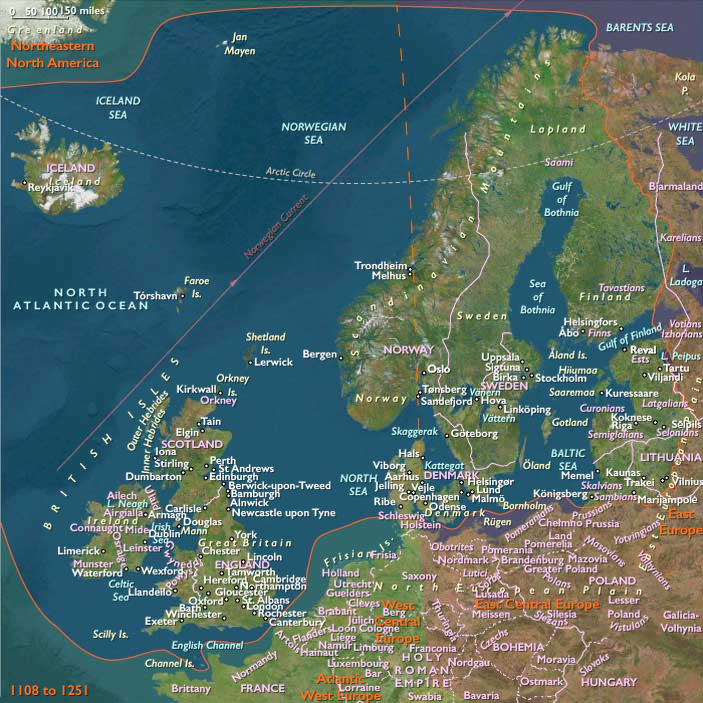
The youngest son of Malcolm III of Scotland and Margaret of Wessex, David spends his early years in Scotland, but is forced on the death of his parents in 1093, into exile by his uncle and new King, Donald III of Scotland Perhaps after 1100, he becomes a dependent at the court of King Henry I of England.
There he is influenced by the Norman and Anglo-French culture of the court.
When David's brother Alexander I of Scotland dies in 1124, David chooses, with the backing of Henry I, to take the Kingdom of Scotland (Alba) for himself.
He is forced to engage in warfare against his rival and nephew, Malcolm, Alexander I's son.
Subduing the latter seems to have taken David ten years, a struggle that involved the destruction of Óengus, Mormaer of Moray.
David's victory allowsexpansion of control over more distant regions theoretically part of his Kingdom.
After the death of his former patron Henry I, David supporsthe claims of Henry's daughter and his own niece, the former Empress-consort, Matilda, to the throne of England.
In the process, he comes into conflict with King Stephen and is able to expand his power in northern England, despite his defeat at the Battle of the Standard in 1138.
The term "Davidian Revolution" is used by many scholars to summarize the changes that took place in the Kingdom of Scotland during his reign.
These included his foundation of burghs, implementation of the ideals of Gregorian Reform, foundation of monasteries, Normanization of the Scottish government, and the introduction of feudalism through immigrant French and Anglo-French knights.