Emperor Liu SongWu of
founding emperor of the Chinese dynasty Liu Song
Years: 363 - 422
Emperor Wu of (Liu) Song (363–422), personal name Liu Yu, courtesy name Dexing, nickname Jinu, is the founding emperor of the Chinese dynasty Liu Song.
He comes from a humble background, but becomes prominent after leading a rebellion in 404 to overthrow Huan Xuan, who had usurped the Jin throne in 403.
After that point, using a mixture of political and military skills, Liu Yu gradually concentrates power in his own hands while expanding Jin's territory.
In 420, he forces Emperor Gong of Jin to yield the throne to him, thus ending Jin and establishing Song.
He rules only briefly, for two years, before dying and passing the throne to his son, Emperor Shao of Liu Song.
Related Events
Filter results
Showing 10 events out of 12 total
Murong Chao holds the traditional imperial gathering on lunar new year 409.
Lamenting the lack of imperial musicians, he proposes an attack on Jin to capture people to be trained as musicians, despite the opposition from Han Zhuo (Han Fan's brother).
A month later, Murong Chao sends the generals Murong Xingzong, Hugu Ti, and Gongsun Gui (Gongsun Wulou's brother) to attack Jin, capturing Suyu (in modern Suqian, Jiangsu) and twenty-five hundred men and women, who are given to the music director to be taught music.
Encouraged by the success, Murong Chao carries out more raids against Jin.
The Jin general Liu Yu, at this time the leader of the Jin government, proposes in April 409 that a major attack be launched against Southern Yan, and even though he faces opposition, he starts the campaign regardless.
Gongsun Wulou and Murong Zhen propose that Southern Yan armies defend Daxian Mountain (in modern Weifang, Shandong) and not allow Jin forces to pass.
Murong Chao, overly confident, instead decides to let Jin forces pass Daxian, and then engage them in the plains north of Daxian.
He further rejects suggestions that the crops be burned to prevent them from being used as food supply by Jin forces.
When Murong Zhen comments to Han Zhuo that this will lead to the empire's destruction, Murong Chao throws Murong Zhen into prison.
Liu Yu is very pleased that Murong Chao does not defend Daxian, as he had feared he would.
The Jin and Southern Yan forces engage near Linqu (also in Weifang), while Murong Chao himself waits in the city of Linqu.
Jin general Hu Fan makes a surprise attack on Linqu, capturing it and forcing Murong Chao to flee.
Liu Yu, with Murong Chao having fled, engages the main Southern Yan forces and defeats them, and Murong Chao flees back to Guanggu.
Liu Yu follows and quickly captured the outer part of the city, putting the inner city under siege.
Murong Chao releases Murong Zhen and requests his assistance in defending the city, but when Murong Zhen suggests that he pitch one final battle rather than just defending Guanggu, he balks, and he instead sends Han Fan to Later Qin to request emergency assistance.
Initially, Yao Xing is willing to provide assistance with an army commanded by the general Yao Qiang, but after he himself suffers a defeat at the hand of the rebel general Liu Bobo (the emperor of Xia), he withdraws Yao Qiang's troops.
Han Fan surrenders to Liu Yu, and the Guanggu garrison becomes even more desperate.
A number of officials suggest to Murong Chao that he surrender to Jin, but he refuses and executes anyone who suggests such.
Guanggu falls in spring 410, and Murong Chao is captured.
Liu Yu rebukes him for refusing to surrender, but he does not answer Liu Yu at all and only entrusts his mother to the Jin general Liu Jingxuan, who had previously been a subject of his uncle Murong De.
Murong Chao is delivered to the Jin capital Jiankang and executed; some three thousand Southern Yan officials and nobles are executed as well.
The Jin general Liu Yu launches a major attack on Later Qin in 416, intending to destroy it.
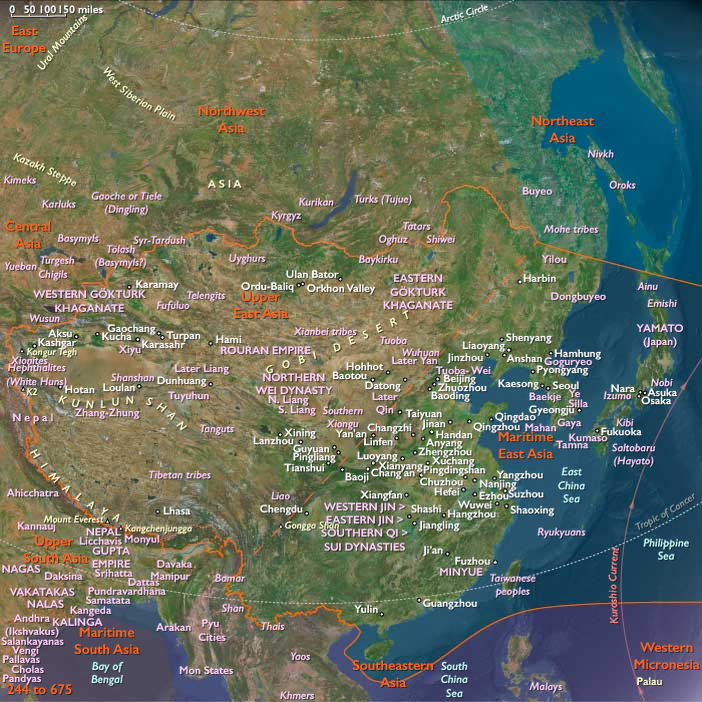
As part of Liu Yu's force, a fleet commanded by the general Wang Zhongde, approaches Northern Wei's only main outpost south of the Yellow River, Huatai (in modern Anyang, Henan), the Northern Wei general Yuchi Jian, apprehensive of the Jin forces, abandons Huatai and flees back north of the Yellow River.
Emperor Mingyuan executes Yuchi and then sends messengers to rebuke Liu Yu and Wang Zhongde, both of whom restate that the target is Later Qin, not Northern Wei, and that the city will be returned as soon as the campaign was over. (Jin does not actually return Huatai, however, and Northern Wei will not have a major presence south of the Yellow River again until 422.)
Jin forces quickly capture Later Qin's major city Luoyang, then head toward the Later Qin capital, Chang'an.
The Later Qin emperor Yao Hong (Yao Xing's son) requests emergency assistance in spring 417.
Emperor Mingyuan summons his council to consider whether to launch armies to try to stop Jin advances to try to save Later Qin.
Most of his advisors, apprehensive at whether Liu Yu actually intends to attack Northern Wei as well, suggest that Emperor Mingyuan try to intercept Liu Yu's forces.
However, Cui Hao opines that this would make Northern Wei the target of Jin attacks; Emperor Mingyuan partially agrees, but still sends some one hundred thousand men, commanded by Baba Song, to guard the northern bank of the Yellow River to prepare for battle.
If a Jin ship is blown by the wind to the northern bank, Northern Wei forces seize the ship and kill or capture its crew, and when Jin forces then land on the northern banks, Northern Wei forces temporarily retreat, then reestablish the northern bank defensive posture as soon as Jin forces reboard their ships.
Angry at this harassment, Liu Yu sends his general Ding Wu to land on the northern bank and deal Northern Wei forces a major defeat.
This ends Emperor Mingyuan's attempts to save Later Qin, and there are no further Jin/Northern Wei battles throughout the campaign as, while Emperor Mingyuan still plans to cut off Liu Yu's path if he is stopped by Later Qin forces, Liu Yu is able to capture Chang'an and destroy Later Qin by fall 417, and Emperor Mingyuan's planned attacks never materialize.
Many former Jin officials who oppose Liu Yu, who had taken refuge with Later Qin, flee to Northern Wei, and Emperor Mingyuan further orders that anyone who can save and deliver members of the Yao imperial clan to Pingcheng will be greatly rewarded.
(How effectively this order was fulfilled is not known; most members of the Yao clan are captured and killed by Liu Yu.)
Emperor Mingyuan launches a major attack on Northern Yan in 418, and puts the Northern Yan capital Helong (in modern Jinzhou, Liaoning) under siege, but is unable to capture Helong and forced to retreat.
Emperor Mingyuan's wife Consort Yao had died in 420, and he posthumously honored her as an empress.
The Emperor suffers a major illness in 422, apparently caused by medicines that alchemists had given him that were supposedly capable of extending life spans.
He consults Cui Hao on what he should do to prepare for events after his death.
Cui Hao predicts that he will recover, but advises him to create his oldest son, fourteen-year-old Tuoba Tao, the Prince of Taiping, crown prince, then transfer some of the authorities to the crown prince so that his own burdens could be lessened.
Baba Song also agrees, and Emperor Mingyuan creates Tuoba Tao crown prince, and further has Crown Prince Tao take the throne to serve as the secondary emperor.
He commissions his key advisors Baba, Cui, Daxi Jin, Anchi Tong, Qiumuling Guan, and Qiudun Dui to serve as the Crown Prince's advisor.
From this point, Crown Prince Ta rules on most matters, particularly domestic matters, while Emperor Mingyuan himself only rules on important matters.
Later in 422, after hearing about the death of Liu Yu (who had seized the Jin throne in 420 and established Liu Song), Emperor Mingyuan breaks off relations with Liu Song and calls his council, informing the advisors that he plans to attack and seize three major cities south of the Yellow River from Liu Song—Luoyang, Hulao, and Huatai, despite Cui's opposition.
He commissions Daxi as the commander of the forced to attack Liu Song.