
Euclid
Greek mathematician
320 BCE to 250 BCE
Euclid, fl.
300 BCE, also known as Euclid of Alexandria, is a Greek mathematician, often referred to as the "Father of Geometry".
He is active in Alexandria during the reign of Ptolemy I (323–283 BC).
His Elements is one of the most influential works in the history of mathematics, serving as the main textbook for teaching mathematics (especially geometry) from the time of its publication until the late 19th or early 20th century.
In the Elements, Euclid deduced the principles of what is now called Euclidean geometry from a small set of axioms.
Euclid also wrote works on perspective, conic sections, spherical geometry, number theory and rigor.
World
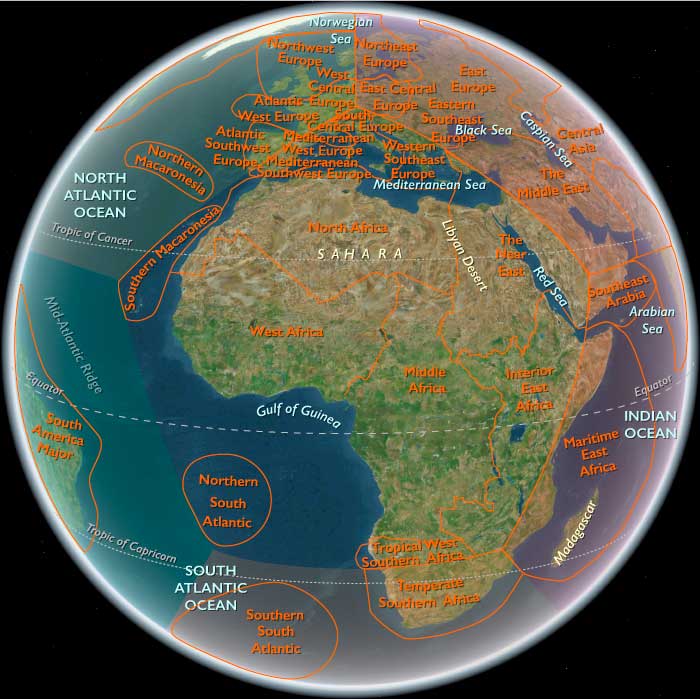
The Middle of The Earth
View →Related Events
Showing 3 events out of 3 total
Near East (333–190 BCE): Hellenistic Conquests and Cultural Transformations
Alexander's Empire and its Immediate Aftermath (333–322 BCE)
The year 333 BCE inaugurates the Hellenistic Age when Alexander III of Macedon defeats the Persian Empire, transforming the geopolitical landscape of the Near East. Alexander’s swift military successes culminate in notable victories at the battles of Granicus (334 BCE), Issus (333 BCE), and Gaugamela (331 BCE). After the prolonged and pivotal siege of Tyre in 332 BCE, Alexander's domain stretches from Greece to the borders of India. He strategically integrates conquered territories through city foundations, notably Alexandria in Egypt, and religious accommodations, earning acceptance among local populations. His unexpected death in 323 BCE at Babylon triggers a complex power struggle among his generals—Perdiccas, Ptolemy Soter, Seleucus, and Antigonus Monophthalmus—eventually leading to the division of Alexander’s vast empire into separate dynasties.
Emergence of the Hellenistic Monarchies (321–298 BCE)
Alexander's territories fragment into significant Macedonian dynasties by 298 BCE. In Egypt, the Ptolemies establish a prosperous rule, significantly influencing the region by founding the renowned Library of Alexandria and the monumental Pharos Lighthouse. In Syria and Mesopotamia, the Seleucid dynasty emerges, though it remains in recurrent conflict with the Ptolemies, particularly over strategically vital areas such as Coele-Syria (modern-day Lebanon and southern Syria). Notably, after a forty-year conflict, a decisive Seleucid victory concludes initial hostilities over Phoenician territories.
Cultural Integration and Scholarly Achievement (297–274 BCE)
The Near East experiences widespread Hellenization, adopting Greek artistic, scientific, and architectural standards. Intellectual advancement peaks with scholars like Euclid, whose foundational texts on geometry and optics profoundly influence science. Cities such as Ashkelon and Ashdod are widely recognized by their Hellenized names, Ascalon and Azotus, exemplifying the era’s cultural synthesis. Egypt’s Ptolemaic Museum and Library at Alexandria become major scholarly hubs, further embedding Greek culture and intellectualism into the region.
Dynastic Rivalries and Egyptian Decline (273–226 BCE)
The Near East remains marked by fierce dynastic rivalries, particularly the Damascene War (280 BCE) and the subsequent First Syrian War (274 BCE). The internal stability of Ptolemaic Egypt significantly weakens due to court intrigues, rebellions, and economic strains. Antiochus III exploits this turmoil, resulting in Egypt's near-total loss of its Asian territories following the Battle of Panium (200 BCE). Such territorial shifts profoundly alter regional power structures.
Revolts and the Rise of Regional Powers (225–190 BCE)
Seleucid domains experience instability due to revolts by powerful satraps, notably Achaeus and Attalus of Pergamon, who successfully assert independence in Asia Minor. Attalus I consolidates Pergamon's power through victories over the Galatians, celebrated in the renowned sculpture The Dying Gaul. The century ends with the devastating Roman–Syrian War (192–188 BCE), significantly curtailing Seleucid authority, limiting it to a fragmented domain centered in Mesopotamia and inland Syria.
Legacy of the Age
The Near East during the Hellenistic Age undergoes profound political and cultural transformations marked by the spread of Greek culture, administrative reforms, and vibrant urban planning. Influential cities like Alexandria and Pergamon symbolize these shifts, becoming enduring centers of culture and learning. Despite flourishing intellectually and artistically, persistent dynastic conflicts and internal instabilities ultimately create vulnerabilities that pave the way for Roman ascendancy, marking this period as a crucial transition shaping the historical evolution of the Near East.
Near East (309–298 BCE): Euclid and the Foundations of Geometry
In the intellectual milieu of the Hellenistic Near East, the renowned mathematician Euclid, active in Alexandria around 300 BCE, fundamentally shapes the future of mathematics and science. He formulates a systematic set of axioms for geometry, laying the groundwork for a coherent, logical structure that will become known as Euclidean geometry. His influential text, the Elements, meticulously compiles these axioms and proofs, profoundly influencing the direction of mathematical thought.
Euclid’s scientific contributions extend beyond pure mathematics. In his works Optics and Catoptrics, he articulates the correct law of reflection, applying it rigorously to both plane and curved mirrors. He further references the phenomenon of refraction, demonstrating a sophisticated understanding of optical principles that will inform subsequent scientific inquiry in the Hellenistic world and beyond. Euclid’s work thus embodies the broader intellectual dynamism and methodological rigor characterizing the scholarly pursuits flourishing under the patronage of Hellenistic Alexandria.
Euclid, working in Hellenistic Alexandria in about 300 BCE, establishes a set of axioms for geometry.
Around the same time, he writes a treatise entitled Optics and Catoptrics, in which he sets forth the correct law of reflection and applies the law to the study of plane and curved mirrors.
He also mentions the phenomenon of refraction.