Emperor Mingyuan, in contrast to to his father's dictatorial style, has instituted a council of eight officials to advise him on all important decisions, with the intent to hear different opinions and then take informed actions.
The council mostly consists of ethnic Xianbei from his tribe, but also includes Han and other ethnic groups.
This will become a tradition that his descendants will follow as well.
However, while he is known as being much more lenient than his father, he also does not tolerate wrongdoing on his advisors' part.
For example, in 413, one of his key advisors, Tuoba Qu, the Marquess of Yuancheng, suffered a major defeat at the hands of Xia forces, and then, once demoted to governorship of Bing Province (modern central and southern Shanxi), failed to carry out his task competently, and Emperor Mingyuan executes him.
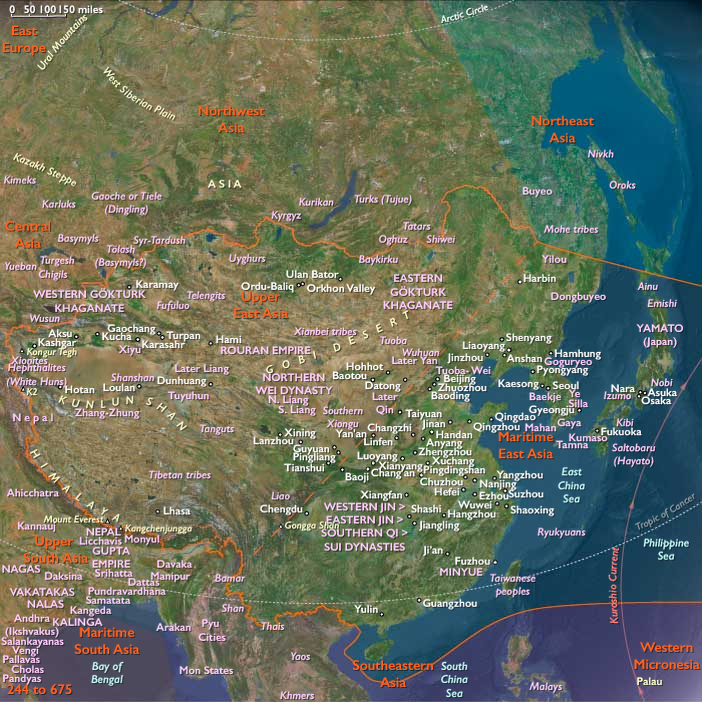
He often leaves the capital, Pingcheng, to examine the defenses on the northern and eastern fronts (with Rouran and Northern Yan), to make sure that his state will be properly defended against enemies.
He also often sends armies to pacify rebelling tribes.
Emperor Mingyuan sends ambassadors to Later Qin, Northern Yan, Jin, and Rouran in 414 in an attempt to establish peaceful relationships.
The Later Qin and Jin missions are apparently largely successful, but his ambassador Huniuyu Shimen has a conflict with the Northern Yan emperor Feng Ba over Feng Ba's insistence that Huniuyu kneel to him.
Feng Ba detains Huniuyu and refuses to establish relations with Northern Wei.
Late in 414, Emperor Mingyuan begins to have his official Cui Hao (the son of his key advisor Cui Hong teach him the ancient texts of I Ching and Hong Fan—both mystical texts.
He also often asks Cui Hao to make predictions based on those texts, which often come true.
Cui Hao therefore becomes increasingly trusted and consulted by Emperor Mingyuan for important decisions.