Francisco Serrão
Portuguese explorer
Years: 1480 - 1521
Francisco Serrão (died 1521) is a Portuguese explorer and a cousin of Ferdinand Magellan.
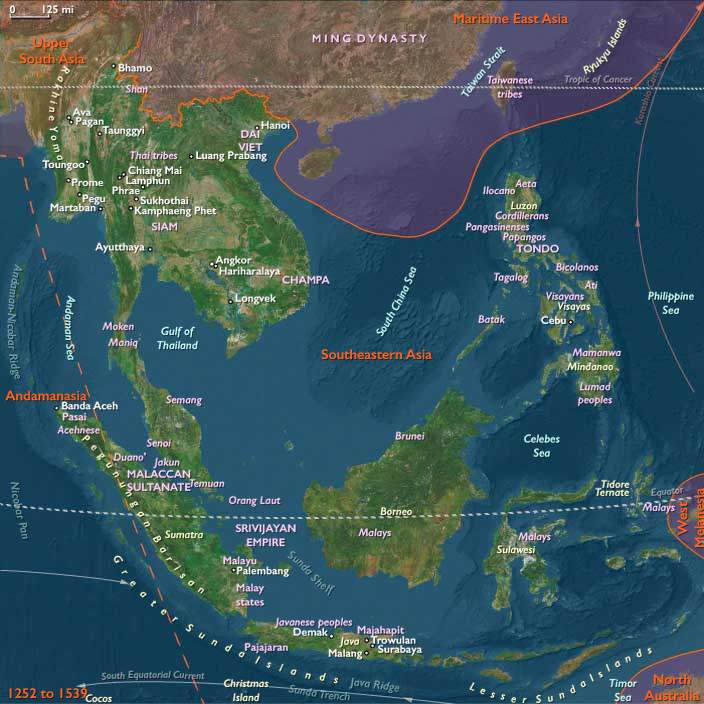
His 1512 voyage is the first known European sailing east past Malacca through Indonesia and the Indies.
He becomes a confidante of the Sultan Bayan Sirrullah, the ruler of Ternate, becoming his personal advisor.
He remains in Ternate where he dies around the same time Magellan dies.
Related Events
Filter results
Showing 6 events out of 6 total
Ferdinand Magellan was born in northern Portugal in around 1480, either at Vila Nova de Gaia, near Porto, in Douro Litoral Province, or at Sabrosa, near Vila Real, in Trás-os-Montes e Alto Douro Province.
He is the son of the late Rodrigo de Magalhães, Alcaide-Mor of Aveiro, son of Pedro Afonso de Magalhães and wife Quinta de Sousa) and wife Alda de Mesquita and brother of Leonor or Genebra de Magalhães, wife with issue of João Fernandes Barbosa.
After the death of his parents during his tenth year, he became a page to Queen Leonor at the Portuguese royal court.
In March 1505 at the age of twenty-five, Magellan had enlisted in the fleet of twenty-two ships sent to host Don Francisco de Almeida as the first viceroy of Portuguese India.
Although his name does not appear in the chronicles, it is known that he remained there eight years, in Goa, Cochin and Quilon.
He has participated in several battles, including the battle of Cannanore in 1506, where he was wounded.
In 1509, he fought in the battle of Diu.
He now sails under Diogo Lopes de Sequeira in the first Portuguese embassy to Malacca, a spice-trading center on the Malay Peninsula, with Francisco Serrão, his friend and cousin.
Sequeira tries to establish contact with the Sultan of Malacca in September 1509 but the expedition falls victim to a conspiracy ending in retreat.
Magellan has a crucial role, warning Sequeira and saving Serrão, who had landed.
They leave behind nineteen Portuguese prisoners.
A Portuguese fleet commanded by viceroy Afonso de Albuquerque, carrying more than a thousand men in eighteen ships, including Ferdinand Magellan and Francisco Serrão, captures the powerful Muslim Malay state of Malacca two years after the rebuffal by its sultan, thereby gaining control of the Strait of Malacca.
Albuquerque builds a naval base here.
Ferdinand Magellan, with a rich plunder, had been promoted after the conquest of Malacca and, in the company of a Malay he had indentured and baptized Enrique of Malacca, he returns to Portugal in 1512.
In the same year, Albuquerque, having learned of the route to the Banda Islands and other 'Spice Islands', sends an exploratory expedition of three vessels under the command of António de Abreu, Simão Afonso Bisigudo and Francisco Serrão.
Banda is the world's only source of nutmeg and mace, spices used as flavorings, medicines, preserving agents, that are highly valued in European markets.
The Portuguese seek to dominate the source, rather than relying on Arab traders who sell it to the Venetians for exorbitant prices.
Malay pilots had guided the expedition east via Java and along the Lesser Sundas before steering them north to Banda via Ambon.
When Serrão's ship berthed at Gresik on Java, he had married a Javanese woman as his wife, who has accompanied him on the expedition's further journey.
His vessel, with nine Portuguese crew and nine Indonesians, had foundered in a squall and had broken up on a reef off a small island.
When the island's inhabitants, who are notorious shipwreck scavengers, surveyed the wreck from a boat, Serrão's crew had posed as unarmed and helpless but wealthy castaways.
As the scavengers drew near, the Portuguese attacked and commandeered both their craft and crew.
Their inadvertent rescuers were then forced to take them to Ambon, where they disembark in Luco-Pino island (Hitu), north of Ambon.
Serrão's armor, muskets, and marksmanship impresses the powerful chiefs of Hitu, who are warring against Luhu, the principal settlement on Seram's Hoamal Peninsula near Hitu.
The visitors are recruited as military allies and their subsequent exploits are heard in the rival neighbors of Ternate and Tidore, who both rush emissaries to induce the visitors to assist.
The Portuguese are also welcomed in the area as buyers of food and spices during a lull in the spice trade due to a temporary disruption to Javanese and Malay sailings to the area following the 1511 conflicts in Malacca.
The expedition remains in Banda for about one month, purchasing and filling their ships with nutmeg and mace, as well as and cloves in which Banda has a thriving entrepôt trade.
Serrão leaves Banda in a Chinese junk purchased from a regional trader to replace his lost ship.
D'Abreu sails through Ambon while Serrão goes ahead towards the Maluku islands.

Maluku is a cosmopolitan society where spice traders from across the region take residence in settlements, or in nearby enclaves, including Arab and Chinese traders who visit or live in the region.
Social organization is usually local, and relatively flat—a general populace guided by a council of elders or rich men, or orang kaya which is Indonesian word can be translated as "rich man".
The earliest archaeological evidence of human occupation of the Maluku Islands is about thirty-two thousand years old, but evidence of even older settlements in Australia may mean that Maluku had earlier visitors.
Evidence of increasingly long-distance trading relationships and of more frequent occupation of many islands, begins about ten to fifteen thousand years later.
Onyx beads and segments of silver plate used as currency on the Indian subcontinent around 200 BCE have been unearthed on some of the islands.
In addition, local dialects employ derivations of the Malay word then in use for 'silver'.
Arabic merchants had begun to arrive in the fourteenth century, bringing Islam.
Peaceful conversion to Islam has occurred in many islands, especially in the centers of trade, while aboriginal animism persists in the hinterlands and more isolated islands.
Archaeological evidence here relies largely on the occurrence of pigs' teeth, as evidence of pork eating or abstinence therefrom.
The most significant lasting effects of the Portuguese presence is the disruption and reorganization of the Southeast Asian trade, and in eastern Indonesia—including Maluku—the introduction of Christianity.
After the Portuguese annexed Malacca in August 1511, one Portuguese diary noted 'it is thirty years since they became Moors'—giving a sense of the competition taking place at this time between Islamic and European influences in the region.
The rulers of the competing island states of Tidore and …
…Ternate also seek Portuguese assistance.
The spice trade soon revives but the Portuguese will be unable to fully monopolize or disrupt this trade.
Serrão, allying himself with Ternate's ruler, Bayan Sirrullah, constructs a fortress on this tiny island and serves as the head of a mercenary band of Portuguese seamen under the service of one of the two local feuding sultans who control most of the spice trade.
He makes no efforts to return to Malacca.
His letters to Magellan will prove decisive, giving information about the spice-producing territories.
However, before they can meet one another again, both Serrão and Magellan will perish in the same year, on opposite sides of the world.
The surviving members of the expedition, unable to decide who should succeed Magellan, finally vote on a joint command with the leadership divided between Duarte Barbosa and João Serrão, brother or cousin to Francisco Serrão, who was residing in the Spice Islands when the voyage began and whom Magellan had hoped to meet (both have died before this could occur).
The Genoese pilot of the Magellan expedition, states—wrongly—in his eye-witness account that the Spaniards had no interpreter when they arrived back to Cebu, because Enrique had died on Mactan along with Magellan during the Battle of Mactan in 1521.
However, Enrique is very much alive on May 1, 1521.
Despite the manumission he was entitled to according to Magellan's will made before departure, either Duarte Barbosa or João Serrão had threatened to turn him slave to the widow of Magellan.
Enrique’s fear of this fate has since been considered an argument for him conspiring with rajah Humabon.
On May 1, 1521, all are invited by the rajah to a banquet ashore to receive a gift for the king of Spain.
Here is killed or poisoned, among many others, Duarte Barbosa.
Antonio Pigafetta writes that João Serrão, who was pleading with the crew from the shore to save him from the Cebuano tribesmen, said that all those who went to the banquet were slain, except for Enrique.
João Serrão is brought by natives who want to exchange him for weapons, but is left behind, being saved only the pilot João Lopes de Carvalho.
Enrique disappears.
A discourse by Giovanni Battista Ramusio claims that Enrique warned the Chief of Subuth that the Spaniards were plotting to capture the king and that this led to the murder of Serrão and others at the banquet.
The mission teetering on disaster, João Lopes de Carvalho takes command of the fleet; he will lead it on a meandering journey through the Philippine archipelago.