François Rabelais
French writer, doctor and humanist
Years: 1494 - 1553
François Rabelais (c. 1494 – April 9, 1553) is a major French Renaissance writer, doctor and Renaissance humanist.
He has historically been regarded as a writer of fantasy, satire, the grotesque, and both bawdy jokes and songs.
Related Events
Filter results
Showing 7 events out of 7 total
François Rabelais, the Chinon-born son of Antoine Rabelais, a rich Touraine landowner and a prominent lawyer, apparently studied law, then became a Franciscan novice at La Baumette in about 1510.
A French scholar and cleric of whose career comparatively little is known, Rabelais was in 1520 studying Greek in the Puy-Saint-Martin convent at Fontenay-le-Comte, where he studied Greek and Latin as well as science, philology, and law, already becoming known and respected by the humanists of his era, including Guillaume Budé.
Harassed due to the directions of his studies, Rabelais had petitioned Pope Clement VII and in 1525 gained permission to leave the Franciscans and to enter the Benedictine order at Maillezais in Poitou, where he was more warmly received.
He had subsequently qualified as a doctor in 1530 and practices medicine in Lyon, where he is credited with performing one of the first public dissections in France.
He also publishes several scientific treatises in Latin.
Rabelais travels widely, mainly with his patrons Geoffroy d'Estissac and Cardinal Jean du Bellay and his brother Guillaume du Bellay, Governor of Piedmont; he visits Rome on several occasions.
The father of at least two illegitimate children, Rabelais, now in his late thirties, begins writing a satirical prose series in 1532, beginning with “Pantagruel,” a humanist's attack on prejudice and old-fashioned scholastic learning.
Mocking linguistic affectation and legal jargon, Rabelais, using the pseudonym Alcofribas Nasier (an anagram of François Rabelais minus the cedille on the c), proselytizes on behalf of humanist education and the Reformers' religious views: the Catholic church should be purified and simplified until it again resembles the church of the early Christians.
In this book, Rabelais sings the praises of the wines from his hometown of Chinon through vivid descriptions of the "eat, drink and be merry" lifestyle of the main character, Pantagruel, and of his friends.
Rabelais, striking a more positive tone than that in his earlier “Pantagruel,” writes “Gargantua,” in which he illustrates the content of an ideal education, the behavior of an ideal humanist prince, especially in war, and reveals a Utopia in the abbey of Theleme.
The Sorbonne condemns both books as obscene.
West Europe (1540–1683 CE)
Principalities, Ports, and the Making of the Early Modern West
Geography & Environmental Context
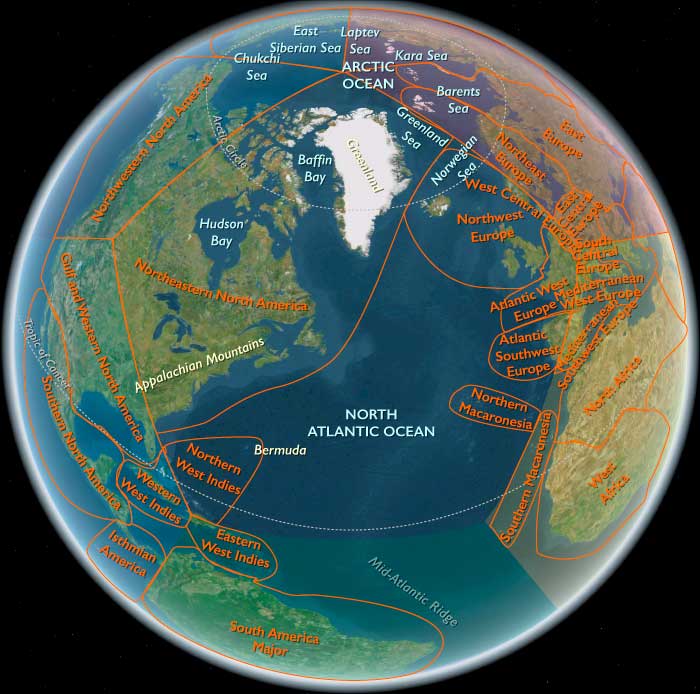
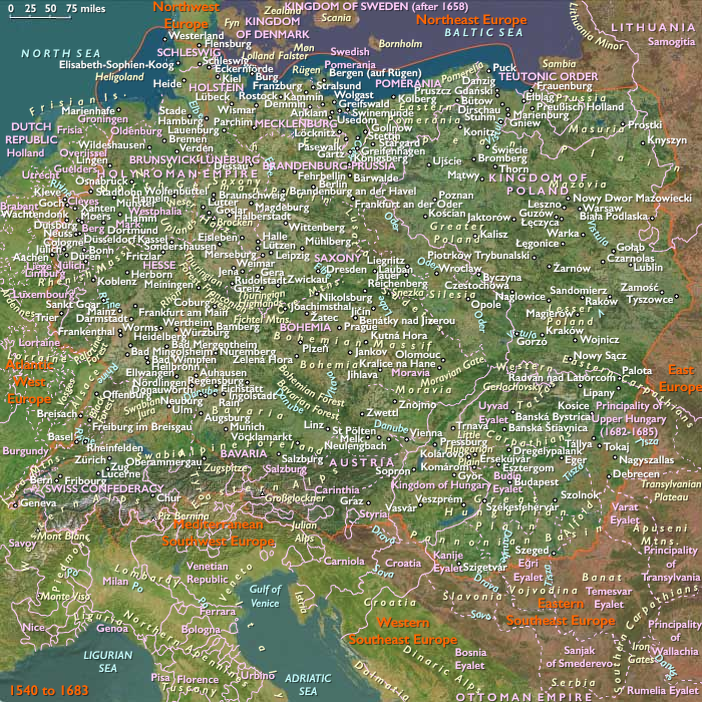
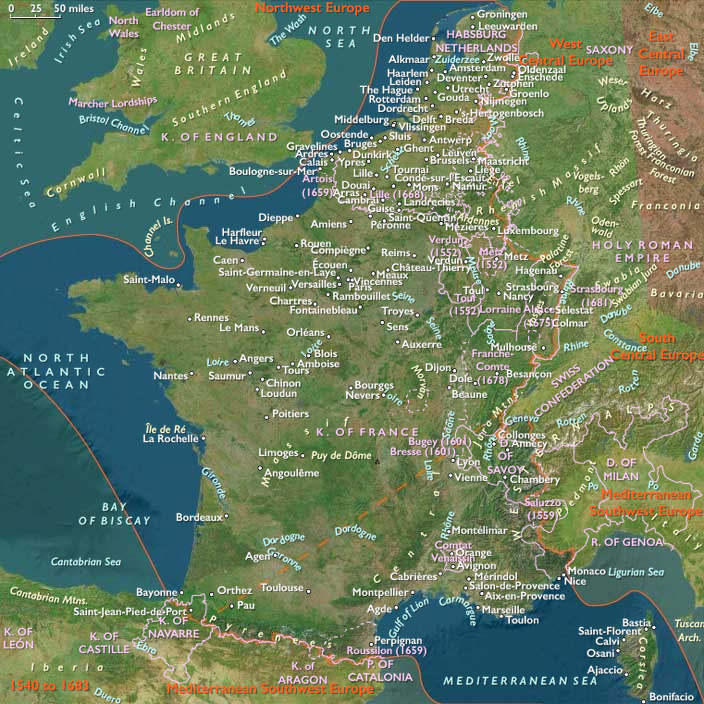
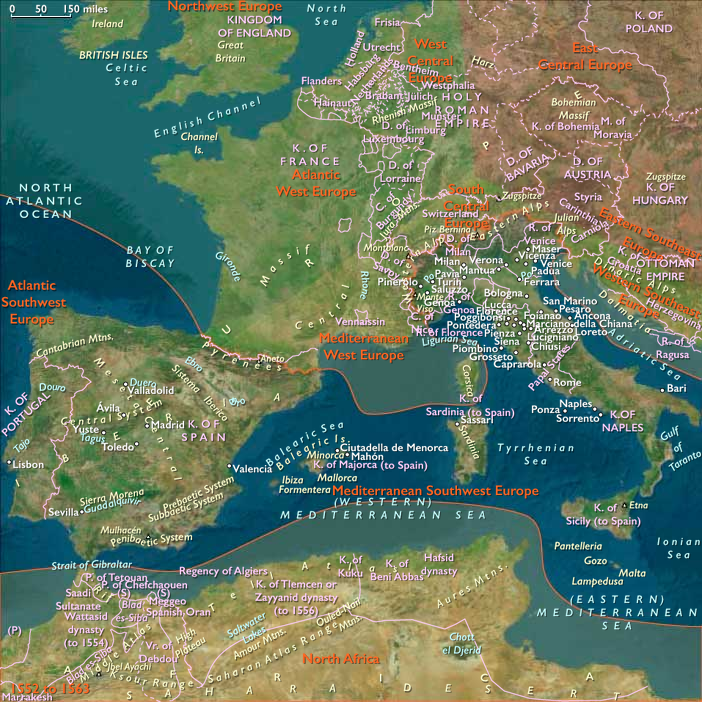
West Europe in this age cohered around two complementary maritime–Mediterranean spheres: Mediterranean West Europe—southern France, Corsica, and Monaco—and Atlantic West Europe—northern France and the Low Countries (the Dutch Republic, Spanish Netherlands, and Luxembourg) along the English Channel and Atlantic. Mountain arcs, river basins (Loire, Seine, Scheldt, Meuse, Rhine), and islanded coasts framed agrarian heartlands and sea-facing emporia. The Little Ice Age brought cooler, more volatile seasons; floods, frosts, and vintner uncertainty alternated with years of bounty, testing grain and wine economies alike.
Subsistence & Settlement
-
Mediterranean West Europe: Terraced vines, olives, figs, wheat, and pastoral uplands underpinned rural life; Corsica remained under Genoese control amid frequent revolts; Monaco, under the Grimaldi, consolidated as a small sovereign principality oriented toward France.
-
Atlantic West Europe: Grain belts and dairying in Flanders and Artois; vineyards in Loire and Burgundy; bustling ports—Amsterdam, Rotterdam, Antwerp, Bordeaux, Nantes, La Rochelle, Rouen—drove urban growth and craft specialization. Toulouse pivoted after the decline of pastel (woad) as indigo from India displaced older dye trades.
Technology & Material Culture
-
Agriculture & hydraulics: Dike and polder engineering in the Low Countries; drainage and crop rotation improved productivity; Mediterranean terraces stabilized thin soils.
-
Shipping & finance: Dutch fluyts, improved charts, and insurance markets supported long-distance trade; the Amsterdam Exchange (1602) epitomized financial innovation.
-
Architecture & arts: Renaissance and Baroque idioms reshaped towns—from Versailles’ courtly grandeur to Flemish guildhalls; coral-and-limestone citadels on Corsica testified to Genoese rule; Monaco’s palace symbolized dynastic continuity.
-
Print culture: Amsterdam, Leiden, Paris, and Antwerp were premier centers for books, newspapers, and scientific tracts.
Movement & Interaction Corridors
-
Sea lanes: Channel and Atlantic routes carried wine, grain, salt, textiles, sugar, tobacco, and enslaved labor; the Dutch and French merchant marines connected Baltic grain to Iberian salt and Caribbean staples.
-
River networks: The Seine–Loire–Rhine–Scheldt–Meuse arteries integrated inland markets with seaports.
-
Diplomatic circuits: Franco–Spanish and Habsburg–Dutch rivalries mapped corridors of war and alliance; Monaco’s 1642 French investiture bound the Rock to Bourbon protection while preserving sovereignty.
Cultural & Symbolic Expressions
-
Humanism → Baroque: French Renaissance letters (Rabelais, La Pléiade) yielded to Baroque classicism under Louis XIII/XIV; in the Low Countries, the Dutch Golden Age and Flemish Baroque flourished—Rembrandt, Vermeer, Rubens.
-
Theater & letters: Molière and Racine codified French drama; the Republic of Letters linked Amsterdam and Paris to London and Rome.
-
Urban identity: Merchant patriciates funded almshouses, canals, and guild chapels; Huguenot salons and Dutch collegia nurtured sciences (Descartes in the Netherlands; Leeuwenhoek’s microscopy).
Political & Military Shocks
Mediterranean West Europe
-
Monaco: Honoré II styled himself Prince (1612); by 1642 he became Duc et Pair Étranger under French protection—an emblem of princely consolidation amid Franco–Spanish rivalry.
-
Corsica: Genoese rule persisted through fortified ports (Calvi, Bonifacio), despite endemic clan revolts and piracy.
-
Southern France: The Wars of Religion (1562–1598) ravaged Languedoc and Provence; the Edict of Nantes (1598) stabilized coexistence until later retrenchments.
Atlantic West Europe
-
Habsburg–Valois conflicts culminated in Cateau-Cambrésis (1559); France turned inward to confront confessional war.
-
Dutch Revolt (1568–1648): The Eighty Years’ War birthed the Dutch Republic; Westphalia (1648) confirmed independence and reoriented the North Sea economy.
-
Absolutism & expansion: Louis XIV’s wars (esp. Franco–Dutch War, 1672–78) and administrative centralization projected France as Europe’s leading power by 1683.
Religious Transformations
-
Reformation & Counter-Reformation: Calvinism spread in the Low Countries and northern France; Jesuit missions, seminaries, and baroque piety spearheaded Catholic renewal.
-
Toleration settlements: The Edict of Nantes and the Dutch Republic’s pragmatic toleration offered early models of pluralism amid enduring confessional fault lines.
Economic Transitions
-
Pastel to indigo: Toulouse’s woad economy declined as Indigofera imports rose; merchants diversified into grain finance, legal professions, and textiles.
-
Dutch commercial hegemony: VOC and WIC networks, Baltic grain trade, and the Amsterdam Exchangeunderwrote a global web.
-
French Atlantic rise: Bordeaux and Nantes expanded on wine and emerging plantation commerce, laying foundations for 18th-century growth.
Environmental Adaptation & Resilience
-
Low Countries: Continuous dike raising, polder drainage, and windmill pumping defended land and stabilized yields.
-
Mediterranean slopes: Terracing, cisterns, and mixed arboriculture buffered droughts; coastal fisheries supplemented diets.
-
Urban welfare: Confraternities, hospices, and poor relief mitigated famine and plague shocks.
Transition
Between 1540 and 1683, West Europe consolidated princely sovereignties and maritime republics, rebuilt after confessional wars, and vaulted into a global commercial system.
-
In the Mediterranean, Monaco’s French alignment, Corsica’s Genoese fortresses, and southern France’s cultural refinement set the tone for principality survival amid great-power rivalry.
-
Along the Atlantic, the Dutch Republic emerged as Europe’s commercial-financial engine, while France moved toward hegemonic monarchy and colonial reach.
By the eve of 1683, West Europe’s ports, polities, and patronage had forged durable institutions and identities—foundations that would dominate the continent’s politics, culture, and oceans in the century ahead.
Atlantic West Europe (1540–1683): Religious Turmoil, Dynastic Rivalries, and Maritime Ascendancy
The era spanning 1540 to 1683 in Atlantic West Europe—encompassing northern France, the Low Countries (modern Belgium, Netherlands, and Luxembourg), and regions along the Atlantic and English Channel coasts—witnessed profound religious transformations, intense political and dynastic conflicts, vibrant cultural achievements, and economic growth driven by maritime expansion and colonial enterprise. This period marked the region's decisive transition from medieval fragmentation to early modern states, characterized by powerful central authorities, dynamic commercial networks, and distinct national identities.
Political and Military Developments
The Habsburg-Valois Conflicts (1540–1559)
-
Early decades were dominated by wars between Francis I of France (1515–1547) and Emperor Charles V (1519–1556), particularly the Italian Wars. These conflicts drained regional economies but solidified centralized monarchical power in France.
-
The Treaty of Cateau-Cambrésis (1559) ended these conflicts, stabilizing the Franco-Habsburg borders and allowing France to refocus internally.
Religious Wars and Political Fragmentation (1562–1598)
-
France endured the brutal Wars of Religion, pitting Catholic factions against Protestant Huguenots, severely disrupting society, economy, and political stability.
-
The wars culminated in the ascension of Henry IV (r.1589–1610), who issued the Edict of Nantes (1598), granting limited religious toleration, stabilizing France, and reasserting royal authority.
Dutch Revolt and Birth of the Dutch Republic (1568–1648)
-
The Low Countries rebelled against Habsburg Spain, triggered by religious persecution, heavy taxation, and centralization attempts under Philip II. The resulting Eighty Years' War forged the Dutch Republic in the north, while the southern provinces (Spanish Netherlands) remained under Spanish rule.
-
The Peace of Westphalia (1648) confirmed the independence of the Dutch Republic, profoundly reshaping the region’s political map and enabling Dutch commercial and cultural ascendancy.
Absolutism under Louis XIV (1643–1683)
-
France reached the zenith of royal absolutism under Louis XIV (r.1643–1715), significantly expanding French territories through wars such as the Franco-Dutch War (1672–1678), solidifying France’s role as Europe's dominant continental power.
-
Centralized bureaucracy, military reforms, and lavish cultural patronage characterized Louis XIV's reign, epitomized by the expansion of Versailles as a symbol of monarchical prestige.
Economic Developments: Maritime Trade and Colonial Expansion
Growth of Atlantic Commerce
-
French Atlantic ports like Bordeaux, Nantes, La Rochelle, and Dutch hubs such as Amsterdam and Rotterdam, flourished through maritime trade, driven by sugar, tobacco, wine, textiles, and the burgeoning slave trade.
-
Bordeaux’s wine industry significantly expanded during this era, becoming a critical economic sector, exporting primarily to England and Northern Europe, reinforcing regional prosperity.
Dutch Commercial Dominance
-
The Dutch Republic emerged as a commercial powerhouse, with Amsterdam becoming Europe’s leading financial and trading center. The establishment of the Amsterdam Stock Exchange (1602) and the Dutch East India Company (VOC, 1602) epitomized the sophistication of Dutch capitalism and global trade.
-
Dutch maritime innovations in shipbuilding, navigation, and banking underpinned their economic success and influence across European markets and overseas colonies.
Agricultural and Industrial Advances
-
Advances in agricultural techniques, notably crop rotation and drainage systems, improved productivity in northern France and the Low Countries, supporting population growth and urbanization.
-
Textile production remained crucial, especially in Flanders and northern France, despite disruptions from warfare, forming a foundation for early industrialization.
Religious Developments: Reform, Conflict, and Toleration
Protestant Reformation and Catholic Response
-
The spread of Protestantism profoundly reshaped religious and political life. Calvinism gained traction, especially in northern France and the Low Countries, fueling religious dissent against Catholic authorities.
-
Catholic Counter-Reformation movements, notably led by the Jesuits, responded vigorously, reforming internal church structures, promoting religious education, and combating Protestant influence.
Religious Wars and Persecution
-
Intense religious violence erupted across France, exemplified by the St. Bartholomew’s Day Massacre (1572), resulting in thousands of Huguenot deaths and heightened religious animosities.
-
Protestant persecution under Spanish rule intensified in the Low Countries, ultimately leading to the Dutch Revolt and the establishment of religious toleration in the northern provinces, notably Holland.
Establishment of Limited Religious Toleration
-
The Edict of Nantes (1598) and the relative religious toleration of the Dutch Republic became early models of coexistence amid religious pluralism, setting critical precedents influencing later European developments.
Cultural and Intellectual Developments
Renaissance Humanism to Baroque Splendor
-
The French Renaissance, spurred by humanist scholars like François Rabelais and poets of La Pléiade, transitioned into the extravagant cultural and artistic patronage of the Baroque period under Louis XIII and Louis XIV.
-
Flemish painters such as Peter Paul Rubens and Dutch Golden Age artists including Rembrandt and Vermeer profoundly impacted European artistic traditions through innovative techniques and compelling naturalism.
Intellectual Innovations and Scientific Advances
-
This era witnessed groundbreaking advances in science, technology, and medicine. Intellectual centers such as Paris and Amsterdam became hubs for scientists and philosophers, exemplified by René Descartes’ philosophical works and Antonie van Leeuwenhoek’s microscopy.
-
The establishment of learned societies, such as the French Académie des Sciences (1666), reflected state-sponsored encouragement of scientific inquiry, significantly advancing European knowledge.
Literary and Cultural Flourishing
-
French literary culture flourished under royal patronage, with notable playwrights like Molière and Jean Racine, whose works profoundly influenced European drama.
-
In the Dutch Republic, high literacy rates and publishing freedoms fostered a vibrant literary culture, marked by prolific book publishing, newspapers, and critical philosophical discourse.
Social and Urban Transformations
Urban Expansion and Socioeconomic Mobility
-
Maritime trade significantly propelled urbanization in port cities such as Amsterdam, Antwerp, Bordeaux, and Nantes, leading to the emergence of affluent merchant classes influential in local governance and cultural patronage.
-
Economic prosperity stimulated the growth of urban infrastructure, including banking institutions, merchant guilds, public buildings, and market spaces, reshaping urban life and society.
Social Tensions and Rural Struggles
-
Despite urban wealth, significant rural poverty persisted, exacerbated by warfare, heavy taxation, agricultural disruption, and periodic famines, particularly notable in northern France and parts of the Low Countries.
-
Rural communities faced pressures from enclosures, increasing commercialization of agriculture, and demographic growth, fueling migrations toward cities and overseas colonies.
Legacy and Historical Significance
By 1683, Atlantic West Europe had undergone transformative shifts in political structure, economic power, cultural expression, and religious dynamics:
-
Politically, the period solidified powerful centralized monarchies in France and independent republican governance in the Netherlands.
-
Economically, the region became integral to global commerce, driven by maritime exploration, colonial expansion, and financial innovation, notably in the Dutch Republic.
-
Culturally and intellectually, Renaissance humanism transitioned into Baroque grandeur and scientific rationalism, profoundly shaping European thought, art, and literature.
-
Religiously, the profound tensions between Protestantism and Catholicism laid the groundwork for modern notions of religious pluralism and toleration.
Thus, this period positioned Atlantic West Europe decisively at the forefront of early modern European transformations, establishing foundational structures, cultural identities, and economic patterns that endured into subsequent centuries.
François Rabelais, the French writer, doctor, and humanist completes the third book in Gargantua and Pantagruel, his panoramic satirical work, in 154.
The two giants, Gargantua and his son Pantagruel, begin to evolve from the comic and grotesque figures of the first two books into incarnations of humanist, Christian, and Stoic ideals.
In this series of tales and voyages, Rabelais blends satire and ribaldry with serious philosophical speculation on the nature of religion, education, and politics.
Marguerite de Navarre, also known as Margaret d’Angoulême, a sister of the late king Francis and the queen consort of King Henry II of Navarre, expresses her intensely felt religious views in poetry and plays.
As patron of humanists and reformers, and as an author in her own right, she is an outstanding figure of the French Renaissance.
Marguerite, who has written many poems and plays, has also written penned the classic collection of stories, the Heptameron, as well as a remarkably intense religious poem, Miroir de l'âme pécheresse or Mirror of the Sinful Soul.
This particular poem is a first-person mystical narrative of the soul as a yearning woman calling out to Christ as her father-brother-lover.
That her work was passed to the royal court of England provides the basis for conjecture that Marguerite had influence on the Protestant reformation in England.
Anne Boleyn, future second wife and Queen to Henry VIII of England, had been a lady-in-waiting to Queen Claude during her years in France before returning to England.
There is conjecture that the court of Queen Claude and the court of Marguerite overlapped and that, perhaps, Anne was in service to Marguerite rather than to Claude, as well as that Anne Boleyn may have become a friend, admirer, and disciple to Marguerite, who absorbed Marguerite's radical views about Christianity.
A written letter by Anne Boleyn after she became queen exists in which Boleyn makes strong expressions of affection to Marguerite.
It is conjectured that Marguerite had given Anne the original manuscript of Miroir de l'âme pécheresse at some point.
It is certain that in 1545, sometime after Anne Boleyn's execution by her husband Henry VIII, that Anne's daughter, who will become Elizabeth I (1533–1603), had translated this very same poem by Marguerite into English when she was twelve years old and presented it, written in her own hand, to her then-stepmother, the English Queen Catherine Parr.
This literary connection among Marguerite, Anne, Catherine Parr, and the future Queen Elizabeth I suggests a direct mentoring link between the legacy of reformist religious convictions and Marguerite.
As a generous patron of the arts, Marguerite befriends and protects many artists and writers, among them Rabelais, Marot and Ronsard.
Marguerite is also a mediator between Roman Catholics and Protestants (including Calvin).
Although Marguerite espouses reform within the Catholic Church, she is not a Calvinist.
She does, however, do her best to protect the reformers and had dissuaded her brother from intolerant measures as long as she could.
She dies on December 21, 1549, at the age of fifty-seven.
François Rabelais in 1552 produces a fourth book in his Gargantua and Pantagruel series.
In search of an answer to his Panurge's question— should he marry or should he not?—the companions set sail for the Oracle of the Divine Bottle.
They visit strange islands peoples by extraordinary beings and things and are caught in a storm and in a battle with an army of sausages.
The book contains many statements on intellectual issues and features some ferocious antipapal satire.