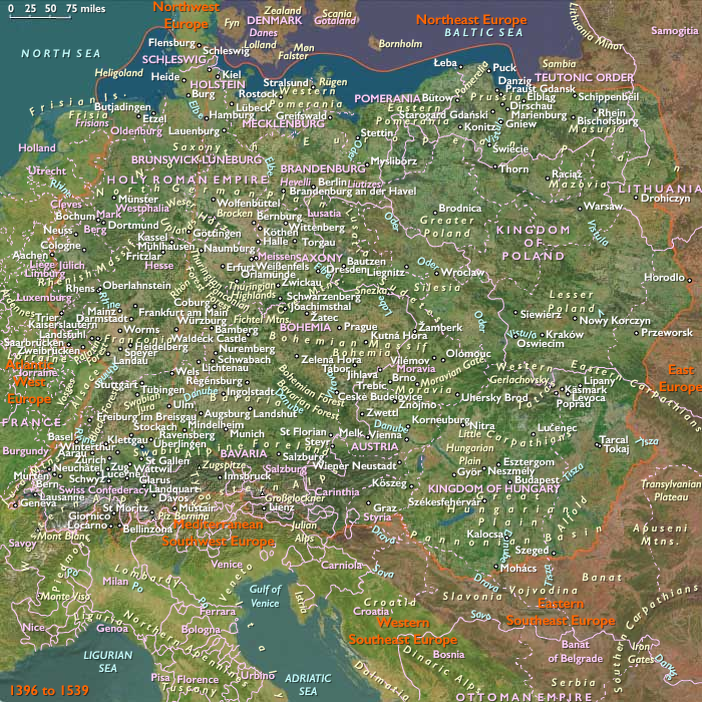
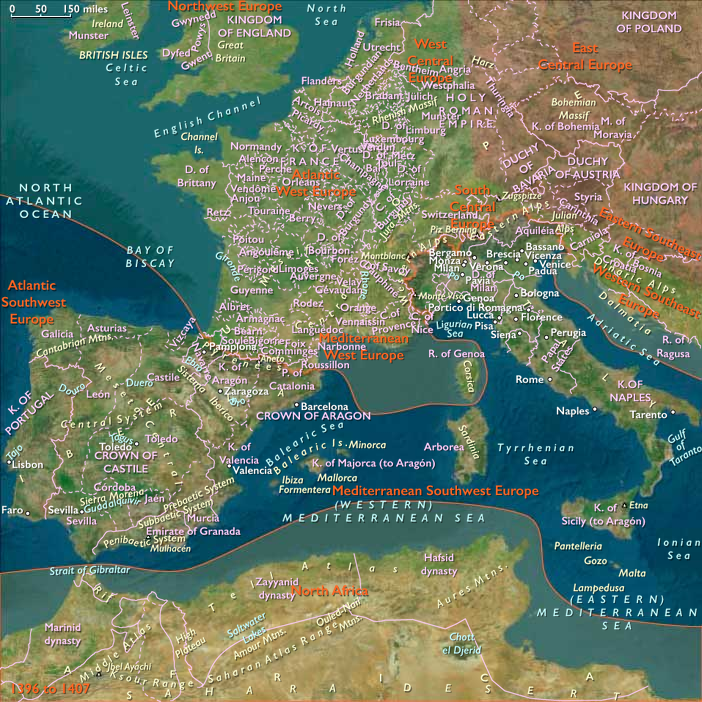
Frederick, Duke of Brunswick-Lüneburg from 1383, takes part in an assembly of the princes of the Holy Roman Empire in Frankfurt in May of 1400 the purpose of the meeting is to discuss the deposition of Wenceslaus, King of the Romans.
Archbishop John II of Mainz favors the election of Rupert, the Elector Palatine.
Frederick according to legend was elected as an anti-king by a subset of the princes; because no agreement over his election could be reached, he left the assembly.
Modern historians are at odds with each other whether Frederick was ever considered a candidate or even elected, since there is no documentary evidence for this.
It is undisputed that he was murdered during his journey home by Henry VII, Count of Waldeck.
The murder may have served to get rid of a royal candidate; or the story of the royal election may have sprung up to find a motive for the murder.
Henry and his men, who include Friedrich von Hertingshausen and Konrad von Falkenberg, attack Duke Frederick at Kleinenglis, south of Fritzlar.
A fierce battle follows and the Duke is killed.
The newly elected King Rupert investigates the attack on Duke Frederick and Henry is sentenced to the foundation of an altar with perpetual requiem mass at the St. Peter's Church in Fritzlar.