Frederick North, Lord North
Prime Minister of Great Britain
Years: 1732 - 1792
Frederick North, 2nd Earl of Guilford, KG PC (April 13, 1732 – August 5, 1792), more often known by his courtesy title, Lord North, which he uses from 1752 until 1790, is Prime Minister of Great Britain from 1770 to 1782.
He leads Great Britain through most of the American War of Independence.
He also holds a number of other cabinet posts, including Home Secretary and Chancellor of the Exchequer.
North's reputation among historians has swung back and forth.
It reaches its nadir in the late nineteenth century when he is depicted as a creature of the king and an incompetent who lost the American colonies.
In the early twentieth century a revisionism emphasizes his strengths in administering the Treasury, handling the House of Commons, and in defending the Church of England.
Herbert Butterfield, however, argues that his indolence was a barrier to efficient crisis management; he neglected his role in supervising the entire war effort.
Related Events
Filter results
Showing 10 events out of 15 total
This temporarily resolves the crisis, and the boycott of British goods largely ceases, with only the more radical patriots such as Samuel Adams continuing to agitate.
The East India Company is one of the firms that had suffered the hardest hits in the crisis.
Failing to pay or renew its loan from the Bank of England, the firm had sought to sell its eighteen million pounds of tea from its British warehouses to the American colonies.
In the 1760s and early 1770s, the Company had been required to sell its tea exclusively in London on which it paid a duty which averaged two shillings and six pence per pound.
Tea destined for the North American colonies would be purchased by merchants specializing in that trade, who transported it to North America for eventual retail sale.
The markups imposed by these merchants, combined with tea tax imposed by the Townshend Acts of 1767, had created a profitable opportunity for American merchants to import and distribute tea purchased from the Dutch in transactions and shipments that violated the Navigation Acts and were treated by British authorities as smuggling.
Smugglers imported some 900,000 pounds (410,000 kilograms) of cheap foreign tea per year.
The quality of the smuggled tea did not match the quality of the dutiable East India Company tea, of which the Americans bought 562,000 pounds (255,000 kg) per year.
Although the British tea is more appealing in taste, some Patriots, like the Sons of Liberty, had encouraged the consumption of smuggled tea as a political protest against the Townshend taxes.
In 1770 most of the Townshend taxes had been repealed, but taxes on tea are retained.
Resistance to this tax includes pressure to avoid legally imported tea, leading to a drop in colonial demand for the Company's tea, and a burgeoning surplus of the tea in the company's English warehouses.
By 1773 the Company is close to collapse due in part to contractual payments to the British government of £400,000 per year, together with war and a severe famine in Bengal which has drastically reduced the Company's revenue from India, and economic weakness in European markets.
Benjamin Franklin is one of several people who suggest things would be greatly improved if the Company were allowed to export its tea directly to the colonies without paying the taxes it was paying in London: "to export such tea to any of the British colonies or plantations in America, or to foreign parts, import duty of three pence a pound."
The administration of Lord North sees an opportunity to achieve several goals with a single bill.
If the Company were permitted to directly ship tea to the colonies, this would remove the markups of the middlemen from the cost of its tea, and reducing or eliminating the duties paid when the tea was landed in Britain (if it was shipped onward to the colonies) would further reduce the final cost of tea in the colonies, undercutting the prices charged for smuggled tea.
Colonists would willingly pay for cheaper Company tea, on which the Townshend tax was still collected, thus legitimizing Parliament's ability to tax the colonies.
The Tea Act, which receives the royal assent on May 10, 1773 reduces the tea price and enables the East India Company’s monopoly over the local tea business in the colonial tea market.
Proposals are made that the Townshend tax also be waived, but North opposes this idea, citing the fact that these revenues are used to pay the salaries of crown officials in the colonies.
The Parliament imposes a three pence tax for each pound of tea sold, and allows the firm to sell directly through its own agents.
Citizens in Charleston, Philadelphia, New York, and Boston, furious about how the British government and the East India Company control the colonial tea trade, reject the imported tea, and these protests eventually lead to the Boston Tea Party in 1773.
Requests to Catherine the Great for Russian troops had been refused, but a number of German principalities were prepared to offer theirs.
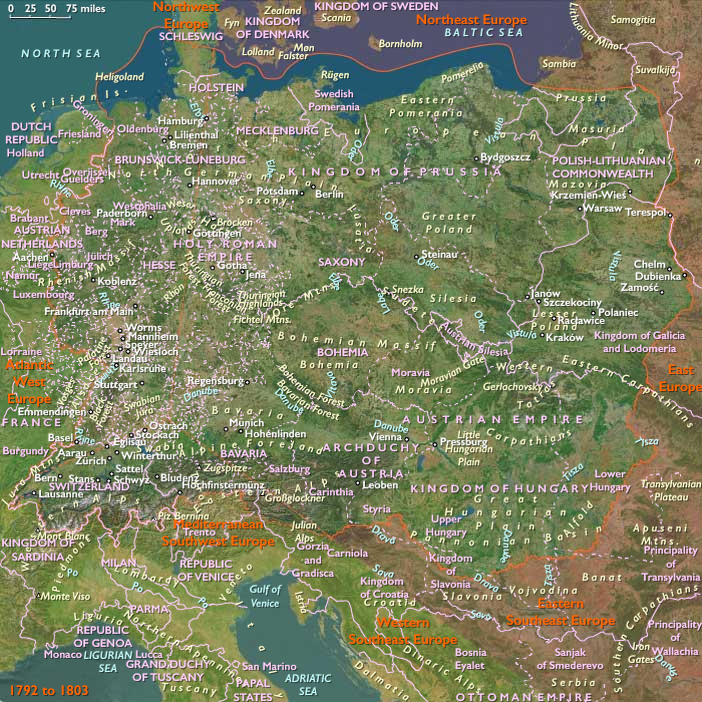
Of the fifty thousand troops that Britain raises in 1776, nearly one third come from a handful of these principalities; the number of troops from Hesse-Cassel and Hesse-Hanau cause them to be widely referred to as Hessians.
Of these fifty thousand, about eleven thousand are destined for service in Quebec.
Troops from Hesse-Hanau and Brunswick-Lüneburg had sailed in February 1776 for Cork, where they joined a convoy carrying British troops that had sailed in early April.
Carleton, having been informed of pace of activity in the American camp, had rapidly unloaded reinforcements from the arrived ships, and around noon marches with a force of about nine hundred troops to test the Americans.
The American response is essentially panic; a disorganized retreat begun that might have ended even more disastrously for the Americans had Carleton pressed his advantage.
Hoping to win over the rebels with a lenient attitude, he is content to send ships up the river to harass the Americans, and to possibly cut them off.
He also captures a number of Americans, mostly sick and wounded, but also a detachment of troops that had been abandoned on the south side of the St. Lawrence.
Of Lord Germain it is said that "the secretary is incapable of conducting a war", and Horace Walpole opines (incorrectly, as it turned out) that "we are ... very near the end of the American war."
Lord North issues a proposal for peace terms in Parliament that does not include independence; when these are finally delivered to Congress by the Carlisle Peace Commission they will be rejected.
John Burgoyne's surrender at the Battle of Saratoga had signaled that the struggle against the American colonies is likely to prove longer and more costly than expected.
British defeat has raised the prospect of French intervention and of a European war.
North's government, fearful of war with France, seeks reconciliation with the American colonies and is willing to grant a fair measure of autonomy to this end, but what would have been enough in 1775 no longer suffices by 1778.
North has no intention of offering independence, but in the wake of Saratoga and with the prospect of a French alliance, the Americans are unlikely to agree with lesser terms.
The North ministry seeks reconciliation with the colonies by consenting to their original demands, although Lord North refuses to grant independence.
The British send out a peace commission headed by the Earl of Carlisle, whose offers, made in June 1778 as Clinton is preparing to abandon Philadelphia, are rejected by Congress.
Aside from the issue of Catholic emancipation, it has also been suggested that the driving force of the riots is Britain's poor economic situation: the loss of trade during the war has led to falling wages, rising prices, and periodic unemployment.
Voting in parliamentary elections is restricted by a property threshold, so most Londoners are unable to vote and many hope for reforms to make Parliament more representative of the people.
Many carry flags and banners proclaiming "No Popery", and most wear blue cockades, which have become the symbol of their movement.
As they march, their numbers swell.
They attempted to force their way into the House of Commons, but without success.
Gordon, petition in hand, and wearing in his hat the blue cockade of the Protestant Association, enters the Commons and presents the petition.
Outside, the situation quickly gets out of hand and a riot erupts.
Members of the House of Lords are attacked as they arrive, and a number of carriages are vandalized and destroyed.
Despite being aware of the possibility of trouble, the authorities had failed to take steps to prevent violence breaking out.
The Prime Minister, Lord North, had forgotten to issue an order mobilizing the small number of Constables in the area.
Those that were present in the House of Commons are not strong enough to take on the angry mob.
Eventually a detachment of soldiers is summoned, and they disperse the crowd without violence.
Inside the House of Commons, the petition is overwhelmingly dismissed by a vote of 192 to 6.
Once the mob around Parliament had dispersed, it seemed to the government that the worst of the disorder was over.
However, the same night a crowd gathers and attacks the Roman Catholic Sardinian Embassy Chapel in Lincoln's Inn Fields.
Bow Street Runners and soldiers are called out and make thirteen arrests, although most of the ringleaders have managed to escape.
The same night the chapel of the Bavarian Embassy in Warwick Street, Soho, is destroyed.
Another suggested cause is Britain's weakened international position, which has arisen from the country's isolation in Europe and the disappointing news coming from the ongoing war.
Some rioters are against the continuation of the war, and many strongly support American independence, while others are angry that Britain's war effort is being mishandled by Lord North.
In many cases a mix of issues blends together and drives people to take part in the rioting.
After a difficult journey, he arrives in Philadelphia, which celebrates for several days.
The British Prime Minister, Lord North, is reported to have exclaimed "Oh God, it's all over" when told of the defeat.