
Frederick William II
King of Prussia
Years: 1744 - 1797
Frederick William II (German: Friedrich Wilhelm II.; September 25, 1744 – November 16, 1797) is King of Prussia, from 1786 until his death.
He is in personal union the Prince-elector of Brandenburg and (via the Orange-Nassau inheritance of his grandfather) sovereign prince of the Canton of Neuchâtel.
Pleasure-loving and indolent, he is seen as the antithesis to his predecessor, Frederick II.
Under his reign, Prussia is weakened internally and externally, and he fails to deal adequately with the challenges to the existing order posed by the French Revolution.
His religious policies are directed against the Enlightenment and aimed at restoring a traditional Protestantism.
However, he is a patron of the arts and responsible for the construction of some notable buildings, among them the Brandenburg Gate in Berlin.

Related Events
Filter results
Showing 10 events out of 26 total
By 5:00 pm, neither side can make any gains; the Prussians hold tenaciously to the captured artillery works, too tired to even retreat: they have pushed the Russians from the Mühlberge, the village, and the Kuhgrund, but no further.
The Allies are in a similar state, except they have more cavalry in reserve and some fresh Austrian infantry.
This part of Laudon's forces, late arrivals to the scene and largely unused, come into action at about 7:00 pm.
To the exhausted Prussians holding the Kuhgrund, the swarm of fresh Austrian reserves is the final stroke.
Although such isolated groups as Hans Sigismund von Lestwitz's regiment put up a bold front, these groups lose heavily and their stubborn defense cannot stop the chaos of the Prussian retreat.
Soldiers throw their weapons and gear aside and run for their lives.
The battle is lost for Frederick—it had actually been lost for the Prussians for a couple of hours—but he had not accepted this fact.
Frederick rides among his melting army, snatches a regimental flag, trying to rally his men: Children, my children, come to me. Avec moi, Avec moi!
They do not hear him, or if they do, they chose not to obey.
Saltykov, watching the chaos and seeking the coup de grâce, throws his own Cossacks and Kalmyks (cavalry) into the fray.
The Chuggavieski Cossacks surround Frederick on a small hill, where he stands with the remnants of his body-guard—the Leib Cuirassiers—determined to either hold the line or to die trying.
With a hundred-strong hussar squadron, Rittmeister (cavalry captain) Joachim Bernhard von Prittwitz-Graffron cuts his way through the Cossacks and drags the King to safety.
Much of his squadron dies in the effort.
As the hussars escorts Frederick from the battlefield, he passes the bodies of his men, lying on their faces with their backs slashed open by Laudon's cavalry.
A dry thunderstorm creates a surreal effect.
That evening back in Reitwein, Frederick sits in a peasant hut and writes a despairing letter to his old tutor, Count Karl-Wilhelm Finck von Finckenstein:
This morning at 11 o'clock I have attacked the enemy. ... All my troops have worked wonders, but at a cost of innumerable losses. Our men got into confusion. I assembled them three times. In the end I was in danger of getting captured and had to retreat. My coat is perforated by bullets, two horses of mine have been shot dead. My misfortune is that I am still living ... Our defeat is very considerable: To me remains 3,000 men from an army of 48,000 men. At the moment in which I report all this, everyone is on the run; I am no more master of my troops. Thinking of the safety of anybody in Berlin is a good activity ... It is a cruel failure that I will not survive. The consequences of the battle will be worse than the battle itself. I do not have any more resources, and—frankly confessed—I believe that everything is lost. I will not survive the doom of my fatherland. Farewell forever!
Frederick also decides to turn over command of the army to Finck.
He tells this unlucky general he is sick.
He names his brother as generalissimo and insists his generals swear allegiance to his nephew, the fourteen-year-old Frederick William.
Northeast Europe (1780–1791 CE): Enlightened Reform, Military Ambitions, and Scientific Innovation
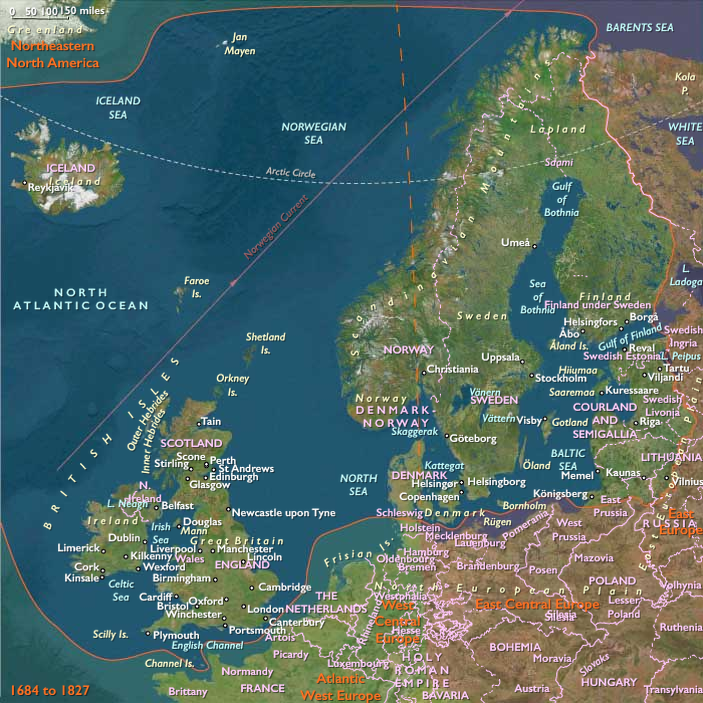
Between 1780 and 1791 CE, Northeast Europe experienced a dynamic period characterized by enlightened reforms, ambitious military campaigns, significant scientific discoveries, and sustained economic and cultural development. Sweden under Gustav III pursued renewed military objectives alongside internal reforms, Denmark–Norway maintained strategic neutrality and domestic modernization, and Prussia under Frederick the Great and subsequently Frederick William II continued administrative efficiency and economic stability. The era was also marked by notable scientific advancements, exemplified by the groundbreaking work of Swedish chemist Peter Jacob Hjelm.
Sweden: Gustav III’s Enlightened Absolutism and Military Ambitions
King Gustav III (r. 1771–1792), having restored royal absolutism in Sweden in 1772, continued extensive internal reforms aimed at strengthening the monarchy, modernizing administration, and advancing cultural life. Alongside domestic reforms, Gustav pursued ambitious foreign policy objectives, notably attempting to revise the territorial outcomes of the earlier Great Northern War. In 1788, Sweden declared war against Russia, seeking to reclaim lost territories along Finland’s eastern border.
The Russo-Swedish War and the Anjala League Mutiny
During the ensuing conflict (1788–1790), known as the Russo-Swedish War, an important internal incident was the mutiny of a faction of Finnish officers within the Swedish military, known as the Anjala League. The mutineers, led prominently by former Swedish army colonel Göran Sprengtporten, aimed to avoid provoking severe Russian retaliation against Finland. Although swiftly suppressed and lacking broad support among Finnish officers, the mutiny highlighted increasing war-weariness among many Finns, particularly Finnish nobles, who were growing weary of Finland's frequent role as a battleground between Sweden and Russia.
Due to Russia’s simultaneous military commitments in a major conflict against the Ottoman Empire, Sweden secured an advantageous diplomatic settlement in the Treaty of Värälä (1790), effectively ending the conflict without territorial changes. Thus, despite Gustav III’s ambitious objectives, the territorial boundaries of Finland remained unchanged, preserving the status quo while leaving underlying tensions unresolved.
Scientific Advancement: Hjelm’s Isolation of Molybdenum
During this period, Sweden also witnessed significant scientific progress. In 1781–1782, Swedish chemist Peter Jacob Hjelm, encouraged by colleague Carl Wilhelm Scheele, successfully isolated the metal molybdenum. By heating a paste composed of molybdenum oxide and linseed oil at high temperatures in a crucible, Hjelm achieved the first-ever isolation of this element. Naming the newly discovered metal from the Greek molybdos, meaning “lead,” Hjelm’s achievement represented a major advancement in European chemical science, underscoring Sweden’s continued prominence in scientific and industrial chemistry research.
Danish–Norwegian Neutrality and Enlightened Domestic Reforms
Under the rule of King Christian VII (r. 1766–1808), Denmark–Norway continued to focus on domestic modernization and cautious neutrality in regional politics. Economic prosperity increased through investments in infrastructure, agriculture, and maritime commerce. Copenhagen became increasingly vibrant as a center of commerce, culture, and Enlightenment-inspired education, maintaining stability and economic growth amidst broader European geopolitical uncertainties.
Prussian Stability under Frederick II and Frederick William II
Prussia under Frederick II (Frederick the Great) (r. 1740–1786), and later under Frederick William II (r. 1786–1797), maintained disciplined governance, economic stability, and strategic territorial control. Frederick II’s enlightened reforms in education, administration, and agriculture persisted, bolstering Prussia’s economic and administrative efficiency, especially in territories around Königsberg (Kaliningrad).
Economic Prosperity and Urban Stability
Key urban centers across Northeast Europe, including Stockholm, Copenhagen, Königsberg, Riga, and Reval (Tallinn), continued to thrive economically, benefiting from maritime trade, improved infrastructure, and stable governance. Regional economic integration deepened, supported by expanding merchant networks and commercial growth, contributing substantially to urban prosperity and stability.
Finland: Agricultural Improvements and the Burden of Warfare
Finland, still under Swedish rule, experienced continued agricultural productivity and internal economic stability. Improvements in scientific agriculture—such as the continued use of potatoes, building upon earlier advancements—enhanced food security and economic resilience. However, the Russo-Swedish War of 1788–1790 reinforced concerns among Finns about the persistent vulnerability and risks associated with Finland’s geopolitical position, as highlighted by the Anjala League incident.
Stability and Incremental Progress in the Baltic Territories
The Baltic territories—Estonia, Latvia, and Lithuania—experienced steady economic growth and internal stability. Predominantly governed by Baltic-German nobility, these regions maintained relative tranquility, with urban centers such as Riga and Reval thriving economically and culturally. Enlightenment-inspired local reforms and educational advancements gradually enhanced regional prosperity and stability.
Cultural Flourishing and Intellectual Life
Cultural and educational institutions flourished across Northeast Europe. King Gustav III significantly patronized arts and sciences in Sweden, establishing influential institutions including the Swedish Academy (Svenska Akademien) in 1786. Denmark–Norway and Prussia continued to nurture academic and cultural development, supporting Enlightenment ideals and intellectual advancement throughout the region.
Diplomatic Pragmatism and Regional Realignment
Diplomatic interactions during this era remained pragmatic and cautious. Sweden’s brief military ambition against Russia revealed clear limitations on Swedish geopolitical influence and highlighted Finland’s vulnerability. Denmark–Norway maintained neutrality and stability, while Prussia skillfully avoided involvement in destabilizing conflicts, preserving regional stability and internal growth.
Legacy of the Era
The period from 1780 to 1791 CE significantly impacted Northeast Europe through Sweden’s ambitious yet ultimately inconclusive war efforts, critical internal political events like the Anjala League mutiny, and landmark scientific advancements exemplified by Hjelm’s discovery of molybdenum. These developments shaped regional geopolitical relationships, reinforced internal political and economic stability, and promoted continued scientific and cultural vitality, laying a strong foundation for future historical trajectories.
East Central Europe (1780–1791 CE): Joseph II’s Radical Reforms, Prussian Ascendancy, and Growing Polish Vulnerability
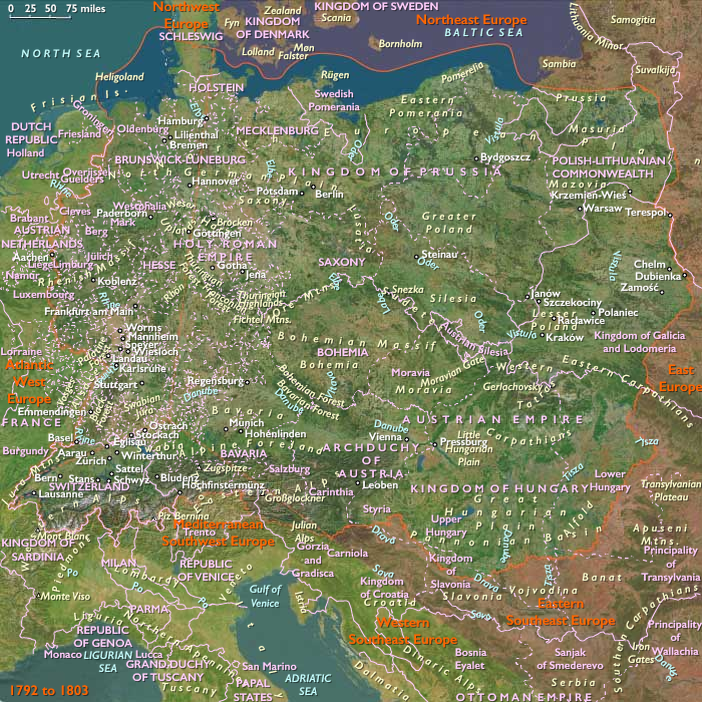
Between 1780 and 1791 CE, East Central Europe—comprising modern-day Poland, Czechia, Slovakia, Hungary, and those regions of eastern Germany and Austria east of 10°E and north of the defined boundary—experienced significant internal reforms, intensified geopolitical rivalries, and increasing vulnerability of the Polish–Lithuanian Commonwealth. Dominated by the ambitious reforms of Joseph II of Austria, the era saw heightened tensions between the Habsburg Monarchy and Prussia, and growing threats from an increasingly assertive Russia. These developments set the stage for dramatic political and territorial upheavals.
Political and Military Developments
Joseph II’s Radical Reforms in Austria (1780–1790)
-
Following the death of Maria Theresa in 1780, her son Joseph II (r. 1780–1790) accelerated extensive Enlightenment reforms in the Habsburg domains, aiming at radical modernization:
-
Abolition of serfdom (1781), dramatically reshaping rural social structures.
-
Centralization of administrative and judicial systems to reduce noble power.
-
Imposition of German as the official administrative language (1784), sparking resistance among non-German populations in Hungary, Czechia, Slovakia, and Galicia.
-
-
Although driven by Enlightenment ideals, Joseph’s reforms provoked widespread backlash, particularly among Hungarian nobles, Slovak and Czech intellectuals, and Polish elites in Galicia, ultimately leading to significant unrest and political instability.
Continued Polish Vulnerability and Constitutional Efforts
-
The Polish–Lithuanian Commonwealth, significantly weakened after the First Partition (1772), sought internal reforms to stave off further decline:
-
The Great Sejm (1788–1792) convened, aiming for sweeping constitutional reform to strengthen central authority and reduce foreign interference.
-
On May 3, 1791, Poland adopted the progressive Constitution of May 3, Europe's first modern codified national constitution, introducing significant political reforms, centralizing governance, and attempting to restore Polish sovereignty.
-
Prussian Ascendancy under Frederick II and Frederick William II
-
Frederick the Great (r. 1740–1786) consolidated Prussian territorial gains, enhancing the kingdom’s economic strength, administrative efficiency, and military power.
-
His successor, Frederick William II (1786–1797), pursued a cautious but assertive foreign policy, positioning Prussia as a critical rival to Austria and actively monitoring developments in Poland, setting the stage for future intervention.
Economic and Technological Developments
Economic Growth and Agricultural Modernization
-
Agricultural reforms, notably Joseph II’s abolition of serfdom in Austria and improved farming methods, significantly increased agricultural productivity and rural prosperity across the region, despite causing considerable social disruption.
-
Prussia continued agricultural and economic advancements, particularly in West Prussia, benefiting from fertile lands, Baltic trade, and efficient administrative practices.
Industrial and Commercial Advances
-
Industrial and commercial activities expanded notably in urban centers such as Vienna, Prague, Budapest, Leipzig, and Wrocław (Breslau), enhancing trade networks connecting East Central Europe to broader European markets.
Cultural and Artistic Developments
Intellectual Vibrancy and Enlightenment Influence
-
Joseph II’s reforms and patronage significantly influenced intellectual and cultural life, with Vienna and Prague emerging as prominent centers of Enlightenment thought, artistic innovation, and educational reform.
-
Key Enlightenment thinkers and cultural figures, including composers Wolfgang Amadeus Mozart and Joseph Haydn, flourished during this period, significantly enriching regional cultural heritage.
National Awakening in Hungary, Czechia, and Poland
-
Rising national consciousness emerged strongly in response to Joseph II’s centralizing reforms:
-
Hungarian nobles, Czech intellectuals, and Polish elites increasingly articulated distinctive national identities, advocating linguistic and cultural autonomy.
-
Literary and cultural movements strengthened national identities, laying the foundations for future national struggles and cultural revivals.
-
Settlement and Urban Development
Accelerated Urban Expansion
-
Major cities such as Vienna, Prague, Budapest, Leipzig, and Warsaw expanded significantly in size, infrastructure, and population, becoming vibrant centers of trade, culture, and intellectual discourse.
-
New administrative and civic structures supported urban growth, reflecting intensified central governance and cultural patronage.
Social and Religious Developments
Transformation of Social Structures
-
Joseph II’s abolition of serfdom profoundly altered social hierarchies, empowering peasants economically yet sparking significant noble resistance and societal tensions throughout Austria, Bohemia, Moravia, Hungary, and Galicia.
Religious Reform and Toleration
-
Joseph II continued to advocate religious tolerance and reform:
-
Edicts such as the Patent of Toleration (1781) significantly relaxed religious restrictions, allowing greater religious freedom for Protestants, Jews, and Orthodox Christians, though encountering opposition from conservative Catholic clergy.
-
Long-Term Consequences and Historical Significance
The period 1780–1791 CE was pivotal for East Central Europe. Joseph II’s ambitious but controversial reforms radically reshaped social, economic, and political landscapes within the Austrian domains, stimulating both modernization and nationalist backlash. Poland’s groundbreaking Constitution of May 3 represented a last attempt to reclaim sovereignty, though it intensified regional geopolitical tensions. Prussia continued to consolidate power, setting the stage for intensified rivalry with Austria and further partitions of Poland. Collectively, these transformations profoundly influenced the region’s historical trajectory, laying foundations for subsequent national movements, revolutionary upheavals, and geopolitical realignments into the nineteenth century.
Franz Karl Achard develops a practical method for extracting sugar from beets in 1787.
A student o the late German chemist Andreas Sigismund Marggraf, who had earlier discovered that the sucrose in beets has the same chemical composition as that in sugarcane, Achard had revived the discovery by Marggraf in 1747 that sugar beets contained sugar, and devised a process to produce it.
Born in Berlin, the son of preacher Max Guillaume Achard, descendant of Huguenot refugees and his wife Marguerite Elisabeth (Rouppert), Achard had studied physics and chemistry in his home city and became interested in sugar refining through his stepfather.
At the age of twenty, Achard had entered the "Circle of Friends of Natural Sciences" and met Marggraf, then director of the physical classes at the Royal Academy of Sciences.
Achard has studied many subjects, including meteorology, evaporation chillness, electricity, telegraphy, gravity, lightning arresters, and published in German and French.
A favorite of King Frederick II of Prussia, Achard had reported directlyto the King on his research twice a week.
About a study on the influence of electricity on mental capabilities, Frederick II was reported to have said: If he is able to provide reason for the half wits in my Prussian states using electricity, then he is worth more than his own weight in gold.
Elected to the Royal Academy of Sciences at Berlin in 1776, Archard went on to become the director of the physical classes of the academy following the death of Marggraf in 1782.
In 1782 he was elected a foreign member of the Royal Swedish Academy of Sciences.
For his discoveries in the acclimatization of tobacco to Germany, the king had granted him a lifetime pension of five hundred taler.
Achard is also esteemed by Frederick William II of Prussia.
On September 13 a Prussian army of twenty thousand men under the command of the Duke of Brunswick crosses the border.
The fortress of Vianen is deserted, ...
The Patriots continue urging citizens to resist the government by distributing pamphlets, creating "Patriot Clubs" and holding public demonstrations.
The government responds by pillaging those towns where the opposition is concentrated.
Most Patriots go into exile in France, while Holland's own "Ancien Régime" strengthens its grip on Dutch government chiefly through the Orangist Grand Pensionary Laurens Pieter van de Spiegel.
The Treaty of Reichenbach is signed on July 27 between Frederick William II of Prussia and Austria under Holy Roman Emperor Leopold II.
The two countries tries to settle their differences; specifically, Leopold attempts to be conciliatory toward Prussia, as Austria and Russia have recently made gains against the Ottoman Empire.
Based on the terms of the treaty, Austria agrees to restore all conquered territories to the Ottoman Empire.
Moreover, Austria agrees to grant the Belgians both amnesty and their old constitution.
The Prussian statesman, Count Ewald Friedrich of Hertzberg, manages to insert a clause whereby Austria will be able to make small acquisitions of Ottoman territory.
However, Austria must first receive permission from the Sublime Porte and must also allow Prussia to acquire an equivalent amount of Ottoman territory.
Even though Austria had to relinquish its conquered territories to the Ottoman Empire, it is allowed to retain its garrison in Chotin.
Moreover, the accord guarantees protection of the Bosnian frontier.
In return for these concessions, Prussia makes herself responsible for several stipulated compensations.
In another aspect of the treaty, Austria is not allowed to overtly or covertly support Russia in its campaigns against the Sublime Porte.
