Fruela II of Asturias
King of Asturias
Years: 875 - 925
Fruela II (Froila II) (c. 875–July 925) is the King of Asturias from the death of his father, Alfonso III of Asturias, in 910 to his own death.
When his father dies, the kingdom is divided, with the third son, Fruela, taking the original portion (Asturias); the second, Ordoño, taking Galicia; and the eldest, García, taking León.
As king of Asturias, he has the job of consolidating the region later called Castile and keeping its counts in check.

Related Events
Filter results
Showing 10 events out of 12 total
Alfonso III of Asturias: Patron of History, Art, and a Troubled Succession
King Alfonso III of Asturias commissions the creation of three chronicles, aimed at legitimizing his kingdom as the rightful successor to the Visigothic Kingdom. These works help shape the historical narrative of Asturias and reinforce its continuity with the pre-Islamic past of Iberia.
Beyond his historical interests, Alfonso III is also a patron of the arts, following the tradition of his grandfather. He orders the construction of the Church of Santo Adriano de Tuñón, an important example of Asturian pre-Romanesque architecture.
The Imperial Crown and Disputed Claims
A letter of debated authenticity, the Epistola Adefonsi Hispaniae regis (906 CE), suggests that Alfonso III attempted to purchase an imperial crown from the Cathedral of Tours, possibly seeking to strengthen his royal legitimacywith symbolic ties to the Carolingian world.
Rebellion and the Partition of the Kingdom
In 909 CE, a year before his death, Alfonso III is forced to abdicate after his three sons revolt against him. The kingdom is then divided among them:
- García becomes King of León.
- Ordoño II rules Galicia.
- Fruela II inherits Asturias, with Oviedo as his capital.
Alfonso III dies in Zamora in December 910, marking the end of a significant reign in Asturian history.
Unstable Succession and Dynastic Struggles
After Alfonso’s death, his former realm is eventually reunified due to a series of dynastic events:
- García dies childless, and León passes to Ordoño II.
- When Ordoño II dies, his children are too young to inherit, and the kingdom falls to Fruela II, reuniting Asturias, León, and Galicia under a single ruler.
- Fruela II’s death the following year triggers a period of internecine struggles, leading to over a century of instability in the succession of the Asturian-Leonese crown.
These conflicts weaken the kingdom, delaying further Christian expansion in Iberia until the mid-10th century.
The Rise of the Kingdom of León and the Reign of Ordoño II
The Kingdom of León emerges as a separate realm when King Alfonso III of Asturias divides his kingdom among his three sons.
Following the death of his brother, King García I, on January 2, 914, Ordoño II, previously King of Galicia, ascends to the throne of León.
One of his most significant decisions is to relocate the capital of the Asturian kingdom from Oviedo to León, marking a new era in the Christian Reconquista and reinforcing León as the dominant Christian power in northern Iberia.
Atlantic Southwest Europe (916–927 CE): Reunification under Ordoño II, Renewed Stability, and Cultural Flourishing
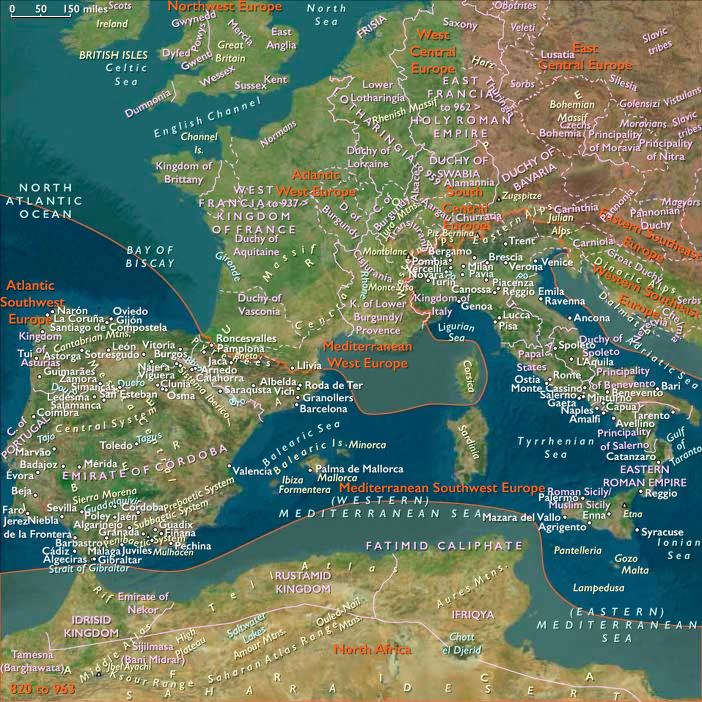
Between 916 and 927 CE, Atlantic Southwest Europe—including Galicia, northern and central Portugal, Asturias, Cantabria, and northern Spain south of the Franco-Spanish border (43.05548° N, 1.22924° W)—experienced significant political reunification, renewed stability, and sustained cultural growth. Under the capable rule of King Ordoño II (914–924 CE) and the initial years of his successor, King Fruela II (924–925 CE), and later Alfonso IV (925–931 CE), the previously fragmented Asturian territories were swiftly reconsolidated into the Kingdom of León, restoring cohesive governance, economic resilience, and cultural continuity. The Basques under the Kingdom of Pamplona continued maintaining political independence and influencing regional dynamics.
Political and Military Developments
Effective Reunification under Ordoño II
King Ordoño II successfully restored centralized authority over territories previously fragmented by Alfonso III’s division among his sons. By 918 CE, Ordoño firmly reunited Galicia, Asturias, and León, re-establishing unified governance and strategic military coordination, significantly strengthening frontier defenses along the Duero River against Islamic al-Andalus.
Brief Succession Uncertainty and Restored Stability
After Ordoño II’s death in 924 CE, brief instability occurred with the short reign of his brother, Fruela II (924–925 CE). This was quickly stabilized by the accession of Alfonso IV ("the Monk," 925–931 CE). Alfonso IV continued strengthening centralized authority, effectively maintaining stability and regional unity.
Continued Basque Autonomy under Sancho Garcés I
In the Kingdom of Pamplona, Sancho Garcés I (905–925 CE) and subsequently García Sánchez I (925–970 CE)maintained robust Basque independence. Pamplona skillfully balanced diplomatic relationships between León, al-Andalus, and neighboring territories, reinforcing Basque autonomy and significantly shaping Iberian politics.
Economic Developments
Renewed Economic Prosperity
Political reunification greatly enhanced regional economic stability. Villa-based agriculture, livestock husbandry, artisanal crafts, and mining activities—particularly gold and silver extraction in Galicia and Asturias—flourished consistently, significantly enriching regional prosperity and sustainability.
Stable Maritime and Regional Trade Networks
Coastal settlements such as Bracara Augusta (Braga) and smaller ports along Galicia and northern Portugal continued steady maritime commerce, maintaining reliable economic exchanges with broader Atlantic and Mediterranean markets. These trade connections reinforced regional resilience and prosperity.
Cultural and Religious Developments
Sustained Growth of Santiago de Compostela
The pilgrimage tradition to Santiago de Compostela maintained robust growth, steadily increasing in religious significance, economic benefit, and cultural prominence. Santiago’s pilgrimage tradition remained deeply embedded in regional identity, fostering cultural unity and religious devotion across Atlantic Southwest Europe.
Robust Ecclesiastical Authority and Social Cohesion
Bishoprics—particularly Braga, Lugo, Asturica Augusta, and Santiago de Compostela—continued their pivotal role, providing moral leadership, community governance, education, and social cohesion. Ecclesiastical institutions remained central to civic life, deeply integrating orthodox Christianity within regional cultural identity.
Monastic Revival and Scholarly Flourishing
Monastic communities continued thriving as essential cultural, educational, and economic centers, preserving manuscripts, advancing literacy and scholarship, enhancing agricultural productivity, and providing vital social welfare. Monasteries significantly contributed to cultural continuity and historical preservation.
Persistent Cultural Syncretism
The longstanding synthesis of orthodox Christianity with indigenous Celtic and Iberian traditions persisted robustly, especially in rural Galicia, Asturias, and northern Portugal. This cultural integration reinforced regional unity, resilience, and local distinctiveness.
Civic Identity and Governance
Restored Centralized Royal-Ecclesiastical Governance
Under Ordoño II’s reunification and Alfonso IV’s stabilizing rule, governance effectively integrated royal and ecclesiastical authority, providing stable central administration balanced by regional autonomy. Civic identities remained strongly anchored to León’s monarchy, ecclesiastical institutions, and pilgrimage traditions to Santiago de Compostela, re-establishing the region as the cohesive center of Iberian Christian identity.
Stable Basque Political and Cultural Autonomy
The Basques, centered around Pamplona, maintained their distinctive territorial independence, political autonomy, and civic identity. Their sustained autonomy decisively influenced broader regional dynamics, strengthening their distinct medieval identity.
Notable Tribal Groups and Settlements
-
Astures and Cantabri: Continued providing political cohesion, military strength, and core regional identity, decisively shaping Leónese governance structures.
-
Galicians and Lusitanians: Maintained resilient local governance, economic prosperity, and cultural autonomy, pragmatically cooperating with Leónese royal authority.
-
Basques: Maintained and solidified political independence, autonomy, and distinct governance under Pamplona, actively influencing regional political developments.
Long-Term Significance and Legacy
Between 916 and 927 CE, Atlantic Southwest Europe:
-
Successfully reunited and stabilized politically, decisively shaping future medieval territorial boundaries, governance structures, and regional cohesion under the Kingdom of León.
-
Sustained economic prosperity, robust ecclesiastical institutions, and vibrant cultural traditions, significantly influencing regional identity and historical continuity.
-
Reinforced Basque autonomy, decisively influencing subsequent Iberian regional dynamics and political identities.
This era significantly advanced political, economic, and cultural foundations, shaping Atlantic Southwest Europe's medieval trajectory and enduring historical legacy.
The Military Campaigns of Ordoño II of León
King Ordoño II of León aggressively expands and defends Christian territories against Muslim forces, fighting on multiple fronts to secure his kingdom’s dominance in the north.
Victories in Galicia and the Repulsion of Muslim Forces
In Galicia, Ordoño II leads Spanish Christian forces to defeat the Moors, preventing further Muslim encroachmentand securing the region for the Christian Reconquista.
Southern Campaigns: Sack of Mérida and Évora
Pushing southward, Ordoño II sacks Mérida and Évora, dealing a significant blow to Muslim control in the region. The local Muslim governor is ultimately forced to buy Ordoño’s retreat, demonstrating the effectiveness of his campaigns.
Eastern Campaigns: Alliance with Navarre and the Siege of San Esteban de Gormaz
To counter the powerful Emir of Córdoba, Abd-ar-Rahman III, Ordoño II forms an alliance with Sancho I Garcés, King of Navarre, strengthening Christian unity in northern Iberia.
In 912, Ordoño initiates the repopulation (repoblación) of San Esteban de Gormaz, a strategic border city between Christian and Muslim zones. This region, largely depopulated since the Muslim conquest, serves as a crucial buffer zone.
Upon learning of Ordoño’s efforts, Córdoban general Abi-Abda orders a siege of the city in 917 CE. However, Ordoño II swiftly comes to its defense, defeating the Muslim forces in September.
During the battle, Abi-Abda is captured and executed by decapitation, his head displayed on the city’s ramparts as a warning to the Moors, symbolizing the growing strength of the Christian kingdoms in Iberia.
Ordoño II’s Conquest of Arnedo and Calahorra (918 CE)
In 918 CE, King Ordoño II of León continues his military campaigns against Muslim-controlled territories, successfully capturing Arnedo and ...
...Calahorra from the Banu Qasi, a powerful Muladi (Muslim Iberian) dynasty in the Ebro Valley.
These victories further strengthen Christian control in the region, pushing the Muslim frontier southward and reinforcing Ordoño II’s role as a key figure in the Reconquista.
Abd ar-Rahman III’s Counteroffensive and the Battle of Valdejunquera (920 CE)
Having underestimated the power of Ordoño II, Emir Abd ar-Rahman III launches a major campaign in 920 CE to reclaim lost territories and reassert Cordoban dominance over the Christian kingdoms of the north.
Marching north, his forces successfully retake Osma and San Esteban de Gormaz, two key Christian frontier strongholds. After securing these towns, Abd ar-Rahman crosses into Navarre, where he inflicts a crushing defeat on the Christian armies at the Battle of Valdejunquera.
Aftermath: Christian Defeat and the Capture of Bishops
In the aftermath of the battle, the bishops of Tuy and ...
...Salamanca are taken captive, delivering a significant blow to the Christian leadership.
Though Abd ar-Rahman initially plans to march on Pamplona to further devastate the Christian resistance, he ultimately turns back to manage the immense spoils of war, consolidating his victory and reinforcing Muslim authority over the contested frontier.
Ordoño II’s Response to the Defeat at Valdejunquera and the Christian Counteroffensive
Following the defeat at the Battle of Valdejunquera (920 CE)—where Ordoño II of León had come to aid King Sancho I of Pamplona—he blames the loss on the absence of the Castilian counts, who had failed to answer his call to battle.
Determined to punish their disloyalty, Ordoño summons the Castilian counts to Tejares, where he has them executed, ensuring that future military campaigns will not suffer from the same lack of unity.
The Christian Counteroffensive and the Conquest of La Rioja
Despite the setback at Valdejunquera, the Christian kingdoms respond swiftly. A counteroffensive follows, leading to the occupation of La Rioja and the incorporation of Nájera and ...
...Viguera into the Kingdom of Navarre.
This campaign strengthens Christian control over the Ebro Valley, securing vital strategic positions against future Muslim incursions and expanding Navarre’s influence in the region.