Geoffrey Chaucer
English poet
Years: 1343 - 1400
Geoffrey Chaucer ( c. 1343 –October 25, 1400), known as the Father of English literature, is widely considered the greatest English poet of the Middle Ages and was the first poet to be buried in Poets' Corner of Westminster Abbey.
While he achieves fame during his lifetime as an author, philosopher, alchemist and astronomer, composing a scientific treatise on the astrolabe for his ten-year-old son Lewis, Chaucer also maintains an active career in the civil service as a bureaucrat, courtier and diplomat.
Among his many works, which include The Book of the Duchess, the House of Fame, the Legend of Good Women and Troilus and Criseyde, he is best known today for The Canterbury Tales.
Chaucer is a crucial figure in developing the legitimacy of the vernacular, Middle English, at a time when the dominant literary languages in England are French and Latin.

Related Events
Filter results
Showing 10 events out of 14 total
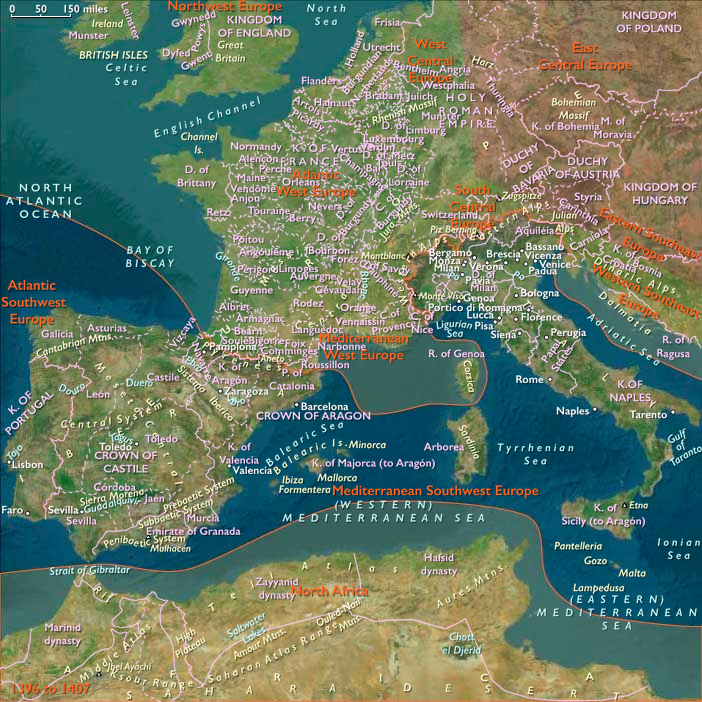
Northwest Europe (1252 – 1395 CE): Hundred Years’ War, Scottish Independence, and North Sea Commerce
Geographic and Environmental Context
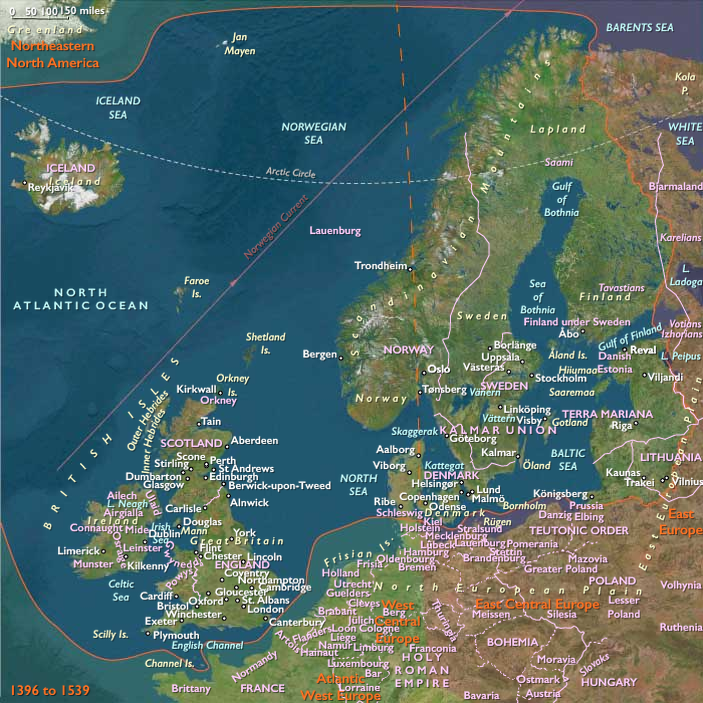
Northwest Europe includes Iceland, Ireland, the United Kingdom, the Faroe, Shetland, and Orkney Islands, the Channel Islands, and the western coastal zones of Norway and Denmark (west of 10°E).
-
Anchors: London–Westminster, Dublin–Cork–Waterford, Edinburgh–Stirling, Bergen, Reykjavík–Thingvellir, Channel ports (Dover, Southampton, Bristol), and North Sea ports (Hull, King’s Lynn).
Climate and Environmental Shifts
-
Little Ice Age onset (~1300): cooler, wetter conditions reduced yields; Great Famine (1315–1317) struck Britain and Ireland.
-
Black Death (1348–1350): decimated urban populations (London, Dublin, York, Edinburgh, Bergen).
-
Fisheries (herring, cod) thrived in colder seas.
Societies and Political Developments
-
England: Edward I’s conquest of Wales (1282); Wars of Scottish Independence (1296–1328, 1332–1357); Hundred Years’ War against France (from 1337).
-
Scotland: William Wallace, Robert the Bruce, and victory at Bannockburn (1314) secured independence, recognized in the Treaty of Edinburgh–Northampton (1328).
-
Ireland: Anglo-Norman lordship declined; Gaelic resurgence after 14th-century crises.
-
Norway: waning influence; Orkney, Shetland, Hebrides slipped toward Scottish control.
-
Iceland: under Norwegian crown (1262–64); Althing continued local governance.
Economy and Trade
-
English wool: critical for Flemish cloth industry; Calais staple (post-1347 English conquest) reorganized trade.
-
North Sea ports: Hull, King’s Lynn, Bristol handled wine, cloth, fish.
-
Hanseatic merchants entered London (Steelyard).
-
Norwegian stockfish trade (Bergen to Lübeck, London) flourished; Iceland supplied wool and fish.
Belief and Symbolism
-
Gothic architecture: Westminster Abbey, York Minster; Scottish abbeys; Norwegian stave churches persisted.
-
Saint cults: St. Thomas Becket in Canterbury, St. Magnus in Orkney.
-
Mysticism: English and Irish vernacular devotion expanded (Julian of Norwich).
Adaptation and Resilience
-
Maritime redundancy: trade shifted among ports during war or plague.
-
England’s parliamentary institutions matured (Model Parliament, 1295).
-
Scotland consolidated monarchy; Ireland fragmented between Gaelic and Anglo-Norman spheres.
Long-Term Significance
By 1395, Northwest Europe was a fractured but dynamic region: England locked in war with France, Scotland independent, Ireland divided, and the North Sea–North Atlantic fisheries increasingly central. It was a crucible for the late-medieval state and maritime economy.
Northwest Europe (1360–1371 CE): Recovery, Conflict, and Cultural Flourishing
England and France: Treaty and Respite
The period opened with the Treaty of Brétigny in 1360, temporarily concluding hostilities in the prolonged Hundred Years' War between England and France. Under the treaty's terms, England secured substantial territorial gains in southwestern France. However, this respite proved unstable, characterized by continued mistrust and intermittent military skirmishes that strained peace and foreshadowed renewed conflicts.
Scotland: Renewed Stability and National Confidence
In Scotland, the era was marked by relative stability under the reign of David II, who returned from English captivity following the Treaty of Berwick in 1357. David’s rule saw increased internal stabilization and diplomatic engagement with both England and continental powers, significantly strengthening Scotland's national identity and political coherence.
Ireland: Gaelic Revival and Norman Retreat
Ireland continued to witness an accelerated Gaelic revival, as indigenous Gaelic lords expanded their control over previously Norman-held lands. The Norman influence receded further into isolated coastal areas around the Pale, with major Gaelic dynasties such as the O'Neills and O'Connors consolidating their regional dominance, significantly reshaping Ireland's political landscape.
Denmark: Gradual Restoration and Monarchical Consolidation
Denmark experienced gradual recovery from earlier political fragmentation, marked by the reestablishment of stronger monarchical authority under Valdemar IV Atterdag. His reign was characterized by ambitious reforms and territorial reconquests, revitalizing Denmark’s international stature and internal coherence, despite lingering economic difficulties.
Norway and Sweden: Declining Influence and Tensions
The united reign of Magnus IV over Norway and Sweden faced increased internal tensions and declining authority. Opposition from regional nobles and succession disputes undermined centralized power, culminating in civil unrest and challenges to Magnus’s authority, signaling the beginning of significant political fragmentation in the union.
Iceland: Continued Literary and Cultural Productivity
In Iceland, literary and cultural production continued robustly despite the island's political incorporation into the Norwegian kingdom. Sagas such as Njal's Saga, composed between about 1230 and 1290, both glorified and repudiated Iceland’s Saga Age (870–1050). The legendary Völsunga Saga, completed in the late thirteenth century, retold mythological tales featuring Odin and supernatural motifs, maintaining Iceland's vibrant intellectual and literary landscape.
Economic and Social Impact of the Black Death
The aftermath of the catastrophic Black Death profoundly reshaped Northwest Europe's economic and social structures. Population decline resulted in labor shortages, shifting economic power towards surviving peasants and artisans who gained improved wages and conditions. This profound social shift generated tensions between the aristocracy and the lower classes, triggering widespread socio-economic transformations.
Religious Movements and Social Unrest
Dominican and Franciscan religious orders continued active roles in societal reform and intellectual discourse, addressing the spiritual crises precipitated by the plague. Religious fervor increased, sometimes manifesting in movements critical of established ecclesiastical authority, reflecting broader social dissatisfaction and foreshadowing later religious reforms.
Artistic and Architectural Continuity
Architectural projects continued to reflect the era's cultural ambition despite ongoing challenges. Construction in the Perpendicular Gothic style flourished, exemplified by continued developments at York Minster, where ambitious architectural plans progressed steadily. Artistic patronage remained robust, illustrating societal resilience amid broader disruptions.
Geoffrey Chaucer and Literary Innovations
The emerging literary figure Geoffrey Chaucer began his influential career during this period. Having studied law and philosophy, Chaucer wrote “The Book of the Duchess” around 1369–1370, an elegiac poem marking the death of Blanche, duchess of Lancaster. His works significantly contributed to English literature, incorporating French poetic forms and fostering the development of vernacular literature.
Legacy of the Era
By 1371 CE, Northwest Europe stood significantly altered by recent challenges. While political recovery, cultural vitality, and economic transformation provided new pathways forward, underlying social tensions hinted at future upheavals, setting the stage for subsequent eras of profound political, religious, and social change.
Geoffrey Chaucer, whose father, John Chaucer, a prosperous London wine merchant with some influence in the court of Edward III, had by 1357 been placed as a seventeen-year-old page in the household of Elizabeth de Burgh, countess of Ulster and wife of the king’s third son, Lionel.
During military service in France in 1359, Chaucer had been captured near Reims but had been ransomed by the Crown.
Chaucer is believed to have studied, in the early 1360s, at the Inns of Chancery and the Inns of Court, and possibly at Oxford, as further preparation for an administrative career at court.
He marries Philippa de Roet, an aristocratic lady, in 1366.
Chaucer by 1367 becomes a yeoman, or valet (vallectus), in the household of King Edward; in 1368, he is mentioned as the king's armiger (esquire).
Blanche, duchess of Lancaster and wife of John of Gaunt, Edward’s fourth son, dies in 1368.
Chaucer in late 1369 or early 1370 writes “The Book of the Duchess,” an elegy for Blanche cast as a traditional French dream-vision and written in eight-syllable lines rhymed in couplets, a form characteristic of French poetry.
French historian and poet Jean Froissart is twenty-three-years old in 1360 when he begins work on his “Chronicles,” an account of European affairs beginning in 1325.
Borrowed from the work of his elder contemporary Jean Le Bel for the period up to 1356; he bases his account of subsequent events on eyewitness reports.
A writer of lyric poetry as well as a historian, Froissart expresses the courtly view of life in “Meliador,” a long Arthurian verse romance.
What little is known of Froissart's life comes mainly from his historical writings and from archival sources which mention him in the service of aristocrats or receiving gifts from them.
Although his poems have also been used in the past to reconstruct aspects of his biography, this approach is in fact flawed, as the 'I' persona which appears in many of the poems should not be construed as a reliable reference to the historical author.
Froissart comes from Valenciennes in the County of Hainaut, situated in the western tip of the Holy Roman Empire, bordering France.
Earlier scholars have suggested that his father was a painter of armorial bearings, but there is actually little evidence for this.
Other suggestions include that he began working as a merchant but soon gave that up to become a cleric.
For this conclusion there is also no real evidence, as the poems which have been cited to support these interpretations are not really autobiographical.
By about age twenty-four, Froissart leaves Hainault and enters the service of Philippa of Hainault, queen consort of Edward III of England, in 1361 or 1362.
This service, which will have lasted until the queen's death in 1369, has often been presented as including a position of court poet and/or official historiographer.
Based on surviving archives of the English court, Croenen has concluded instead that this service did not entail an official position at court, and probably was more a literary construction, in which a courtly poet dedicated poems to his 'lady' and in return received occasional gifts as remuneration.
Froissart takes a serious approach to his work.
He travels in England, Scotland, Wales, France, Flanders and Spain gathering material and firsthand accounts for his Chronicles.
He travels with Lionel, Duke of Clarence, to Milan to attend and chronicle the duke's wedding to Violante, the thirteen-year-old daughter of Galeazzo Visconti, in May 1368.
At this wedding, two other significant writers of the Middle Ages are present: Chaucer and Petrarch.
Northwest Europe (1372–1383 CE): Political Realignments and Cultural Vitality
England and France: Escalation of Hostilities
The uneasy peace established by the Treaty of Brétigny broke down completely as hostilities reignited in the Hundred Years' War. By 1372, English territorial gains in France began to diminish as French forces, under the strategic leadership of Charles V, successfully retook key territories such as Poitou and Saintonge. The English faced notable defeats, including the significant naval setback at the Battle of La Rochelle (1372), weakening their continental foothold.
Scotland: Succession and Political Stability
Scotland experienced significant political change with the death of David II in 1371, succeeded by Robert II, marking the beginning of the Stuart Dynasty. Robert II’s ascension brought about increased stability and internal consolidation, as the new royal line worked to strengthen Scottish national identity and resolve longstanding internal rivalries.
Ireland: Continued Gaelic Expansion
In Ireland, Gaelic resurgence intensified, further reducing Norman influence beyond the shrinking confines of the Pale. Indigenous Gaelic dynasties, including the powerful O’Neill and O’Brien clans, solidified their territorial control. This period saw a marked retreat of English rule, with Gaelic law and culture reasserting dominance across much of Ireland.
Denmark: Valdemar IV’s Reign and Territorial Consolidation
Under Valdemar IV Atterdag, Denmark continued to recover economically and politically. Valdemar pursued aggressive territorial expansion, successfully reintegrating lost provinces and significantly strengthening the monarchy. However, his death in 1375 ushered in uncertainty, setting the stage for subsequent succession struggles and political instability.
Norway and Sweden: Fragmentation and Dynastic Struggles
The weakening reign of Magnus IV finally ended in 1374, giving rise to intensified political fragmentation between Norway and Sweden. Internal struggles and succession disputes significantly diminished centralized power, as regional nobles increasingly asserted their independence. Norway particularly began drifting under the influence of Danish monarchy, laying groundwork for later dynastic unions.
Iceland: Continued Cultural Productivity
Despite its political incorporation into Norway, Iceland maintained a vibrant cultural and literary tradition. The ongoing composition and circulation of sagas and poetic works, such as adaptations and expansions of earlier legendary and historical narratives, illustrated Iceland’s continued intellectual and literary vitality, reinforcing its cultural resilience amidst political shifts.
Socio-Economic Transformations Post-Black Death
Northwest Europe continued to grapple with the demographic and economic consequences of the Black Death, as labor scarcity profoundly reshaped rural and urban societies. Peasants increasingly asserted their rights, securing improved conditions and wages, while landholders struggled to adapt to new economic realities, creating tension and occasional unrest.
Religious Movements and Reformist Critiques
Religious fervor intensified, further inspired by socio-economic upheavals. Reformist critiques, exemplified by emerging figures such as John Wycliffe in England, began challenging traditional ecclesiastical structures and advocating for religious and social reforms. These critiques would profoundly influence future religious transformations, notably foreshadowing the later Protestant Reformation.
Architectural and Artistic Developments
Cultural production flourished amid political uncertainty, with significant progress in architectural projects. The expansion of York Minster in the ambitious Perpendicular Gothic style continued, symbolizing resilience and cultural pride. Artistic endeavors, including manuscript illumination and church decoration, underscored an ongoing appreciation for sophisticated artistry and cultural expression.
Geoffrey Chaucer: Literary Maturity
Geoffrey Chaucer continued his literary ascent, producing works that enriched English vernacular literature. His poem “House of Fame,” composed after his diplomatic missions to Italy in 1372–1373, showcases both overt and subtle influences from Dante’s "Divine Comedy" and the works of Petrarch and Boccaccio. In 1374, King Edward III appointed Chaucer controller of customs and subsidies on wool, skins, and hides for the port of London. Chaucer’s diplomatic roles frequently took him abroad, notably to France in 1377 to negotiate the marriage of Princess Marie of France and Prince Richard, the future Richard II. By 1380, he had translated significant philosophical and theological texts, including Boethius's “Consolation of Philosophy”, Pope Innocent III's “On the Misery of the Human Condition,” and “Life of Saint Cecilia” from the “Golden Legend.” Chaucer’s literary contributions significantly developed narrative poetry, drawing from continental influences while fostering distinctly English sensibilities, exemplifying the cultural vibrancy and intellectual curiosity of this era.
Legacy of the Era
By 1383 CE, Northwest Europe experienced significant political realignments, economic shifts, and cultural developments. The era's socio-political uncertainties coexisted with vibrant cultural productivity, setting the stage for enduring transformations in governance, society, religion, and artistic expression in subsequent decades.
Geoffrey Chaucer’s “House of Fame,” written, like “The Book of the Duchess,” in eight-syllable lines rhymed in couplets, contains some overt parody of Dante's “Divine Comedy” (and thus is usually dated after Chaucer's Italian mission in 1372—73, when a familiarity with the Italian language enables him to read the works of Petrarch, Dante, and Boccaccio; the last whom he is said to have met in Florence.)
King Edward III on June 8, 1374, appoints Chaucer controller of the customs and subsidies on wool, skins, and hides for the port of London.
The ambassadorial missions undertaken by Chaucer, who is evidently an exceptionally able and trusted civil servant, frequently take him to France—once, in 1377, to negotiate a marriage between Princess Marie of France and Prince Richard, who in that year becomes Richard II—and at least once more to Italy, in 1378.
Chaucer around 1380 translates several meditative Latin works whose terms had been important in his own artistic terminology: Boethius's “Consolation of Philosophy;” Pope Innocent III's “On the Misery of the Human Condition,”(the translation of which is lost but survives in part in his later “Canterbury Tales” in the "Man of Law's Tale"); and a “Life of Saint Cecilia” from the “Golden Legend.”
He also (possibly) translates an abbreviated French version of part of the “Book of Consolation and Counsel” by Albertanus of Brescia (which appears as the "Tale of Melibeus" in "The Canterbury Tales”).
Chaucer writes or begins to write a satirical dream-vision,“The Parliament of Fowls,” the “Legend of Good Women,” an unfinished series of nine so-called lives of Cupid's saints like Cleopatra and Dido, in about 1382, the year that Richard makes him controller of petty customs.
Boccaccio had completed his affectionate biography of Dante, “Trattatello in laude di Dante” (“Little Tractate in Praise of Dante,” in 1372.
The following year, by invitation of the Florentine Commune, he had delivered public readings of Dante's Divine Comedy (and is said to have met Chaucer in Florence in that year).
He dies at sixty-two on December 21, 1375, having outlived his great friend and fellow humanist Petrarch, who had died at seventy on July 19 of the previous year.
Northwest Europe (1384–1395 CE): Turmoil, Transition, and Cultural Flourishing
England: Political Turbulence, Chaucer’s Literary Peak, and the Rise of Lollardy
The political instability under Richard II continued as the youthful king's favoritism toward certain nobles increased tensions among the English aristocracy. The period was characterized by ongoing disputes between royal authority and powerful magnates, exacerbated by the death of influential reformer John Wycliffe on December 31, 1384. Wycliffe's theological challenges to ecclesiastical authority left an enduring legacy through the Lollards, who criticized the church's power and wealth. Led by Wycliffe's "poor priests," the Lollards taught from his English translation of the Bible, preaching a nonsacramental Christianity focused on poverty, ethical purity, and personal devotion. Their rapid spread attracted support from Oxford scholars, powerful nobles, merchants, and the common people, further intensifying religious and social debates.
During these turbulent times, Geoffrey Chaucer, England’s preeminent literary figure, significantly advanced his literary contributions. By 1385, Chaucer had embarked on composing "Troilus and Criseyde," considered among his greatest poetic achievements, further enhancing the prestige of English vernacular literature. He also produced "The Legend of Good Women" around 1386, demonstrating his continued creativity and influence.
Scotland: Military Resilience and Stewart Consolidation
Under Robert II, Scotland faced renewed threats from England. The earlier failed invasion known as Burnt Candlemas in early 1356, commanded by King Edward III, had been the last major campaign of the Second War of Scottish Independence. In 1385, Richard II launched another devastating but ultimately unsuccessful invasion, which reinforced Scottish resilience rather than weakening it. This event strengthened national unity and further solidified the legitimacy of the Stewart monarchy, contributing to a period of relative internal stability despite external pressures.
Ireland: Gaelic Autonomy and Norman Decline
In Ireland, Gaelic lordships continued consolidating power and autonomy, significantly diminishing Norman influence outside the Pale. The powerful Gaelic dynasties, notably the O'Neill and O'Brien clans, fortified their territories, reinforcing traditional Gaelic law and culture and further distancing Ireland from Anglo-Norman dominance.
Denmark and Norway: Toward Dynastic Union
Following the reign of Valdemar IV, Denmark experienced ongoing political uncertainty and dynastic struggles. This instability paved the way for future dynastic shifts and greater alignment with Norway. Meanwhile, Norway’s weakened monarchy increasingly aligned itself with Danish interests, anticipating the dynastic union that would soon follow, significantly reshaping Scandinavia’s political landscape.
Iceland: Literary Flourishing Amidst Political Dependency
Despite political subordination to Norway, Iceland maintained a vibrant cultural tradition. The composition of sagas continued to thrive, epitomized by the completion of the influential Njal's Saga around this time, which provided both glorification and critique of Iceland’s Saga Age and the Sturlung Age. These literary works underscored Iceland’s enduring intellectual and cultural vitality, maintaining a distinct national identity.
Social and Economic Shifts
Across Northwest Europe, the demographic and economic aftershocks of the Black Death persisted. The widespread scarcity of labor empowered peasants to seek improved conditions and rights, challenging traditional feudal relationships. The nobility, meanwhile, struggled to adapt to these shifting economic realities, leading to increased tensions and eventual social restructuring.
Architectural Ambition: York Minster
Despite broader societal uncertainties, significant architectural developments continued. The expansion and refinement of York Minster in the ornate Perpendicular Gothic style proceeded, representing cultural resilience and artistic ambition. The ongoing construction symbolized both spiritual devotion and a commitment to cultural expression during a period of political and social upheaval.
Legacy of the Era
By 1395 CE, Northwest Europe had navigated significant political, cultural, and economic transitions. The resilience of its societies during this tumultuous era set the stage for significant future developments in governance, literature, and cultural identity. Notably, the literary and architectural achievements of this period, alongside emerging religious movements such as the Lollards, would profoundly influence subsequent European intellectual and artistic traditions.
Chaucer had rewritten a stellar version of the romantic “tragedy,” Troilus and Criseyde in about 1385.
In the work’s five books and more than eighty-two hundred lines in rhyme royal stanzas, Chaucer transforms Boccaccio's stylized Filostrato by his penetrating analysis of common human motives within a Boethian and ultimately Christian overview.
Chaucer had served in 1385 as justice of peace for Kent, and in 1386 had been elected representative to Parliament from Kent, having that year given up his two posts of customs controller, both of which were important for the king's revenues.
He had in 1387 begun his Canterbury Tales, a collection of twenty-four tales, with frequent dramatic links, told to pass the time during a spring pilgrimage to the shrine of St. Thomas a Becket in Canterbury.
For a comic effect in his “Tale of Sir Thopas,” written in mock epic style around 1387, Chaucer employs doggerel: monotonous, excessively regular verse, predictable in both rhythm and rhyme to the point of banality.
Appointed clerk of the king's works in 1389, Chaucer continues to receive, in addition to salary, gifts and annuities for his service to the Crown.
John Gower, whose work is favorably compared by contemporaries with that of his friend Geoffrey Chaucer, writes in Latin and French, but his masterpiece is the long (thirty-three thousand lines), formal, didactic poem in English, Confessio Amantis, a blend of contemporary learning with classical stories often taken from the Latin poet Ovid, in which the poet discusses the Seven Deadly Sins and also develops the theme of courtly love with great rhetorical skill and subtlety.
It stands with the works of Chaucer, Langland, and the Pearl poet as one of the great works of late fourteenth-century English literature.
Composition of the work probably began around 1386, and the work is completed in 1390.
The prologue of this first recension recounts that the work was commissioned by Richard II after a chance meeting with the royal barge on the River Thames; the epilogue dedicates the work to Richard and to Geoffrey Chaucer, as the "disciple and poete" of Venus.
This version of the work saw widespread circulation, perhaps due to its royal connections (Peck 2000), and is the most popular of Gower's works, with at least thirty-two of the forty-nine surviving manuscripts of the Confessio containing this version.
In genre it is usually considered a poem of consolation, a medieval form inspired by Boethius' Consolation of Philosophy and typified by works such as Pearl.
Despite this, it is more usually studied alongside other tale collections with similar structures, such as the Decameron of Boccaccio, and particularly Chaucer's Canterbury Tales, with which the Confessio has several stories in common.