Gilbert Motier de La Fayette
Marshal of France
Years: 1380 - 1462
Gilbert Motier de La Fayette (1380 – February 22, 1462) Lord of La Fayette, Pontgibaud Ayes, Nébouzac, Saint-Romain and Monteil Gelat, is a Marshal of France
Related Events
Filter results
Showing 5 events out of 5 total
The Battle of Baugé (March 21, 1421): The English Defeat and the Death of the Duke of Clarence
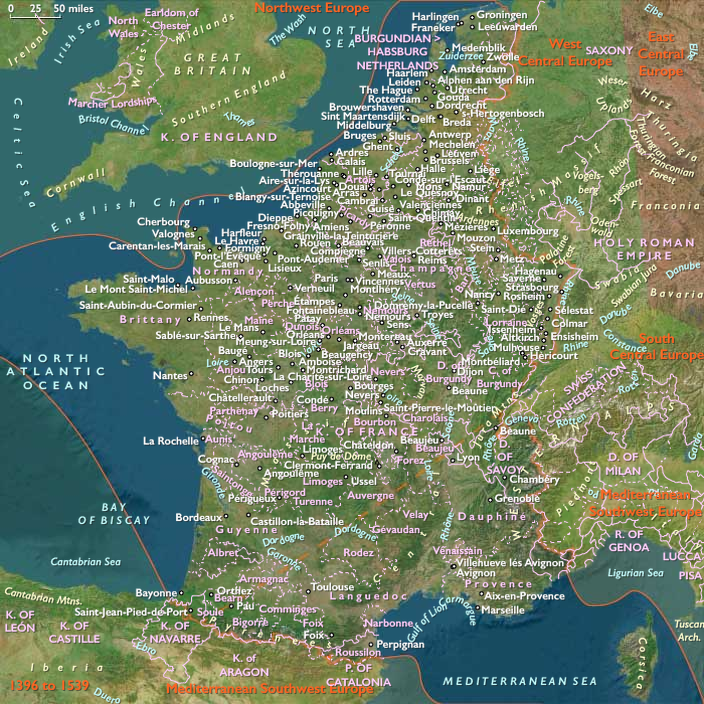
The Battle of Baugé, fought on March 21, 1421 (Easter Saturday), was a decisive Franco-Scottish victory during the Hundred Years’ War, marking England’s first major defeat since Agincourt (1415). The battle was largely determined by the rash leadership of Thomas, Duke of Clarence, brother of King Henry V of England, who led a reckless charge with insufficient forces and was killed in battle.
I. The English Chevauchée and the Approach to Battle
- Clarence, following King Henry V’s orders, led 4,000 men in a devastating chevauchée through Anjou and Maine, encountering little resistance.
- By March 21, 1421 (Good Friday), his forces camped near the town of Vieil-Baugé.
- Meanwhile, a Franco-Scottish force of around 5,000 men, commanded by:
- John Stewart, Earl of Buchan (leading the Scots).
- Gilbert Motier de La Fayette, the new Constable of France.
- The Franco-Scottish force moved into the area to block further English advances.
II. The Dispersed English Forces and Clarence’s Rash Decision
- The English army was scattered, as many of the archers had ridden off in search of plunder and forage.
- On Easter Saturday, Clarence’s scouts captured a Scottish man-at-arms, revealing the presence of the Franco-Scottish army.
- Clarence faced a dilemma:
- A battle on Easter Sunday was unthinkable due to its religious significance.
- A two-day delay was also unacceptable, as it would allow the Franco-Scots time to strengthen their position.
- Walter Bower’s chronicles suggest that a brief truce was agreed upon, but battle nevertheless commenced that same day.
III. The Reckless Charge and the Battle at the Bridge
- Ignoring the advice of his lieutenants, Huntingdon and Gilbert Umfraville, Clarence ordered the Earl of Salisbury to round up the archers and follow as soon as possible.
- With only 1,500 men-at-arms and virtually no archers, Clarence charged the Franco-Scottish lines, underestimating their strength.
- A hundred Scottish archers, led by Sir Robert Stewart of Ralston, along with the retinue of Hugh Kennedy, held the bridge long enough for the Earl of Buchan to rally the main force.
- When Clarence finally forced his way across, he was confronted by the bulk of the Franco-Scottish army, whose men-at-arms had dismounted and were protected by archers.
IV. The Death of the Duke of Clarence
- In the melee, John Carmichael of Douglasdale broke his lance unhorsing Clarence.
- Several versions exist of how Clarence met his death:
- Bower’s account: Scottish knight John Swinton wounded Clarence in the face, but Alexander Buchanan struck the fatal blow with a mace, then raised Clarence’s coronet on his lance in triumph.
- Another tradition states Alexander Macausland of Lennox killed Clarence.
- French chronicler Georges Chastellain attributes Clarence’s death to a Frenchman.
V. Salisbury’s Counterattack and the English Retreat
- Later that evening, the Earl of Salisbury regrouped the remaining English forces, using his archers to cover the retreat.
- He managed to rescue the surviving English troops and retrieve Clarence’s body.
- Despite this, the battle ended in a decisive Scottish-French victory.
VI. Consequences of the Battle
- First major English defeat since Agincourt (1415), shattering the illusion of English invincibility.
- Boosted Franco-Scottish morale, securing Charles VII’s resistance against English occupation.
- Clarence’s death weakened English leadership in France, as he had been one of Henry V’s most experienced commanders.
- Strengthened the reputation of the Scottish forces, who were crucial in defending the French Dauphin’s cause.
The Battle of Baugé (March 21, 1421) was a turning point, demonstrating that the English war machine was not invincible and that the Franco-Scottish alliance could effectively challenge English advances.
ftermath of the Battle of Verneuil (1424): The Fate of the Scottish Army and the French Response
Despite suffering devastating losses at the Battle of Verneuil (August 17, 1424), the Army of Scotland was not completely annihilated. However, the defeat significantly weakened its role in future campaigns, as Scottish reinforcements to France drastically declined after this battle.
The Dauphin Charles VII, though devastated by the loss, continued to honor the Scottish survivors, recognizing their sacrifices in the fight against English domination.
I. The Diminished Role of the Scottish Army in France
- While the Franco-Scottish force had suffered enormous casualties, with over 4,000 Scots killed, some survivors remained active in the French cause.
- The battle marked a turning point, as Scotland could no longer provide large-scale military reinforcementsto France.
- The destruction of the Scottish contingent severely weakened Charles VII’s ability to challenge English control in northern France.
II. The Fate of the Captured Commanders
Among the high-ranking prisoners captured by the English were:
- John, Duke of Alençon, a key nobleman in the Dauphin’s army.
- Pierre, the Bastard of Alençon.
- Gilbert Motier de La Fayette, Marshal of France, who had fought alongside the Scots.
Their captivity further disrupted the French war effort, depriving Charles VII of important commanders.
III. Charles VII’s Response and the Recognition of Scottish Survivors
- Charles VII, though greatly saddened by the catastrophe at Verneuil, continued to honor the remaining Scottish troops who had fought for him.
- One such survivor was John Carmichael of Douglasdale, the chaplain to the slain Archibald Douglas, Earl of Douglas.
- In recognition of his service and the sacrifice of the Scottish troops, Carmichael was appointed Bishop of Orléans, a symbolic gesture of gratitude toward Scotland.
IV. Consequences for the Hundred Years' War
- Verneuil marked the effective end of large-scale Scottish involvement in the Hundred Years' War.
- The French were forced to rely more on native troops and diplomacy in their continued resistance against English rule.
- The defeat solidified English control over northern France, making the task of reconquering lost territories even more difficult for Charles VII.
The Battle of Verneuil (1424) was a disaster for the Franco-Scottish alliance, effectively ending Scotland’s ability to send major reinforcements and further weakening Charles VII’s military position. However, the recognition of Scottish survivors, like John Carmichael, showed that their sacrifices were not forgotten, as France continued its long struggle for independence from English rule.

Gilbert Motier de La Fayette, Richemont, and the Turning Point at Arras (1435)
Gilbert Motier de La Fayette, Marshal of France and influential member of King Charles VII’s Great Council, played a pivotal diplomatic role at the critical conferences of Nevers and ...
...Arras in 1435. These diplomatic gatherings laid essential groundwork for the reconciliation between Charles VII and Philip the Good, Duke of Burgundy, effectively shifting the balance of power in the protracted Hundred Years' War.
Arthur de Richemont, Constable of France, skillfully leveraged his extensive Burgundian connections to negotiate and finalize the Treaty of Arras, signed on September 21, 1435. This landmark agreement ended decades of bitter hostility stemming from the 1419 assassination of Philip’s father, John the Fearless, a crime in which Charles VII had been implicated. The treaty fundamentally altered the geopolitical landscape by severing Burgundy's longstanding alliance with England, consolidating Charles VII’s legitimacy, and isolating English ambitions in northern France. It marked a critical turning point—not only in the Hundred Years' War—but also in Richemont's distinguished political and military career, significantly elevating his status as a statesman and diplomat.
Under the terms established by the pivotal Treaty of Arras (September 1435), Philip formally recognized Charles VII as the legitimate king of France, abandoning the rival claim of England’s Henry VI. In return, Charles VII granted Philip significant concessions, notably exempting Burgundy from homage to the French crown and pledging justice for the murder of Philip’s father, John the Fearless.
The treaty profoundly reshaped the political landscape. The bitter divide between the Armagnac and Burgundian factions, which had dominated French internal politics for decades, effectively dissolved. With Burgundy now aligned firmly with Charles VII, France consolidated its internal unity against England, leaving Henry VI diplomatically isolated.
Already allied with Scotland, France's strengthened diplomatic position rendered England increasingly vulnerable. From 1435 onward, English influence and territorial control in northern France steadily eroded, signaling the beginning of their ultimate expulsion from the continent. The Treaty of Arras thus marked not only a diplomatic turning point but also the practical end of significant English ambition in Atlantic West Europe.