Haakon Sigurdarson
de facto ruler of Norway
Years: 937 - 995
Haakon Sigurdarson (Haakon Jarl) (c. 937 – 995) is the de facto ruler of Norway from about 975 to 995.

Related Events
Filter results
Showing 10 events out of 10 total
Haakon is the son of Sigurd Haakonsson, Jarl of Lade and ruler of Trøndelag and Hålogaland.
His mother was Bergljot Toresdatter, daughter of Tore Ragnvaldsson, Earl of Møre.
Adam of Bremen wrote that he was "of the stock of Ivar (possibly Ivar the Boneless) and descended from a race of giants".
In the sagas, Haakon claimed descent from the divine lineage of Sæming, son of Odin.
The Hakon Jarl Runestones in Sweden may refer to him.
Haakon had become earl after his father was killed by King Harald Greycloak's men in 961.
He had warred with King Harald for some time, until he was forced to flee to Denmark and Harald Bluetooth.
In Denmark he had conspired with Harald Bluetooth against Harald Greycloak.
Haakon Jarl arranges the death of Harald Greycoak around 970 with the connivance of Harald Bluetooth, who had invited his foster-son to Denmark to be invested with new Danish fiefs.
Civil war breaks out between Haakon Jarl and the surviving brothers of Harald Greycloak, but Haakon proves victorious.
After this, Haakon Jarl rules Norway as a vassal of Harald Bluetooth, but he is in reality an independent ruler.
Haakon Sigurdarson, the de facto ruler of Norway, attacks Götaland on behalf of Harald Bluetooth and kills its ruler, Jarl Ottar.
Denmark’s King Harald “Bluetooth” Gormson, baptized in 965, is the first Scandinavian monarch to actively promote Christianity.
Although Harald's predecessors had adopted Christianity at the instigation of the Frankish Carolingian kings in 826, paganism would remain predominant among Danes and northerners for centuries.
However, the prominent part the Germans had in these achievements as well as the lofty idea of the Roman Empire currently prevailing had led Otto I “the Great,” to require Harald to recognize him as advocatus, or lord protector of the Danish church, and even as "Lord Paramount".
The king of the Danes had replied to this demand with a declaration of war, and the emperor seeks to force his "vassal" into subjection.
The devastating expeditions, which are pushed as far as the Limfjord, enable the emperor to beat down all opposition by 972 and to compel Harald not only to conclude peace but to accept baptism.
Henceforth paganism will steadily lose ground.
Haakon goes to Denmark around 973-974 to help Harald Bluetooth in his defense against the Emperor Otto I, whose forces successfully oppose an attempt by Harald to throw off the German yoke.
After this, Haakon pays no taxes to Denmark.
When Haakon is in Denmark, Harald Bluetooth forces him to accept baptism and assigns him clergymen to take to Norway to spread Christianity.
When a favorable wind comes for Haakon to leave, he commands the clergymen to return ashore.
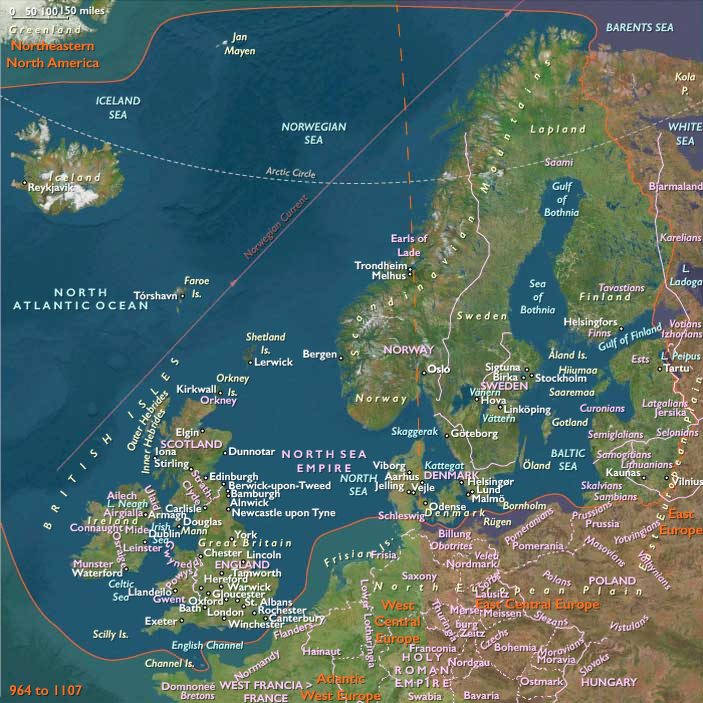
It is not known when and how the kingdom of Sweden was born, but the list of Swedish monarchs is drawn from the first kings known to have ruled both Svealand (Sweden) and Götaland (Gothia) as one province, beginning with Eric the Victorious.
Sweden and Gothia were two separate nations long before that into antiquity.
It is not known how long they existed: the epic poem Beowulf describes semi-legendary Swedish-Geatish wars in the sixth century.
"Götaland" in this sense, mainly included the provinces of Östergötland (East Gothia) and Västergötland (West Gothia).
The island of Gotland is disputed by other than Swedes, at this time (Danish, Hanseatic, and Gotland-domestic).
Småland is at this time of little interest to anyone due to the deep pine forests, and only city, Kalmar with its castle, is of importance.
The southwest parts of the Scandinavian peninsula consist of three Danish provinces (Scania, Blekinge and Halland).
North of Halland, Denmark has a direct border to Norway and its province Bohuslän.
There are Swedish settlements in southwest Finland, and along the southern coastline of Norrland.
The culture and history of Svealand has been preserved better than that of Götaland.
Haakon is a strong believer in the old Norse gods, and when Harald Bluetooth attempts to force Christianity upon him around 975, Haakon breaks his allegiance to Denmark.
Haakon is the son of Sigurd Haakonsson, Jarl of Lade and ruler of Trøndelag and Hålogaland.
His mother was Bergljot Toresdatter, daughter of Tore Ragnvaldsson, Earl of Møre.
Adam of Bremen wrote that he was "of the stock of Ivar (possibly Ivar the Boneless) and descended from a race of giants".
In the sagas, Haakon claimed descent from the divine linage of Sæming, son of Odin.
The Hakon Jarl Runestones in Sweden may refer to him.
Haakon had become earl after his father was killed by King Harald Greyhide's men in 961.
He warred with King Harald for some time, until he was forced to flee to Denmark and Harald Bluetooth.
In Denmark, he had conspired with Harald Bluetooth against Harald Greyhide.
Haakon Jarl had arranged the death of Harald Greyhide around 971 with the connivance of Harald Bluetooth, who had invited his foster-son to Denmark to be invested with new Danish fiefs.
Civil war had broken out between Haakon Jarl and the surviving brothers of Harald Greyhide, but Haakon proved victorious.
After this, Haakon Jarl ruled Norway as a vassal of Harald Bluetooth, but he is in reality an independent ruler.
For Harald, he had attacked Götaland and killed its ruler Jarl Ottar.
When Haakon was in Denmark, Harald Bluetooth had forced him to accept baptism and assigned him clergymen to take to Norway to spread Christianity.
When a favorable wind came for Haakon to leave, he had commanded the clergymen to return ashore.
Around 973-974, he had gone to Denmark to help Harald Bluetooth of Denmark in his defense against the Holy Roman Emperor Otto II.
Otto's forces had successfully opposed an attempt by Harald to throw off the German yoke.
Since then, Haakon pays no taxes to Denmark.
Haakon is a strong believer in the old Norse gods, and when Harald Bluetooth attempted to force Christianity upon him around 975, Haakon had broken his allegiance to Denmark.
In 977, Vladimir I of Kiev had fled to him, collecting as many of the Viking warriors as he could to assist him to recover Novgorod, and on his return the next year marched against Yaropolk I of Kiev.
Haakon Sigurdsson rules Norway as a vassal of King Harald Bluetooth of Denmark, but he is in reality an independent ruler.
Haakon is a strong believer in the old Norse gods.
When Harald Bluetooth attempted to force Christianity upon him around 975, Haakon had broken his allegiance to Denmark.
Harald Bluetooth had suffered defeat at the hands of Otto II, Holy Roman Emperor.
Haakon had taken advantage of the weakened position of the Danish king to make Norway independent of Denmark.
A Danish invasion fleet led by the fabled Jomsvikings is defeated in 986 at the Battle of Hjörungavágr.
The Jomsvikings, a possibly legendary company of Viking mercenaries or brigands of the tenth and eleventh centuries, dedicated to the worship of such deities as Odin and Thor, are staunchly pagan, but they reputedly will fight for any lord able to pay their substantial fees, and occasionally fight alongside Christian rulers.
The battle is described in the Norse kings' sagas—such as Heimskringla—as well as in Jómsvíkinga saga and Saxo Grammaticus' Gesta Danorum.
Saxo Grammaticus estimated that the battle took place while Harald Bluetooth was still alive.
Traditional has set the battle during the year 986.
Those late literary accounts are fanciful but historians believe that they contain a kernel of truth.
Rumors have begun to surface in Norway in 995 about a king in Ireland of Norwegian blood.
This catches the ear of Jarl Haakon, who had sent Thorer Klakka to Ireland, posing as a merchant, to see if he was the son of Tryggve Olafson.
Haakon told Thorer that if it were him, to lure him to Norway, so Haakon could have him under his power.
Thorer had befriended Olaf and told him of the situation in Norway, that Haakon Jarl had become unpopular with the populace, because he often took daughters of the elite as concubines, which was his right as ruler.
He quickly grew tired of them and sent them home after a week or two. (A number of textually related sources also recount Earl Haakon's predilection for raping women, whether the daughters of nobles or of commoners.)
He had also been weakened by his fighting with the Danish king, due to his rejection of the Christian faith.
Olaf seizes this opportunity, and sets sail for Norway.
A quarrel breaks out in spring 995 between Haakon II Sigurdsson Jarl, de facto ruler of Norway for a quarter-century, and the Trønders, the dominant tribe inhabiting central Norway and east central Sweden, just as Olaf Tryggvason arrives.
Haakon quickly loses all support and goes into hiding in a hole dug in a pigsty, together with one of his slaves, Tormod Kark.
When Olaf meets the rebels, they accept him as their king, and together they start to search for Haakon.
They eventually come to the farm where Haakon and Kark are hiding, but cannot find them.
Olaf hols a meeting just outside the pigsty and promises a great reward for the man who kills the Jarl.
The two men in the hole hear this speech, and Haakon becomes distrustful of Kark, fearing he will kill him to claim the price.
He cannot leave the sty, nor can he keep awake forever, and when he falls asleep Kark takes out a knife and cuts off Haakon's head.
The next day, the slave goes to meet Olaf and presents him with the head of Haakon.
The king does not reward him, and instead beheads the slave.
Olaf, after his confirmation as King of Norway, travels to the parts of Norway that had not been under the rule of Haakon but of that of the King of Denmark; they, too, swear allegiance to him.
He then demands that they all be baptized, and, most reluctantly, they agree.
Haakon’s two sons Eric and Sven, and several others, flee to …
…the new king of Sweden, Olof Skötkonung, and the Hakon Jarl Runestones may refer to them.
Eric I the Victorious is the first Swedish king about whom anything definite is known.
His original territory lay in Uppland and neighboring provinces.
He had been victorious over an invasion from the south in the Battle of the Fýrisvellir close to Uppsala.
The extent of his kingdom is unknown.
In addition to the Swedish heartland around Lake Mälaren, it may have extended down the Baltic Sea coast as far south as Blekinge.
According to the Flateyjarbok, his success was due to the fact that he allied with the peasants against the nobility, and it is obvious from archaeological findings that the influence of the latter diminished during the last part of the tenth century.
He was also, probably, the introducer of the famous medieval Scandinavian system of universal conscription known as the ledung in the provinces around Mälaren.
According to Adam of Bremen, Eric allied himself with the Polish prince Boleslav to conquer Denmark and chase away its king Sweyn Forkbeard.
He proclaimed himself the king of Sweden and Denmark which he ruled until his death, which would have taken place in the mid-990s.
Adam says that Eric was baptized in Denmark, but later returned to the Norse gods.
Adam of Bremen gives Emund Eriksson as Eric's predecessor.
In all probability he founded the town of Sigtuna, which still exists and where the first Swedish coins were stamped for Olof Skötkonung, Eric’s son by Sigrid the Haughty, who some sources say was the daughter of the powerful Swedish Viking Skoglar Toste.
According to the Sagas, Olof's father ruled together with Eric's brother Olof Björnsson.
When Olof Björnsson died, Olof had been proclaimed co-ruler instead of his cousin Styrbjörn Starke.
This happened before he was even born.
At his father's death, he inherits the throne of Sweden and becomes its sole ruler.
Olof is the first king known for certain to have ruled over both the Svear and the Götar, Sweden’s two main peoples.
Our knowledge of Olof is mostly based on Snorri Sturluson's and Adam of Bremen's accounts, which have been subject to criticism from scholars.
According to Adam of Bremen, Sweyn Forkbeard had been forced to defend his Danish kingdom from attacks by Olof who had claimed the Danish throne.
The conflict is resolved by Sweyn's marriage with Olof's mother and the two kings are hereafter allies.