Harald Kesja
son of Eric I of Denmark and anti-king of Denmark
Years: 1080 - 1135
Harald Kesja, Harald the Spear, (1080–1135) is the son of Eric I of Denmark and anti-king of Denmark.
Related Events
Filter results
Showing 10 events out of 10 total
Medieval chroniclers, such as Saxo Grammaticus, and myths portrayed Eric II of Denmark as a “strapping fellow” appealing to the common people.
He can keep his place when four men try their best to move him.
Eric is a good speaker, and people go out of their way to hear him.
After a ting assembly concludes, he goes about the neighborhood greeting men, women and children at their homesteads.
He has a reputation as a loud man who likes parties and who leads a rather dissolute private life.
Though a presumed supporter of a strong centralized royal power, he seems to have behaved like a diplomat avoiding any clash with the magnates.
He has a reputation for being ruthless to robbers and pirates.
On a visit to the Pope in Rome he obtains canonization for his late brother, Canute IV, and an archbishopric for Denmark (now Lund in Scania), instead of being under the Archbishop of Hamburg-Bremen.
Bishop Asser in 1104 will become the first Archbishop of Lund.
King Eric announces at the Viborg assembly that he has decided to go on pilgrimage to the Holy Land.
The cause, according to Danmarks Riges Krønike, is the murder of four of his own men while drunk at a feast in his own hall.
Despite the pleadings of his subjects, he will not be deterred.
Eric appoints his son, Harald Kesja, and Bishop Asser as regents.

Harald Kresja has acted as regent for his father in 1103-1104 while he was on pilgrimage to Jerusalem alongside Archbishop Asser of Lund.
As regent, he is courageous but violent, cruel and debauched.
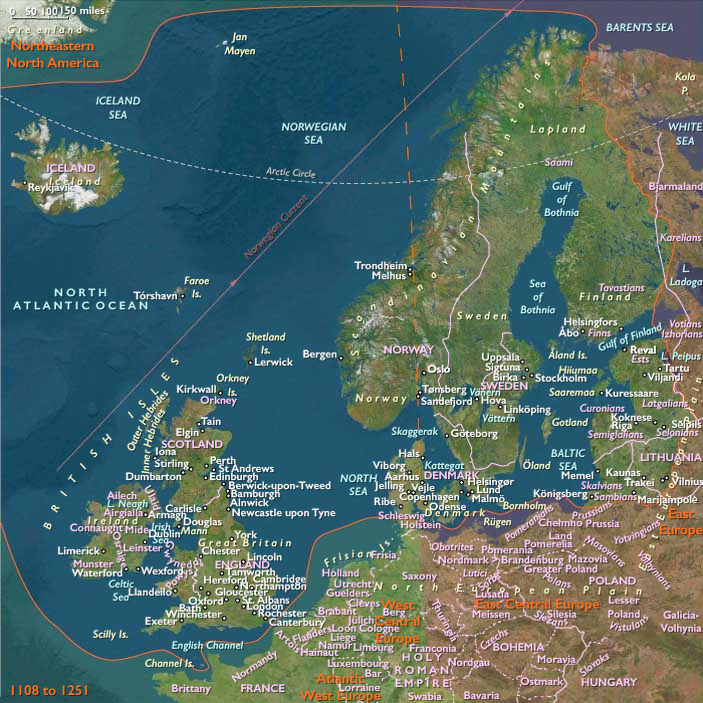
Harald plunders far and wide from his stronghold Haraldsborg at Roskilde.
This behavior greatly contributes to the reasons that he had not been elected king after news of his father’s death on crusade in 1103 reached Denmark.
Instead, his uncle Niels, a son of King Sweyn II Estridson and a concubine, is in 1104 elected king.
Margaret Fredkulla had been married to King Magnus of Norway in 1101 as a part of the peace treaty between Sweden and Norway.
Often referred to as Margaret Fredkulla (Margaret the Maiden of Peace), she had brought with her large fiefs and areas in Sweden as her dowry, probably in Västergötland.
Made a widow in 1103 after two years of childless marriage, she had soon left Norway.
Her departure is seen as an insult by the Norwegians, who had expected her to stay, and she is accused of having stolen the holy relics of Saint Olav.
In 1105, she marries King Niels of Denmark, described as a passive monarch who lacks the capacity to rule and who leaves the affairs of the state to his queen.
With his blessing, Margaret becomes the de facto Queen regnant of Denmark.
She is described as a wise ruler, and the relationship between Denmark and her birth country Sweden will be very peaceful during her time as queen.
Eric, born around 1090 to king Eric I of Denmark and an unknown concubine, had been given some Danish isles by his half-brother Canute Lavard, and was jarl of Møn, Lolland, and Falster.
When Lavard was murdered in 1131, Eric had joined his half-brother Harald Kesja in a rebellion against the responsible king Niels of Denmark.
Eric had been elected Danish Antiking in Scania in April 1131, prompting Kesja to support Niels in jealousy.
Eric's army had lost several battles against Niels and his son Magnus the Strong, including Jelling in Jutland in 1131 and Værbro on Zealand, and he had fled to Scania.
His retreat had earned him the nickname Harefoot.
Eric had unsuccessfully tried to convince Lothair III, Holy Roman Emperor, to support his bid for kingship, and had had no luck asking Magnus IV of Norway for help.
He returns to Scania in 1134, where Archbishop Asser of Lund joins his cause, and Lothair eventually supports him as well.
Eric, proclaimed king at Scania's landsting assembly at St Liber's Hill, makes Lund his capital city.
With the resounding victory at Fotevik, Eric is given the nickname the Memorable to replace Harefoot.
Eric II, having dispatched Harald Kresla and most of his sons, now seeks to consolidate and legitimize his rule over Denmark.
He awards titles and privileges to his supporters, and proclaims Archbishop Asser's nephew as Bishop Eskil of Roskilde.
Eric is defeated in 1135 in a naval battle near the coast of Denmark, and Slavs under duke Ratibor I, Duke of Pomerania, sack Roskilde.
Harald Kesja, having fled to Denmark after the Battle of Fotevi, has been proclaimed king at Urnehoved landsting in Schleswig.
Eric II chases him down and decapitates Kesja and eight of his sons, of whom only Olaf Haraldsen escapes with his life.
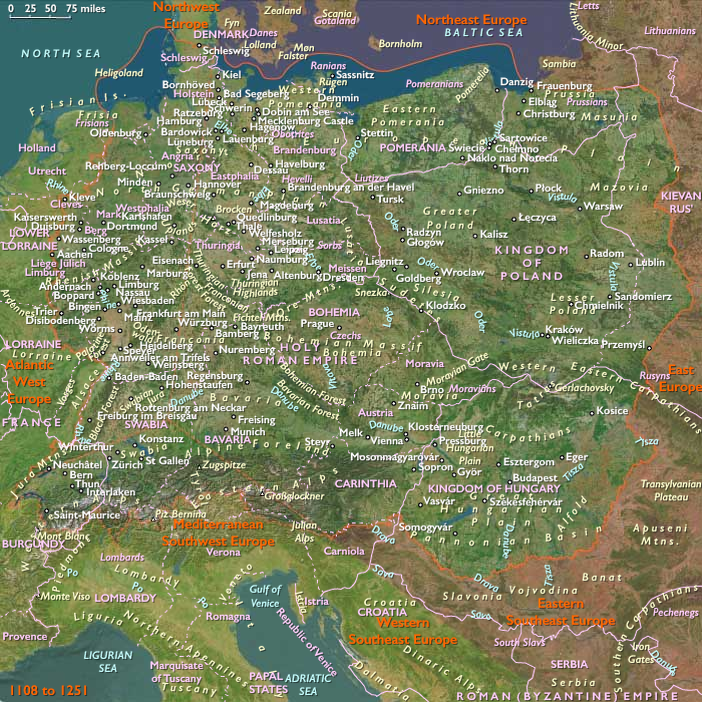
Pomeranian ships from Szczecin, from the southern coast of the Baltic Sea, had attacked the Danish coast in the 1120s.
Duke Ratibor on August 10, 1135, assaults the Norwegian towns.
Konghelle is captured and burnt to the ground by Ratibor's forces, assisted by a fleet of five hundred and fifty ships with cavalry on board (each carrying forty-four men and two horses).
They lay the town in ruins, kill a large part of the population, and abduct most of the survivors as thralls to Szczecin.
Snorri Sturluson, writing a century later, says that Konghelle never completely recovered.
Eric, on learning that Eskil has raised the nobles of Zealand against him, races north to put down the rebellion, which had spread rapidly across Funen and Jutland, and fines Eskil heavily.
Eric II of Denmark is known as a harsh king to his enemies.
In the summer of 1136, Eric undertakes a crusade against the pagan population on the Baltic island of Rügen and its capital Arkona.
He orders his men to dig a canal between the city and the rest of the island.
The canal has the effect of drying up the spring that supplies Arkona with drinking water.
Arkona is forced to surrender.