Henry I of France
King of the Franks
Years: 1008 - 1060
Henry I (May 4, 1008 – August 4,1060) is the King of the Franks from 1031 to his death.
The royal demesne of France reaches its smallest size during his reign, and for this reason he is often seen as emblematic of the weakness of the early Capetians.
This is not entirely agreed upon, however, as other historians regard him as a strong but realistic king, who was forced to conduct a policy mindful of the limitations of the French monarchy.



Related Events
Filter results
Showing 10 events out of 54 total
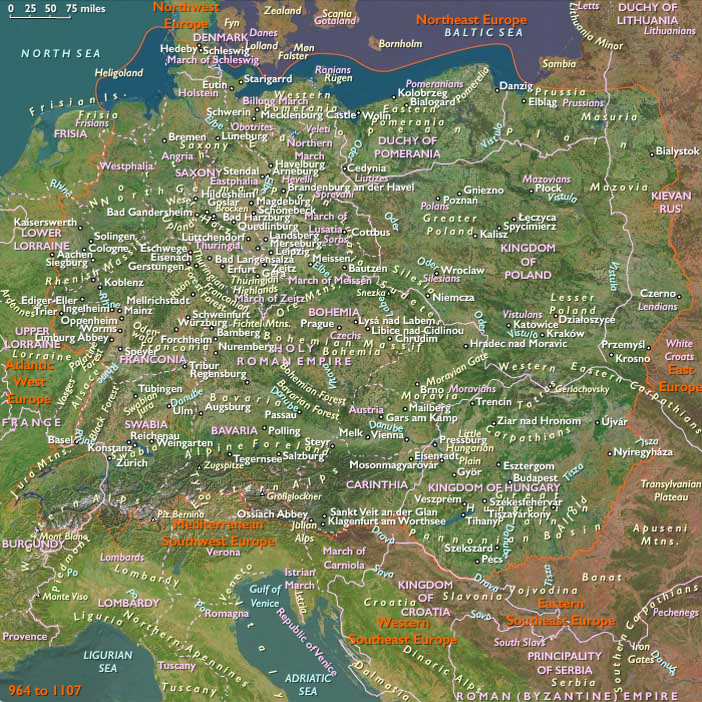
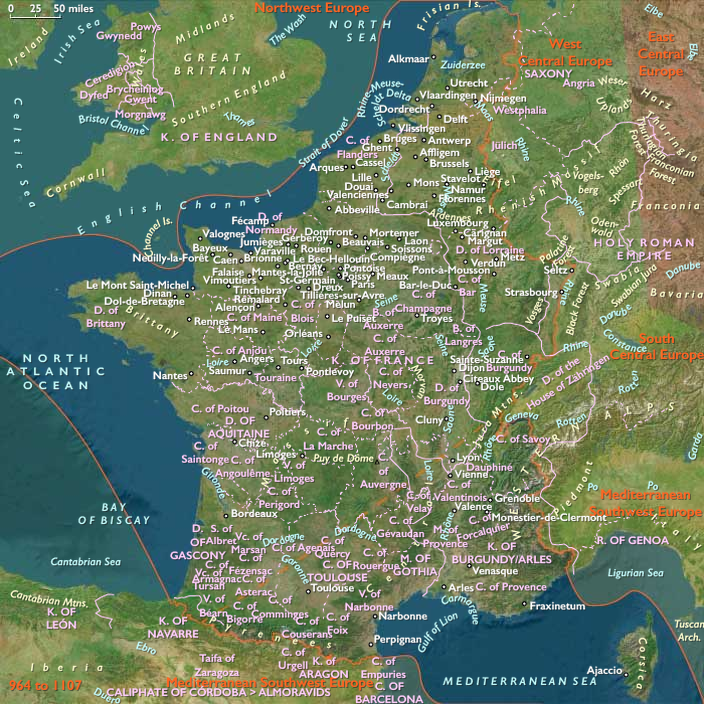
Atlantic West Europe (1000–1011): Dynastic Crisis and the Struggle for Burgundy
Between 1000 and 1011, Atlantic West Europe—which includes the Low Countries, Brittany, Normandy, Aquitaine, Burgundy, central France, Alsace, and Franche-Comté—experienced significant dynastic turmoil, notably in Burgundy, alongside ongoing consolidation of feudal territories.
Political and Military Developments
-
Burgundy: Succession Crisis (1002)
Following the death of Henry the Venerable, Duke of Burgundy (r. 965–1002), a bitter dynastic conflict erupted between his nephew, King Robert the Pious of France, and his stepson and adopted heir, Otto-William, Count of Burgundy and Mâcon.- Robert the Pious asserted his claim based on royal overlordship and blood kinship, aiming to incorporate Burgundy firmly into the French sphere.
- Otto-William, backed by his son-in-law Landry, Count of Nevers, contested this claim, envisioning a unified Burgundy (combining both the duchy and county), potentially aligned with the Holy Roman Empire, which would have profoundly shifted regional geopolitics.
-
France: Capetian Consolidation
King Robert the Pious (r. 996–1031) sought to strengthen royal authority, but his reign was strained by noble revolts and the Burgundy conflict, limiting effective centralization elsewhere. -
Normandy and Aquitaine
Normandy enjoyed stability under Duke Richard II (r. 996–1026), consolidating territorial authority.
Aquitaine under William V (r. 995–1030) remained internally prosperous, although tensions persisted with neighboring feudal lords.
Religious and Cultural Developments
- Monastic Reform Movements
The Cluniac reform movement, emanating from Burgundy, continued to spread, reinforcing ecclesiastical authority and spiritual renewal across Western Europe.
Atlantic West Europe (1012–1023): Burgundy's Fate and the Capetian Settlement
Between 1012 and 1023, Atlantic West Europe witnessed the resolution of the Burgundian succession crisis, consolidating French influence in the region while definitively preventing the creation of a unified Burgundian state under imperial influence.
Political and Military Developments
-
Resolution of the Burgundian Conflict (1015)
After thirteen years of protracted and destructive warfare, Robert the Pious emerged victorious, securing the Duchy of Burgundy firmly within the Kingdom of France.- The territories west of the Saône, including the strategic city of Dijon, came under definitive Capetian control.
- Otto-William, retaining only the County of Burgundy (Franche-Comté) east of the Saône, saw his ambitions to unify the two Burgundies dashed, ensuring that the duchy would remain French and the county influenced more by the Holy Roman Empire.
-
Capetian Territorial Redistribution (1016–1032)
Initially, Robert the Pious incorporated the duchy directly into the French royal domain. However, acknowledging practical administrative challenges and family politics, Robert granted the territory to his younger son and namesake, Robert, around 1016.- The arrangement became definitive in 1032 under King Henry I (r. 1031–1060), formally recognizing his brother Robert as Duke of Burgundy, allowing the duchy to be passed down within the Capetian lineage while owing feudal allegiance to the French crown.
-
Normandy and Brittany
Duke Richard II continued his stable rule in Normandy, strengthening ties with England and Scandinavia. Brittany maintained internal stability under Geoffrey I (r. 992–1008) and Alan III (r. 1008–1040), emphasizing regional autonomy amid surrounding tensions.
Economic and Social Developments
- Trade and Urban Development
Despite regional conflict, urban economies—especially Dijon, Auxerre, Tours, and Orléans—continued to grow as agricultural surpluses expanded markets.
Religious and Cultural Developments
- Growth of Cluniac Influence
The Cluniac movement continued its spiritual and cultural expansion, profoundly influencing monastic life, church reform, and European spirituality from its Burgundian heartland.
Atlantic West Europe (1012–1023): Burgundy's Fate and the Capetian Settlement
Between 1012 and 1023, Atlantic West Europe witnessed the resolution of the Burgundian succession crisis, consolidating French influence in the region while definitively preventing the creation of a unified Burgundian state under imperial influence.
Political and Military Developments
-
Resolution of the Burgundian Conflict (1015)
After thirteen years of protracted and destructive warfare, Robert the Pious emerged victorious, securing the Duchy of Burgundy firmly within the Kingdom of France.- The territories west of the Saône, including the strategic city of Dijon, came under definitive Capetian control.
- Otto-William, retaining only the County of Burgundy (Franche-Comté) east of the Saône, saw his ambitions to unify the two Burgundies dashed, ensuring that the duchy would remain French and the county influenced more by the Holy Roman Empire.
-
Capetian Territorial Redistribution (1016–1032)
Initially, Robert the Pious incorporated the duchy directly into the French royal domain. However, acknowledging practical administrative challenges and family politics, Robert granted the territory to his younger son and namesake, Robert, around 1016.- The arrangement became definitive in 1032 under King Henry I (r. 1031–1060), formally recognizing his brother Robert as Duke of Burgundy, allowing the duchy to be passed down within the Capetian lineage while owing feudal allegiance to the French crown.
-
Normandy and Brittany
Duke Richard II continued his stable rule in Normandy, strengthening ties with England and Scandinavia. Brittany maintained internal stability under Geoffrey I (r. 992–1008) and Alan III (r. 1008–1040), emphasizing regional autonomy amid surrounding tensions.
Economic and Social Developments
- Trade and Urban Development
Despite regional conflict, urban economies—especially Dijon, Auxerre, Tours, and Orléans—continued to grow as agricultural surpluses expanded markets.
Religious and Cultural Developments
- Growth of Cluniac Influence
The Cluniac movement continued its spiritual and cultural expansion, profoundly influencing monastic life, church reform, and European spirituality from its Burgundian heartland.
Atlantic West Europe (1024–1035): Consolidation of Power, Regional Stability, and the Emergence of Capetian Burgundy
The era from 1024 to 1035 in Atlantic West Europe—which includes the Low Countries, Brittany, Normandy, Aquitaine, Burgundy, central France, Alsace, and Franche-Comté—was defined by ongoing consolidation of power, strategic alliances, territorial stabilization, and the pivotal establishment of Capetian Burgundy.
Political and Military Developments
-
France: Capetian Consolidation and Stability
-
King Robert II (the Pious, r. 996–1031) maintained domestic stability, strengthened central authority, and secured regional loyalties through strategic marriages and alliances.
-
His successor, Henry I (r. 1031–1060), initially faced internal conflicts and noble revolts but gradually consolidated royal authority through tactical diplomacy and territorial concessions.
-
-
Duchy of Burgundy: Formation of Capetian Burgundy
-
Following the succession crisis after Duke Henry the Venerable’s death in 1002, the prolonged dispute between Robert II and Otto-William ended in favor of Robert by around 1015, definitively placing the Duchy of Burgundy under French influence.
-
In 1032, King Henry I solidified this arrangement by formally granting the Duchy of Burgundy to his younger brother, Robert I, marking the beginning of the Capetian Dukes of Burgundy, distinct from the County of Burgundy (Franche-Comté), which remained under the sphere of the Holy Roman Empire.
-
-
County of Burgundy (Franche-Comté): Distinct Identity
-
Otto-William and his descendants retained the County of Burgundy, which became increasingly oriented toward the Holy Roman Empire, diverging politically and culturally from the Duchy.
-
-
Normandy and Brittany: Regional Power Dynamics
-
Duke Richard III of Normandy’s short reign (1026–1027) led to internal disputes, quickly resolved under his brother Robert I (r. 1027–1035), who stabilized the duchy and extended Norman influence.
-
Brittany remained relatively autonomous, managing external pressures from Normandy and strengthening its internal cohesion.
-
Economic and Social Developments
-
Continued Agricultural Expansion
-
Technological improvements in agriculture, including crop rotation and the widespread use of heavy plows, further enhanced productivity and supported growing populations.
-
-
Urban Revival and Trade Networks
-
Urban centers such as Paris, Rouen, and Dijon continued expanding economically, benefiting from improved trade routes and local production.
-
Religious and Cultural Developments
-
Monastic Reforms and Cluniac Influence
-
Cluny Abbey and its affiliated monasteries strengthened their spiritual and political roles, spreading Cluniac reforms throughout the region and beyond.
-
-
Cultural Flourishing and Manuscript Production
-
Monastic scriptoria continued to produce illuminated manuscripts, fostering literary and intellectual growth across Atlantic West Europe.
-
Legacy and Significance
The period 1024 to 1035 significantly shaped the political landscape of Atlantic West Europe. The establishment of Capetian Burgundy under Duke Robert I clarified regional political alignments, distinguishing the French-aligned Duchy from the Holy Roman-oriented County. This political delineation influenced subsequent territorial and diplomatic dynamics across the region, laying foundations for future developments in Atlantic West Europe.
The Rebellion and Death of Hugh Magnus (1025) and the Capetian Succession Crisis
Hugh Magnus, the eldest son of King Robert II of France and Constance of Arles, had been crowned co-king in 1017 at his mother’s insistence, securing his place as heir to the throne. However, by 1025, Hugh had grown impatient, demanding real authority and eventually rebelling against his father.
Hugh’s Coronation and Rebellion (1017–1025)
- In 1017, at Constance of Arles’ urging, Robert II crowned Hugh as co-king, reinforcing the Capetian tradition of securing succession through joint kingship.
- By 1025, however, Hugh became frustrated with his lack of power, insisting that his father and mother share rule with him.
- His demands led to open rebellion, as Hugh attempted to forcefully assert his authority over the kingdom.
Constance’s Reaction and the Family Conflict
- Unlike previous instances where she had championed Hugh, Constance of Arles was furious at her son’s disobedience.
- She rebuked him at every turn, siding with Robert II against his insubordinate heir.
- Despite the conflict, Hugh eventually reconciled with his parents, though his position remained uncertain.
Hugh’s Sudden Death and Succession Crisis
- Shortly after his reconciliation, Hugh died suddenly in Compiègne on September 17, 1025, at the age of about eighteen.
- Some sources suggest he fell from his horse, though the exact circumstances of his death remain unclear.
- With his death, the Capetian succession was thrown into uncertainty, leading to bitter disputes between Robert II and Constance over which surviving son should be heir.
The Dispute Over the Next Heir
- Robert II favored Henry, his second son, as the next heir to the throne.
- Constance of Arles, however, supported their third son, Robert, leading to intense family conflict over succession.
- This dispute would continue beyond Robert II’s death in 1031, when Constance openly opposed Henry’s ascension, forcing him into exile and civil war before he could secure the throne.
Legacy
- Hugh’s untimely death prevented a direct father-to-son succession, intensifying dynastic struggles within the Capetian court.
- The dispute between Constance and Robert II over their sons exposed deep divisions within the royal family, foreshadowing future Capetian succession conflicts.
- Henry I ultimately succeeded his father, but only after years of resistance from his mother and rival noble factions, demonstrating the delicate nature of Capetian inheritance during the early medieval period.
Hugh Magnus’ rebellion and death in 1025 were pivotal moments in the Capetian dynasty’s early history, shaping the political tensions and struggles for royal authority that followed.
Constance of Arles and the Capetian Revolt Against Robert II (1025–1031)
By the late 1020s, tensions within the Capetian royal family erupted into open rebellion, with Queen Constance of Arles encouraging her sons to rise against their father, King Robert II of France. Frustrated by Robert’s favoritism toward his second son, Henry, and the continued denial of Burgundy to her third son, Robert, Constance actively supported and incited their revolt.
Constance's Role in the Rebellion
- Having previously sided with Robert II against their rebellious eldest son, Hugh Magnus, Constance now turned against her husband after Hugh’s death in 1025.
- She urged her surviving sons to seize their inheritance by force, taking advantage of the kingdom’s fragmented feudal structure.
- Her actions reflected the political ambitions of her Provençal family, as she sought to secure power and lands for her children.
The Revolt of Robert and Henry (Late 1020s–1031)
- Robert, Duke of Burgundy, frustrated that his father had never formally granted him the Duchy of Burgundy, launched a campaign against the region.
- Henry, the heir apparent, seized Dreux, a vital fortress and key Capetian stronghold, in defiance of his father.
- Their coordinated attacks targeted castles and towns loyal to Robert II, plunging the kingdom into a succession crisis before the king had even died.
Consequences and Legacy
- Robert II, despite his strong reputation as a pious ruler, was unable to prevent the growing rebellion, as much of the nobility aligned with or against his sons.
- This family conflict weakened Capetian authority, highlighting the fragility of royal power in early medieval France.
- The rebellion foreshadowed the greater succession crisis that would unfold after Robert II’s death in 1031, when Constance continued to oppose Henry’s rule.
The Capetian revolt of the late 1020s was a direct consequence of Robert II’s divisive succession policies, aggravated by Constance’s political maneuvering and ambition. Her encouragement of her sons’ rebellion nearly fractured the royal dynasty, underscoring the complex nature of Capetian inheritance and the ongoing struggle for territorial control in medieval France.
King Robert II's Capitulation and the Temporary Capetian Peace (1030–1031)
Following a prolonged rebellion led by his sons, Henry and Robert, King Robert II of France was ultimately forced to retreat to Paris, unable to effectively suppress their uprising. Facing increasing pressure and internal instability, the king reluctantly conceded to their demands, restoring peace within the Capetian dynasty—at least temporarily.
Robert II’s Reluctant Concessions
- After his sons’ relentless attacks on royal lands, including Henry’s seizure of Dreux and Robert’s campaign against Burgundy, the king could no longer sustain his resistance.
- Weakened and unable to rally enough support, Robert II negotiated with his sons, agreeing to a peace settlement.
- The terms of the agreement likely included:
- Recognition of Henry as heir to the throne while securing lands and influence for Robert.
- Territorial concessions to prevent further uprisings.
- A fragile reconciliation between Constance of Arles and Robert II, as she had actively encouraged the rebellion.
A Short-Lived Peace (1030–1031)
- The truce brought a temporary end to hostilities, ensuring relative stability within the Capetian realm.
- However, the underlying tensions remained, as Constance continued to favor Robert over Henry, fueling further succession disputes.
- The peace lasted only until Robert II’s death in July 1031, after which new conflicts erupted, with Constance actively opposing Henry’s ascension to the throne.
Legacy and Impact
- This episode demonstrated the fragility of early Capetian rule, where royal authority remained vulnerable to internal feudal pressures.
- Henry’s position as heir remained uncertain, leading to further strife after Robert’s death, when his mother and younger brother challenged his kingship.
- The conflict highlighted the precarious balance of medieval French monarchy, where kings struggled to enforce primogeniture and dynastic stability.
Robert II’s final years were overshadowed by rebellion, and though he secured peace before his death, the succession crisis that followed ensured that the Capetian dynasty remained embroiled in internal conflict well into Henry I’s reign.
The Coronation of Henry I and Constance of Arles’ Defiance (1027)
On May 14, 1027, Henry I of France was crowned King of the Franks at Reims Cathedral, in accordance with Capetian tradition, ensuring his place as his father’s successor while Robert II was still alive. However, his mother, Queen Constance of Arles, fiercely opposed his coronation, creating tensions that would persist well beyond Robert II’s death.
Capetian Coronation Tradition
- Since Hugh Capet’s reign, Capetian monarchs crowned their heirs during their lifetime to ensure dynastic stability and prevent succession crises.
- Henry’s coronation at Reims, the traditional site for French royal anointings, reinforced his legitimacy as heir to the throne.
- However, the ceremony did not quell internal dissent, as Constance of Arles refused to accept Henry as the rightful heir.
Constance’s Resistance and Political Maneuvering
- Constance had favored her younger son, Robert, and opposed Henry’s elevation, fearing her influence would be weakened once Henry took full control of the kingdom.
- Her defiance alarmed many within the royal court, including bishops and nobles who feared her volatile nature.
- The ailing Bishop Fulbert of Chartres, a highly respected cleric, confided in a colleague that while he could physically travel to Reims, he was too afraid of Queen Constance to attend.
The Political Fallout
- Despite Constance’s protests and support from several bishops, Henry I’s coronation proceeded, marking him as the undisputed heir to the Capetian throne.
- However, Constance did not relent, and after Robert II’s death in 1031, she actively fomented rebellion against Henry, nearly splitting the kingdom in the subsequent Capetian civil war.
Legacy and Impact
- Henry I’s early reign was overshadowed by his mother’s opposition, as Constance allied with nobles and bishops to install Robert as king instead.
- The fear Constance inspired—even among prominent church leaders—illustrates her ruthlessness and political cunning, making her one of the most formidable queens of early Capetian France.
- The tensions within the royal family weakened the monarchy, delaying Henry I’s ability to fully consolidate power after his father’s death.
Constance’s unyielding ambition and resentment toward Henry’s coronation foreshadowed the intense struggle for power that would erupt after Robert II’s passing, marking one of the most significant succession crises of early Capetian rule.
The Death of Robert II and Constance of Arles' Conflict with Her Sons (1031)
Following the death of King Robert II on July 20, 1031, Queen Constance of Arles quickly found herself at odds with both of her surviving sons, Henry I and Robert of Burgundy. Rather than accepting Henry’s rightful succession, she seized her dower lands and refused to surrender them, escalating tensions into open conflict.
Constance’s Defiance and Henry’s Flight to Normandy
- Despite Henry I’s coronation at Reims in 1027, Constance continued to oppose his rule, preferring her younger son, Robert of Burgundy, as king.
- Upon Robert II’s death, Constance refused to recognize Henry’s authority, taking control of her dower landsand seeking to rally nobles to her side.
- Facing immediate hostility, Henry was forced to flee the royal domain, seeking refuge in Normandy, where he received support from his younger brother, Robert of Normandy.
- Robert of Normandy provided weapons, soldiers, and strategic aid, helping Henry regroup and launch a counteroffensive against their mother.
Henry’s Siege of Poissy and Constance’s Escape
- With Norman reinforcements, Henry returned to France with an army, determined to assert his authority.
- He besieged Constance at Poissy, a key stronghold where she had entrenched herself with her supporters.
- However, before Henry could capture her, Constance escaped to Pontoise, prolonging the conflict.
The Widening Civil War
- Constance’s continued resistance plunged France into civil war, as factions aligned either with Henry or Robert of Burgundy.
- The power struggle destabilized the early Capetian monarchy, further highlighting the fragility of royal authority in a feudal France dominated by ambitious nobles.
Legacy and Consequences
- The struggle between Constance and her sons demonstrated the deep divisions within the Capetian dynasty, a common theme in early medieval France.
- Henry’s reliance on Norman support strengthened Normandy’s influence in French affairs, a factor that would have long-term repercussions in the 11th century.
- The conflict delayed Henry I’s full consolidation of power, reinforcing the difficulty Capetian kings faced in asserting direct control over their kingdom.
Constance’s unyielding defiance in 1031 was a final act of political resistance, showcasing her tenacity and ambition—qualities that made her one of the most fierce and influential queens of early medieval France.