Henry IV of France
King of France
Years: 1553 - 1610
Henry IV (13 December 1553 – 14 May 1610) is King of France from 1589 to 1610 and King of Navarre from 1572 to 1610.
He is the first monarch of the Bourbon branch of the Capetian dynasty in France.
His parents were Queen Jeanne III and King Antoine of Navarre.
As a Huguenot, Henry had been involved in the Wars of Religion before ascending the throne in 1589.
Before his coronation as king of France at Chartres, he changes his faith from Calvinism to Catholicism and, in 1598, he enactsthe Edict of Nantes, which guarantees religious liberties to the Protestants and thereby effectively ends the civil war.
One of the most popular French kings, both during and after his reign, Henry shows great care for the welfare of his subjects and displays an unusual religious tolerance for the time.
He is assassinated by a fanatical Catholic, François Ravaillac.
Henry is nicknamed Henry the Great (Henri le Grand), and in France is also called le bon roi Henri ("the good king Henry") or le Vert galant ("the Green gallant"), a reference to both his dashing character and his attractiveness to women.
In English he is most often referred to as Henry of Navarre.
He also gave his name to the Henry IV style of architecture, which he patronized.
He is the eponymous subject of the royal anthem of France, "Marche Henri IV".

Related Events
Filter results
Showing 10 events out of 80 total
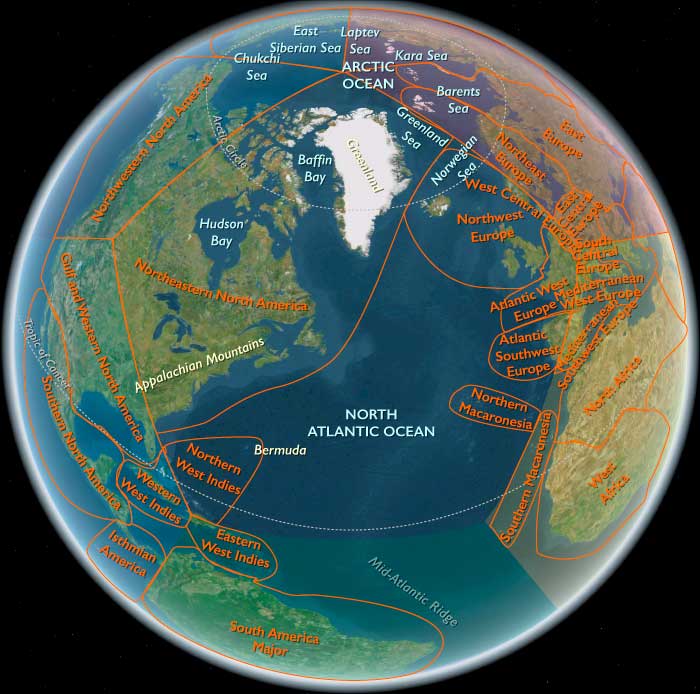
West Europe (1540–1683 CE)
Principalities, Ports, and the Making of the Early Modern West
Geography & Environmental Context
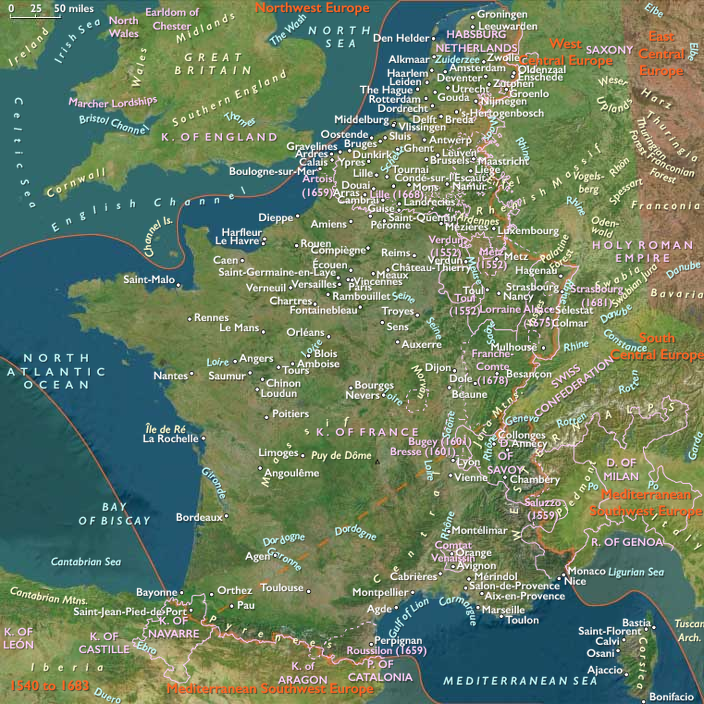
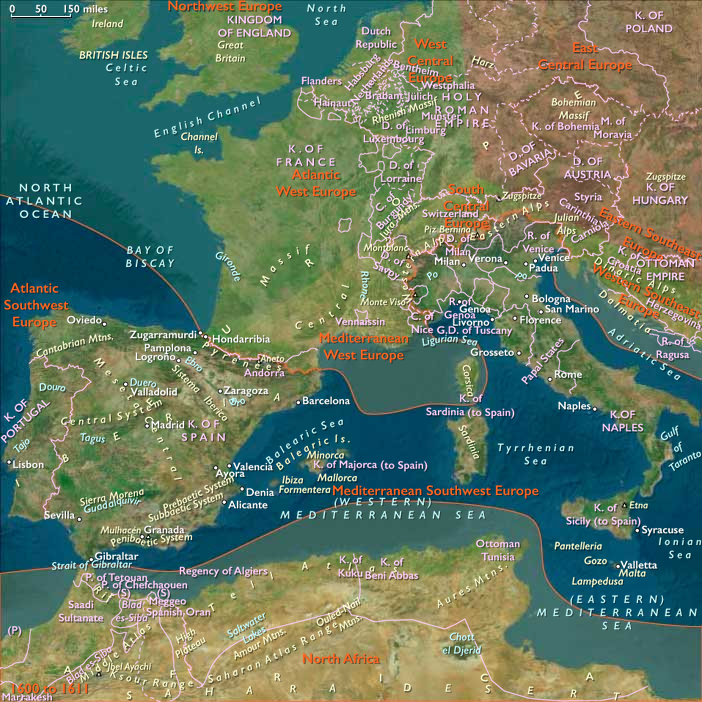
West Europe in this age cohered around two complementary maritime–Mediterranean spheres: Mediterranean West Europe—southern France, Corsica, and Monaco—and Atlantic West Europe—northern France and the Low Countries (the Dutch Republic, Spanish Netherlands, and Luxembourg) along the English Channel and Atlantic. Mountain arcs, river basins (Loire, Seine, Scheldt, Meuse, Rhine), and islanded coasts framed agrarian heartlands and sea-facing emporia. The Little Ice Age brought cooler, more volatile seasons; floods, frosts, and vintner uncertainty alternated with years of bounty, testing grain and wine economies alike.
Subsistence & Settlement
-
Mediterranean West Europe: Terraced vines, olives, figs, wheat, and pastoral uplands underpinned rural life; Corsica remained under Genoese control amid frequent revolts; Monaco, under the Grimaldi, consolidated as a small sovereign principality oriented toward France.
-
Atlantic West Europe: Grain belts and dairying in Flanders and Artois; vineyards in Loire and Burgundy; bustling ports—Amsterdam, Rotterdam, Antwerp, Bordeaux, Nantes, La Rochelle, Rouen—drove urban growth and craft specialization. Toulouse pivoted after the decline of pastel (woad) as indigo from India displaced older dye trades.
Technology & Material Culture
-
Agriculture & hydraulics: Dike and polder engineering in the Low Countries; drainage and crop rotation improved productivity; Mediterranean terraces stabilized thin soils.
-
Shipping & finance: Dutch fluyts, improved charts, and insurance markets supported long-distance trade; the Amsterdam Exchange (1602) epitomized financial innovation.
-
Architecture & arts: Renaissance and Baroque idioms reshaped towns—from Versailles’ courtly grandeur to Flemish guildhalls; coral-and-limestone citadels on Corsica testified to Genoese rule; Monaco’s palace symbolized dynastic continuity.
-
Print culture: Amsterdam, Leiden, Paris, and Antwerp were premier centers for books, newspapers, and scientific tracts.
Movement & Interaction Corridors
-
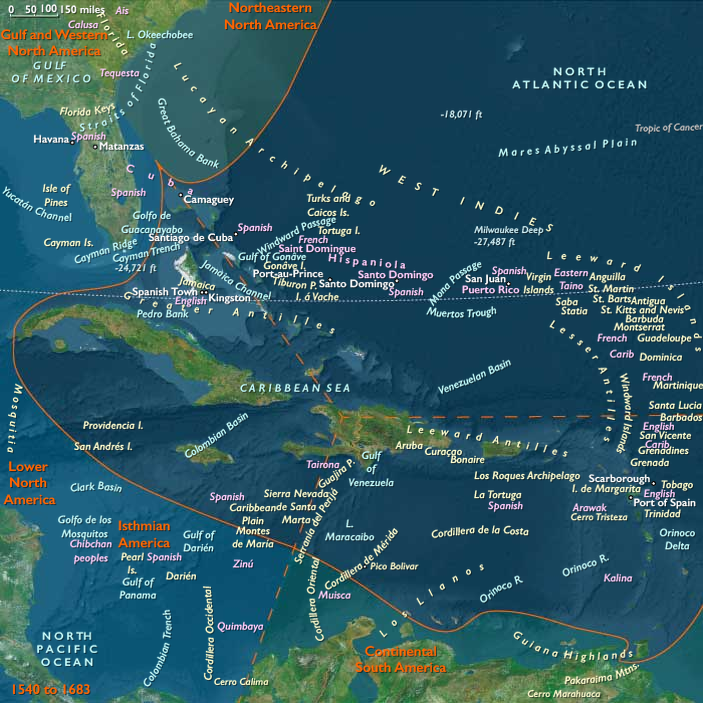
Sea lanes: Channel and Atlantic routes carried wine, grain, salt, textiles, sugar, tobacco, and enslaved labor; the Dutch and French merchant marines connected Baltic grain to Iberian salt and Caribbean staples.
-
River networks: The Seine–Loire–Rhine–Scheldt–Meuse arteries integrated inland markets with seaports.
-
Diplomatic circuits: Franco–Spanish and Habsburg–Dutch rivalries mapped corridors of war and alliance; Monaco’s 1642 French investiture bound the Rock to Bourbon protection while preserving sovereignty.
Cultural & Symbolic Expressions
-
Humanism → Baroque: French Renaissance letters (Rabelais, La Pléiade) yielded to Baroque classicism under Louis XIII/XIV; in the Low Countries, the Dutch Golden Age and Flemish Baroque flourished—Rembrandt, Vermeer, Rubens.
-
Theater & letters: Molière and Racine codified French drama; the Republic of Letters linked Amsterdam and Paris to London and Rome.
-
Urban identity: Merchant patriciates funded almshouses, canals, and guild chapels; Huguenot salons and Dutch collegia nurtured sciences (Descartes in the Netherlands; Leeuwenhoek’s microscopy).
Political & Military Shocks
Mediterranean West Europe
-
Monaco: Honoré II styled himself Prince (1612); by 1642 he became Duc et Pair Étranger under French protection—an emblem of princely consolidation amid Franco–Spanish rivalry.
-
Corsica: Genoese rule persisted through fortified ports (Calvi, Bonifacio), despite endemic clan revolts and piracy.
-
Southern France: The Wars of Religion (1562–1598) ravaged Languedoc and Provence; the Edict of Nantes (1598) stabilized coexistence until later retrenchments.
Atlantic West Europe
-
Habsburg–Valois conflicts culminated in Cateau-Cambrésis (1559); France turned inward to confront confessional war.
-
Dutch Revolt (1568–1648): The Eighty Years’ War birthed the Dutch Republic; Westphalia (1648) confirmed independence and reoriented the North Sea economy.
-
Absolutism & expansion: Louis XIV’s wars (esp. Franco–Dutch War, 1672–78) and administrative centralization projected France as Europe’s leading power by 1683.
Religious Transformations
-
Reformation & Counter-Reformation: Calvinism spread in the Low Countries and northern France; Jesuit missions, seminaries, and baroque piety spearheaded Catholic renewal.
-
Toleration settlements: The Edict of Nantes and the Dutch Republic’s pragmatic toleration offered early models of pluralism amid enduring confessional fault lines.
Economic Transitions
-
Pastel to indigo: Toulouse’s woad economy declined as Indigofera imports rose; merchants diversified into grain finance, legal professions, and textiles.
-
Dutch commercial hegemony: VOC and WIC networks, Baltic grain trade, and the Amsterdam Exchangeunderwrote a global web.
-
French Atlantic rise: Bordeaux and Nantes expanded on wine and emerging plantation commerce, laying foundations for 18th-century growth.
Environmental Adaptation & Resilience
-
Low Countries: Continuous dike raising, polder drainage, and windmill pumping defended land and stabilized yields.
-
Mediterranean slopes: Terracing, cisterns, and mixed arboriculture buffered droughts; coastal fisheries supplemented diets.
-
Urban welfare: Confraternities, hospices, and poor relief mitigated famine and plague shocks.
Transition
Between 1540 and 1683, West Europe consolidated princely sovereignties and maritime republics, rebuilt after confessional wars, and vaulted into a global commercial system.
-
In the Mediterranean, Monaco’s French alignment, Corsica’s Genoese fortresses, and southern France’s cultural refinement set the tone for principality survival amid great-power rivalry.
-
Along the Atlantic, the Dutch Republic emerged as Europe’s commercial-financial engine, while France moved toward hegemonic monarchy and colonial reach.
By the eve of 1683, West Europe’s ports, polities, and patronage had forged durable institutions and identities—foundations that would dominate the continent’s politics, culture, and oceans in the century ahead.
The rise of Protestantism in Europe leads France to a civil war known as the French Wars of Religion, where, in the most notorious incident, thousands of Huguenots are murdered in the St. Bartholomew's Day massacre of 1572.
The Wars of Religion are ended by Henry IV's Edict of Nantes, which grants some freedom of religion to the Huguenots.
Under Louis XIII, the energetic Cardinal Richelieu promotes the centralization of the state and reinforces the royal power by disarming domestic power holders in the 1620s.
He systematically destroys castles of defiant lords and denounces the use of private violence (dueling, carrying weapons, and maintaining private army).
By the end of 1620s, Richelieu has established "the royal monopoly of force" as the doctrine.
During Louis XIV's minority and the regency of Queen Anne and Cardinal Mazarin, a period of trouble known as the Fronde occurs in France, which is at this time at war with Spain.
This rebellion is driven by the great feudal lords and sovereign courts as a reaction to the rise of royal absolute power in France.
The monarchy reaches its peak during the seventeenth century and the reign of Louis XIV.
By turning powerful feudal lords into courtiers at the Palace of Versailles, Louis XIV's personal power becomes unchallenged.
Remembered for his numerous wars, he makes France the leading European power.
France becomes the most populous country in Europe and has tremendous influence over European politics, economy, and culture.
French becomes the most-used language in diplomacy, science, literature and international affairs, and remains so until the twentieth century.
France obtains many overseas possessions in the Americas, Africa and Asia.
Louis XIV also revokes the Edict of Nantes, forcing thousands of Huguenots into exile.
Atlantic West Europe (1540–1683): Religious Turmoil, Dynastic Rivalries, and Maritime Ascendancy
The era spanning 1540 to 1683 in Atlantic West Europe—encompassing northern France, the Low Countries (modern Belgium, Netherlands, and Luxembourg), and regions along the Atlantic and English Channel coasts—witnessed profound religious transformations, intense political and dynastic conflicts, vibrant cultural achievements, and economic growth driven by maritime expansion and colonial enterprise. This period marked the region's decisive transition from medieval fragmentation to early modern states, characterized by powerful central authorities, dynamic commercial networks, and distinct national identities.
Political and Military Developments
The Habsburg-Valois Conflicts (1540–1559)
-
Early decades were dominated by wars between Francis I of France (1515–1547) and Emperor Charles V (1519–1556), particularly the Italian Wars. These conflicts drained regional economies but solidified centralized monarchical power in France.
-
The Treaty of Cateau-Cambrésis (1559) ended these conflicts, stabilizing the Franco-Habsburg borders and allowing France to refocus internally.
Religious Wars and Political Fragmentation (1562–1598)
-
France endured the brutal Wars of Religion, pitting Catholic factions against Protestant Huguenots, severely disrupting society, economy, and political stability.
-
The wars culminated in the ascension of Henry IV (r.1589–1610), who issued the Edict of Nantes (1598), granting limited religious toleration, stabilizing France, and reasserting royal authority.
Dutch Revolt and Birth of the Dutch Republic (1568–1648)
-
The Low Countries rebelled against Habsburg Spain, triggered by religious persecution, heavy taxation, and centralization attempts under Philip II. The resulting Eighty Years' War forged the Dutch Republic in the north, while the southern provinces (Spanish Netherlands) remained under Spanish rule.
-
The Peace of Westphalia (1648) confirmed the independence of the Dutch Republic, profoundly reshaping the region’s political map and enabling Dutch commercial and cultural ascendancy.
Absolutism under Louis XIV (1643–1683)
-
France reached the zenith of royal absolutism under Louis XIV (r.1643–1715), significantly expanding French territories through wars such as the Franco-Dutch War (1672–1678), solidifying France’s role as Europe's dominant continental power.
-
Centralized bureaucracy, military reforms, and lavish cultural patronage characterized Louis XIV's reign, epitomized by the expansion of Versailles as a symbol of monarchical prestige.
Economic Developments: Maritime Trade and Colonial Expansion
Growth of Atlantic Commerce
-
French Atlantic ports like Bordeaux, Nantes, La Rochelle, and Dutch hubs such as Amsterdam and Rotterdam, flourished through maritime trade, driven by sugar, tobacco, wine, textiles, and the burgeoning slave trade.
-
Bordeaux’s wine industry significantly expanded during this era, becoming a critical economic sector, exporting primarily to England and Northern Europe, reinforcing regional prosperity.
Dutch Commercial Dominance
-
The Dutch Republic emerged as a commercial powerhouse, with Amsterdam becoming Europe’s leading financial and trading center. The establishment of the Amsterdam Stock Exchange (1602) and the Dutch East India Company (VOC, 1602) epitomized the sophistication of Dutch capitalism and global trade.
-
Dutch maritime innovations in shipbuilding, navigation, and banking underpinned their economic success and influence across European markets and overseas colonies.
Agricultural and Industrial Advances
-
Advances in agricultural techniques, notably crop rotation and drainage systems, improved productivity in northern France and the Low Countries, supporting population growth and urbanization.
-
Textile production remained crucial, especially in Flanders and northern France, despite disruptions from warfare, forming a foundation for early industrialization.
Religious Developments: Reform, Conflict, and Toleration
Protestant Reformation and Catholic Response
-
The spread of Protestantism profoundly reshaped religious and political life. Calvinism gained traction, especially in northern France and the Low Countries, fueling religious dissent against Catholic authorities.
-
Catholic Counter-Reformation movements, notably led by the Jesuits, responded vigorously, reforming internal church structures, promoting religious education, and combating Protestant influence.
Religious Wars and Persecution
-
Intense religious violence erupted across France, exemplified by the St. Bartholomew’s Day Massacre (1572), resulting in thousands of Huguenot deaths and heightened religious animosities.
-
Protestant persecution under Spanish rule intensified in the Low Countries, ultimately leading to the Dutch Revolt and the establishment of religious toleration in the northern provinces, notably Holland.
Establishment of Limited Religious Toleration
-
The Edict of Nantes (1598) and the relative religious toleration of the Dutch Republic became early models of coexistence amid religious pluralism, setting critical precedents influencing later European developments.
Cultural and Intellectual Developments
Renaissance Humanism to Baroque Splendor
-
The French Renaissance, spurred by humanist scholars like François Rabelais and poets of La Pléiade, transitioned into the extravagant cultural and artistic patronage of the Baroque period under Louis XIII and Louis XIV.
-
Flemish painters such as Peter Paul Rubens and Dutch Golden Age artists including Rembrandt and Vermeer profoundly impacted European artistic traditions through innovative techniques and compelling naturalism.
Intellectual Innovations and Scientific Advances
-
This era witnessed groundbreaking advances in science, technology, and medicine. Intellectual centers such as Paris and Amsterdam became hubs for scientists and philosophers, exemplified by René Descartes’ philosophical works and Antonie van Leeuwenhoek’s microscopy.
-
The establishment of learned societies, such as the French Académie des Sciences (1666), reflected state-sponsored encouragement of scientific inquiry, significantly advancing European knowledge.
Literary and Cultural Flourishing
-
French literary culture flourished under royal patronage, with notable playwrights like Molière and Jean Racine, whose works profoundly influenced European drama.
-
In the Dutch Republic, high literacy rates and publishing freedoms fostered a vibrant literary culture, marked by prolific book publishing, newspapers, and critical philosophical discourse.
Social and Urban Transformations
Urban Expansion and Socioeconomic Mobility
-
Maritime trade significantly propelled urbanization in port cities such as Amsterdam, Antwerp, Bordeaux, and Nantes, leading to the emergence of affluent merchant classes influential in local governance and cultural patronage.
-
Economic prosperity stimulated the growth of urban infrastructure, including banking institutions, merchant guilds, public buildings, and market spaces, reshaping urban life and society.
Social Tensions and Rural Struggles
-
Despite urban wealth, significant rural poverty persisted, exacerbated by warfare, heavy taxation, agricultural disruption, and periodic famines, particularly notable in northern France and parts of the Low Countries.
-
Rural communities faced pressures from enclosures, increasing commercialization of agriculture, and demographic growth, fueling migrations toward cities and overseas colonies.
Legacy and Historical Significance
By 1683, Atlantic West Europe had undergone transformative shifts in political structure, economic power, cultural expression, and religious dynamics:
-
Politically, the period solidified powerful centralized monarchies in France and independent republican governance in the Netherlands.
-
Economically, the region became integral to global commerce, driven by maritime exploration, colonial expansion, and financial innovation, notably in the Dutch Republic.
-
Culturally and intellectually, Renaissance humanism transitioned into Baroque grandeur and scientific rationalism, profoundly shaping European thought, art, and literature.
-
Religiously, the profound tensions between Protestantism and Catholicism laid the groundwork for modern notions of religious pluralism and toleration.
Thus, this period positioned Atlantic West Europe decisively at the forefront of early modern European transformations, establishing foundational structures, cultural identities, and economic patterns that endured into subsequent centuries.
France’s Bourbon dynasty, the direct line having died out in 1503 and the collateral Montpensier branch having become extinct in 1527, survives in the collateral line of the Vendôme, descending from Jacques de la Marche, constable of France in the mid-fourteenth century.
Antoine de Bourbon, duc de Vendôme, titular king-consort of Navarre, is himself eight generations removed from Louis IX, father of the dynasty’s founder, Robert of Clermont, grandfather of Jacques de la Marche; the junior Bourbon line of Condé descends from Antoine's brother, Louis.
Antoine de Bourbon had temporarily allied himself with the Protestants but changes sides and is mortally wounded in battle against them at Rouen.
At Antoine’s death on October 26, 1562, the Bourbon line continues in nine-year-old Henri de Navarre, or de Bourbon, the son of Antoine and Jeanne d'Albret, Queen of Navarre from 1555.
Prince Henry, who spent most of his early childhood in the Béarnaise city of Pau, had gone to live with his second cousins, the children of the king of France and Catherine de Médici, in 1561.
His mother, meanwhile, had announced her Calvinism in 1560.
The French Huguenots in the course of the Third War of Religion, a more multinational conflict than the previous two, attempt to fortify the Southwest and stand off the crown.
Several months into the war, after much skirmishing, royalist forces under the nominal leadership of French king Charles IX’s younger brother, Henri d'Anjou—and actually led by Gaspard de Tavannes—surprise and soundly defeat the Huguenots at Jarnac on March 13, 1569.
Condé is killed; Coligny succeeds him as commander of the Huguenot forces.
Condé’s death leaves his son Henri I de Bourbon, second prince de Condé, and his cousin Henry of Navarre as titular leaders of the Huguenots.
Henri, the Calvinist-raised son of Antoine de Bourbon and Jeanne d'Albret, heiress to the throne of Navarre, had succeeded his father as titular leader of the Huguenot faction in France.
When the nineteen-year-old Henri becomes king of Navarre on the death of his mother in June 1572, he also becomes the Huguenot’s effective leader.
Guise mercenaries attack the invalided Coligny at his house at dawn on the 24th, St. Bartholomew's Day, after killing his guard: striking repeated blows, they finally toss the admiral, still living, from the window to the street, where one of Guise's henchmen cuts off his head.
Rumors fly, and both the neighborhood militias and the general population, wrongly believing themselves to be fully sanctioned by the king and the church, advertise their Catholic status with white crosses on their hats and go on a rampage against the Huguenots.
Henri of Navarre, who has brought to Paris eight hundred mounted noblemen in his train, is attacked in his bridal suite with an entourage of fofty Huguenot gentlemen, all of whom are killed.
Henri and his cousin Henri, the Prince de Condé, are dragged before the king.
Threatened with forced conversion or death, they choose the former, an act of dubious sincerity.
Petrus Ramus had in 1568 found the position of affairs again so threatening that the nfluential French anti-Aristotelian logician had found it advisable to ask permission to travel, spending around two years in Germany and Switzerland.
The Second Helvetic Confession had earned his disapproval, in 1571, rupturing his relationship with Theodore Beza and leading Ramus to write angrily to Heinrich Bullinger.Having taught successively at Geneva, Lausanne, and Heidelberg for the past two years, had returned to Paris in 1572.
He falls a victim in the St. Bartholomew's Day Massacre, when, after hiding for a while in a bookshop off the Rue St. Jacques, he returns to his lodgings, on August, 26 the third day of the violence.
Here he is stabbed while at prayer.
Three days pass before city councilors and the king are able to halt the massacre in Paris, in which some three thousand Huguenots have been slain.
The slaughter extends to Protestants in the provinces, not abating until October, by which an estimated twenty to fifty thousand Protestants have been slain.
Henri of Navarre is held prisoner at the royal court, Condé eventually escapes to Germany, and Andelot, Coligny's younger brother, becomes an exile in Switzerland.