Henry of Franconia
East Frankish general
Years: 830 - 886
Henry (died 886), possibly a son or grandson of Count Poppo of Grapfeld, one of the first Babenbergs, is the most important East Frankish general during the reign of Charles the Fat.
He is variously titled Count or Margrave of Saxony and Duke of Franconia.


Related Events
Filter results
Showing 5 events out of 5 total
The Viking Siege of Asselt (882) and the Controversial Treaty of Charles the Fat
In 882, Emperor Charles the Fat gathers a large Frankish army at Worms to confront the Vikings encamped at Asselt on the Meuse in Frisia. This campaign, intended to drive the Norse invaders from Carolingian lands, ultimately results in a controversial treaty with Viking leaders Godfrid and Sigifrid, shaping Charles’ historical reputation.
The Frankish Military Campaign Against the Vikings
- Following his return from Italy and assumption of the East Frankish throne in Regensburg (early May 882), Charles takes immediate action against the Viking threat in Frisia.
- An army is assembled consisting of:
- Franks, Alemanni, Bavarii, Thuringii, Saxons, and Lombards.
- The campaign strategy:
- Lombards, Alemanni, and Franks move up the Rhine on the western bank.
- Bavarians march along the eastern bank and cross the Rhine at Andernach.
- Arnulf of Carinthia (Bavarians) and Henry of Franconia (Franks) are sent ahead to ambush the Norsemen.
The Siege of Asselt and the Unexpected Truce
According to the Mainz continuation of the Annales Fuldenses:
- The Frankish army is on the verge of capturing the Viking camp, but Charles is persuaded by Liutward of Vercelli (allegedly bribed by the Vikings) to accept peace terms instead of pressing the attack.
- Charles meets Viking envoys, leading to negotiations instead of outright battle.
- Godfrid is granted the Kennemerland (formerly ruled by Rorik of Dorestad) as a vassal of Charles.
- Sigifrid is paid Danegeld, with some funds taken from church treasuries.
Alternative Account from the Bavarian Continuation of the Annales Fuldenses
- The ambush fails due to treachery, delaying the Frankish assault.
- The twelve-day siege is broken by disease from rotting corpses and a violent hailstorm.
- Godfrid swears oaths to Charles, promising never again to raid the empire, and is baptized, with Charles serving as his godfather.
Aftermath and Contemporary Reactions
- Charles disperses his army at Koblenz, bringing an end to the campaign.
- The Mainz continuator of the Annales Fuldenses presents the event as a humiliating failure, blaming Charles for weakness and bribery, possibly due to the influence of Liutbert of Mainz, who had been dismissed from court.
- Other sources, including the Bavarian continuation, offer a less critical perspective, portraying the negotiations as a pragmatic response to unforeseen difficulties.
- Contemporaries do not widely view the campaign as a disaster, but later historians emphasize Charles’ diplomatic approach as an example of Carolingian weakness against Viking aggression.
Significance and Legacy
- The treaty of Asselt (882) is part of a larger Carolingian pattern of dealing with Vikings, alternating between military action, payments, and territorial concessions.
- Charles the Fat’s reputation for weakness largely stems from this campaign and its depiction in the Mainz annals, though his diplomatic approach was consistent with previous Frankish rulers.
- The continued Norse presence in Frisia reflects the ongoing fragmentation of Carolingian rule, as Viking leaders are increasingly integrated into the Frankish political system.
Though Charles' campaign at Asselt did not result in a decisive victory, it was not universally seen as a failure at the time. However, the perception of Charles as an ineffective ruler, shaped by contemporary political rivalries and later historical interpretations, has come to define his legacy.
The Viking Siege of Paris (885–886): Charles the Fat’s Failure and the Rise of Odo
By 885, West Francia remains under severe Viking pressure, particularly in the Seine Valley, where Norse fleets continue to raid inland settlements. That year, a massive Viking fleet, led by Sigfred, sails up the Seine River and lays siege to Paris, marking one of the most significant and prolonged Viking attacks on the city.
The Viking Siege Begins (885)
- Sigfred’s fleet, composed of hundreds of ships and thousands of warriors, arrives at Paris, a strategically vital city on the Seine.
- This is the first major Viking attack on Paris in years, and the Norse leader demands tribute in exchange for sparing the city.
- However, unlike previous rulers, Charles the Fat refuses to pay a bribe, likely attempting to avoid further incentivizing Viking raids.
Odo of Paris and the Call for Reinforcements
- At the time of the Viking invasion, Charles the Fat is in Italy, leaving West Francia without centralized leadership.
- Odo, Count of Paris, and Bishop Gozlin organize the city’s defense, refusing to surrender to the Norsemen.
- Odo secretly sneaks a group of men through Viking lines to request military assistance from Charles.
- In response, Charles dispatches Henry of Saxony to relieve the siege.
The Siege Intensifies
- The Vikings launch multiple assaults against the fortified bridges of Paris, but the defenders hold strong, repelling attack after attack.
- The siege will last over a year, becoming one of the greatest tests of Frankish resilience against the Vikings.
Significance of the Siege of Paris
- Odo emerges as a heroic leader, rallying the defenders and proving his military competence, which will later lead to his election as King of West Francia (888).
- The Carolingian monarchy’s inability to protect its key cities further erodes Charles the Fat’s authority, contributing to his downfall in 887.
- The siege becomes legendary, symbolizing the determination of the Franks against Viking aggression and the gradual shift of power from the Carolingians to local lords.
The Siege of Paris (885–886) marks a turning point in Viking-Frankish relations, highlighting both the growing autonomy of regional rulers like Odo and the declining influence of the Carolingian emperors in the face of repeated Viking invasions.
The Siege of Paris (885–886) and Charles the Fat’s Betrayal
Between 885 and 886, Paris, heavily fortified since its sack by the Danes in 857, withstands a massive Viking siegelasting eleven months. The Norse invaders, numbering around 40,000 warriors aboard 700 ships, launch relentless attacks against the fortified city, yet the Parisian defenders, led by Count Odo and Bishop Gozlin, refuse to surrender.
Paris Under Siege: A Brutal Standoff
- The Vikings attempt multiple assaults, trying to breach the fortified bridges of the Île de la Cité, but the Parisian garrison holds firm.
- Disease and starvation begin to spread within the city, weakening the defenders.
- In early 886, Count Odo personally rides out of Paris, breaking through Viking lines to seek reinforcements from Emperor Charles the Fat.
Charles the Fat Arrives… But Refuses to Fight
- Charles the Fat finally arrives with a large army and encircles the Viking force, setting up a camp at Montmartre.
- Despite securing a strong position, Charles refuses to engage the Vikings in battle, shocking his own commanders.
- Instead of fighting, he negotiates with the Norse leaders and pays them off, allowing them to continue their raids elsewhere.
The Humiliation of West Francia
- Charles orders the Vikings to sail down the Seine and plunder Burgundy, which is already in revolt against him.
- This diplomatic maneuver further undermines Frankish authority, as Charles is seen as abandoning his own people to Viking devastation.
- The decision enrages the nobles of West Francia, who see Charles’ inaction as cowardice and betrayal.
Consequences of the Siege and Charles’ Downfall
- Despite being greatly outnumbered, Paris holds out and is never taken, solidifying its status as a center of Frankish resistance.
- Count Odo’s leadership during the siege makes him a hero among the Frankish nobility, paving the way for his later election as King of West Francia in 888.
- The humiliating settlement with the Vikings severely damages Charles the Fat’s already weak reputation, leading to his deposition in 887.
The Siege of Paris: A Turning Point in West Francia
The Siege of Paris (885–886) is a defining moment in the decline of Carolingian authority and the rise of local feudal power. While Charles the Fat’s failure to protect his kingdom leads to his downfall, the bravery of Paris’ defenders propels Odo into power, marking the beginning of the end of Carolingian rule in West Francia.
Henry of Franconia: Defender of Neustria Against the Vikings (884–886)
Henry of Franconia was one of Charles the Fat’s most trusted military commanders, assigned to hold the March of Neustria against the Viking invasions following Charles’ accession to the throne of West Francia in 884. His career was marked by his campaigns against the Norse, his role in the political intrigues of Charles' court, and his untimely death in 886.
Role in the March of Neustria
- After Charles became King of West Francia in 884, he appointed Henry as margrave of Neustria, a military frontier region responsible for defending against Viking raids.
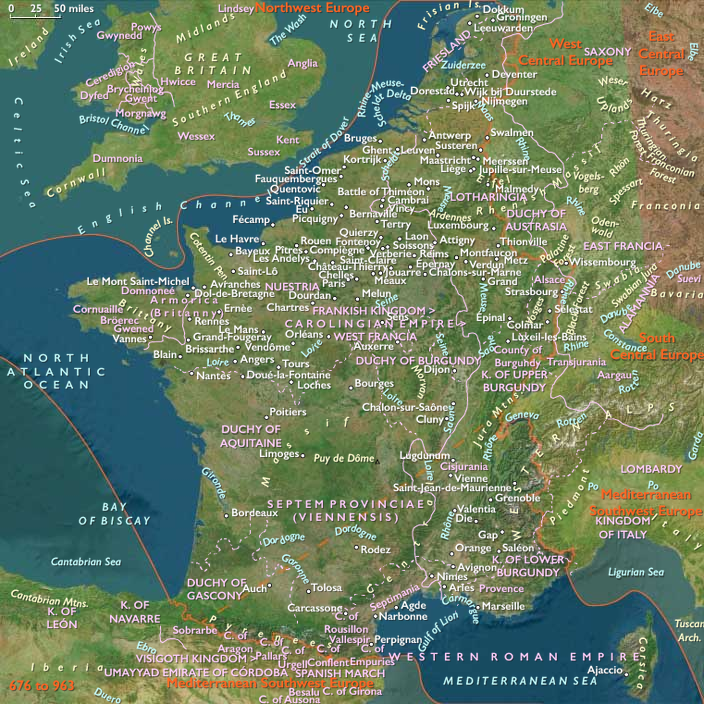
- Neustria, situated along the Loire and Seine rivers, was one of the regions most affected by Norse incursions, making Henry’s role critical to Frankish defense.
The Arrest of Hugh of Alsace and Godfrey of Frisia (885)
- In 885, Charles summoned Hugh, Duke of Alsace, and Godfrey, Duke of Frisia, to a court at Lobith.
- It was Henry who carried out their arrest on Charles' orders:
- Godfrey was executed, removing a powerful Viking-allied warlord from Frisia.
- Hugh was blinded and imprisoned at Prüm, eliminating a political rival in Lotharingia.
Campaigns During the Siege of Paris (885–886)
- In early 886, Henry was sent to aid the besieged defenders of Paris, where Vikings under Sigfred and Rollohad been attacking for months.
- However, he did not stay long, likely due to Charles the Fat’s hesitance to fully commit to battle.
- Later in 886, Henry returned to Paris with Charles, but en route, he was killed in a skirmish with the Vikings.
- His death was a serious blow to Carolingian military efforts, as Henry had been one of the few commanders capable of dealing with Viking incursions in Neustria.
Family and Possible Marriages
Though details of Henry’s family are unclear, sources and onomastic studies suggest he was married and had children:
- Wife #1 (Possible): Ingeltrude, daughter of Eberhard of Friuli and Gisela, daughter of Louis the Pious.
- Wife #2 (Possible): A daughter of Berengar I of Neustria, possibly linking Henry to the Conradine family.
- If this is correct, their marriage may have been a strategic alliance, securing Henry’s position in Neustriaand aiding his campaigns against the Vikings.
Children
- Hedwiga → Later marries Otto I, Duke of Saxony, linking Henry’s lineage to the future Ottonian dynasty.
- A possible son:
- Some scholars propose a son named Henry or Berenger, who might be identified with Berengar II of Neustria.
- This theory is based on onomastic evidence (name similarities) and the continuation of Henry’s influence in Neustria.
Legacy of Henry of Franconia
- His military leadership in Neustria was one of the last effective Frankish responses to Viking raids before the Carolingian collapse.
- His daughter Hedwiga’s marriage to Otto I of Saxony helped establish the future Ottonian dynasty, which would rise to power in Germany.
- His death in 886 weakened Carolingian resistance, accelerating the decline of Charles the Fat’s rule and the further decentralization of West Francia.
Henry’s tenure as Margrave of Neustria was short but critical in the ongoing struggle against Viking invasions. His death marked the loss of one of Charles the Fat’s strongest military leaders, further destabilizing West Francia at a time when the Carolingian Empire was already unraveling.
The Viking Withdrawal and the Final Decline of Charles the Fat (887)
By spring 887, the Vikings withdraw from France, taking with them the 700 pounds of silver promised by Emperor Charles the Fat. His decision to pay off the Norse invaders rather than fight them is widely seen as an act of weakness, further diminishing his already fragile prestige in West Francia.
Charles’ Actions in Paris During and After the Siege
- During and after the Siege of Paris (885–886), Charles remains in the city, issuing several charters to West Frankish recipients.
- These charters confirm previous rights and privileges granted by his predecessors, particularly in:
- Neustria, where Viking incursions remain a pressing issue.
- The Spanish March, reaffirming Frankish control over border territories.
- Provence, ensuring continued governance of the southern frontier of the empire.
- His contact with Nantes suggests that Charles recognizes the growing influence of Alan I, Duke of Brittany, in the region.
Recognition of Alan I of Brittany as “Rex”
- It is probable that Charles the Fat grants Alan I the right to be titled rex (king) of Brittany, a privilege that only an emperor could bestow.
- Alan I was already the most powerful ruler in Brittany, successfully resisting Viking invasions and expanding his control.
- His claim to the title appears legitimate, as later Breton sources acknowledge it, and a charter dating between 897 and 900 mentions prayers being said at Redon Abbey for the soul of Karolus (likely Charles the Fat), ordered by Alan.
Consequences of Charles’ Rule and the Aftermath
- Charles’ failure to protect France from Viking threats leads to his deposition in 887, marking the final collapse of Carolingian imperial unity.
- Alan I’s rise as King of Brittany reinforces Breton autonomy and weakens West Francia’s territorial control over its westernmost regions.
- The events of 887 contribute to the increasing fragmentation of the Carolingian world, paving the way for the rise of local feudal rulers and dynastic change.
The Viking withdrawal in 887 marks the end of Charles the Fat’s reign, as his failure to defend the realm leads to his downfall, while Alan I’s recognition as King of Brittany cements the region’s growing independence.