Henry Pelham
British Whig statesman, Prime Minister of Great Britain
Years: 1694 - 1754
Henry Pelham, PC, FRS (September 25, 1694 – March 6, 1754) is a British Whig statesman, who served as Prime Minister of Great Britain from 27 August 1743 until his death.
He is the younger brother of Thomas Pelham-Holles, 1st Duke of Newcastle, who serveds in Pelham's government and succeeds him as Prime Minister.
Pelham is generally considered to have been Britain's third Prime Minister after Sir Robert Walpole and the Earl of Wilmington.
Pelham's premiership is relatively uneventful in terms of domestic affairs.
In foreign affairs, Great Britain fights in several wars.
Upon Pelham's death, his brother Newcastle takes full control of the ministry.
Related Events
Filter results
Showing 10 events out of 53 total
A declaration is drawn up for Maurice declaring that Louis XV has no territorial designs on England and has imposed no conditions on King James.
The rivalry between France and England is due only to the Elector of Hanover and is not in the interests of England.
Furthermore, Maurice's troops will be withdrawn as soon as a Stuart restoration occurs and commerce will bring mutual prosperity.
However, François de Bussy, a senior clerk in the French Foreign Office, informs the Duke of Newcastle (in a coded message) of the plans in return for two thousand pounds.
The message is decoded on February 14 and Bussy has named the Duke of Beaufort, Lord Barrymore, Wynn and Cotton.
These include the Catholic Duke of Perth, his uncle Lord John Drummond of Fairntower, Lord Lovat, Donald Cameron of Lochiel and Lord Linton, with John Murray of Broughton an intermediary between the Highlands and the Lowlands and linking the Association with the House of Stuart.
The Battle off the Berlangas (May 8, 1744) and the War of the Austrian Succession
By the early 1740s, Britain and France were locked in an escalating struggle for maritime supremacy as part of the War of the Austrian Succession (1740–1748). The conflict had begun as a dispute over the Habsburg succession following the death of Holy Roman Emperor Charles VI, but it quickly evolved into a broader European war, with Britain, Austria, and the Dutch Republic opposing France, Spain, and Prussia. The war extended beyond continental battlefields, fueling a fierce naval rivalry between Britain and the Bourbon allies, France and Spain.
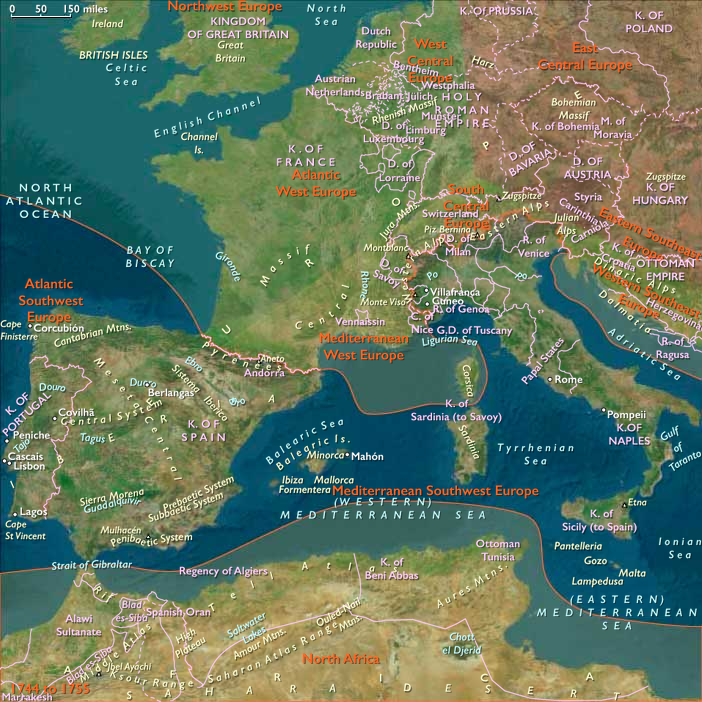
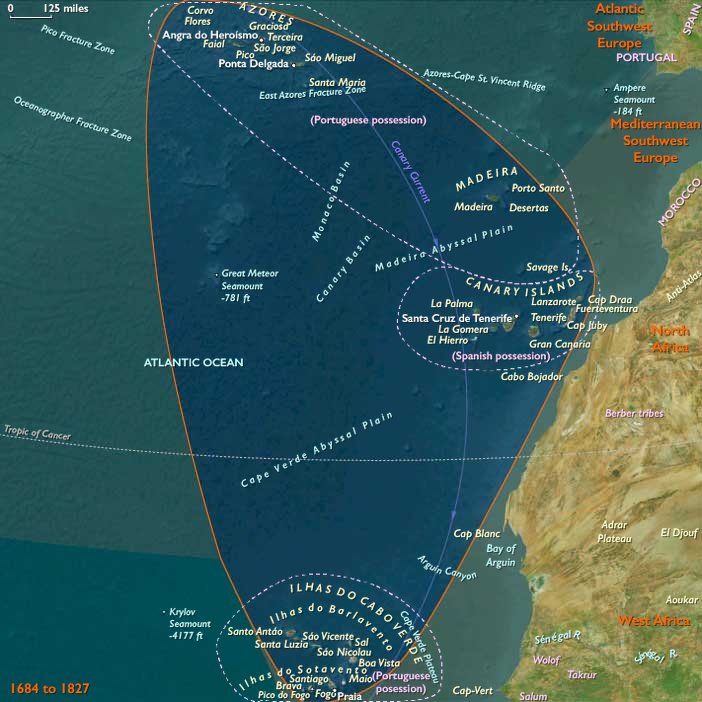
In this volatile environment, British naval squadrons patrolled European waters to counter French and Spanish movements. One such squadron, commanded by Sir Charles Hardy, was operating off the Berlangas, a small Portuguese archipelago west of Peniche, when it encountered an enemy sail on May 8, 1744. The Northumberland, a seventy-gun British ship of the line, was dispatched to investigate.
As it closed the distance, the Northumberland identified the vessel as the Mars, a sixty-four-gun French warship, accompanied by two other ships: the sixty-gun Content and a sixth-rate frigate. Despite the numerical disadvantage, Captain Thomas Watson—a man of unquestioned bravery but questionable tactical judgment—chose not to signal their presence to Vice-Admiral Hardy. Instead, he pressed forward under full sail, isolating himself from British support.
The French ships were widely dispersed, and by 5 PM, the Northumberland reached the Mars, engaging in a running battle. As the two exchanged volleys, Watson attempted to close the distance on the Content as well, intensifying the engagement into a multi-ship action. The Northumberland fought fiercely for nine hours, but under sustained French fire, she became unmanageable, her wheel shattered and her rigging severely damaged.
Amidst the chaos, Captain Watson was mortally wounded, and command fell into disorder. With the ship adrift and incapable of maneuvering, the Northumberland’s master—later court-martialed for surrendering without sufficient cause—struck the British colors, handing victory to the French.
Implications and Aftermath
The loss of the Northumberland was a serious blow to British naval prestige, demonstrating the risks of overzealous command decisions in isolated engagements. The event also underscored the increasing strategic importance of Portugal, a traditional British ally, whose coastline had become a contested zone in the Anglo-French naval struggle.
More broadly, this action reflected the larger challenges Britain faced in the early years of the War of the Austrian Succession. French naval forces were becoming bolder, and Britain’s reliance on isolated squadrons left them vulnerable to well-coordinated counterattacks. The defeat further motivated British naval strategists to strengthen squadron coordination and intelligence-sharing to avoid similar disasters.
By 1747, Britain had recovered from early setbacks, delivering decisive blows to the French navy at the First and Second Battles of Cape Finisterre, reinforcing British control of Atlantic trade routes. However, the events off the Berlangas in 1744 served as an important reminder of the perils of independent action and the enduring challenge of maritime warfare in the 18th century.

James II had been deposed as the King of England in 1688 in favor of his daughter, Mary, and her husband the Protestant Prince of Orange—William III of the house of Orange-Nassau.
There remains a significant element of the population of the British Isles that hops for the return of the Stuart family as monarchs.
King Louis XIV of France had shown great support for Stuart cause.
Indeed, in 1715, France had sponsored an uprising in Scotland, which the pretender James had joined, but it was defeated.
Forbidden to return to France by the new king, Louis XV, James had sought sanctuary elsewhere.
Finally, Pope Clement XI had offered James and his family the use of Palazzo Muti and a lifetime annuity of eight thousand Roman scudi.
It was here, in the Palazzo Muti, that Charles Edward Stuart, was born and had lived his whole life.
Charles has much more charisma than his father James, and now Louis XV is favorably disposed toward helping him create another uprising in Scotland.
Charles had sent Drummond of Balhaldy, who Louis XV had sent as an emissary to the Stuart "court" in Rome, to England in spring 1744 on an intelligence mission.
Balhaldy had reported that the English Tory Jacobites wish for Charles to come as soon as possible.
Charles had written to Louis XV, his second cousin, on July 24, saying he had been informed that England could be retaken without civil war as it is stripped of soldiers.
In August, he meets Murray of Broughton at Tuileries Palace, who tells him he will not get the support of more than four thousand Highlanders and that he must drop his plans to come to Scotland.
When Murray says French backing is extremely unlikely given their defensive position in Flanders, Charles replies that he is "determined to come the following summer to Scotland, though with a single footman".
The Jacobite (Stuart) rebellion of 1745, which attempts to put “Bonnie Prince Charles” on the British throne, is crushed in Scotland.
The Association in Scotland had written in early 1745 that it objected to a Jacobite rising if it was not supported by six thousand French soldiers; however, Lord Linton had been unable to find a safe way of transporting the letter to Charles.
Charles goes to Paris again in defiance of a French government ban of his presence there, determined to go to Scotland to force the French to back him.
Charles borrows forty thousand livres from Parisian banker George Walters (who later extends Charles' credit to one hundred and twenty thousand) to purchase broadswords.
The commander of the Irish Brigade of the French Army, Lord Clare, introduces Charles to Irish shipowners who agree to help him get to Scotland with money, volunteers and arms.
Sir Walter Ruttlidge gives Charles the captured sixty-four-gun British warship Elisabeth, which has on board one hundred volunteers from Clare's Regiment of the Irish Brigade, fifteen hundred muskets and eighteen hundred broadswords.
Charles' ship is to be the sixteen-gun privateer Du Teillay, which also had on board muskets, swords and four thousand louis d'or.
Volunteers drawn from the Irish Brigade of France are to form a bridgehead for the main French invasion, but due to the vigilance of the English Channel fleet, only one composite Irish battalion (five hundred men) will land in Scotland where they will fight bravely in the campaign.
The Du Teillay had sailed from Nantes on June 22, 1745, meeting the Elisabeth at Brittany on July 4 and then sailing together for Scotland.