Henry the Navigator
Duke of Viseu, Infante of Portugal
Years: 1394 - 1460
Infante Henry, Duke of Viseu (Porto, 4 March 1394 – Sagres, 13 November 1460), better known as Henry the Navigator, is an important figure in the early days of the Portuguese Empire and the Age of Discoveries in total.
He is responsible for the early development of European exploration and maritime trade with other continents.
Henry is the third child of King John I of Portugal, founder of the Aviz dynasty, and of Philippa of Lancaster, John of Gaunt's daughter.
Henry encourages his father to conquer Ceuta (1415), the Muslim port on the North African coast across the Straits of Gibraltar from the Iberian peninsula.
He learns of the opportunities from the Saharan trade routes that terminate there, and becomes fascinated with Africa in general; he is most intrigued by the Christian legend of Prester John and the expansion of Portuguese trade.
Henry is regarded as the patron of Portuguese exploration.
In "Crónica da Guiné" Henry is described as having no luxuries, not avaricious, speaking with soft words and calm gestures, a man of many virtues who never allowed any poor person leave his presence empty-handed.
Related Events
Filter results
Showing 10 events out of 68 total
King Denis and the Resolution of the Church-Crown Conflict (1279–1325)
The long-standing conflict between the Portuguese Crown and the Church over property rights was finally settled during the reign of King Denis (r. 1279–1325). Determined to assert royal authority over the kingdom’s land and resources, Denis took decisive action to curb the Church’s unchecked accumulation of property.
The Deamortization Laws and Excommunication (1284–1285)
- In 1284, King Denis launched a new round of inquiries into Church landholdings.
- The following year (1285), he issued deamortization laws, which prohibited the Church and religious orders from purchasing land and required them to sell all properties acquired since the start of his reign.
- This action led to Denis’s excommunication, following the precedent of his father (Afonso III) and grandfather (Afonso II), both of whom had clashed with the papacy over land reform.
- Unlike his predecessors, however, Denis refused to submit to papal authority, securing once and for all the Portuguese Crown’s control over royal patrimony.
The Nationalization of Military Orders
Denis’s assertion of royal supremacy over land extended to military-religious orders, which had amassed vast wealth and influence during the Reconquista. By nationalizing these orders, Denis ensured that their resources would serve the kingdom rather than remain under foreign or papal control.
- The Order of Avis (1280s) – Originally a Castilian military order (the Calatravans), the knights became effectively Portuguese when King Afonso II granted them the town of Avis. Under Denis, the Order of Avis remained a dedicated military force, later playing a key role in Portugal’s independence from Castile.
- The Order of Saint James (Santiago) (1288) – Although founded in Castile, the Portuguese knights of the order elected their own master in 1288, effectively separating themselves from Castilian control.
- The Suppression of the Templars and the Order of Christ (1312) – When Pope Clement V dissolved the Templars, their immense landholdings were initially transferred to the Hospitallers. However, King Denis successfully petitioned the pope to grant the Templars’ Portuguese wealth to a new military-religious order, the Order of Christ, founded in 1319 and originally based at Castro Marim before moving to Tomar.
The Legacy of the Military Orders
After their nationalization, most of these military-religious orders transitioned into chivalric landowning institutions, becoming quasi-celibate noble orders responsible for governing vast estates. However, two orders retained military significance:
- The Order of Avis remained a combat-ready force, playing a major role in securing Portugal’s independence from Castile.
- The Order of Christ retained military and religious functions, but more importantly, its vast wealth later funded Prince Henry the Navigator’s early voyages of discovery, financing Portugal’s maritime expansion in the 15th century.
Conclusion
King Denis’s bold assertion of royal control over land, wealth, and military orders ensured that Portugal’s resources remained under the Crown’s authority rather than the Church’s influence. His reforms not only strengthened the monarchy but also laid the foundations for Portugal’s later dominance in exploration and global trade.
Philippa of Lancaster and the Anglo-Portuguese Alliance (1387–1430)
In 1387, Philippa of Lancaster, daughter of John of Gaunt, married King João I of Portugal, sealing the Anglo-Portuguese alliance, one of the longest-standing diplomatic alliances in history. Through this union, João and Philippa became the parents of a remarkable generation of princes, whom poet Luís de Camões would later call the "marvelous generation", responsible for leading Portugal into its golden age.
Philippa’s Influence: Education, Morality, and Commerce
Philippa brought to the Portuguese court the Anglo-Norman tradition of aristocratic education, ensuring her children received a rigorous intellectual and moral upbringing. She reformed the royal court, instilling strict standards of morality and discipline, shaping Portugal’s royal culture for generations.
Beyond courtly influence, Philippa also provided royal patronage for English commercial interests, fostering trade between Portugal and England. English merchants supplied cod and cloth, while Portuguese traders exported wine, cork, salt, and olive oil through English warehouses in Porto, strengthening economic ties between the two nations.
The "Marvelous Generation" and Their Achievements
Philippa’s sons were among the most accomplished figures in Portuguese history:
- Duarte (Edward I of Portugal) – A scholar-king, he authored moral treatises and ruled as King of Portugal from 1433 until his death in 1438.
- Pedro, Duke of Coimbra – A well-traveled intellectual, deeply interested in history and governance, who later served as regent of Portugal after Duarte’s death.
- Fernando, the Saint Prince – A crusader, he participated in the failed 1437 attack on Tangier, where he was captured and later died in captivity.
- Henrique (Prince Henry the Navigator) – Master of the Order of Avis, he became the driving force behind Portugal’s early voyages of discovery, laying the groundwork for the Age of Exploration.
Philippa’s Enduring Legacy
Philippa of Lancaster’s legacy extended beyond diplomacy; through her court reforms, patronage, and maternal influence, she shaped the cultural, political, and economic foundations of Portugal’s golden age. Her children’s military, intellectual, and exploratory achievements propelled Portugal to the forefront of European expansion and discovery in the 15th and 16th centuries.
Many inhabitants of the Gold Coast area are striving to consolidate their newly acquired territories and to settle into a secure and permanent environment wWhen the first Europeans arrive in the late fifteenth century.
Several African immigrant groups have yet to establish firm ascendancy over earlier occupants of their territories, and considerable displacement and secondary migrations are in progress.
Ivor Wilks, a leading historian of Ghana, has observed that Akan purchases of slaves from Portuguese traders operating from the Congo region augmented the labor needed for the state formation that is characteristic of this period.
Unlike the Akan groups of the interior, the major coastal groups, such as the Fante, Ewe, and Ga, are for the most part settled in their homelands.
The Portuguese are the first to arrive.
By 1471, under the patronage of Prince Henry the Navigator, they have reached the area that is to become known as the Gold Coast.
Europeans know the area as the source of gold that reaches Muslim North Africa by way of trade routes across the Sahara.
The initial Portuguese interest in trading for gold, ivory, and pepper increases so much that in 1482 the Portuguese build their first permanent trading post on the western coast of present-day Ghana.
This fortress, Elmina Castle, constructed to protect Portuguese trade from European competitors and hostile Africans, still stands.
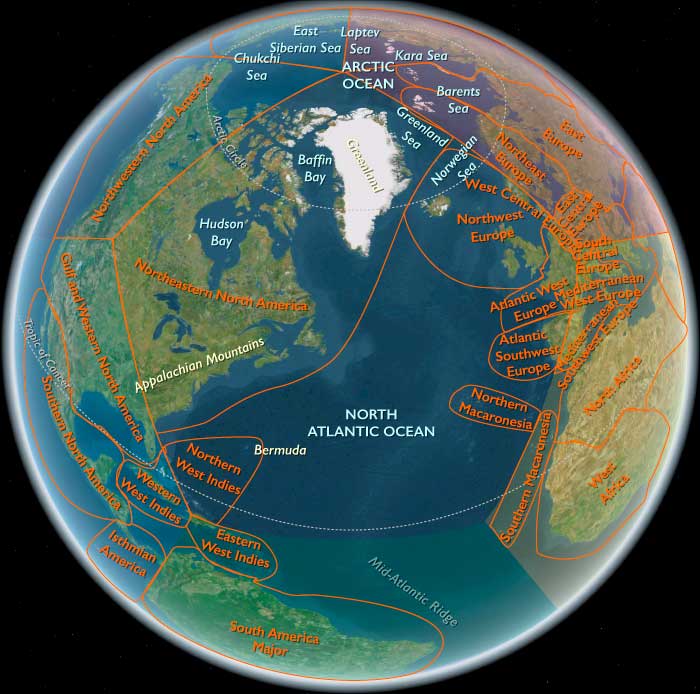
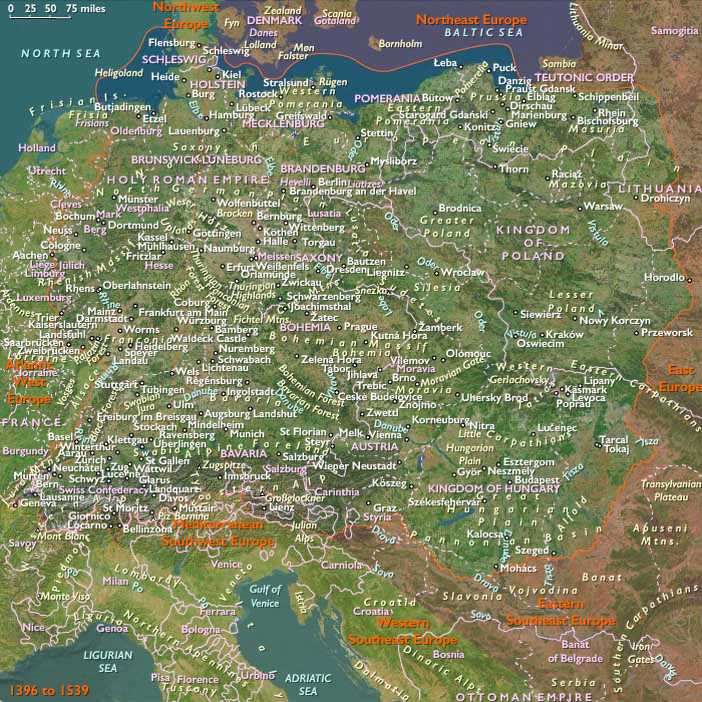
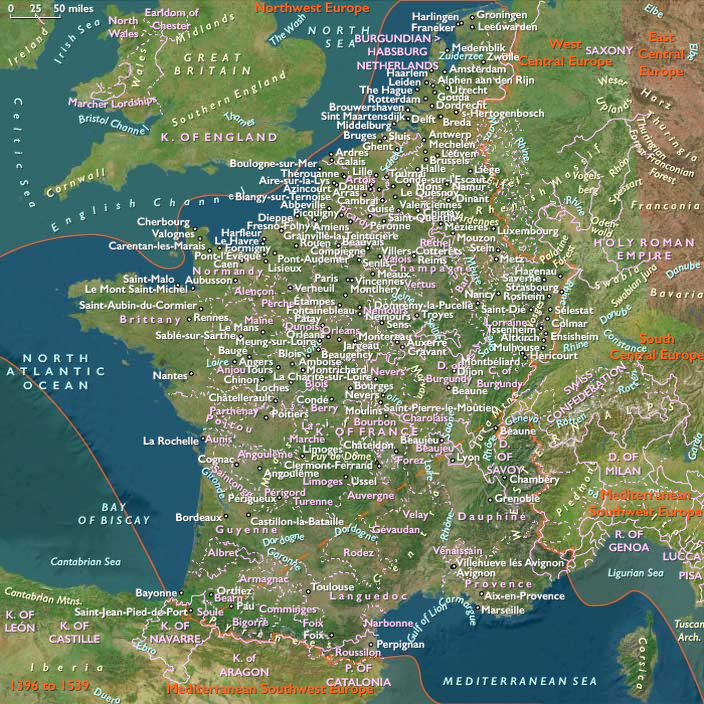
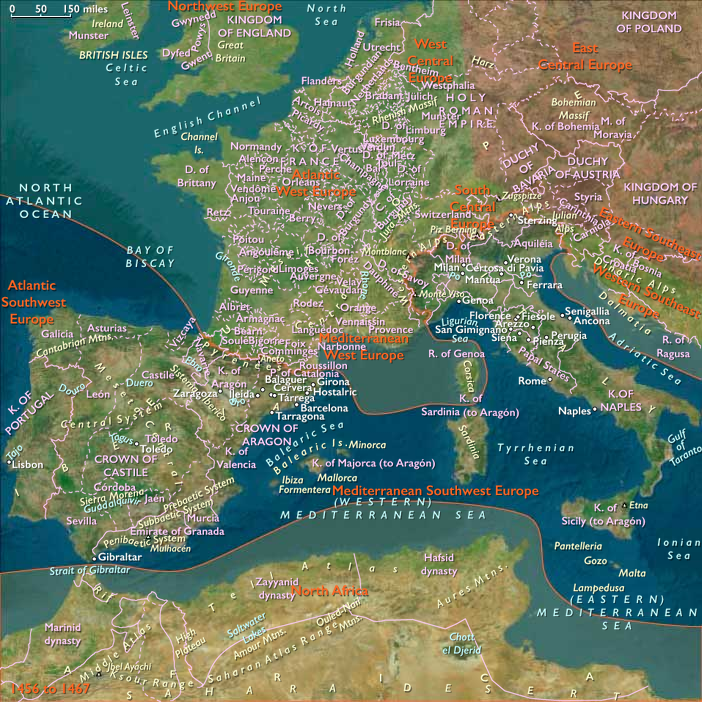
Mediterranean Southwest Europe (1396–1539 CE): Aragonese Sea Lanes, Italian Renaissance, and Habsburg–Valois Wars
Geographic & Environmental Context
The subregion of Mediterranean Southwest Europe includes Italy (including Sardinia and Sicily), Malta, southern and eastern Spain (Andalusia, Murcia, Valencia, Catalonia), and the Balearic Islands. Anchors span the Po Valley and Venetian–Adriatic gateways, the Apennine spine with Tyrrhenian and Adriatic littorals, the grain and volcanic uplands of Sicily, the rugged Sardinian interior, Malta’s limestone plateau astride central sea-lanes, and Spain’s irrigated huertas and ports from Seville–Cádiz (Atlantic–Mediterranean hinge) through Valencia–Barcelonato the Balearics. Together, these corridors fed and armed Europe’s busiest inland sea.
Climate & Environmental Shifts
Under the Little Ice Age, winters were cooler and variability sharper:
-
Po Valley & northern Italy: alternating droughts and Po floods unsettled wheat/rice rotations; foggy winters extended.
-
Sicily, Sardinia, southern Spain: periodic droughts dented wheat and olive yields; citrus and pastoralism buffered shortfalls.
-
Valencian/Murcian huertas: canal and acequia irrigation moderated dry spells; occasional torrential floods (riadas) damaged terraces.
-
Balearics & Malta: thin soils and rainfall swings drove reliance on cisterns, terracing, and imported grain in lean years.
Subsistence & Settlement
-
Italy: Wheat, barley, vines, and olives dominated; rice spread in Lombardy; urban gardens ringed city-states.
-
Sicily & Sardinia: Grain, olives, vines, citrus, pastoral flocks; granaries supplied Italian and Iberian ports.
-
Southern & eastern Spain: Andalusian cereals, olives, vines; Valencia/Murcia grew rice, sugarcane, mulberry–silk; Catalan uplands raised sheep for wool.
-
Balearics & Malta: Mixed grain, olives, vines, goats; fisheries vital; harbors provisioned passing fleets.
Port cities—Venice, Genoa, Naples, Palermo, Barcelona, Valencia, Seville, Palma, Cagliari—functioned as collection and redistribution hubs for Mediterranean and, increasingly, Atlantic trade.
Technology & Material Culture
-
Irrigation & terracing: acequias, qanat-derived galleries, pozzos/cisterns, stone-walled benches stabilized yields on coasts and islands.
-
Maritime technology: galleys remained the workhorse; Italian and Iberian yards developed round-hulled naos and early caravels; bronze cannon transformed siege and naval warfare.
-
Manufactures: Florentine wool and silk; Venetian glass and print (Aldine press); Valencian silk and sugar; Catalan and Neapolitan shipyards.
-
Architecture & arts: Gothic to Renaissance transitions—Brunelleschi’s dome, Alberti’s façades, Venetian palazzi; Spanish Mudéjar and early Plateresque; island watchtowers and coastal walls.
Movement & Interaction Corridors
-
Aragonese thalassocracy: Barcelona–Valencia–Balearics–Sardinia–Sicily–Naples stitched a western Mediterranean network later inherited by Habsburg Spain.
-
Italian sea-lanes: Venice and Genoa collected Levantine and North African wares; peninsular roads (Via Emilia, Apennine passes) bound inland cities to ports.
-
Iberian hinge: Seville–Cádiz bridged Atlantic and Mediterranean circuits after 1492; Atlantic silver would later amplify these flows.
-
Island waypoints: Malta, Sardinia, and the Balearics provisioned convoys and guarded straits against corsairs.
Cultural & Symbolic Expressions
-
Renaissance humanism: Florence, Rome, and Venice fostered painting, sculpture, architecture, philology; courts of Naples, Ferrara, and Urbino radiated styles into Iberia and the islands.
-
Catholic Christendom: Papal Rome remained a pilgrimage and patronage center; confraternities, processions, and mendicant orders structured urban piety.
-
Iberian transformations: The Fall of Granada (1492) ended Nasrid rule; the Inquisition and expulsion/forced conversion reshaped Andalusian society; Valencian and Catalan towns mixed mercantile pragmatism with reforming currents.
-
Island identities: Genoese, Aragonese, and local elites fused on Corsica/Sardinia; Malta blended Sicilian, Catalan, and Arabic legacies—until 1530, when it became the fief of the Knights Hospitaller.
Environmental Adaptation & Resilience
-
Risk-spreading agriculture: cereal–legume rotations, vine–olive intercropping, and chestnut economies in uplands; rice paddies where water allowed.
-
Water management: canal dredging (Po/Adige), huerta maintenance (Valencia), terrace/cistern upkeep (Malta, Balearics, Ligurian and Amalfi coasts).
-
Urban buffers: state granaries, grain imports, and charitable confraternities mitigated dearth; fisheries and salted staples bridged bad harvests.
Technology & Power Shifts (Conflict Dynamics)
-
Hundred Years’ War (to 1453): peripheral raids reached Languedoc and Catalonia, nudging Aragonese naval policy.
-
Conquest of Naples (1442): Alfonso V of Aragon knit Naples to the Crown of Aragon’s sea empire.
-
Italian Wars (1494–1559): France, Spain, and the Empire fought over Italian hegemony—
-
Battle of Fornovo (1495) checked Charles VIII’s withdrawal;
-
Battle of Cerignola (1503) (Apulia) showcased gunpowder infantry, securing Spanish control in southern Italy;
-
Battle of Agnadello (1509) humbled Venice on the terraferma;
-
Battle of Pavia (1525) delivered a decisive Habsburg victory and Francis I’s capture;
-
the Sack of Rome (1527) shattered papal prestige and artists’ security.
-
-
Western Mediterranean contest: Barbary and Ottoman corsairs raided Sicily, Sardinia, Balearics, and Valencia; Rhodes (1522) fell to the Ottomans, redirecting the Hospitallers to Malta (1530); Preveza (1538) cemented Ottoman naval dominance in the eastern basin with echoes westward.
-
Iberian unification: The crowns of Aragon and Castile united (1479), projecting Spanish power across the peninsula, Italy, and the sea.
Transition
By 1539 CE, Mediterranean Southwest Europe was a crucible of power and culture. Habsburg Spain controlled Naples, Sicily, and Sardinia; Venice and Genoa mediated eastern and western trades under growing Habsburg and Ottoman pressure; Malta stood newly under the Knights as a central bastion; Valencia–Barcelona and Italian ports thrummed with commerce and shipbuilding. Despite climatic swings, terracing, irrigation, and maritime provisioning sustained populations. Renaissance patronage glowed even as Italian Wars and corsair/Ottoman threats remade the political seascape—setting up a long sixteenth century of Spanish predominance and Mediterranean contest.
Southwest Europe (1396–1539 CE)
Aragonese Sea Lanes, Italian Renaissance, and Habsburg–Valois Wars
Geography & Environmental Context
Southwest Europe encompassed Italy (including Sardinia and Sicily), Malta, southern and eastern Spain (Andalusia, Murcia, Valencia, Catalonia), and the Balearic Islands. Anchors spanned the Po Valley and Venetian–Adriatic gateways, the Apennine spine with Tyrrhenian and Adriatic littorals, the grain and volcanic uplands of Sicily, the rugged Sardinian interior, Malta’s limestone plateau astride central sea-lanes, and Spain’s irrigated huertas and ports from Seville–Cádiz (Atlantic–Mediterranean hinge) through Valencia–Barcelona to the Balearics.
Together these corridors provisioned, armed, and cultured Europe’s busiest inland sea.
Climate & Environmental Shifts
Under the Little Ice Age, winters cooled and variability intensified:
-
Po Valley & Lombardy: alternating droughts and Po floods unsettled rice and wheat rotations.
-
Sicily, Sardinia, southern Spain: recurrent droughts reduced grain and olive yields; citrus and pastoralism buffered loss.
-
Valencia–Murcia huertas: Acequia irrigation offset dry years, but torrential riadas periodically destroyed terraces.
-
Balearics & Malta: thin soils and rainfall swings required cisterns, terracing, and imported grain.
Subsistence & Settlement
-
Italy: Wheat, barley, vines, olives, and, in Lombardy, irrigated rice; urban gardens surrounded the city-states.
-
Sicily & Sardinia: Grain, olives, vines, citrus, and livestock; granaries provisioned Italian and Iberian ports.
-
Southern & eastern Spain: Andalusian cereals, olives, and vines; Valencian and Murcian sugarcane and mulberry–silk; Catalan wool flocks.
-
Islands: Grain, olives, vines, goats, and fisheries sustained mixed economies; harbors provisioned passing fleets.
Major ports—Venice, Genoa, Naples, Palermo, Barcelona, Valencia, Seville, Palma, Cagliari—served as collection hubs for Mediterranean and emerging Atlantic commerce.
Technology & Material Culture
-
Irrigation & terracing: Acequias, qanat-derived galleries, pozzos and cisterns, and stone-bench terraces stabilized yields on coasts and islands.
-
Maritime innovation: Galleys remained indispensable; Italian and Iberian shipyards developed round-hulled naos and early caravels; bronze cannon revolutionized siege and naval warfare.
-
Manufactures: Florentine wool and silk, Venetian glass and books (the Aldine Press), Valencian silk and sugar, Catalan and Neapolitan shipbuilding.
-
Architecture & arts: Gothic–Renaissance transitions—Brunelleschi’s dome, Alberti’s façades, Venetian palazzi; Spanish Mudéjar and early Plateresque; island watchtowers and coastal walls.
Movement & Interaction Corridors
-
Aragonese thalassocracy: The Barcelona–Valencia–Balearics–Sardinia–Sicily–Naples chain formed a western Mediterranean empire later absorbed by Habsburg Spain.
-
Italian sea-lanes: Venice and Genoa dominated Levantine and North African trade; Apennine passes linked inland production to ports.
-
Iberian hinge: Seville–Cádiz bridged Atlantic and Mediterranean routes after 1492, prefiguring global circuits of silver and spice.
-
Islands: Malta, Sardinia, and the Balearics provisioned convoys and guarded corsair-prone straits.
Cultural & Symbolic Expressions
-
Renaissance humanism: Florence, Rome, and Venice led Europe’s artistic renewal; courts of Naples, Ferrara, and Urbino radiated taste into Iberia and the islands.
-
Catholic Christendom: Rome remained pilgrimage center and patron of arts; confraternities and mendicant orders structured devotion.
-
Iberian transformations: The Fall of Granada (1492) ended Nasrid rule; the Inquisition and expulsions reshaped Andalusian society; Valencian and Catalan towns mixed mercantile realism with reformist thought.
-
Islands: Malta, blending Sicilian, Catalan, and Arabic legacies, was granted in 1530 to the Knights Hospitaller as a new crusading bastion.
Environmental Adaptation & Resilience
Cereal–legume rotations, vine–olive intercropping, chestnut economies in uplands, and rice paddies in irrigated lowlands spread risk.
Huerta canals and terrace systems were continuously maintained; state granaries and charitable confraternities mitigated dearth; fisheries and salted staples balanced harvest failures.
Technology & Power Shifts (Conflict Dynamics)
-
Aragonese expansion: Alfonso V (1442) united Naples with Aragon’s sea empire.
-
Italian Wars (1494–1559): France, Spain, and the Empire contested Italy—Fornovo (1495), Cerignola (1503), Agnadello (1509), Pavia (1525), and the Sack of Rome (1527) redefined European warfare and diplomacy.
-
Corsair & Ottoman pressure: Raids struck Sicily, Sardinia, Valencia, and the Balearics; Preveza (1538) confirmed Ottoman naval mastery in the east.
-
Iberian union: The crowns of Aragon and Castile (1479) created a Spanish monarchy projecting power across the peninsula and into the Mediterranean.
Transition
By 1539 CE, Southwest Europe was a crucible of power and culture. Habsburg Spain controlled Naples, Sicily, and Sardinia; Venice and Genoa mediated East–West trades under Ottoman pressure; Malta under the Knights became a bulwark; Valencia–Barcelona and Italian ports thrived on commerce and shipbuilding. Terracing, irrigation, and maritime provisioning sustained populations amid climatic volatility. Renaissance brilliance endured even as corsairs and cannon ushered in a new Mediterranean order.
The Portuguese continue after the death of Prince Henry to explore the coast of Africa, but without their earlier singleness of purpose.
A dispute has arisen among the military aristocracy over whether Portugal can best achieve its strategic objectives by conquering Morocco or by seeking a sea route to India.
Duarte had continued his father's Moroccan policy and had undertaken a military campaign against Tangiers but was unsuccessful. Afonso V orders several expeditionary forces to Morocco.
In 1458 he conquers Alcazarquivir; in 1471 he takes Arzila, followed by Tangiers and Larache.
Afonso's successors continue this policy of expansion in Morocco, especially Manuel I (r. 1495-1521), who conqueras Safim and Azamor.
The Moroccan empire is expensive because it keeps Portugal in a constant state of war; therefore, it is abandoned by João III (r. 1521-57), except for Ceuta and Tangiers.
Prince Henry's plan requires the circumnavigation of Africa.
His early voyages stay close to the African coast.
After repeated attempts, Gil Eanes finally rounds Cape Bojador on the west coast of Africa in present-day Western Sahara in 1434, a psychological, as well as physical, barrier that is thought to be the outer boundary of the knowable world.
After passing Cape Bojador, the exploration of the coast southward proceeds very rapidly.
In 1436 Gil Eanes and Afonso Baldaia arrived at the Senegal River, which they call the River of Gold because two Africans they had captured are ransomed with gold dust.
In 1443 Nuno Tristão arrives at the Bay of Arguin off the coast of present-day Mauritania.
These voyages return enslaved Africans to Portugal, which sparks an interest in the commercial value of the explorations, and a factory is established at Arguin as an entrepôt for human cargo.
In 1444 Dinis Dias discovers the Cape Verde Islands, at this time heavily forested, and Nuno Tristão explorea the mouth of the Senegal River.
In 1445 Cape Verde is rounded, and in 1456 Portuguese arrive at the coast of present-day Guinea.
The following year, they reach present-day Sierra Leone.
Thus, when Prince Henry dies in 1460, the Portuguese have explored the coast of Africa down to Sierra Leone and discovered the archipelagoes of Madeira, the Azores, and the Cape Verde Islands.
He continues to direct Portugal's early maritime activity.
As the master of the Order of Christ, Prince Henry is able to draw on the vast resources of this group to equip ships and pay the expenses of the early maritime expeditions.
Prince Henry is motivated by scientific curiosity and religious fervor, seeing the voyages as a continuation of the crusades against the Muslims and the conversion of new peoples to Christianity, as well as by the desire to open a sea route to India.
Shortly after the school is established, two of Prince Henry's captains discover the island of Porto Santo, and the following year the Madeira Islands are discovered.
In 1427 Diogo de Silves, sailing west, discovers the Azores archipelago, also uninhabited.
Both Madeira and Porto Santo are colonized immediately and divided into captaincies.
These are distributed to Prince Henry's captains, who in turn have the power to distribute land to settlers according to the Law of the Sesmarias.
North Africa (1396–1539 CE): Dynastic Fragmentation and Imperial Incursions
Geographic & Environmental Context
The subregion of North Africa includes Morocco (together with the Western Sahara), Algeria, Tunisia, and Libya. Anchors included the Atlas Mountains, the Tell plains, the Saharan oases and trade routes, the Western Sahara corridor linking to the Sahel, and the Maghreb seaports of Fez, Tlemcen, Tunis, Tripoli, and Ceuta. This was a region where desert, steppe, and sea converged: caravan roads from Timbuktu and Gao brought gold and slaves across the Sahara, while Mediterranean ports tied the Maghreb into the larger Islamic and Christian worlds.
Climate & Environmental Shifts
The Little Ice Age brought cooler winters and erratic rainfall. Drought cycles struck the Western Sahara and Maghreb steppe, tightening dependence on oases and irrigation. Locust invasions and periodic plague outbreaks compounded crises, shrinking urban populations. Yet fertile plains along the Tell and Atlas valleys sustained wheat, olives, and fruit production. Coastal fisheries provided further resilience.
Subsistence & Settlement
Agrarian villages cultivated cereals, olives, and figs, while nomadic herders managed sheep, goats, and camels across steppe and desert. Oases of the Western Sahara sustained date palms, cereals, and salt trade. Cities like Fez and Tunis thrived as centers of crafts, scholarship, and trade, while Tripoli and Algiers connected desert routes to Mediterranean shipping.
Technology & Material Culture
Workshops in Fez, Tunis, and Tlemcen produced fine textiles, ceramics, and leatherwork. Goldsmithing and manuscript illumination flourished in urban centers. Zawiyas (Sufi lodges) served as nodes of education, manuscript copying, and devotion. Camel caravans remained the backbone of Saharan commerce, though firearms began to trickle into the region via European trade, altering the dynamics of warfare.
Movement & Interaction Corridors
-
Western Sahara caravans: Carried salt, gold, and slaves from West Africa northward, exchanging for horses, textiles, and metal goods.
-
Mediterranean seaports: Linked Maghreb cities with Italy, Iberia, and the Ottoman Levant.
-
Portuguese expansion: Ceuta fell to Portugal in 1415; Tangier, Asilah, and other coastal strongholds soon followed, embedding Iberian enclaves along the Atlantic littoral.
-
Spanish expansion: After 1492, Spain joined in the seizure of Melilla (1497) and Oran (1509).
-
Ottoman interest: Algiers increasingly leaned toward Ottoman protection against Spain, foreshadowing Ottoman conquest.
Cultural & Symbolic Expressions
Madrasas in Fez and Tunis trained scholars in Islamic law and sciences, while Sufi brotherhoods expanded across steppe and desert, binding rural populations into ritual networks. Oral epics of tribal champions and saints’ legends circulated widely. Decorative tiles, stucco, and calligraphy adorned mosques and palaces. Christian forts along the coast embodied rival European claims.
Environmental Adaptation & Resilience
Nomadic tribes shifted grazing routes in response to drought. Farmers rotated cereals and legumes, relying on irrigation and terrace cultivation in mountain valleys. Caravan merchants diversified routes to avoid conflict and secured oasis rights through diplomacy or tribute. Waqf endowments and Sufi zawiyas supported the needy in times of famine.
Transition
By 1539 CE, North Africa was politically fragmented but geopolitically pivotal. The Wattasid dynasty in Morocco struggled to defend Atlantic ports against Portugal. The Hafsids in Tunis and Tripoli balanced diplomacy and piracy. The Ottomans, through corsair captains like Barbarossa (Hayreddin Pasha), were entering the scene, soon to secure Algiers. Spain and Portugal pressed inland from fortified ports, foreshadowing centuries of contest between European powers, Ottoman regencies, and Indigenous dynasties across the Maghreb and Sahara.
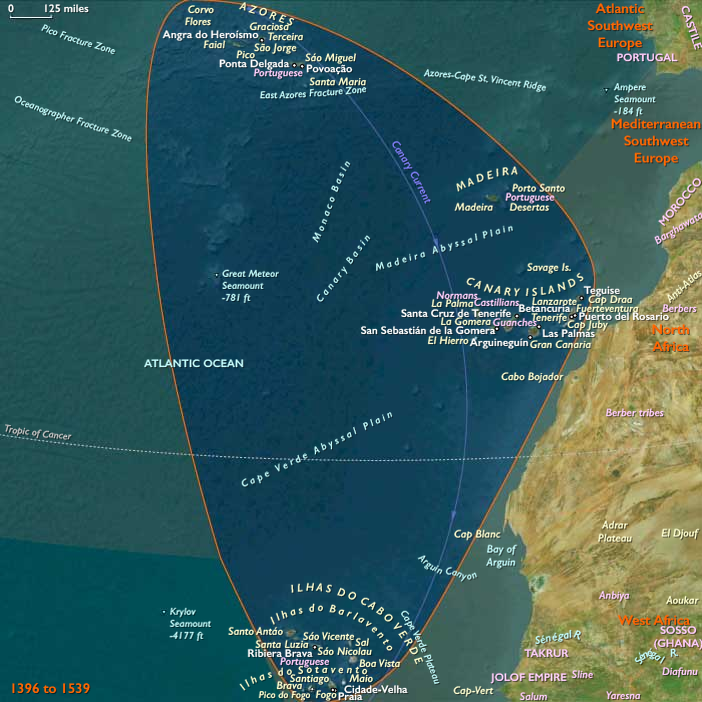
Northern Macaronesia (1396–1539 CE): Discovery, Colonization, and Atlantic Integration
Geographic & Environmental Context
The subregion of Northern Macaronesia includes the Azores and Madeira archipelago. The Azores stretched in three groups of volcanic islands (western, central, eastern) across the mid-Atlantic, with high peaks, calderas, and crater lakes. Madeira featured rugged volcanic massifs, deep valleys, and laurel-clad uplands. Both archipelagos were positioned in the North Atlantic subtropical gyre, at the crossroads of winds and currents that soon became indispensable to Iberian navigation.
Climate & Environmental Shifts
During this age, the early centuries of the Little Ice Age brought cooler winters and occasional drought in the Azores, but the maritime climate moderated extremes. Madeira’s laurel forests continued to harvest cloud moisture, while leeward coasts grew drier. Seasonal storms occasionally battered harbors, yet fertile volcanic soils sustained productive agriculture.
Subsistence & Settlement
This was the pivotal era of human arrival and colonization:
-
Madeira: Discovered by Portuguese navigators c. 1419. Settlement soon followed, clearing laurel forests for wheat, vineyards, and especially sugarcane, cultivated with enslaved labor (African and later Guanche captives).
-
Azores: Officially discovered c. 1427, settled by Portuguese colonists, including Flemings and other Europeans. Agriculture centered on wheat, vineyards, orchards, and livestock. Fishing and whaling developed offshore.
-
Indigenous populations did not exist in these northern archipelagos; settlement began directly with colonization.
Technology & Material Culture
Portuguese colonists introduced iron tools, plows, sugar mills, waterwheels, and terracing techniques. Stone churches, forts, and towns (e.g., Funchal in Madeira, Angra in the Azores) embodied European architectural traditions. Sugar production technology integrated Iberian, Mediterranean, and Islamic precedents. Material culture included ceramics, textiles, and hybrid Afro-Portuguese religious and artistic forms brought by enslaved laborers.
Movement & Interaction Corridors
Northern Macaronesia became a keystone in Atlantic navigation:
-
The Azores lay on the return route for Iberian fleets from Africa and the Americas, serving as staging posts and weathering ports.
-
Madeira exported sugar and wine to Europe, linking the islands into Mediterranean and northern European markets.
-
Both archipelagos became hubs in the transatlantic system, receiving enslaved Africans and exporting cash crops.
These corridors made the islands both economic engines and geopolitical prizes.
Cultural & Symbolic Expressions
Catholicism was established immediately with colonization. Churches, chapels, and processions anchored religious life. Marian devotion in Madeira and the cult of the Holy Spirit in the Azores became central symbolic expressions, blending Iberian Christianity with the lived reality of frontier life. Music, oral traditions, and festivals reflected Portuguese heritage, with African influences emerging subtly in labor and ritual.
Environmental Adaptation & Resilience
Colonists reshaped fragile island ecologies:
-
Deforestation of Madeira’s laurisilva destabilized slopes and altered watersheds.
-
Terracing and irrigation adapted to steep volcanic terrain.
-
In the Azores, cattle ranching, grain fields, and vineyards were adapted to wetter conditions and storm exposure.
Resilience was found in diversified crops, shared labor systems, and integration into wider imperial trade, though ecological degradation had already begun.
Transition
By 1539 CE, Northern Macaronesia was firmly integrated into the Portuguese Atlantic empire. Madeira was a major sugar producer, the Azores a critical provisioning and navigation hub. Both archipelagos were transformed from pristine oceanic ecosystems into human-dominated plantation and trade landscapes, foreshadowing the role of Atlantic islands as laboratories of colonization and models for the Americas.