
Hieronymus Bosch
Netherlandish painter
Years: 1450 - 1516
Hieronymus Bosch (born Jeroen Anthoniszoon van Aken; c. 1450 – August 9, 1516) is an Early Netherlandish painter.
His work is known for its use of fantastic imagery to illustrate moral and religious concepts and narratives.

Related Events
Filter results
Showing 10 events out of 11 total
The Artistic Revolution of the International Renaissance
The International Renaissance was a period of unprecedented artistic innovation, fueled by scientific advancements in anatomy, optics, and perspective. Artists sought a new realism, emphasizing proportion, harmony, and the resolution of complex and conflicting elements. This movement was not confined to Italy but spanned across Europe and beyond, influencing Flemish, Byzantine, and Chinese art traditions.
I. The Italian Renaissance: Masters of Proportion and Perspective
Italy was the epicenter of Renaissance art, producing visionary painters, sculptors, and architects who redefined artistic expression:
- Fra Angelico – A Dominican friar who blended spiritual devotion with Renaissance realism, best known for his frescoes at the Convent of San Marco in Florence.
- Jacopo de' Barbari – One of the first Italian artists to experiment with engraving, blending Venetian and Northern Renaissance influences.
- Sandro Botticelli – Known for his mythological masterpieces, including The Birth of Venus and Primavera, where elegance and fluidity of line define his style.
- Leonardo da Vinci – A polymath who mastered anatomy, light, and shadow, producing iconic works like Mona Lisa and The Last Supper.
- Fra Filippo Lippi – A master of delicate expressions and graceful figures, influencing later Florentine painters.
- Masaccio – The first painter to use scientific perspective in frescoes, revolutionizing spatial depth in painting.
- Piero della Francesca – Famous for his mathematical approach to perspective, exemplified in The Flagellation of Christ.
- Piero and Antonio del Pollaiuolo – Masters of anatomical accuracy and dynamic movement, pioneering the study of the human body in action.
- Luca Signorelli – Created some of the most vivid and muscular human forms, particularly in his frescoes in Orvieto Cathedral.
- Andrea del Verrocchio – Teacher of Leonardo da Vinci, known for his sculptures and refined painting techniques.
II. The Flemish Renaissance: Masters of Light and Detail
The Flemish Renaissance artists focused on realism, meticulous detail, and mastery of oil painting, influencing later European art:
- Hieronymus Bosch – Created surreal, dreamlike imagery with complex allegories and moral narratives, seen in The Garden of Earthly Delights.
- Hugo van der Goes – Renowned for his expressive emotion and intense realism, particularly in The Portinari Altarpiece.
- Hans Memling – Specialized in portraits and religious compositions, combining graceful figures with luminous color.
- Jan and Hubert van Eyck – Innovators of oil painting, with Jan's Arnolfini Portrait demonstrating unmatched precision and use of light.
- Rogier van der Weyden – Master of pathos and human expression, particularly in The Descent from the Cross.
- Michael Wolgemut – A leading German painter and printmaker, influential as the teacher of Albrecht Dürer.
III. The Byzantine and Chinese Renaissance Masters
- Theophanes the Greek (Byzantium) – The most famous Byzantine painter of the period, known for his dynamic, expressive figures and influence on early Russian iconography.
- Shen Zhou and Wen Zhengming (China) – Masters of the Wu School, blending traditional Chinese landscape painting with poetic expression, emphasizing personal expression over strict realism.
IV. Bridging the Early and High Renaissance: Dürer and Michelangelo
- Albrecht Dürer (Germany) – Bridged Gothic tradition and Renaissance humanism, mastering woodcuts, engravings, and scientific perspective in works like Melencolia I.
- Michelangelo Buonarroti (Italy) – His career spanned the transition from the Early to High Renaissance, creating sculptures, paintings, and architectural marvels, such as the Sistine Chapel frescoes and David.
V. The Legacy of the Renaissance Masters
The International Renaissance was an era of unparalleled artistic achievement, shaped by scientific inquiry, humanistic ideals, and cross-cultural influences. Through innovations in light, color, and perspective, artists redefined realism and transformed the visual world, leaving a legacy that continues to inspire modern art.
West Europe (1396–1539 CE)
Dynastic Struggles, Maritime Republics, and Reformation Currents
Geography & Environmental Context
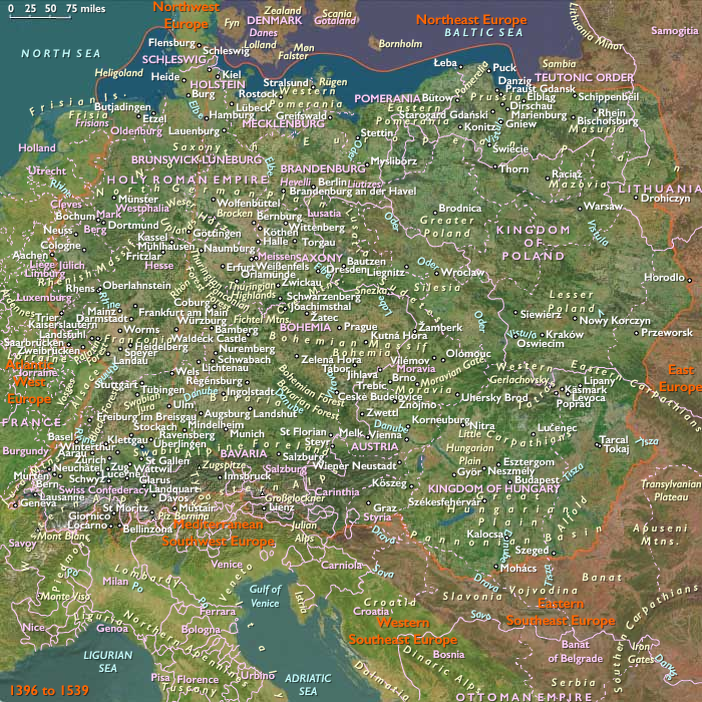
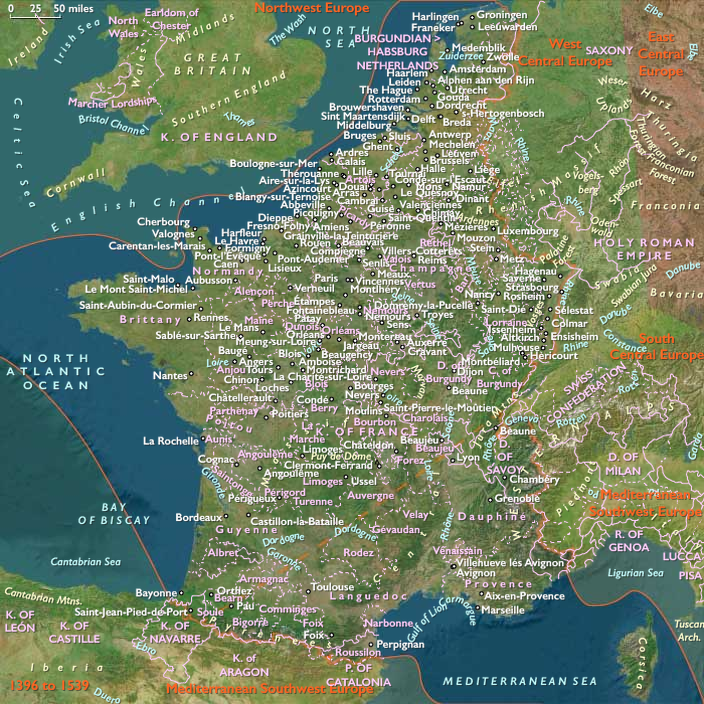
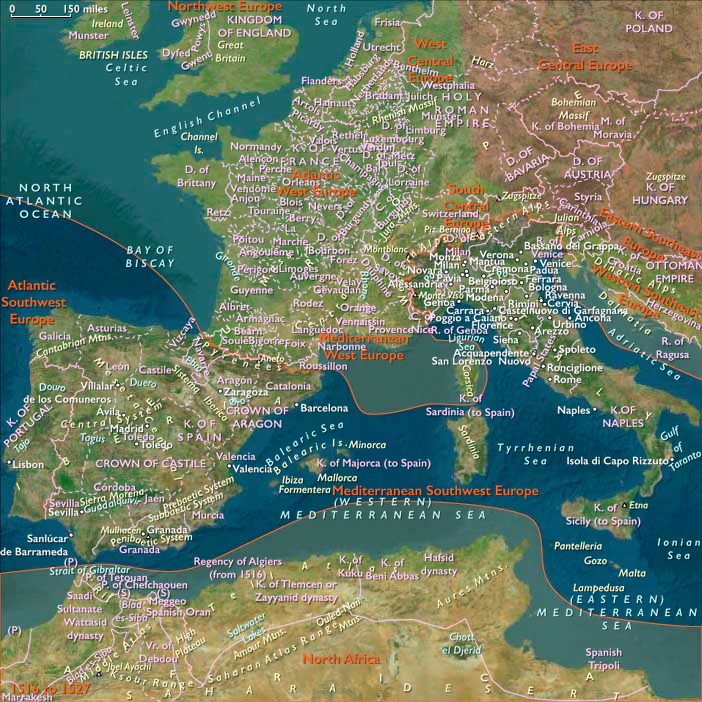
West Europe in this age bridged the Mediterranean and the Atlantic through two intertwined spheres.
Mediterranean West Europe encompassed southern France (Languedoc, Provence, the Rhône valley, the French Pyrenees), Monaco, and Corsica—a frontier of mountain uplands, terraced coasts, and river plains tied to Italian and Iberian seas.
Atlantic West Europe ran along the Atlantic and Channel coasts of France, the Loire Valley Burgundy, northern France (including Paris), and the Low Countries (Belgium, the Netherlands, Luxembourg)—fertile basins and estuaries linked to Europe’s commercial cores.
From Marseille and Nice to Antwerp, Rouen, and Bordeaux, ports, riverways, and passes bound inland grainlands to sealanes and mercantile emporia.
Climate & Environmental Shifts
The Little Ice Age brought cooler winters, late frosts, and erratic rains.
-
Languedoc–Provence & Corsica: Vine and olive belts suffered frost damage in severe winters; storms battered harbors.
-
Rhône & Loire valleys; Paris Basin; Burgundy: Alternating floods, droughts, and cold snaps reshaped grain and grape yields.
-
Low Countries & Channel coasts: North Sea surges and wetter fields demanded relentless dike upkeep; fisheries endured rougher seas yet remained staples.
Subsistence & Settlement
-
Mediterranean sphere: Mixed farming of wheat, barley, rye, and legumes in valleys; vines and olives on coastal terraces; chestnuts in Corsican uplands. Sheep–goat transhumance linked Pyrenean and island pastures to town markets. Marseille, Avignon, Montpellier, Nice, and Ajaccio thrived as fortified, trade-facing towns.
-
Atlantic sphere: Wheat, rye, oats, and barley dominated; Burgundy’s vineyards and the Loire’s orchards supported regional exchange; flax and hemp in Flanders; dairy and cattle in the Low Countries. Paris, Rouen, Dieppe, Bordeaux, Bruges, Antwerp, Ghent, and Brussels anchored urban craft and export economies. Fisheries for herring and cod—salted and barreled—fed towns and long-distance trade.
Technology & Material Culture
-
Agriculture: Three-field rotations; water- and windmills; hillside terracing across Provence and Corsica.
-
Shipbuilding & seamanship: Mediterranean galleys and Atlantic cogs evolved toward caravels and larger ocean-going hulls; coastal shipyards provisioned fleets from Marseille to Rouen and Antwerp.
-
Architecture: Flamboyant Gothic cathedrals in Narbonne and Montpellier; papal complexes at Avignon; Genoese towers on Corsica; Burgundian ducal palaces; Flemish belfries and town halls; early Renaissance idioms appeared in Loire châteaux.
-
Print & craft: Lyon, Paris, and Antwerp emerged as printing hubs; Flemish woolens and tapestries, Burgundian wines, and Parisian luxury metalwork set European tastes.
Movement & Interaction Corridors
-
Mediterranean sealanes: Marseille and Monaco linked to Genoa, Naples, and Barcelona; Corsica sat astride Italy–Iberia–Maghreb routes.
-
Rhône corridor: Carried salt, wine, and grain north to Lyon and beyond.
-
Atlantic & Channel arteries: Bruges (declining by 1500), Antwerp (rising), and Rouen tied northern Europe to Iberia and the Mediterranean; Bordeaux connected the Loire–Garonne basins to the ocean.
-
Overland networks: Burgundian roads knit Dijon and Brussels to the Empire and France; pilgrimage roads joined Roussillon, Provence, and the Loire to Santiago de Compostela and Rome.
Cultural & Symbolic Expressions
-
Catholic orthodoxy & humanism: Monastic houses and cathedrals structured devotion; Avignon’s papal legacy lingered. Lyon and Avignon sustained humanist circles; Montpellier’s medical school gained renown.
-
Burgundian court culture: Under the Valois dukes (Philip the Good, Charles the Bold), Dijon and Brussels patronized Jan van Eyck, Rogier van der Weyden, and civic pageantry.
-
French monarchy & Renaissance: Post–Hundred Years’ War recovery culminated in Francis I’s embrace of Italianate forms and royal patronage along the Loire.
-
Netherlandish art: Early Netherlandish painters pioneered oil technique; civic commissions in Ghent, Bruges, and Antwerp flourished. Troubadour legacies survived in lyric verse across Provence; confraternities staged processions and charity in town parishes.
Environmental Adaptation & Resilience
-
Diversified ecologies: Mixed cereals, vines, olives, flax, and livestock spread climatic risk.
-
Water & earth works: Terraces and dikes stabilized fragile slopes and polders; flood embankments guarded the Rhône, Loire, and Low Country coasts.
-
Storage & exchange: Communal barns, urban granaries, and salt trade mitigated shortfalls; guild aid, hospitals, and beguinages provided social buffers.
Technology & Power Shifts (Conflict Dynamics)
-
Hundred Years’ War (to 1453): Though major battles lay north, raids and instability touched Languedoc and Provence. French resurgence culminated in Joan of Arc’s campaigns (1429) and Castillon (1453).
-
Aragon–French rivalry: Roussillon oscillated between crowns; Pyrenean frontiers remained militarized.
-
Burgundian Wars (1474–1477): Charles the Bold fell at Nancy; his inheritance split—parts to France, the rest to the Habsburgs—reshaping Low Country sovereignty.
-
Italian Wars (1494–1559): Drew Provence and Corsica into Valois–Habsburg struggles; Fornovo (1495) and Pavia (1525, capture of Francis I) reverberated through Provençal ports.
-
Corsica: Fought over by Genoa and Aragon; Genoa reasserted control, fortifying coasts against Barbary corsairs.
-
Naval theaters: Mediterranean galley wars and Adriatic–Aegean rivalries impacted Marseille and Monaco; the Low Countries pivoted toward Habsburg naval finance and Atlantic networks.
Transition (to 1539 CE)
By 1539, West Europe stood as a frontier of empires and a laboratory of recovery and renaissance.
In the Mediterranean, France had consolidated Provence and Roussillon yet suffered reverses in Italy; Genoa controlled Corsica, bracing against French and Ottoman pressure; Marseille and Monaco thrived as naval–mercantile hubs under the shadow of corsair raids.
Across the Atlantic sphere, Burgundy was partitioned between Valois and Habsburg realms; the Low Countries emerged as Europe’s commercial heart, with Antwerp surpassing Bruges as entrepôt to Iberian spice and silver trades.
Humanism animated Lyon and Avignon; Gothic and early Renaissance forms stood side by side; confessional tensions gathered on the horizon.
Poised between the Mediterranean and the Atlantic, West Europe entered the mid-16th century as both battlefield and marketplace—its rivers and ports set to channel the coming storms of Reformation and Habsburg–Valois rivalry.
Atlantic West Europe (1396–1539 CE): Burgundian Prestige, French Recovery, and Netherlandish Flourishing
Geographic & Environmental Context
The subregion of Atlantic West Europe includes the Atlantic and Channel coasts of France, the Loire Valley, Burgundy, northern France (including Paris), and the Low Countries (Belgium, the Netherlands, Luxembourg). Anchors included the Channel ports (Calais, Rouen, Dieppe, Antwerp, Bruges, Amsterdam), the Loire valley (Orléans, Tours, Nantes), the Burgundian heartlands (Dijon, Beaune), and the Paris Basin. This zone blended coastal trade hubs, fertile river valleys, and political cores, linking France, England, and the Holy Roman Empire.
Climate & Environmental Shifts
The Little Ice Age imposed cooler winters and erratic harvests:
-
Paris Basin & Burgundy: Periodic frosts reduced wheat and grape harvests.
-
Loire valley: Vineyards and orchards remained productive in most decades but saw occasional setbacks from floods and cold snaps.
-
Low Countries: Waterlogged fields required dike maintenance; storm surges (notably 15th-century North Sea floods) devastated coastal settlements.
-
Atlantic coasts: Rough seas complicated fishing and shipping; herring and cod fisheries persisted, anchoring diets.
Subsistence & Settlement
-
Agriculture: Wheat, rye, oats, and barley; vineyards in Burgundy and the Loire; flax and hemp in Flanders; dairy and cattle in the Low Countries.
-
Fishing: Channel and North Sea fisheries for herring, cod, and flatfish; salted and barrelled for trade.
-
Urban centers: Paris as royal capital; Bruges, Antwerp, Ghent, and Brussels as mercantile and craft hubs; Rouen, Dieppe, and Bordeaux on the Atlantic coast.
-
Craft production: Flemish cloth, Burgundian wines, and Parisian luxury goods (illuminated manuscripts, metalwork).
Technology & Material Culture
-
Agrarian systems: Three-field rotation, water- and windmills, improved plows in northern France and the Low Countries.
-
Textiles: Flemish woolens, later outpaced by English cloth but still dominant; silk and luxury fabrics in Lyon by early 16th century.
-
Architecture: Gothic cathedrals (Rouen, Chartres), Burgundian ducal palaces, Flemish town halls, and belfries; early Renaissance style appeared in royal châteaux along the Loire.
-
Print: Presses in Paris, Lyon, Antwerp; humanist works circulated widely.
Movement & Interaction Corridors
-
Channel & Atlantic ports: Bruges (declining), Antwerp (rising after c.1500), and Rouen tied northern Europe to Iberia and the Mediterranean.
-
Loire River corridor: Linked Atlantic ports to Paris and Burgundy.
-
Burgundian roads: Connected Dijon and Brussels to the Empire and France.
-
Pilgrimage routes: To Chartres, Mont-Saint-Michel, and Santiago via Atlantic ports.
Cultural & Symbolic Expressions
-
Burgundian court culture: Centered at Dijon and Brussels under the Valois dukes (Philip the Good, Charles the Bold); patronized Jan van Eyck, Rogier van der Weyden, and courtly pageantry.
-
French monarchy: Reasserted authority after the Hundred Years’ War; patronage of the arts flourished under Francis I, who embraced the Renaissance.
-
Netherlandish art: Early Netherlandish painters pioneered oil painting; civic patronage in Ghent, Bruges, and Antwerp thrived.
-
Religious life: Catholic piety remained dominant; confraternities, processions, and urban guild altars structured devotion. Reformist murmurs appeared by early 16th century.
Environmental Adaptation & Resilience
-
Dike building & poldering: Secured farmland in the Low Countries; towns rebuilt after floods.
-
Diversification: Farmers planted grains, vines, flax, and maintained cattle to spread risk.
-
Grain storage & trade: Surpluses from fertile regions like Artois and Flanders mitigated poor harvests elsewhere.
-
Urban resilience: Guild charities, hospitals, and beguinages provided relief in lean years.
Technology & Power Shifts (Conflict Dynamics)
-
Hundred Years’ War (1337–1453): Culminated in Joan of Arc’s campaigns (1429) and the Battle of Castillon (1453), restoring French control of most territory.
-
Burgundian Wars (1474–1477): Charles the Bold fell at the Battle of Nancy (1477); his lands were split between France and the Habsburgs.
-
French monarchy: Consolidated Loire valley as a royal heartland; launched the Italian Wars (1494–1559)under Charles VIII, Louis XII, and Francis I, drawing Burgundy and French Atlantic ports into continental conflict.
-
Low Countries: Fell under Habsburg rule after the Burgundian inheritance (1477–1482); Antwerp rose as a Habsburg entrepôt, drawing Iberian spice and silver trades by 1500.
-
Franco-Imperial rivalry: Battle of Pavia (1525) saw Francis I captured by Charles V, marking Habsburg predominance; northern France became a frontier of war finance and recruitment.
Transition
By 1539 CE, Atlantic West Europe had shifted from Hundred Years’ War devastation to Renaissance resurgence and early global entanglement. France’s Loire valley glittered with Renaissance châteaux; Burgundy had been absorbed into Valois and Habsburg spheres; the Low Countries emerged as Europe’s commercial heart, with Antwerp surpassing Bruges. Coastal fisheries and Channel ports endured climatic strain, but shipping and finance tied the region ever more tightly to Iberian Atlantic empires. Rivalries between Valois France and Habsburg Spain–Netherlands shaped a region poised at the forefront of European conflict and global expansion.
Northwest Europe (1396–1539 CE): North Sea Commons, Island Kingdoms, and Tudor Beginnings
Geographic & Environmental Context
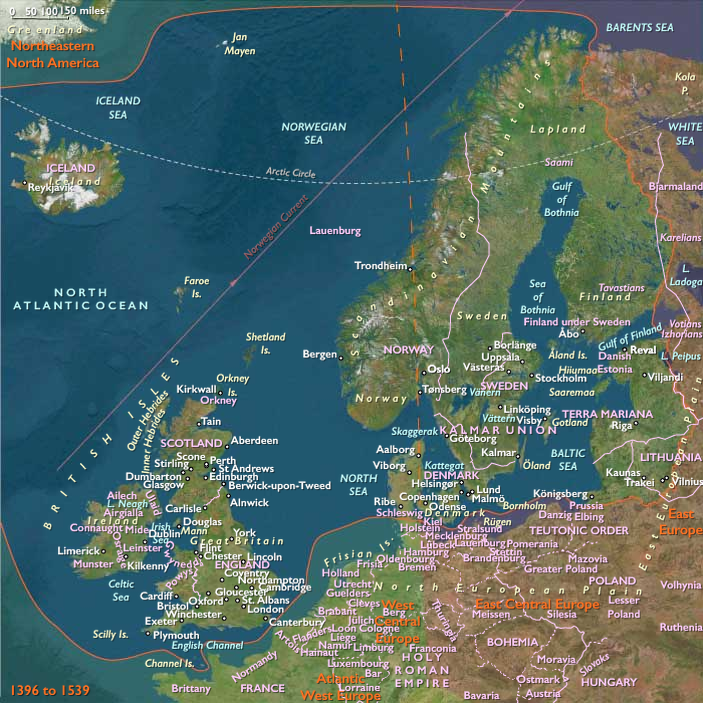
The subregion of Northwest Europe includes the British–Irish archipelago, Iceland and the Faroes, and the ocean-facing rims of western Norway and western Denmark. Anchors span the North Atlantic fisheries (Iceland, Faroes, Shetland–Orkney), the North Sea littoral (Jutland, Yorkshire–East Anglia, Firths of Forth and Clyde), the Irish Sea and Channel approaches, and inland cores such as the Thames–Severn lowlands, Scottish Highlands/Islands, and Irish midlands. River corridors (Thames, Severn, Humber), firths, and sounds tied agrarian interiors to maritime trade, while the Norwegian fjords and Jutland bights faced wind-heavy seas.
Climate & Environmental Shifts
The Little Ice Age sharpened cold and storminess:
-
North Atlantic fringe (Iceland, Faroes, west Norway): longer sea-ice seasons and harsher gales; erratic cod/herring runs shaped fishing booms and busts.
-
Britain & Ireland: cooler winters, wet summers in some decades; harvest failures recurred locally; severe storms and surges disrupted coasts.
-
Jutland & North Sea: shifting bars and storm surges altered havens; dunes advanced on exposed shores.
Despite volatility, fisheries and mixed husbandry buffered many communities.
Subsistence & Settlement
-
Lowland farms (England, eastern Ireland, Jutland): wheat, rye, barley, oats; cattle, sheep, and dairying; open-field systems persisted in much of England, while enclosed demesnes and pastures spread unevenly.
-
Uplands & isles (Scotland, Wales, west Ireland, Norway): oats, barley, stock-rearing, and transhumant dairying; peat fuel; kelp and shore-gathering in island economies.
-
Iceland & Faroes: subsistence grain marginal; livelihoods centered on cod, dried fish, seabirds, sheep, and trade with Bergen–Hanse merchants.
-
Towns & ports: London (Thames) surged as a staple market; York, Bristol, Dublin, Cork, Edinburgh/Leith, Aberdeen, Bergen, and Aalborg tied hinterlands to sea lanes.
Technology & Material Culture
-
Maritime craft: clinker-built hulks and cogs gave way to round-hulled naos and early caravels; North Sea sailing rigs adapted to shoals and tides; Icelandic and Norse open boats remained crucial.
-
Arms & fortification: English longbow remained decisive into the mid-15th century; early handguns and field guns appeared; castles evolved toward gun-forts and, in Scotland/Ireland, tower houses.
-
Print & craft: William Caxton introduced printing to England (1476); cloth finishing (East Anglia, Yorkshire), tin/lead (Cornwall), and shipwrighting expanded.
-
Architecture & art: Perpendicular Gothic in England; late medieval parish art in Ireland; stave-church legacies and stone churches in west Norway; bardic manuscripts in Gaelic lands; saga copying continued in Icelandic scriptoria.
Movement & Interaction Corridors
-
North Sea/Irish Sea lanes: carried wool, cloth, salt fish (herring, cod), wine, salt, and iron; London, Hull, and east-coast ports linked to Hanseatic towns and Bergen’s fish market.
-
Atlantic ventures: Bristol merchants probed western waters; John Cabot’s voyage (1497) opened English awareness of Newfoundland’s cod banks.
-
Fjord & Jutland coasts: Bergen–Hanse convoy cycles and Jutland’s cattle/grain exports sustained Norway–Denmark’s Atlantic rim.
-
Isles networks: Birlinn and galley traffic knit Hebrides, Islay, Kintyre, Man, and Ulster; inter-island lordships balanced sea power and kin ties.
Cultural & Symbolic Expressions
-
Monarchy & law: English common law courts stabilized after civil war; Scottish kings balanced Highland/Lowland blocs; Gaelic lordships in Ireland maintained Brehon law and bardic patronage alongside the English Pale.
-
Language & letters: Middle English matured into Tudor English; Scots literature flourished (Dunbar, Henryson); Gaelic poetry remained courtly and genealogical; Icelandic annals and sagas preserved memory.
-
Devotion & reform: Late medieval piety—guild altars, pilgrimages (St. Andrews, Walsingham, St. David’s)—coexisted with early humanism; by the 1530s, England’s break with Rome began to reorder ritual and property.
Environmental Adaptation & Resilience
-
Mixed portfolios: grain–livestock rotations, dairying, and woodland management hedged climatic risk; parish granaries and seigneurial stores mitigated famine.
-
Fisheries & curing: salt fish, stockfish, and barrelled herring stabilized caloric intake and trade; salt-pan and coopers’ crafts were critical.
-
Field systems & enclosure: commons and open fields balanced with piecemeal enclosure to protect flocks and improve yields; drainage in fens and dike work on exposed coasts guarded arable.
-
Island adaptations: peat, driftwood, and turf for fuel; drying sheds and fish lofts; seasonal transhumance to shielings.
Technology & Power Shifts (Conflict Dynamics)
-
Hundred Years’ War (to 1453): English chevauchées faded after Joan of Arc’s campaigns (1429); defeat at Castillon (1453) ended English rule in France, redirecting power struggles homeward.
-
Wars of the Roses (1455–1487): Yorkist–Lancastrian civil war saw set-piece battles—Towton (1461), Tewkesbury (1471)—culminating in Tudor victory at Bosworth Field (1485); Henry VII stabilized crown finances and order.
-
Anglo-Scottish warpoints: Border raids persisted; Scotland’s defeat at Flodden (1513) killed James IV, reshaping regency politics.
-
Ireland: Tudor authority remained thin beyond the Pale; Gaelic confederacies and earldoms contested royal initiatives; intermittent wars foreshadowed later Tudor conquest.
-
Scandinavia: Denmark–Norway ruled the Atlantic rim; Bergen’s Hanse links endured; the Count’s Feud (1534–1536) in Denmark–Norway (closing years of this age) ushered in the Lutheran Reformation and tighter royal control.
-
Sea conflict: Privateering and piracy flickered in the Channel and North Sea; naval gunnery began to matter in convoy defense.
Transition
By 1539 CE, Northwest Europe had shifted from external continental wars to internal consolidation and oceanic horizons. England emerged under the Tudors with an embryonic navy and a royal church; Scotland balanced Franco-Scottish ties after Flodden; Ireland’s patchwork lordships and the Pale foreshadowed Tudor campaigns; Denmark–Norway steered the North Atlantic trades toward Lutheran monarchy; Iceland and the Faroes remained fishing outposts within this orbit. Fisheries, wool–cloth trades, and mixed husbandry underwrote resilience in a stormier climate, while printing and court centralization set the stage for later religious and imperial transformations.
Jheronimus Bosch and His Distinctive Artistic Legacy (c. 1450–1516)
Hieronymus Bosch (c. 1450–1516), originally named Jheronimus van Aken, emerged as one of the most enigmatic and imaginative artists of the late fifteenth century. Born in the city of ’s-Hertogenbosch (commonly shortened to Den Bosch, meaning “the forest”), located in the Duchy of Brabant in the southern part of the Burgundian Netherlands, Bosch distinguished himself by creating works that stood starkly apart from the refined realism and polished elegance characterizing most Flemish painting of his era. Instead, Bosch explored moralistic and religious themes with intense originality, surreal imagination, and striking visual power.
Background and Early Influences
Little concrete is known of Bosch’s early life, training, or personality; he left no surviving diaries or correspondence. Born around 1450, Bosch belonged to a family deeply embedded in the artistic and religious community of Hertogenbosch. His grandfather, father (Anthonius van Aken), and several uncles were painters, with his father serving as an artistic adviser to the prestigious local religious confraternity, the Illustrious Brotherhood of Our Blessed Lady. Though uncertain, scholars widely assume that Bosch trained either under his father or an uncle, inheriting Flemish artistic traditions infused with strong local religious influences and a distinctly moralizing outlook.
A formative experience was likely the catastrophic fire of 1463, which devastated the town, destroying thousands of houses. This event profoundly shaped Bosch’s artistic imagination, inspiring his recurring depictions of apocalyptic scenes, moral allegories, and the transience of human life.
Artistic Career and Style
Bosch became prominent in Bruges and Hertogenbosch by the 1480s, widely respected for the unique individuality and imaginative quality of his painting. His works stood in marked contrast to the meticulous, refined, and translucent glazing techniques typical of contemporary Flemish masters such as Hans Memling or Gerard David. Instead, Bosch preferred a looser, rougher surface texture, employing early forms of impasto painting, allowing the brushwork itself to remain visible. This technique lent Bosch’s works a raw immediacy and vivid, expressive character.
His characteristic style combined detailed realism with surrealistic fantasy, creating images filled with symbolic moral warnings, nightmarish visions, and religious allegories. Bosch explored moral and religious themes through strange, dreamlike, and often unsettling visual imagery that departed significantly from contemporary artistic conventions.
Key Works: Devotion and Fantasy
By the mid-1480s, Bosch had become popular with local patrons, creating numerous religious works, including passion scenes such as the poignant Crowning with Thorns (Ecce Homo) painted about 1485. Bosch's skillful portrayal of human suffering, emotional anguish, and grotesque imagery deeply moved contemporary audiences.
Among his most celebrated creations is the elaborate reliquary triptych, The Garden of Earthly Delights (ca. 1490–1510). This masterpiece visually encapsulates Bosch’s moral vision and artistic ingenuity. Comprising three panels, the work explores humanity’s progression from innocent purity (the left panel depicting Eden), through indulgent worldly pleasures in the central panel, culminating in the nightmarish and surreal visions of torment in the hellscape depicted in the right panel. The Garden of Earthly Delights’ fantastical imagery—featuring exotic hybrid creatures, distorted figures, oversized fruits, and bizarre stone formations—remains uniquely compelling, exemplifying Bosch’s extraordinary imagination and allegorical genius.
Patronage, Popularity, and Cultural Impact
Bosch enjoyed a distinguished reputation during his lifetime, frequently commissioned by prominent religious institutions, wealthy merchants, and local nobility. Among his patrons was the prestigious Illustrious Brotherhood of Our Blessed Lady, a religious fraternity to which his father had served as artistic adviser. For them, Bosch painted several altarpieces, now lost, intended for the Cathedral of Saint John in Den Bosch.
Artistic Innovations and Influence
Bosch's unique style represented a stark departure from established Flemish artistic conventions. His visionary imagery, compelling emotional intensity, and unprecedented willingness to explore surreal and allegorical forms profoundly influenced subsequent generations of European painters. Though initially considered somewhat eccentric, Bosch’s imaginative iconography laid critical foundations for later developments in European art, significantly influencing artists ranging from Bruegel the Elder to the Surrealists of the twentieth century.
Long-Term Significance
Bosch’s career reflected larger trends in late medieval Atlantic West Europe, notably the growing complexity of religious expression, the rise of introspective piety, and increased preoccupation with morality, sin, and redemption. His distinctive artistic approach profoundly impacted subsequent European art, bridging medieval symbolism and emerging Renaissance sensibilities, making him one of the most influential figures of his time. Bosch’s work continues to captivate scholars and audiences, serving as a profound meditation on humanity’s moral complexities, fears, and aspirations, and establishing a lasting artistic legacy.
Hieronymus Bosch’s The Garden of Earthly Delights and The Temptation of Saint Anthony (c. 1500)
Around 1500, Flemish painter Hieronymus Bosch created his most famous and enigmatic masterpiece, The Garden of Earthly Delights, along with the similarly significant triptych, The Temptation of Saint Anthony. Bosch’s work represents an extraordinary convergence of moral allegory, visionary symbolism, and technical virtuosity, distinguishing him as one of the most original and unconventional artists in Atlantic West Europe.
The Garden of Earthly Delights
Bosch's renowned triptych, The Garden of Earthly Delights, likely commissioned for the private contemplation and enjoyment of an aristocratic patron, unfolds a vivid moral narrative across three interconnected panels. Its exterior shutters portray a solemn depiction of the Creation of the World, presented in monochromatic tones to emphasize divine order and purity.
Opening the altarpiece reveals a vibrant yet cautionary tale of humanity's moral trajectory. On the left panel, Bosch depicts Adam and Eve in Eden, symbolizing original innocence and its impending loss. The expansive central panel, from which the work derives its name, presents an exuberant and sensuous garden populated by frolicking nudes, immense fruits, exotic animals, and fantastical creatures—an allegorical depiction of humankind's indulgence in earthly pleasures and sensual excess. The final right panel starkly contrasts this imagery with a vivid, surreal representation of a nightmarish Hell, showcasing torments characterized by darkness, fire, coldness, and grotesque punishments for earthly sins.
The Temptation of Saint Anthony
In parallel, Bosch also explores human virtue and resilience in The Temptation of Saint Anthony, another significant triptych from this period. Focused on Bosch’s revered spiritual exemplar, the steadfast Saint Anthony, this work illustrates the hermit’s relentless spiritual trials and ultimate victory over temptation.
The left panel portrays harrowing physical torments inflicted upon the saint; the central scene depicts a sinister Black Mass, symbolizing profound spiritual and moral corruption. The right wing, abundant with temptations of sensuality, feasting, and earthly pleasures, contrasts sharply with Anthony’s unwavering moral resolve. Bosch reinforces Anthony’s triumph over these tribulations through associated imagery of other steadfast hermit saints and scenes of Christ’s suffering, depicted on the outer panels.
Cultural and Artistic Significance:
Bosch’s deeply symbolic and unsettling compositions represent a significant departure from contemporary artistic conventions. His imaginative, dreamlike imagery embodies late medieval anxieties about morality, spiritual salvation, and human susceptibility to temptation, providing powerful visual commentaries that resonated deeply in the religious and moral climate of the time. Bosch’s works thus illuminate complex contemporary views on sin, punishment, and redemption, integrating religious symbolism with profound psychological insight.
Long-term Consequences and Legacy:
Bosch’s imaginative and provocative art had a lasting influence, resonating throughout subsequent artistic movements and influencing generations of painters, from the Renaissance to modern surrealism. The Garden of Earthly Delightsand The Temptation of Saint Anthony remain among the most studied and debated artworks in Western art history, exemplifying the late medieval preoccupation with morality and redemption, as well as signaling a remarkable early expression of psychological depth in visual storytelling.
Bosch's Seven Deadly Sins and the Moral Vision of Late Medieval Art (c. 1500)
Around 1500, Flemish painter Hieronymus Bosch completed the allegorical masterpiece, Seven Deadly Sins, reflecting the era’s intense fascination with morality, judgment, and the afterlife. In this remarkable rectangular panel, Bosch presents a vivid and complex visual meditation on human vice, virtue, and eternal judgment, encapsulating central moral concerns of late medieval Europe.
The painting's central feature is a detailed circular motif depicting the Seven Deadly Sins: pride, greed, lust, envy, gluttony, wrath, and sloth, each vividly portrayed in everyday scenes. Encircling this central motif is an inscription warning viewers of divine omniscience, emphasizing moral accountability: “Cave cave dominus videt” (“Beware, beware, God sees”). At each corner of the panel, Bosch depicts traditional eschatological scenes prevalent in medieval devotional literature: Deathbed, Last Judgment, Heaven, and Hell—motifs recurrently explored by Bosch throughout his artistic career.
This piece exemplifies Bosch’s distinctive approach to religious art, merging complex symbolism, vivid realism, and moral allegory to engage viewers directly in contemplation of spiritual consequences. The work, most likely created for private devotion and moral reflection, echoes contemporary devotional literature, reinforcing themes common to widely circulated moral handbooks and preaching manuals of the period.
Cultural and Artistic Significance:
Bosch’s innovative blending of narrative realism with allegorical intensity deeply reflects the spiritual and moral anxieties prevalent in late medieval society. The painting's sophisticated visual language underscores Bosch's role as both moral commentator and artistic innovator, contributing significantly to the artistic tradition of Northern Renaissance painting.
Consequences and Legacy:
Bosch's profound imaginative power and moral messaging in Seven Deadly Sins had a lasting impact on European art, profoundly influencing subsequent generations of painters and laying the foundations for new approaches to symbolic and moralistic imagery. His exploration of vice, judgment, and redemption continues to resonate, maintaining a central position in art-historical scholarship on late medieval and early modern moral imagination.
Hieronymus Bosch’s Commission from Philip the Handsome (1504)
In 1504, the renowned Flemish painter Hieronymus Bosch, who likely spent most of his life in or near his hometown of 's-Hertogenbosch, received a prestigious commission from the Habsburg ruler Philip the Handsome. Bosch was tasked with creating an altarpiece depicting the Last Judgment, reflecting the growing recognition and patronage of his extraordinary artistic vision. Unfortunately, this significant work has since been lost, with no known surviving copies or detailed descriptions.
The commission by Philip the Handsome—a powerful patron who would soon rule Spain alongside his wife, Joanna of Castile—underscores Bosch’s rising prominence beyond his local community. Despite Bosch’s probable limited travel, the wide distribution and appeal of his vividly imaginative works had already extended his reputation across Europe, attracting attention from notable political and noble patrons seeking religious artworks with strong moral and symbolic messages.
Artistic and Cultural Significance:
Although the altarpiece itself does not survive, its commission highlights Bosch’s reputation for powerful visual allegories centered around human sinfulness, judgment, and redemption. Bosch’s distinctively complex, imaginative compositions made him uniquely suited for depicting eschatological themes like the Last Judgment—topics popular among late medieval rulers who used religious art to reinforce spiritual authority and ethical governance.
Consequences and Legacy:
This lost commission from Philip the Handsome emphasizes Bosch’s important place in the artistic and cultural life of early 16th-century Atlantic West Europe. His works resonated deeply with contemporary religious and moral anxieties, significantly influencing subsequent Northern Renaissance art. Bosch’s engagement by high-profile patrons such as Philip marks the elevation of his career and the lasting impact of his artistic innovations.
Hans Baldung Establishes Himself in Strasbourg (1509)
In 1509, the painter Hans Baldung, having completed his apprenticeship under Albrecht Dürer, returned to Strasbourg, became a citizen of the city, and quickly established himself as a prominent artistic personality within Atlantic West Europe. Baldung, influenced deeply by Dürer’s Renaissance composure and classical mastery, increasingly developed his distinctive style, embracing greater Mannerist complexity and dramatic expression.
Artistic Evolution and Influence
After his marriage and citizenship in Strasbourg, Baldung diverged sharply from Dürer’s poised Renaissance aesthetic. Instead, his work adopted expressive, emotionally charged, and often unsettling qualities—key characteristics of early Mannerism. His compositions are noted for their dynamic figures, exaggerated poses, dramatic color contrasts, and powerful symbolism.
Baldung’s most striking paintings, such as Eve, the Serpent and Death, vividly reflect this transformation. In this work, Baldung evokes a potent narrative intensity, juxtaposing classical figures with dramatic tension. The disturbing encounter of Eve, the Serpent, and Death exemplifies Baldung’s imaginative departure toward darker, morally complex themes—similar to the allegorical intensity of his Flemish contemporary, Hieronymus Bosch.
Themes and Cultural Context
Baldung frequently explored themes of mortality, vanity, and human frailty. His allegorical portrayal of the human life cycle, often embodied by nude female figures, communicated profound meditations on beauty’s transience, the inevitability of aging, and the ultimate futility of worldly pleasures. By confronting viewers with powerful visual statements on life's fleeting nature, Baldung echoed widespread Renaissance anxieties and moral contemplations regarding sensuality, aging, and death.
Consequences and Legacy
Baldung’s distinct and provocative artistic language significantly influenced later developments in Northern European art, laying groundwork for the heightened expressivity of Mannerism and its embrace of psychological complexity. His innovative use of symbolic and allegorical imagery, combined with powerful emotional resonance, secured Baldung’s reputation as one of the most distinctive artistic voices in early 16th-century Atlantic West Europe, leaving an enduring impact on subsequent generations of painters.
The Death of Hieronymus Bosch and His Artistic Legacy (August 1516)
In August 1516, the celebrated Netherlandish painter Hieronymus Bosch died at the age of sixty-six, leaving behind an artistic legacy defined by enigmatic and visionary depictions of sin, temptation, and divine judgment. Known throughout Europe for his powerful religious imagery, Bosch was famed for his inventive portrayals of infernal punishments and moral allegories, setting his work apart in both style and subject from his contemporaries.
Context and International Renown
Bosch had become internationally recognized as a uniquely imaginative artist whose paintings captivated aristocratic collectors across the Netherlands, Austria, and notably, Spain. His haunting and surreal depictions of hell, temptation, and sin—steeped in symbolic, dreamlike imagery—held particular resonance for patrons drawn to the moral and theological introspection sparked by his art. Works by Bosch adorned the collections of prominent noble families, including those of the Habsburgs, who deeply admired and sought out his extraordinary visions.
The "Haywain" Triptych (circa 1516)
One of Bosch’s last major works, the Haywain triptych, painted around 1516, encapsulated the central themes of his artistic philosophy: sin, temptation, greed, and damnation. Across its three panels, Bosch depicted humanity’s progression from the initial purity of Eden, through the corruption and folly of the earthly pursuit of wealth (symbolized by a hay-filled wagon—the "haywain"), culminating finally in the torments of Hell.
In the central panel, Bosch used the allegory of a wagonload of hay as a potent metaphor for earthly riches and transitory desires, toward which a greedy humanity futilely grasps. The wagon symbolizes human folly, as nobles, peasants, and clergy alike struggle and compete, blind to the spiritual and moral consequences awaiting them in the afterlife. His portrayal underscored the pervasive influence of sin in human life, as well as society’s obliviousness to eternal truths.
Artistic Influence and Significance
Bosch’s unique artistic vision exerted a profound influence upon subsequent generations of European painters, especially those intrigued by moral allegory and religious symbolism. His work paved the way for later Northern artists such as Pieter Bruegel the Elder, who similarly explored humanity’s follies through intricate allegorical narratives.
The deeply moral, symbolic, and surreal qualities of Bosch’s art also anticipated certain strands of later artistic movements, such as Romanticism and even Surrealism. His works continue to fascinate scholars and viewers alike, inviting endless interpretation and reflection on themes of human morality, spirituality, and existential angst.
Legacy and Historical Consequences
Bosch’s death in 1516 marked the conclusion of a remarkable artistic career, but his reputation only grew posthumously, securing his place as one of Europe’s most original and compelling artists. By depicting the spiritual tensions and moral anxieties of his age in striking visual terms, Bosch contributed significantly to broader cultural dialogues on morality, theology, and human nature. His legacy endured far beyond his lifetime, shaping European cultural consciousness for generations and influencing artistic developments long after his death.
