Honoré de Balzac
French novelist and playwright
Years: 1799 - 1850
Honoré de Balzac (20 May 1799 – 18 August 1850) was a French novelist and playwright.
His magnum opus is a sequence of short stories and novels collectively entitled La Comédie humaine, which presents a panorama of French life in the years after the 1815 fall of Napoleon.
Due to his keen observation of detail and unfiltered representation of society, Balzac is regarded as one of the founders of realism in European literature.
He is renowned for his multifaceted characters, who are complex, morally ambiguous and fully human.
His writing influenced many subsequent novelists such as Marcel Proust, Émile Zola, Charles Dickens, Edgar Allan Poe, Fyodor Dostoyevsky, Gustave Flaubert, Benito Pérez Galdós, Marie Corelli, Henry James, William Faulkner, Jack Kerouac, and Italo Calvino, and philosophers such as Friedrich Engels and Karl Marx.
Many of Balzac's works have been made into or have inspired films, and they are a continuing source of inspiration for writers, filmmakers and critics.
An enthusiastic reader and independent thinker as a child, Balzac had trouble adapting to the teaching style of his grammar school.
His willful nature caused trouble throughout his life and frustrated his ambitions to succeed in the world of business.
When he finished school, Balzac was an apprentice in a law office, but he turned his back on the study of law after wearying of its inhumanity and banal routine.
Before and during his career as a writer, he attempted to be a publisher, printer, businessman, critic, and politician; he failed in all of these efforts.
La Comédie humaine reflects his real-life difficulties, and includes scenes from his own experience.
Balzac suffered from health problems throughout his life, possibly due to his intense writing schedule.
His relationship with his family was often strained by financial and personal difficulties, and he ended several friendships over critical reviews.
In 1850, he married Ewelina Hańska, his longtime love; he died five months later.

Related Events
Filter results
Showing 9 events out of 9 total
Honoré de Balzac, who now owes one hundred thousand francs because of his failed type foundry, printing establishment, and publishing venture, is bailed out of debt by his family.
His literary output had begun with chronicles and sketches on widely varied social and artistic topics.
The journals to which he contributes—political and artistic reviews set up by a new generation of intellectuals who viewed the cultural debris of the French Revolution and the Napoleonic Empire, and the complacency of the restored monarchy with a mixture of cynicism, idealism and regret—are increasingly looking for short fiction, which Balzac is able to provide.
A collection, Scènes de la vie privée (Scenes from Private Life) comes out in 1829, and is well received.
Told with a journalistic eye that examines the fabric of modern life, the tales do not shrink from social and political realities.
At thirty, Balzac has found a distinctive voice.
He had already turned out potboiler historical novels in the manner of Walter Scott and Anne Radcliffe, on commission from publishers, but only under pseudonyms ('Horace de Saint-Aubin', for example, was responsible for the scandalous Vicaire des Ardennes (1822), banned for its depiction of pseudo-incestuous relations and, more importantly, of a married priest).
He enters the mainstream as an author of full-length fiction with Le Dernier chouan, a sober tale of provincial France in Revolutionary times, published under his own name (a first) in 1829, as is The Physiology of Marriage, which is an unqualified success.
In this year, he begins writing La Comedie humaine.
Honoré de Balzac, like Prosper Mérimée, combines folktale material with formal artistic technique in A Passion in the Desert, published in 1830.
Honoré de Balzac, after writing several novels, in 1832 conceived the idea for an enormous series of books that would paint a panoramic portrait of "all aspects of society".
The moment the idea came to him, Balzac raced to his sister's apartment and proclaimed: "I am about to become a genius"!
Although he originally calls it Etudes des Mœurs (literally "Studies of manners", or "The Ways of the World") it eventually becomes known as La Comédie Humaine, and he includes in it all the fiction that he has published in his lifetime under his own name.
This is to be Balzac's life work and his greatest achievement.
As an apprentice at law in 1819, Balzac had produced his first play, Cromwell, in 1819, having convinced his prosperous middle class family to subsidize him meagerly for two years while he wrote, fueled by countless cups of coffee, in a Paris garret.
Realizing he would have trouble finding a composer, however, he turned to other pursuits.
In 1820 Balzac completed the five-act verse tragedy Cromwell.
When he finished, Balzac went to Villeparisis and read the entire work to his family; they were unimpressed.
He followed this effort by starting (but never finishing) three novels: Sténie, Falthurne, and Corsino.
Readers advised him to try anything but writing.
Undaunted, Balzac turned to writing Gothic thrillers, working with several collaborators under various pen names.Balzac had met Laure de Berny, a woman twice his age and the mother of nine children, in 1821, who braved ridicule to become the mistress of the twenty-two-year old writer.
In 1821 also, Balzac had met the enterprising Auguste Le Poitevin, who persuaded the author to write short stories, which Le Poitevin then sells to publishers.
Balzac quickly turned to longer works, and by 1826 he had written nine novels, all published under pseudonyms and often produced in collaboration with other writers.
These books were potboiler novels, designed to sell quickly and titillate audiences.
During this time Balzac wrote two pamphlets in support of primogeniture and the Society of Jesus.
The latter, regarding the Jesuits, illustrate his lifelong admiration for the Catholic Church.
In the late 1820s Balzac had dabbled in several business ventures, a penchant his sister blamed on the temptation of an unknown neighbor.
His first enterprise was in publishing which turned out cheap one-volume editions of French classics including the works of Molière.
This business failed miserably.
Balzac had better luck publishing the Memoirs of the Duchess of Abrantès, with whom he also had a love affair.
Balzac borrowed money from his family and friends, and tried to build a printing business, then a typefounder enterprise.
His inexperience and lack of capital caused his ruin in these trades.
He gave the businesses to a friend (who made them successful) but carries the debts for many years.
As of April 1828 Balzac owed fifty thousand francs to his mother.
Honoré de Balzac had definitively launched his literary career with his 1831 novel, The Wild Ass’s Skin.
Around this time, he had ended his relationship with his influential mistress, Laure de Berny, to whom he had remained devoted for a decade.
Mademoiselle Hanska, a wealthy Polish countess, had in 1832 written an anonymous fan letter to Balzac, signing it L’Etrangere (“the foreign lady”).
The two had begun a correspondence; a courtship soon followed.
A prolific writer, he churns out three or four novels a year, maintains a voluminous correspondence, and writes articles, reviews and historical dramas.
Although successful, his spending habits are so uncontrolled that 1838 finds him two hundred and thirty thousand francs in debt.
An aside in this novel, referring to a character who contemplates suicide after being jilted, speaks about his attitude towards his home country: "To make this course of action clear to my French readers, I must explain that in Italy, a country very far away from us, people are still driven to despair by love."
Drawing from the Napoleonic Era and the Italian Renaissance to create a fanciful setting for his reexamination of the theme of the individual against society, Stendahl tells the story of an Italian nobleman in the Napoleonic era.
Later admired by Balzac, Tolstoy, André Gide and Henry James, and eventually adapted for opera, film and television, the novel is inspired by an inauthentic Italian account of the dissolute youth of Alessandro Farnese.
Stendahl, born Henri Marie Beyle, the son of a doctrinaire, unimaginitive, well-to-do Grenoble lawyer that he grew up resenting, had entered the Polytechnic Institute in Paris in 1799.
Trained by his maternal grandfather in rationalism and emotionally close to his aunt following the death of his adored mother at seven years of age, the seventeen-year-old Beyle had dreamed of writing plays rather than attending classes.
The military and theatrical worlds of the First French Empire were a revelation to Beyle.
He had been named an auditor with the Conseil d'État on August 3, 1810, and thereafter took part in the French administration and in the Napoleonic wars in Italy.
He had traveled extensively in Germany and had been part of Napoleon's army in the 1812 invasion of Russia.
Stendhal had witnessed the burning of Moscow from just outside the city.
Appointed Commissioner of War Supplies and sent to Smolensk to prepare provisions for the returning army, he had crossed the Berezina River by finding a usable ford rather than the overwhelmed pontoon bridge, which probably saved his life and those of his companions.
Stendhal had arrived in Paris in 1813, largely unaware of the general fiasco that the retreat had become.
Stendhal had become known, during the Russian campaign, for keeping his wits about him, and maintaining his "sang-froid and clear-headedness."
He also maintained his daily routine, shaving each day during the retreat from Moscow.
After the 1814 Treaty of Fontainebleau, he left for Italy, where he has settled in Milan.
He forms a particular attachment to Italy, where he will spend much of the remainder of his career, serving as French consul at Trieste and Civitavecchia.
Stendhal's Memoirs of a Tourist, published in 1838, further contributes to the development of the cult of the self in literature.
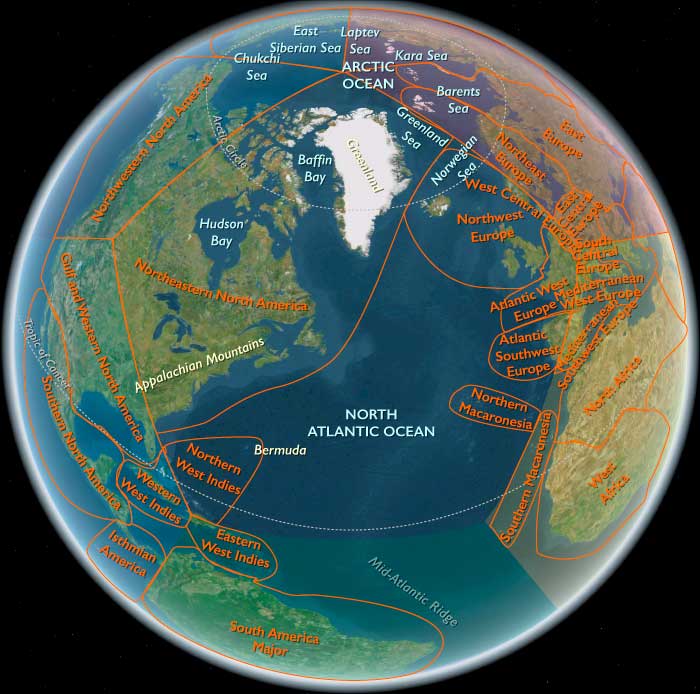
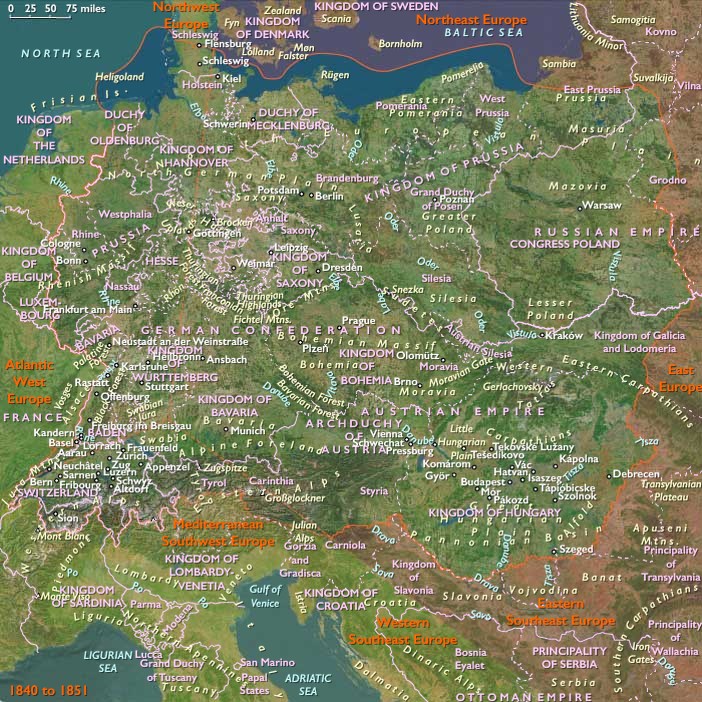
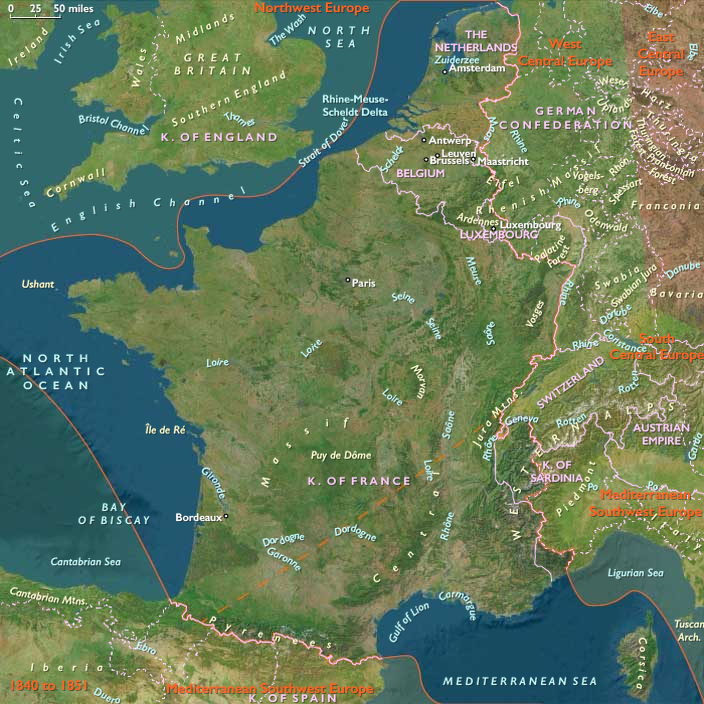
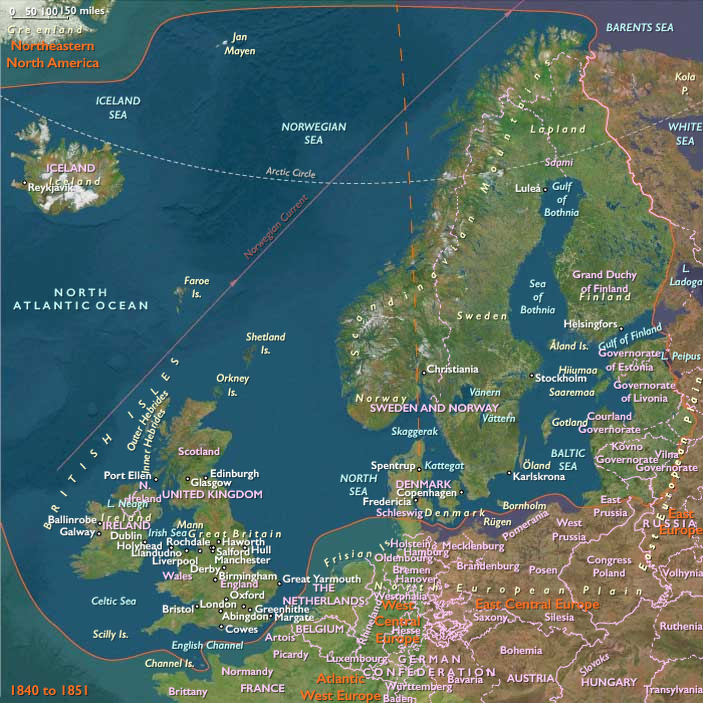
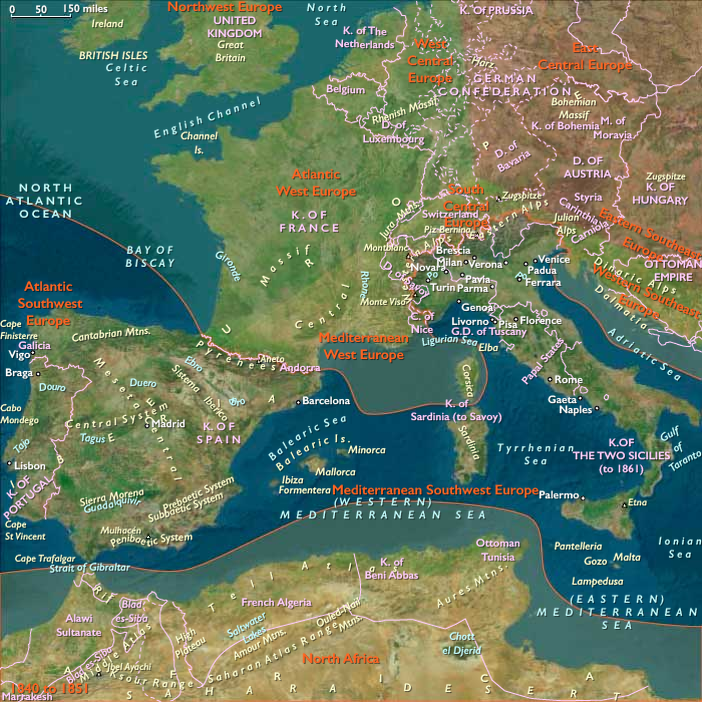
Atlantic West Europe (1840–1851): Industrial Acceleration, Social Unrest, and Early Liberal Reforms
From 1840 to 1851, Atlantic West Europe—including northern France, Belgium, the Netherlands, Luxembourg, and the Atlantic and Channel coasts—experienced intensified industrialization, heightened social tensions, and continued liberal reforms. This era further entrenched industrial capitalism, spurred extensive urban growth, and saw rising labor unrest, driving governments toward cautious liberal measures to address emerging socio-economic challenges.
Political and Military Developments
France: The Fall of July Monarchy and Rise of the Second Republic
-
The July Monarchy under Louis-Philippe (1830–1848) pursued moderate liberalism, but escalating social inequality and dissatisfaction culminated in the 1848 Revolution.
-
February 1848 saw widespread revolt in Paris, forcing Louis-Philippe's abdication and establishment of the short-lived Second French Republic, marking a decisive moment of liberal and democratic aspirations, though its initial reforms were soon tempered by conservative reaction under Louis-Napoléon Bonaparte.
Belgium: Consolidation of Liberal Constitutionalism
-
Belgium under King Leopold I solidified its constitutional monarchy, achieving stability and relative prosperity through balanced liberal policies and prudent economic management.
-
Despite stability, Belgium grappled with linguistic tensions between Flemish and Walloon communities and early signs of labor unrest emerging from its rapidly industrializing cities, notably Brussels, Ghent, and Liège.
Netherlands and Luxembourg: Stable Monarchical Reforms
-
The Netherlands under King William II (1840–1849) implemented cautious constitutional reforms, including the liberal Constitution of 1848, crafted by Johan Thorbecke. This reduced monarchical powers and established parliamentary governance, strengthening democratic institutions.
-
Luxembourg maintained a stable Grand Duchy under Dutch sovereignty, cautiously navigating its dual identity as part of the German Confederation, preserving autonomy through careful diplomacy and internal political stability.
Economic and Social Developments
Industrial Expansion and Technological Innovation
-
Industrial growth accelerated across Atlantic West Europe, driven by increased coal production, iron manufacturing, and expansion of railroads. Belgium and northern France, particularly around Lille and Liège, emerged as leading industrial hubs with robust coal and steel industries.
-
Technological innovation expanded dramatically, including improvements in steam-engine technology, mechanized textiles, and early telegraph communications, deeply transforming industrial productivity and economic integration.
Railroad Boom and Transportation Revolution
-
The era witnessed explosive railway expansion, dramatically improving trade, communication, and urban connectivity:
-
France constructed critical railway lines connecting Paris to northern industrial centers, significantly boosting economic integration.
-
Belgium expanded its rail network rapidly, reinforcing its centrality as a European industrial and commercial crossroads.
-
The Netherlands invested in national railway expansion, connecting Amsterdam, Rotterdam, and the industrializing south.
-
Rising Labor Unrest and Social Inequality
-
Industrial expansion exacerbated urban poverty, poor working conditions, and widening socio-economic divides. Labor unrest became frequent in northern France and Belgium, where strikes and demonstrations highlighted grievances over low wages, hazardous working environments, and inadequate housing.
-
Early socialist and labor organizations emerged, notably in industrial cities like Lille, Roubaix, Ghent, and Antwerp, articulating workers’ demands and advocating social reforms.
Cultural and Intellectual Developments
Romanticism and Early Realism
-
The Romantic movement, emphasizing national identity, individualism, and emotional expression, remained influential, though by mid-century, early Realism gained momentum, particularly in France through writers like Honoré de Balzac and Gustave Flaubert, who critically examined urban and social realities.
Intellectual Debates on Social Reforms
-
Intellectual discourse intensified on social issues such as poverty, industrial working conditions, and public education. Prominent thinkers, economists, and early socialists, including Louis Blanc in France, promoted ideas on state-sponsored employment and social welfare, reflecting growing public awareness and demand for social justice.
Religious Developments
Continued Secularization and Religious Debates
-
Secularizing trends continued, particularly in education and governance. Liberal governments enacted reforms reducing church influence, provoking resistance from conservative religious communities, particularly Catholic strongholds in Belgium and northern France.
-
In the Netherlands, Protestant liberalism encouraged progressive social policies, further distinguishing Dutch political and cultural identity from its Catholic neighbors.
Social and Urban Dynamics
Urban Expansion and Population Growth
-
Industrialization drove dramatic urban growth. Major cities—Brussels, Antwerp, Lille, Roubaix, Ghent, and Amsterdam—expanded rapidly, attracting rural migrants seeking employment, significantly reshaping urban demographics and living conditions.
-
Urban overcrowding, insufficient housing, poor sanitation, and rising poverty led to urgent demands for municipal reform, public sanitation projects, and improved social infrastructure.
Emergence of Organized Labor and Socialist Movements
-
Early socialist movements gained traction, advocating workers’ rights and state intervention to address social inequities. Belgium saw the formation of early labor groups advocating worker cooperatives and improved labor conditions.
-
France experienced early labor mobilization, notably around Paris and Lille, setting a foundation for future social-democratic and socialist politics.
Long-Term Consequences and Historical Significance
The period 1840–1851 significantly advanced Atlantic West Europe’s transformation toward modernity:
-
Politically, liberal and democratic revolutions reshaped governance structures, notably in France (Second Republic) and constitutional reforms in the Netherlands.
-
Economically, intensified industrialization dramatically increased regional prosperity but also exposed deep social inequalities, laying groundwork for labor and socialist movements.
-
Socially, this era firmly established urbanization as a central societal phenomenon, significantly transforming living conditions and highlighting the urgency of social reform.
-
Culturally and intellectually, the shift toward Realism and critical social discourse marked deeper engagement with social realities, influencing European intellectual life profoundly.
By 1851, Atlantic West Europe had solidified its position at the forefront of European industrial, political, and social modernization, setting crucial foundations for future democratic reforms, labor movements, and cultural transformations.
The Comédie humaine consists of ninety-one finished works (stories, novels or analytical essays) and forty-six unfinished works (some of which exist only as titles).
It does not include Balzac's five theatrical plays or his collection of humorous tales, the "Contes drolatiques" (1832–37).
The title of the series is usually considered an allusion to Dante's Divine Comedy; while Ferdinand Brunetière, the famous French literary critic, suggests that it may stem from poems by Alfred de Musset or Alfred de Vigny.
While Balzac sought the comprehensive scope of Dante, his title indicates the worldly, human concerns of a realist novelist.
The stories are placed in a variety of settings, with characters reappearing in multiple stories.
In 1839, in a letter to his publisher, Balzac mentioned for the first time the expression Comédie humaine, and this title is in the contract he signed in 1841.
The publication of the Comédie humaine in 1842 was preceded by an important preface or "avant-propos" describing his major principles and the work's overall structure (see below).
For this edition, novels which had appeared in serial form were stricken of their chapter titles.
Balzac's intended collection will never be finished.
In 1845, Balzac had written a complete catalogue of the ensemble which includes works he started or envisioned but never finished.
In some cases, Balzac moves a work around between different sections as his overall plan develops.
Honoré de Balzac, after courting Mme. Hanska for eighteen years, marries her on March 2, 1850.
Less than six months later, he is dead at the age of fifty-one, worn out from his three coffee-fueled decades as what he called “a galley slave of the pen.”
Atlantic West Europe (1852–1863): Imperial Ambitions, Industrial Expansion, and Social Change
From 1852 to 1863, Atlantic West Europe—including northern France, Belgium, the Netherlands, Luxembourg, and the Atlantic and Channel coasts—experienced an era of profound economic growth, imperial ambitions, social reforms, and shifting political dynamics. This period marked the ascendance of France under Napoleon III’s Second Empire, further industrial and infrastructural growth across the region, and increasing social consciousness driven by labor activism and emerging socialist ideologies.
Political and Military Developments
France: The Second Empire under Napoleon III
-
Following a coup d'état in December 1851, Louis-Napoléon Bonaparte established the Second French Empirein 1852 as Emperor Napoleon III, promising political stability, economic growth, and national prestige.
-
Under Napoleon III, France pursued active imperialist policies, engaging in international diplomacy and conflicts such as the Crimean War (1853–1856), which temporarily bolstered France’s European prestige and military influence.
Belgium: Stability, Neutrality, and Economic Prosperity
-
Belgium, under King Leopold I (r. 1831–1865), maintained political stability and economic prosperity, emphasizing constitutional monarchy and international neutrality. The country strengthened its economy through industrial and commercial expansion.
-
Although politically stable, Belgium faced internal tensions due to linguistic divides and emerging demands for social and electoral reforms.
Netherlands and Luxembourg: Moderate Liberalism and Stability
-
Under King William III (r. 1849–1890), the Netherlands solidified its liberal constitutional monarchy, fostering political moderation and gradual democratic reforms. The Dutch economy prospered due to colonial trade (notably in the Dutch East Indies) and domestic industrialization.
-
Luxembourg remained stable, preserving its autonomy within the German Confederation and Dutch rule, pursuing economic modernization through railway expansion and industrial growth.
Economic Developments: Industrial Expansion and Innovation
France: Industrial Growth and Infrastructure Expansion
-
Napoleon III strongly promoted economic modernization and infrastructure development, significantly expanding railways, ports, and urban improvements, notably in Paris, Lille, and northern industrial centers.
-
Key northern cities such as Lille, Roubaix, Calais, and Le Havre saw robust growth in textile, steel, and shipbuilding industries, enhancing Atlantic trade and commercial networks.
Belgium: Industrial Powerhouse and International Trade Hub
-
Belgium solidified its status as one of Europe's leading industrial nations. Cities such as Liège, Ghent, and Antwerp thrived on coal mining, iron production, textiles, and international commerce.
-
The port of Antwerp flourished as a crucial trade center, further integrating Belgium into the broader European and global economic systems.
Netherlands: Commercial Expansion and Maritime Trade
-
The Netherlands, leveraging its maritime heritage, significantly expanded its international trade networks, benefiting from Dutch colonial enterprises and trade in goods such as coffee, spices, and tobacco.
-
Amsterdam and Rotterdam emerged as vital European commercial hubs, driving economic prosperity and facilitating industrial growth.
Social Developments: Rising Labor Movements and Social Reforms
Growth of Labor Activism
-
Rapid industrialization and urbanization intensified social inequalities and labor unrest, especially in Belgian and northern French industrial centers such as Lille, Roubaix, and Liège.
-
Early socialist and labor organizations grew stronger, advocating improved working conditions, higher wages, shorter workdays, and increased political representation for working-class communities.
Social and Educational Reforms
-
Governments responded to social challenges by introducing moderate reforms in labor conditions, public health, and education. France under Napoleon III expanded public works, urban sanitation, and educational access, notably influenced by Baron Haussmann’s transformative urban reforms in Paris.
-
Belgium advanced public education and early social welfare measures, addressing growing public demand for improved living conditions and social justice.
Cultural and Intellectual Developments
Realism and the Emergence of Modern Literature
-
Literary realism matured in this period, with influential French authors such as Gustave Flaubert (Madame Bovary, 1857) and Victor Hugo (Les Misérables, 1862), critically depicting contemporary society, social injustices, and moral complexities.
-
Realist painting also flourished, notably with artists such as Gustave Courbet in France, challenging traditional aesthetics and addressing social realities directly.
Scientific and Technological Advancements
-
The era saw notable scientific progress, particularly through advancements in chemistry, metallurgy, and medicine, significantly contributing to improved industrial productivity, healthcare, and urban sanitation systems.
Religious Developments
Ongoing Secularization and Religious Reactions
-
The trend toward secularization persisted, notably in France and Belgium, where liberal governments increasingly limited church influence in public education and governance, prompting strong conservative Catholic reactions.
-
In the Netherlands, Protestant liberalism continued to support moderate social and educational reforms, though religious tensions persisted, especially in predominantly Catholic regions.
Urbanization and Social Dynamics
Urban Expansion and Population Growth
-
Urban centers such as Brussels, Antwerp, Lille, Roubaix, Ghent, and Amsterdam continued rapid expansion, driven by industrial employment opportunities and improved transportation networks.
-
This accelerated urbanization brought significant challenges, including overcrowding, poor sanitation, housing shortages, and increased demand for public services.
Growing Middle-Class Influence
-
The middle class expanded significantly, benefiting from economic prosperity and industrial growth. Merchants, industrialists, and professionals increasingly influenced political and social reforms, advocating liberal economic policies, political moderation, and social stability.
Long-Term Consequences and Historical Significance
The period 1852–1863 represented a crucial phase in Atlantic West Europe’s transition toward modernity:
-
Politically, the consolidation of the Second Empire in France and continued stability in Belgium and the Netherlands established enduring governance frameworks, though tensions over liberalization and labor rights grew.
-
Economically, the region saw dramatic industrial growth, infrastructural expansion, and increased integration into global trade networks, positioning it as a vital economic center.
-
Socially, this era intensified labor activism, accelerated urban growth, and introduced critical early reforms addressing working conditions and public health, laying foundations for future social welfare policies.
-
Culturally, the flourishing of realism in literature and art reflected deeper societal engagement with modern life, influencing European culture profoundly into the late 19th century.
By 1863, Atlantic West Europe had firmly established itself as a prosperous, industrially dynamic region, grappling actively with emerging social challenges and setting essential foundations for future democratic and social transformations.