Jacques-Louis David
French painter in the Neoclassical style
Years: 1748 - 1825
Jacques-Louis David (August 30, 1748 – December 29, 1825) is a French painter in the Neoclassical style, considered to be the preeminent painter of the era.
In the 1780s his cerebral brand of history painting marks a change in taste away from Rococo frivolity toward a classical austerity and severity, heightened feeling harmonizing with the moral climate of the final years of the Ancien Régime.
David later becomes an active supporter of the French Revolution and friend of Maximilien Robespierre (1758–1794), and is effectively a dictator of the arts under the French Republic.
Imprisoned after Robespierre's fall from power, he aligns himself with yet another political regime upon his release: that of Napoleon, The First Consul of France.
At this time he develops his Empire style, notable for its use of warm Venetian colors.
After Napoleon's fall from Imperial power and the Bourbon revival, David exileds himself to Brussels, at this time in the United Kingdom of the Netherlands, where he remains until his death.
David has a large number of pupils, making him the strongest influence in French art of the early nineteenth century, especially academic Salon painting.

Related Events
Filter results
Showing 10 events out of 18 total
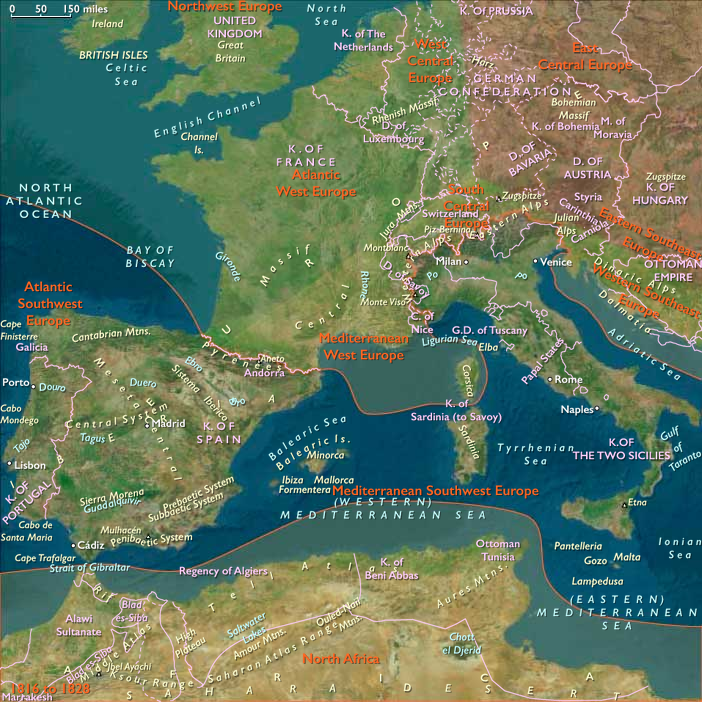
Southwest Europe (1540–1683 CE)
Habsburg Sea Power, Baroque Splendor, and Ottoman Encounters
Geography & Environmental Context
Southwest Europe in this era encompassed Spain, Italy (including Sicily, Sardinia, and Milan), Malta, and the Balearic Islands—a region unified under the broad influence of Habsburg empire and shadowed by the Ottoman frontier. Anchors stretched from the Po Valley and Apennines to the Andalusian plains, from the Valencian huertas to the fortified harbors of Malta, Messina, and Barcelona. The western Mediterranean linked fertile deltas and mountainous interiors to a network of maritime highways—the very arteries of imperial power and commerce.
Climate & Environmental Shifts
The Little Ice Age deepened its grip between the mid-sixteenth and mid-seventeenth centuries. Cool, wet decades (1550s–1620s) alternated with prolonged droughts (1630s–1660s):
-
Po Valley floods and silting tested irrigation networks.
-
Andalusia, Sicily, and Murcia suffered harvest failures under aridity.
-
Terraced slopes of Catalonia and Liguria faced erosion from torrential winter rains.
Urban resilience relied on imported Sicilian and Sardinian grain, huerta irrigation, and charitable granaries. American crops such as maize and peppers, diffusing gradually, improved food security across rural districts.
Subsistence & Settlement
Cereal, vine, and olive cultures remained the economic base, complemented by citrus and pastoralism.
-
Italy: Rice expanded in Lombardy; olives and silk thrived around Naples and Tuscany.
-
Spain: Andalusia’s olive estates, Valencia’s sugar and silk, and Murcia’s irrigated citrus supported dense populations.
-
Sicily and Sardinia: Granaries of empire; wheat exports fed Naples, Rome, and the Spanish navy.
-
Malta & Balearics: Dependent on imports but essential as naval depots and fisheries.
Urbanization peaked: Naples exceeded a quarter million inhabitants; Seville, Valencia, Palermo, and Venice flourished as port metropolises linking Europe to the Atlantic and Levant.
Technology & Material Culture
-
Hydraulics & irrigation: Canal dredging in the Po Delta, acequia upkeep in Valencia, and cistern systems in Malta and Sardinia mitigated climatic stress.
-
Maritime innovation: Arsenal systems at Venice, Genoa, and Barcelona produced galleons and galleasses; the transition from oared to sail-driven fleets blurred the Mediterranean–Atlantic divide.
-
Manufactures: Venetian glass, Neapolitan and Florentine silks, Valencian ceramics, and Sevillian metalwork adorned both courtly and ecclesiastical settings.
-
Architecture & arts: The Baroque replaced the Renaissance—Bernini and Borromini in Rome, Caravaggio in Naples, Zurbarán and El Greco in Iberia—melding sacred passion with imperial majesty.
Movement & Interaction Corridors
-
Imperial arteries: The Spanish Road linked Milan to Flanders, while Mediterranean convoys moved troops, bullion, and grain to the Levantine frontier.
-
Trade circuits: Venice dealt in Levantine goods; Genoa financed Habsburg loans; Seville and later Cádiz funneled American silver into Mediterranean markets.
-
Pilgrimage & diplomacy: Jubilee processions in Rome and the fortified splendor of Valletta symbolized Catholic resilience. Jesuit missions spread education and reform from Italian and Iberian ports to Africa, Asia, and the Americas.
Cultural & Symbolic Expressions
The Catholic Reformation defined the region’s spiritual and artistic life.
-
The Council of Trent (1545–1563) reaffirmed doctrine and inspired an artistic counteroffensive—the visual eloquence of Baroque sculpture, music, and architecture proclaiming divine order.
-
Rome regained its stature as capital of faith; Jesuit colleges and Franciscan missions spread learning from Palermo to Lisbon.
-
Malta, entrusted to the Knights of St. John, repelled the Ottoman siege (1565), transforming Valletta into a walled sanctuary of Christendom.
-
Folk traditions—harvest feasts, confraternities, and processions—endured beneath clerical orthodoxy, fusing old and new devotional worlds.
Environmental Adaptation & Resilience
Mixed agriculture, rotational grazing, and intercropped vines and olives buffered against famine. Urban monti di pietà(public grain funds) and confraternal charities distributed bread in crisis years. Imports of maize, potato, and beans from the New World diversified diets, easing demographic recovery after plague cycles (notably Naples 1656, Seville 1649). Irrigation and terrace rebuilding sustained rural populations through climatic volatility.
Technology & Power Shifts (Conflict Dynamics)
-
Ottoman frontier: Naval clashes at Malta (1565) and Lepanto (1571) marked the zenith of Christian–Ottoman contest.
-
Venetian wars: Costly struggles for Cyprus (1570–73) and Crete (1645–1669) sapped Venice’s strength yet preserved its maritime prestige.
-
Habsburg entanglements: The Dutch Revolt, Thirty Years’ War, and Neapolitan and Catalan uprisings (1640s) drained Spanish coffers and authority.
-
Corsair and pirate war: Barbary fleets raided Sicily, Valencia, and the Balearics, while Mediterranean galleons hunted rivals across shifting alliances.
-
Fiscal exhaustion & renewal: The 17th century’s recessions and plagues weakened Spain’s grip, but stable dynasties restored order by the 1680s.
Transition (to 1683 CE)
By 1683, Southwest Europe remained the cultural and maritime heart of the Catholic world. Habsburg Spain ruled Naples, Sardinia, and Sicily; Venice and Genoa persisted as cosmopolitan city-states; Malta, rebuilt after siege, stood as fortress and hospital of the seas.
Baroque art and Jesuit learning animated its cities, while ships from Seville, Valencia, Naples, and Venice spanned oceans from the Caribbean to the Levant.
Despite famine, plague, and revolt, irrigation, terrace agriculture, and global commerce preserved prosperity. The region’s blend of imperial might, artistic grandeur, and maritime innovation made Southwest Europe the enduring core of the early modern Mediterranean world.
Mediterranean Southwest Europe (1540–1683 CE)
Empire, Faith, and the Baroque Sea
Geography & Environmental Context
Mediterranean Southwest Europe spans Italy (with Sardinia and Sicily), Malta, and southeastern Spain—including Andalusia, Murcia, Valencia, Catalonia’s southern coast, and the Balearic Islands. Anchors included the volcanic peaks of Etna and Vesuvius, the Po Valley, the Apennine spine, the Bay of Naples, the Ebro delta, and the Mediterranean archipelagos linking Iberia to Italy.
The Little Ice Age brought alternating droughts and torrential winters, particularly across Andalusia and southern Italy. Erratic rains affected wheat and olive harvests, while extended cool seasons reduced grape yields in uplands. Yet the region’s maritime orientation, diversified crops, and enduring irrigation networks sustained dense populations and vibrant coastal cities.
Political Landscapes & Imperial Tides
Spanish and Italian Worlds under Habsburg Rule
By the mid-16th century, Habsburg Spain presided over a trans-Mediterranean empire linking Andalusia, Naples, Sicily, Milan, and the Balearics into a single imperial framework. From Seville, treasure fleets departed for the Americas; from Naples and Messina, fleets supplied the garrisons of Tunis and Oran. The Spanish Crown maintained tight control through viceroys in Naples, Sicily, and Milan, whose palaces and arsenals symbolized both imperial reach and bureaucratic weight.
Habsburg Italy bore the dual imprint of Spanish absolutism and local autonomy: the Republics of Venice and Genoaremained formally independent but economically bound to the empire’s trade and credit systems.
The Papal and Ducal States
In central Italy, the Papal States reasserted ecclesiastical sovereignty under the Counter-Reformation. Popes like Paul III and Urban VIII fused religious zeal with Baroque patronage—rebuilding St. Peter’s Basilica, commissioning Bernini’s colonnades, and sponsoring the Jesuit missions that radiated outward through Malta, Goa, and the New World.
Elsewhere, ducal courts—Florence, Ferrara, Modena, Parma, Mantua—balanced Habsburg oversight with artistic grandeur, cultivating painters, architects, and philosophers whose work defined European taste.
Malta and the Great Siege (1565)
The Order of Saint John transformed Malta into a fortified bastion of Christendom. The Great Siege of 1565, when Ottoman fleets besieged the island for months, became a defining episode: the Knights’ victory resonated across Europe as a triumph of faith and endurance. Valletta, rebuilt after the siege, embodied Renaissance geometry fused with military modernity—a city of bastions, domes, and arsenals facing east toward perpetual vigilance.
Ottoman–Habsburg Maritime Conflict
The Battle of Lepanto (1571)—fought off western Greece—marked the climax of Mediterranean naval rivalry. A Holy League fleet led by Don John of Austria shattered Ottoman naval supremacy, though piracy and privateering persisted from Barbary corsairs to Calabrian coasts. Coastal watchtowers, signal fires, and galleys patrolling from Messina to Alicante embodied the militarization of the sea.
Economy & Material Life
Agrarian Systems and Maritime Exchange
Across Italy and Spain’s southern provinces, irrigation channels, terraces, and communal cisterns preserved the legacy of Moorish and Roman water management. Andalusian latifundia produced olives, citrus, and wine for export through Cádiz and Valencia. Sicily and Apulia fed the empire with grain; Malta and the Balearics served as provisioning depots. Sardinia’s salt pans and cork forests entered Mediterranean trade, while silk from Naples and Valencia graced European markets.
Maritime commerce thrived despite warfare: Genoese financiers bankrolled the Spanish Crown; Neapolitan shipyards armed the fleets; and Italian artisans dominated luxury production in glass, lace, and ceramics.
Urban Economies and Guild Networks
Cities flourished as centers of both art and manufacture. Florence and Naples were theaters of opulence, their streets lined with new palaces and churches under Jesuit influence. Palermo, Messina, Seville, and Barcelona pulsed with the wealth of trade and bureaucracy. Guilds of silk-weavers, metalworkers, and printers maintained civic identity amid imperial centralization, while ports such as Livorno and Cádiz emerged as entrepôts for northern European merchants seeking Mediterranean wares.
Culture, Faith, and Expression
Counter-Reformation and the Baroque Imagination
No region embodied the Baroque Age more vividly than southern Europe. Following the Council of Trent (1545–1563), Catholic renewal found physical form in art, architecture, and ritual. Painters—Caravaggio, Zurbarán, Guido Reni, Ribera—filled churches with chiaroscuro devotion, dramatizing saints and martyrdoms.
Jesuit missions, schools, and printing presses spread reformed Catholic orthodoxy. Religious festivals combined processions, fireworks, and theater; mystery plays and pilgrimages reaffirmed sacred geography from Santiago de Compostela to Loreto.
Humanism and Science
Italian universities and academies bridged Renaissance inquiry and early modern science. Galileo Galilei’s telescopes in Florence and Pisa redefined astronomy even as the Inquisition curtailed intellectual freedom. In Spain, writers like Cervantes and Lope de Vega turned chivalric decline into modern literature. Across Naples, Rome, and Madrid, patrons fused scholarship with spectacle, blending theology, natural philosophy, and performance into a single continuum of learning and faith.
Music and Theater
Opera was born in Florence around 1600, merging classical drama with courtly spectacle; by mid-century, it spread to Naples and Rome. Polyphonic sacred music flourished in Spanish and Italian cathedrals—Palestrina’s harmonies at St. Peter’s epitomized the new ideal of clarity and devotion. In Spain, Lope de Vega, Calderón de la Barca, and Tirso de Molina filled public theaters with moral and political allegories reflecting the tensions of empire and conscience.
Environmental Adaptation & Resilience
Farmers adapted to climatic variability through intercropping olives, vines, and grains, rotating fallows, and expanding irrigation. Mountain communities relied on chestnuts, wool, and transhumant flocks; coastal peasants planted citrus and maintained cisterns against drought. Urban granaries, monastic charities, and confraternities distributed food in famine years. Shipwrights and salt-makers rebuilt quickly after storms; the rhythms of harvest, pilgrimage, and festival intertwined survival with faith.
Conflict, Decline, and Renewal
From the Dutch Revolt to the Thirty Years’ War, Spain’s imperial burdens drained southern Europe’s resources. Taxation, plague (notably the Neapolitan outbreak of 1656), and warfare bred discontent and revolt—Masaniello’s uprising in Naples (1647) symbolized urban desperation. Yet even amid decline, the region’s artistic vitality and maritime skill endured. The Spanish Road through Lombardy carried troops north; Genoese bankers continued to fund empire; and Malta’s bastions stood firm against the Ottoman frontier.
By the 1670s, French influence under Louis XIV encroached on Catalonia and northern Italy, presaging new rivalries that would reshape Mediterranean geopolitics.
Transition (to 1683 CE)
By 1683, Mediterranean Southwest Europe remained the visual and spiritual heart of Catholic Europe. From Seville’s cathedrals to Rome’s domes and Valletta’s bastions, faith, art, and empire were inseparable. Habsburg power was ebbing, yet the Baroque imagination reached its zenith—its frescoes, sonatas, and marble colonnades echoing both triumph and fatigue.
As cooler climates, fiscal exhaustion, and northern rivals eroded its dominance, the region nonetheless retained its role as Europe’s sacred theater: a world of processions and harbors, saints and sailors, whose enduring blend of devotion and splendor would continue to define the Mediterranean soul for centuries to come.
Southwest Europe (1684 – 1827 CE)
Enlightenment, Revolution, and Imperial Decline
Geography & Environmental Context
Southwest Europe united two complementary subregions: Mediterranean Southwest Europe—southern and eastern Spain and Italy (from Catalonia and Valencia through Naples, Sicily, Sardinia, and Malta, including Andorra and Monaco)—and Atlantic Southwest Europe—northern Spain (Galicia, Asturias, Cantabria, León) and central–northern Portugal, including Lisbon and the Douro Valley. The region encompassed contrasting worlds: Mediterranean coasts and olive-clad uplands, Atlantic-facing rías and mountain pastures, and the global imperial hubs of Madrid, Lisbon, and Naples.
Climate & Environmental Shifts
The Little Ice Age’s final pulses brought cooler winters, erratic rains, and droughts punctuated by floods. The Tambora eruption (1815) caused the “Year Without a Summer” (1816–1817), producing harvest failures and famine across Iberia and Italy. In the Mediterranean, drought and locusts struck Sicily and Valencia; Atlantic coasts endured storms and failed fisheries. Yet maize, introduced earlier, spread widely and improved subsistence resilience, while the Douro and Ebro valleys sustained wine and olive production even in lean years.
Subsistence & Settlement
-
Agriculture & trade: Wheat, rye, and maize anchored highland diets; olives, vines, and citrus defined Mediterranean valleys; the Douro terraces produced port wine for export; Andalusian and Neapolitan estates exported olive oil and citrus; inland herders raised sheep and goats across the Meseta and Apennines.
-
Fisheries & maritime life: Sardines, cod, and tuna sustained Atlantic coasts; coral and sponge fishing remained profitable in the Mediterranean.
-
Urban networks: Madrid, Lisbon, Barcelona, Valencia, Naples, Palermo, Porto, Bilbao, A Coruña, and Genoa served as hubs of administration and commerce; Lisbon rebuilt after its 1755 earthquake with wide boulevards and Pombaline architecture; Monaco and Andorra survived as enclaved principalities amid continental warfare.
Technology & Material Culture
-
Agrarian reform: The Enlightenment era promoted new crops, irrigation, and land surveys; Charles III’s Spain (1759–1788) fostered rational agronomy and economic societies.
-
Urban reconstruction: Post-1755 Lisbon embodied neoclassical town planning; Naples, Turin, and Barcelonaadopted Enlightenment grids and academies.
-
Industrial stirrings: Mining, silk weaving (Valencia, Lyon–Turin), shipyards on the Tagus and Bay of Biscay, and Lisbon’s arsenals foreshadowed later industrialization.
-
Material life: Mix of peasant implements, maritime tools, and luxury imports from the Americas—Brazilian gold, sugar, coffee, and tobacco funded rococo palaces and religious art.
Movement & Interaction Corridors
-
Imperial arteries:
-
Lisbon remained Europe’s bridge to Brazil, channeling sugar, gold, diamonds, and coffee.
-
Seville–Cadiz shifted to Atlantic trade after 1717; Barcelona–Valencia retained Mediterranean shipping to Italy and the Levant.
-
The Douro–Porto corridor tied vineyards to Britain under the Methuen Treaty (1703), fostering Anglo-Portuguese mercantile ties.
-
-
War and diplomacy:
-
War of the Spanish Succession (1702–1714): Reshaped European alliances; Austria gained Italian territories, Savoy took Sardinia.
-
Peninsular War (1808–1814): French occupation of Spain and Portugal brought devastation but also nationalist mobilization and guerrilla warfare; Lisbon survived under British naval protection.
-
Congress of Vienna (1815): Reinstated monarchies—Bourbon Spain, Sardinian Savoy, Naples/Bourbon Two Sicilies—yet could not erase revolutionary legacies.
-
Cultural & Symbolic Expressions
-
Religion & reform: Catholic devotion persisted but came under scrutiny; Enlightened monarchs curbed monastic orders and seized church lands; the Jesuit expulsion (1767) marked a decisive shift toward state control.
-
Intellectual ferment: Universities in Coimbra, Madrid, Naples, Barcelona, and Bologna hosted reformist thinkers; Spanish and Italian Enlightenments circulated through learned societies and journals.
-
Art & literature: Neoclassicism flourished in Rome and Madrid; Goya’s paintings captured both Enlightenment optimism and Napoleonic horror; Jacques-Louis David’s Roman studies influenced European art.
-
Popular culture: Pilgrimages to Santiago de Compostela, Galician bagpipes (gaita), Portuguese fado, and Neapolitan song embodied enduring vernacular identities.
Environmental Adaptation & Resilience
Diversified economies—grain, vines, olives, livestock, and fisheries—softened climatic shocks. Parish relief and monastic charity mitigated famine. Terracing and irrigation expanded arable land; maize and potatoes became famine crops. Coastal shipping distributed grain between famine and surplus ports.
Political & Military Shocks
-
Spanish decline: After Charles III’s reforms, misrule under Charles IV and Manuel de Godoy drew Spain into Napoleonic wars; the Peninsular War wrecked the economy and precipitated loss of nearly all American colonies by 1825, leaving only Cuba and Puerto Rico.
-
Revolutionary upheavals: The Constitution of Cádiz (1812) heralded liberalism; Riego’s revolt (1820)reinstated it briefly before French intervention (1823) restored absolutism.
-
Italian and Sardinian reorganization: Austrian dominance over Lombardy–Venetia and Savoyard expansion into Piedmont–Sardinia laid foundations for 19th-century nationalism.
-
Portuguese transition: The royal family’s flight to Brazil (1807) and return (1821) transformed Lisbon’s empire; Brazilian independence (1822) ended Portugal’s golden age.
Transition
Between 1684 and 1827 CE, Southwest Europe evolved from Baroque monarchy to a crucible of Enlightenment reform, revolution, and imperial loss. Lisbon and Madrid, once capitals of world empires, faced contraction as Brazil and Spanish America broke free. Napoleonic invasion, liberal constitutions, and restorations alternated in dizzying succession. Yet from Porto’s terraces to Naples’ quays and Andorra’s valleys, resilient agrarian and maritime communities sustained cultural continuity. The age ended with monarchies restored but Enlightenment ideals—and Atlantic winds of change—irreversibly reshaping the destiny of Southern Europe.
Mediterranean Southwest Europe (1684–1827 CE): Enlightenment, Revolution, and Imperial Decline
The period 1684–1827 CE in Mediterranean Southwest Europe encompasses significant political, social, and economic transformations marked by Enlightenment reforms, revolutionary movements, and shifting imperial dynamics, profoundly influencing the future course of the region.
Shifts in Power and the Enlightenment
In the early eighteenth century, the War of the Spanish Succession (1702–1714) drastically reshapes the political landscape. Austria emerges as the dominant foreign power in Italy, replacing Spain, and the House of Savoy expands its influence into Piedmont and Sardinia. Despite these territorial adjustments, Spain retains its internal unity and much of its colonial empire, although its political power in Europe is significantly reduced.
Under Charles III of Spain (r. 1759–1788), Spain experiences a period of enlightened despotism, promoting economic and governmental reforms inspired by Enlightenment ideals. However, anticlericalism and aggressive state centralization provoke social and political tensions, and reforms falter without sustained royal patronage.
Spanish Decline and Colonial Losses
Spain’s economic and military decline accelerates under Charles IV (r. 1788–1807), whose rule is overshadowed by Manuel de Godoy, the influential and unpopular chief minister. Godoy's shifting alliances embroil Spain in the Napoleonic Wars, draining resources and weakening internal stability.
The Peninsular War (1808–1814) significantly disrupts Spanish governance. Napoleon’s imposition of his brother, Joseph Bonaparte, as King of Spain provokes widespread resistance and guerrilla warfare, severely undermining French control and galvanizing Spanish nationalism. Following the war, Ferdinand VII regains the throne but struggles to reestablish authority, especially amidst attempts to reconquer rebellious American colonies.
By 1825, nearly all Spanish colonies in the Americas have achieved independence, leaving only Cuba and Puerto Rico under Spanish control. Spain’s failed military efforts to suppress these independence movements exacerbate its economic strain and internal divisions.
Revolutionary Turmoil and Liberal Aspirations
In 1820, Major Rafael de Riego leads a successful pronunciamiento, reinstating the liberal Constitution of 1812 and ushering in the Constitutional Triennium (1820–1823). The liberal reforms introduced during this period, advocating equality, centralized governance, and economic liberalism, face fierce conservative opposition.
In 1823, a French intervention, requested by Ferdinand VII and supported by European conservative powers, crushes the liberal government, restoring royal absolutism. Despite this setback, liberal ideals continue to influence Spain’s political discourse and revolutionary activities throughout the nineteenth century.
Italy's Evolving Political Landscape
Following the Congress of Vienna (1814–1815), Italian regions undergo substantial territorial and political reorganizations. Northern and central Italy, previously part of Napoleonic client states, revert to traditional rulers, with Austria maintaining significant influence. Genoa’s integration into the Kingdom of Sardinia marks the end of its historic independence, reinforcing the House of Savoy’s regional power.
In southern Italy, regions that briefly flourished under Joachim Murat as king of Naples revert to Bourbon control, yet revolutionary sentiments and the influence of French Revolutionary ideals persist, sowing seeds for future conflicts and nationalist movements.
Stability in Andorra
Andorra maintains its traditional co-principality status, experiencing relative stability despite broader regional upheavals. The principality briefly experiences changes under Napoleonic rule but quickly reasserts its historical autonomy and economic independence in 1814.
Cultural and Intellectual Developments
Throughout this period, cultural and intellectual life flourishes, notably in Italy, where Enlightenment and neoclassical ideas profoundly impact the arts. The painter Jacques-Louis David exemplifies the neoclassical revival, influencing European art through his studies and experiences in Rome.
Conclusion: A Region Transformed
From 1684 to 1827, Mediterranean Southwest Europe witnesses profound changes—Enlightenment reforms, revolutionary upheavals, and shifting imperial structures redefine political boundaries and cultural landscapes. These transformations set the stage for ongoing struggles between liberal and conservative forces, significantly shaping the region’s subsequent history.
Mediterranean Southwest Europe (1768–1779 CE): Artistic Flourishing, Economic Reforms, and Enlightened Governance
The era 1768–1779 CE in Mediterranean Southwest Europe marks a significant phase of artistic achievement, continued Enlightenment-inspired reforms, and complex social transformations across the region.
Artistic and Intellectual Developments
In Rome, the French Academy becomes a center for artistic innovation, hosting artists who profoundly influence European art. Among them, Jacques-Louis David, arriving in 1775, deeply engages with classical antiquity and Renaissance masters, notably Caravaggio, Raphael, and the Carracci. His meticulous studies and the influence of Enlightenment thinkers like Johann Joachim Winckelmann lay foundations for the Neoclassical movement, transforming artistic norms across Europe.
In Naples, archaeological excavations at sites such as Pompeii and Herculaneum continue under King Ferdinand IV, intensifying interest in classical culture and profoundly impacting artistic and intellectual discourse across the continent.
Economic and Administrative Reforms in Spain
Under Charles III, Spain experiences significant administrative improvements and economic revival. Charles continues the modernization initiatives begun during earlier years, emphasizing urban development, trade liberalization, and agricultural innovation. His policies promote industry and commerce, reduce regional trade barriers, and encourage infrastructural advancements, notably road building and urban renewal.
Challenges and Limitations of Reform
Despite these economic advancements, structural reforms under Charles III remain uneven. The persistence of traditional aristocratic landholding patterns and bureaucratic inertia hinder deeper socio-economic transformation. Moreover, Charles III's anti-clerical policies and the expulsion of the Jesuits in 1767 continue to generate significant tensions, limiting educational opportunities and intellectual diversity, and reflecting broader European struggles between Enlightenment ideals and conservative religious forces.
Cultural and Political Developments in Malta
Under Grandmaster Emmanuel Pinto de Fonseca and his successors, Malta maintains its strategic Mediterranean importance. Major fortification projects and extensive baroque architectural endeavors enhance Malta’s defenses and cultural prestige. The Sacra Infermeria sustains its reputation as a premier European medical institution. The island's cultural flourishing is characterized by architectural patronage and continued artistic innovation.
Conclusion: Enlightenment and Complexity
The period 1768–1779 CE in Mediterranean Southwest Europe is characterized by vibrant artistic expression, ongoing Enlightenment-driven reforms, and persistent challenges between modernizing aspirations and traditionalist resistance. These dynamics significantly shape the trajectory of the region’s future social, cultural, and political landscapes.
Born into a prosperous family in Paris on August 30, 1748, when he was about nine his father was killed in a duel and his mother had left him with his well-off architect uncles.
They had seen to it that he received an excellent education at the Collège des Quatre-Nations, University of Paris, but he was never a good student: he has a facial tumor that impedes his speech, and he was always preoccupied with drawing.
He had covered his notebooks with drawings, and he once said, "I was always hiding behind the instructor's chair, drawing for the duration of the class".
Soon, he desired to be a painter, but his uncles and mother wanted him to be an architect.
He overcame the opposition, and had gone to learn from François Boucher (1703–1770), the leading painter of the time, who was also a distant relative.
Boucher was a Rococo painter, but tastes were changing, and the fashion for Rococo was giving way to a more classical style.
Boucher decided that instead of taking over David's tutelage, he would send David to his friend, Joseph-Marie Vien (1716–1809), a painter who embraced the classical reaction to Rococo.
There David attended the Royal Academy, based in what is now the Louvre.
Each year the Academy awards an outstanding student the prestigious Prix de Rome, which funds a three- to five-year stay in the Eternal City.
The culmination of the Academy's educational program, the Rome trip provides its winners the opportunity to study the remains of classical antiquity and the works of the Italian Renaissance masters at first hand.
Each pensionnaire is lodged in the French Academy's Roman outpost, which from the years 1737 to 1793 is the Palazzo Mancini in the Via del Corso.
David had competed for, and failed to win, the prize for three consecutive years (with Minerva Fighting Mars, Diana and Apollo Killing Niobe's Children and The Death of Seneca), each failure contributing to his lifelong grudge against the institution.
After his second loss in 1772, David had gone on a hunger strike, which lasted two and a half days before the faculty encouraged him to continue painting.
Confident he now had the support and backing needed to win the prize, he had resumed his studies with great zeal—only to fail to win the Prix de Rome again the following year.
Finally, in 1774, David is awarded the Prix de Rome on the strength of his painting of Erasistratus Discovering the Cause of Antiochus' Disease, a subject set by the judges.
In October 1775 he makes the journey to Italy with his mentor, Joseph-Marie Vien, who had just been appointed director of the French Academy at Rome.
While in Italy, David especially studies the works of seventeenth-century masters such as Poussin, Caravaggio, and the Carracci.
Although he declares, "the Antique will not seduce me, it lacks animation, it does not move", David fills twelve sketchbooks with drawings that he and his studio will use as model books for the rest of his life.
He is introduced to the painter Raphael Mengs (1728–1779), who opposea the tendency in Rococo painting to sweeten and trivialize ancient subjects, advocating instead the rigorous study of classical sources and close adherence to ancient models.
Mengs' principled, historicizing approach to the representation of classical subjects profoundly influences David's pre-revolutionary painting, such as The Vestal Virgin, probably from the 1780s.
Mengs also introduces David to the theoretical writings on ancient sculpture by Johann Joachim Winckelmann (1717–1768), the German scholar held to be the founder of modern art history.
In 1779, David tours the newly excavated ruins of Pompeii, which deepens his belief that the persistence of classical culture is an index of its eternal conceptual and formal power.
While in Rome, David also assiduously studies the High Renaissance painters, Raphael making a profound and lasting impression on the young French artist.
Atlantic West Europe (1768–1779): Enlightenment Reforms, Economic Revival, and Rising Revolutionary Sentiment
From 1768 to 1779, Atlantic West Europe—spanning northern France, the Low Countries (Belgium, Netherlands, Luxembourg), and regions along the Atlantic and English Channel coasts—experienced a crucial period of intellectual vibrancy, economic recovery, administrative reform, and escalating revolutionary ideas. This era set important foundations for the profound social and political transformations that would soon follow.
Political and Administrative Developments
Bourbon Reforms and Administrative Centralization
-
Under King Louis XV (r.1715–1774) and then Louis XVI (r.1774–1792), France pursued administrative reforms inspired by Enlightenment rationalism, attempting to streamline government efficiency, reduce corruption, and stabilize the economy.
-
Ministers such as Anne Robert Jacques Turgot (Controller-General from 1774–1776) enacted policies aimed at fiscal restructuring, reducing noble privileges, and rationalizing trade and agriculture, although conservative opposition severely limited their effectiveness.
The Low Countries under Habsburg Rule: Reforms of Maria Theresa
-
Austrian-controlled Belgium and Luxembourg experienced significant administrative and economic reforms under Empress Maria Theresa (r.1740–1780). Efforts to modernize infrastructure, education, and fiscal policy enhanced efficiency and prosperity, particularly in cities like Brussels, Antwerp, and Ghent.
-
Joseph II, Maria Theresa’s co-regent from 1765, began introducing Enlightenment-inspired reforms—religious toleration, judicial modernization, and reduced censorship—paving the way for tensions between progressive ideals and conservative institutions.
Dutch Republic: Political Stagnation and Economic Revival
-
The Dutch Republic entered a period of relative political stagnation, marked by tensions between Orangists (supporters of the House of Orange) and Republican factions. Yet economic recovery began to stabilize following earlier setbacks from Anglo-Dutch rivalries, aided by renewed international trade and finance in cities such as Amsterdam and Rotterdam.
Economic Developments: Recovery and Innovation
Maritime Trade Revival and Colonial Commerce
-
Post-war economic recovery gained momentum, particularly in northern French ports like Bordeaux and Nantes, which revitalized trade networks, notably in wine, textiles, sugar, and Atlantic fisheries. Bordeaux emerged as a premier wine-exporting hub, particularly to Britain, significantly enhancing regional prosperity.
-
Antwerp and Amsterdam regained importance as international trade and financial centers, benefiting from colonial commerce and innovative financial institutions, such as enhanced banking and insurance systems, reinforcing their global economic influence.
Agricultural and Industrial Innovations
-
Enlightenment-era agricultural reforms in northern France and the Low Countries aimed at increasing productivity, introducing crop rotation, land reclamation, and improved cultivation techniques. These developments significantly enhanced food production and rural prosperity.
-
Proto-industrialization advanced markedly, especially in the textile industries of Flanders, northern France, and Brabant. Cities like Ghent, Lille, and Bruges saw significant growth in linen and wool manufacturing, employing rural labor and fueling urban economic expansion.
Intellectual and Cultural Developments
Enlightenment Expansion: Philosophy and Critique
-
Enlightenment ideas flourished through philosophers like Voltaire, Rousseau, Condorcet, and Beaumarchais, whose works openly criticized aristocratic privilege, religious intolerance, and absolutist governance.
-
Rousseau's writings—particularly his influential novel Émile (1762) and Confessions (1770–1778)—inspired profound introspection about education, individual liberty, and social justice, shaping public consciousness in France and beyond.
Scientific and Educational Advances
-
Significant progress in sciences continued with figures like Antoine Lavoisier revolutionizing chemistry and fostering empirical methods. Universities in Paris, Leiden, and Louvain reinforced scientific rationalism, disseminating Enlightenment principles widely.
-
Educational reforms broadened public access to learning, supported by initiatives to establish schools, academies, and scientific societies, significantly raising literacy and critical inquiry across the region.
Religious and Social Developments
Religious Toleration and Secular Trends
-
Toleration advanced markedly in the Low Countries, especially in urban centers such as Amsterdam and Brussels, enabling diverse religious and intellectual communities—Catholic, Calvinist, Jewish, and freethinking—to coexist productively, fostering cosmopolitan cultural vitality.
-
In France, despite state-supported Catholic orthodoxy, Enlightenment critiques increasingly challenged church authority, fueling secular tendencies and religious skepticism among urban intellectual elites.
Social Criticism and Emerging Revolutionary Sentiment
-
Social inequalities, excessive taxation, and political abuses provoked escalating criticism. Urban intellectuals, merchants, and the emerging bourgeoisie openly challenged feudal privileges, advocating principles of meritocracy, civil equality, and representative governance.
-
Salons, cafés, and reading societies proliferated in Paris, Brussels, and Amsterdam, becoming vibrant forums for revolutionary debate and civic participation, profoundly influencing public opinion and social consciousness.
Cultural and Artistic Flourishing
Transition from Rococo to Neoclassicism
-
Artistic expression in this period shifted decisively toward Neoclassicism, reflecting Enlightenment ideals of reason, symmetry, and classical harmony. Prominent artists like Jacques-Louis David emerged in Paris, while influential architects and sculptors transformed the urban landscape in Brussels, Amsterdam, and Antwerp with elegant, classically inspired designs.
-
Decorative arts flourished, notably French porcelain production at Sèvres, setting European tastes through sophisticated craftsmanship and refined aesthetics.
Literary and Musical Innovations
-
Literary culture thrived with socially critical writers like Voltaire and playwright Pierre Beaumarchais (Le Barbier de Séville, 1775), whose satirical works sharply critiqued societal injustices and aristocratic corruption.
-
Musical culture saw continued growth, with burgeoning concert life in Paris, Brussels, and Amsterdam. Composers and performers introduced new styles bridging late Baroque and early Classical forms, enriching urban cultural life.
Urban and Social Transformations
Urban Growth and Merchant Prosperity
-
Economic recovery facilitated substantial urban expansion. Northern French ports such as Bordeaux, Nantes, and Rouen expanded trade infrastructure, growing economically prosperous merchant and artisan communities.
-
Amsterdam and Antwerp regained economic vitality, reinforcing their global trade prominence, contributing significantly to urban modernization, enhanced civic institutions, and improved public infrastructure.
Social Dynamics and Reformist Movements
-
Increasing urban social mobility allowed merchant and bourgeois classes greater political influence, intensifying demands for representation, administrative efficiency, and reduced privileges for traditional aristocratic elites.
-
Heightened social awareness, driven by Enlightenment ideals, fostered civic engagement, municipal reforms, and strengthened communal identities, particularly evident in urban centers across Atlantic West Europe.
Legacy and Historical Significance
The period 1768–1779 critically influenced Atlantic West Europe's historical trajectory:
-
Politically, Bourbon and Habsburg administrative reforms, though limited, demonstrated early attempts at modern governance, highlighting tensions between Enlightenment ideals and entrenched conservative resistance.
-
Economically, significant recovery, maritime expansion, and industrial innovation positioned the region favorably for future industrialization and global economic integration.
-
Intellectually and culturally, the era deepened Enlightenment influences, promoting revolutionary ideas that would profoundly shape subsequent political transformations.
-
Socially, urban growth, merchant prosperity, and rising civic activism fostered demands for reform and greater political participation, establishing conditions ripe for revolutionary upheaval.
Ultimately, the era significantly set the stage for the Atlantic revolutions and profound changes that would redefine the region’s social and political landscape in the decades ahead.
Mediterranean Southwest Europe (1780–1791 CE): Enlightenment Challenges, Social Tensions, and Artistic Transformation
The era 1780–1791 CE in Mediterranean Southwest Europe is defined by intensified Enlightenment influences, notable administrative reforms, significant social tensions, and artistic developments amid the broader context of European upheaval leading towards revolutionary change.
Enlightenment and Administrative Reforms
In Spain, King Charles III (r. 1759–1788) continues his reform agenda, seeking modernization through centralized governance, rationalized taxation, and efforts to curb ecclesiastical power. Under his successor, Charles IV (r. 1788–1808), these reforms face mounting resistance and stagnation due to political conservatism and economic difficulties exacerbated by poor harvests and rising prices. Despite setbacks, administrative improvements begun under Charles III leave lasting impacts on Spanish governance.
Social Tensions and Economic Struggles
The later years of this period witness growing social and economic pressures throughout the region. In Spain, rising bread prices and rural impoverishment heighten social unrest. Attempts at agrarian reform and infrastructure investment provide limited relief, with substantial disparities remaining entrenched due to traditional aristocratic privileges and regional inequalities. In regions such as Andalusia and Catalonia, socio-economic discontent occasionally erupts into local disturbances.
Cultural and Artistic Developments
Artistic expression continues to evolve under the impact of Neoclassicism and early Romantic sentiments. In Italy, the enduring influence of Jacques-Louis David inspires a new generation of artists who blend classical discipline with emerging Romantic ideals. Artists explore historical and mythological themes with heightened emotional expression and innovative techniques.
In Naples, continued archaeological excavations at Pompeii and Herculaneum drive widespread fascination with classical antiquity, profoundly influencing decorative arts, architecture, and intellectual discourse throughout Europe.
Political Dynamics in Malta
Malta, under Grandmaster Emmanuel de Rohan-Polduc (1775–1797), experiences significant infrastructural and administrative improvements. De Rohan enhances the island's defensive capabilities and urban planning, notably commissioning the creation of new towns and fortifications. Malta maintains its strategic importance in Mediterranean politics, acting as a crucial nexus of cultural exchange and maritime commerce.
Conclusion: Transition and Anticipation
The era 1780–1791 CE sees Mediterranean Southwest Europe grappling with the complexities of Enlightenment reform and entrenched social divisions. The region is marked by administrative ambition tempered by resistance, economic vulnerability, and evolving artistic expression, setting the stage for more dramatic transformations soon to unfold across Europe.
Atlantic West Europe (1780–1791): Revolutionary Tensions, Economic Strains, and the Prelude to Upheaval
Between 1780 and 1791, Atlantic West Europe—comprising northern France, the Low Countries (modern Belgium, Netherlands, Luxembourg), and the Atlantic-facing and English Channel coastal regions—stood at a historic turning point. Marked by intensified revolutionary fervor, deepening economic pressures, Enlightenment-inspired critiques of established authority, and escalating social tensions, this era directly precipitated monumental political transformations, most notably the French Revolution of 1789.
Political and Administrative Developments
Rising Tensions and Prelude to Revolution in France
-
Under Louis XVI (r.1774–1792), France grappled with mounting fiscal crises, notably due to debts accumulated from aiding the American Revolution (1775–1783). Ministers, including Jacques Necker and Charles Alexandre de Calonne, attempted fiscal reforms but faced vehement resistance from aristocratic and clerical elites.
-
The convening of the Estates-General (1789)—France’s legislative body, dormant since 1614—was a response to the fiscal impasse but quickly evolved into a political catalyst, igniting revolutionary demands for constitutional governance, equal representation, and the dismantling of feudal privileges.
Revolt and Reform in the Austrian Netherlands
-
Under Emperor Joseph II (r.1780–1790), extensive Enlightenment-inspired reforms sought centralization, religious tolerance, and reduced ecclesiastical influence, sparking widespread unrest in the Austrian Netherlands (Belgium).
-
The Brabant Revolution (1789–1790) emerged as a regional revolt against Austrian centralization, establishing a short-lived United States of Belgium (1790), which briefly asserted local autonomy before Habsburg control was re-established under Leopold II (r.1790–1792).
Dutch Republic: Patriotic Movement and Foreign Intervention
-
In the Dutch Republic, the Patriotic Revolution (1780–1787)—driven by progressive political societies demanding republican reforms and reduced monarchical influence—challenged traditional Orangist dominance.
-
The revolution ended with Prussian military intervention (1787), reinstating Orangist authority, yet profoundly altering Dutch political culture and laying foundations for future republican reforms.
Economic Developments: Prosperity, Crisis, and Transition
Maritime Trade Prosperity and Vulnerability
-
Atlantic trade remained prosperous, notably benefiting ports such as Bordeaux, Nantes, and Amsterdam through vibrant commerce in wine, textiles, sugar, and colonial commodities. However, increasing competition from Britain, financial volatility, and trade disruptions from ongoing conflicts gradually eroded economic stability.
-
Dutch maritime trade and finance faced growing pressure from British naval power, while Antwerp and Brussels, despite regional unrest, experienced continued economic resilience through sustained commercial activities.
Agricultural Crisis and Food Scarcity
-
Severe agricultural disruptions, particularly the devastating harvest failures of 1787–1789, led to widespread food scarcity, rising bread prices, and intensified rural hardship across northern France and Belgium. These conditions inflamed social unrest, fueling popular grievances against feudal structures and aristocratic privileges.
-
Economic desperation among rural populations accelerated rural-urban migration, exacerbating urban poverty and intensifying political radicalization in Paris, Brussels, Lille, and other cities.
Intellectual and Cultural Developments
Enlightenment Radicalism and Revolutionary Ideals
-
Enlightenment thought reached its revolutionary peak. Radical ideas about equality, liberty, secular governance, and human rights—advanced by figures like Voltaire, Rousseau, Condorcet, and radical journalist Camille Desmoulins—inspired widespread calls for political and social reform.
-
Revolutionary ideals proliferated rapidly through pamphlets, journals, and political clubs in urban centers, deeply influencing popular consciousness and intensifying demands for change.
Scientific and Educational Advancements
-
Significant advances continued in science and education, exemplified by the vibrant intellectual life at institutions such as the University of Leiden and Paris’s scientific academies, contributing to Enlightenment rationalism and empirical inquiry.
-
New public education initiatives, promoted by revolutionary ideals, fostered expanded literacy and political awareness among urban middle classes, artisans, and broader populations.
Religious and Social Developments
Secularization and the Decline of Ecclesiastical Authority
-
Enlightenment critiques continued undermining traditional religious authority, promoting secularism and anticlerical attitudes, particularly among urban populations in Paris, Amsterdam, and Brussels.
-
Joseph II’s reforms in Belgium further attempted to curtail clerical privileges, inciting strong resistance but also advancing the principle of state sovereignty over church authority.
Social Crisis and Revolutionary Mobilization
-
Deepening economic disparities and increasing taxation inflamed social tensions among peasants, urban artisans, and middle-class intellectuals across northern France and the Low Countries, fueling revolutionary mobilization.
-
Revolutionary clubs, salons, and public assemblies proliferated, especially in Paris, Brussels, and Amsterdam, creating potent environments for political radicalization and activism.
Cultural and Artistic Flourishing
Neoclassical Dominance and Revolutionary Art
-
Neoclassicism thrived, reflecting Enlightenment ideals of rationality, republican virtue, and civic morality. Artists such as Jacques-Louis David, whose politically charged works (Oath of the Horatii, 1784) symbolized revolutionary ideals, profoundly influenced public sentiment.
-
Architectural and urban planning developments, exemplified in Paris and Brussels, emphasized rational planning, classical aesthetics, and civic utility, reflecting broader Enlightenment ideals.
Literary Innovation and Revolutionary Expression
-
Literary output surged, characterized by revolutionary fervor. Writings of political thinkers and journalists proliferated, significantly shaping revolutionary discourse and spreading revolutionary consciousness among literate and semi-literate populations.
-
In theater, plays critical of aristocratic privilege and advocating republican values captivated urban audiences, reinforcing revolutionary ideology.
Urban and Social Transformations
Urban Expansion and Revolutionary Epicenters
-
Urban centers like Paris, Brussels, and Amsterdam became crucibles of revolutionary ideas and actions. Rising urban poverty and dissatisfaction over social inequalities intensified revolutionary activism, public demonstrations, and political organization.
-
Paris notably emerged as the epicenter of revolutionary mobilization, culminating in major political events such as the storming of the Bastille (July 14, 1789), which symbolically ended feudal absolutism and initiated revolutionary governance.
Social Mobility and Revolutionary Agitation
-
Increasingly influential urban middle classes, merchants, and intellectuals, combined with disenfranchised artisans and urban poor, constituted crucial revolutionary constituencies. Their mobilization significantly undermined traditional social hierarchies, fostering new social dynamics and revolutionary ideals of meritocracy, equality, and political representation.
Legacy and Historical Significance
The period 1780–1791 decisively shaped the historical trajectory of Atlantic West Europe:
-
Politically, the era witnessed revolutionary tensions erupting into open revolt, profoundly altering traditional governance structures and heralding republican ideals.
-
Economically, crises, vulnerabilities, and agricultural disruptions intensified social tensions, directly fueling revolutionary fervor.
-
Intellectually, revolutionary Enlightenment ideas reached their zenith, fundamentally reshaping political ideologies, social attitudes, and cultural expressions.
-
Socially and culturally, the mobilization of urban populations, strengthened by Enlightenment ideals and revolutionary rhetoric, established potent models of civic activism, political organization, and public participation.
Ultimately, these decisive years set the stage for transformative revolutionary upheavals, dramatically reshaping Atlantic West Europe’s political, social, and cultural landscapes, and profoundly influencing subsequent European history.
The beginning of the end for Rococo had come in the early 1760s as figures like Voltaire and Jacques-François Blondel began to voice their criticism of the superficiality and degeneracy of the art.
Blondel had decried the "ridiculous jumble of shells, dragons, reeds, palm-trees and plants" in contemporary interiors.
By 1785, Rococo has passed out of fashion in France, replaced by the order and seriousness of Neoclassical artists like Jacques-Louis David.