Jean Froissart
French author and court historian
Years: 1337 - 1405
Jean Froissart (c. 1337 – c. 1405) is a medieval French author and court historian, who writes several works, including Chronicles and Meliador, a long Arthurian romance, and a large body of poetry, both short lyrical forms, as well as longer narrative poems.
For centuries, Froissart's Chronicles have been recognized as the chief expression of the chivalric revival of the fourteenth century Kingdom of England and France.
His history is also an important source for the first half of the Hundred Years' War.

Related Events
Filter results
Showing 10 events out of 12 total
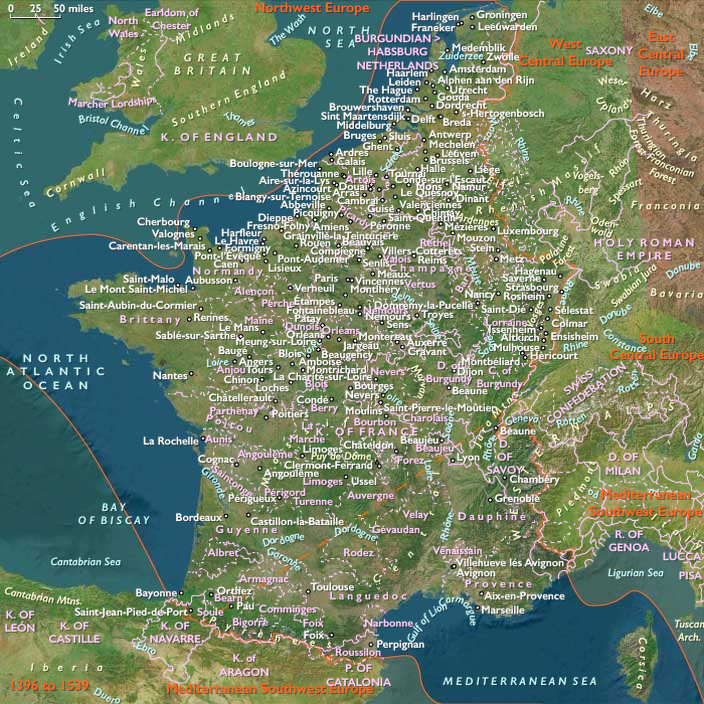
Atlantic West Europe (1108 – 1251 CE): The Angevin Empire, Champagne–Flanders Circuits, and Aquitaine under the English Crown
Geographic and Environmental Context
Atlantic West Europe spans northern France and the Low Countries.
-
Anchors: Paris–Seine–Reims, Upper Loire (Orléans–Blois–Tours), Anjou/Angers–Maine–Le Mans, Poitou/Poitiers–La Rochelle–Saintes, Bordeaux–Gironde–Bayonne, Flanders/Bruges–Ghent–Ypres, Low Countries delta.
Climate and Environmental Shifts
-
High-medieval peak supported population and urbanization; river improvements eased up-country grain and wine traffic.
Societies and Political Developments
-
Eleanor of Aquitaine married Louis VII (1137), annulled (1152), then married Henry II Plantagenet (1152)—creating the Angevin Empire (from Anjou/Normandy to Aquitaine).
-
Capetian–Angevin rivalry dominated: Philip II conquered Normandy (1204), but Aquitaine/Guyenne largely remained under English suzerainty; La Rochelle and Bordeaux became Angevin pillars.
-
Flanders and Champagne fairs integrated Mediterranean–northern circuits; communes of Bruges, Ghent, Ypres asserted charters.
-
Brittany navigated between Plantagenets and Capetians.
Economy and Trade
-
Bordeaux claret exports to England boomed; La Rochelle shipped salt and wine; Nantes handled salt fish and grain.
-
Flanders/Champagne fairs: Italian capital met northern cloth; Bruges emerged as a banking mart.
-
Upper Loire and Anjou–Touraine supplied wine/grain to Paris and ports.
Belief and Symbolism
-
Gothic beginnings in Chartres, Paris; pilgrimage roads of Poitou–Bordeaux remained crowded.
Long-Term Significance
By 1251, Aquitaine was England’s continental anchor; Flanders the cloth workshop; Paris–Loire the Capetian core—poised for 13th–14th-century contests.
The Execution of Olivier IV de Clisson and the Collapse of the Truce of Malestroit (1343–1345)
Though the Truce of Malestroit was meant to pause hostilities between England and France until September 29, 1346, tensions quickly escalated. By early 1345, war fully resumed, but even before then, Philip VI of France had already violated the spirit of the truce through a series of politically motivated executions, shocking the nobility and further fueling the Breton War of Succession.
Philip VI Ends the Truce with Executions (1343–1344)
- On August 2, 1343, Philip VI ordered the execution of Olivier IV de Clisson in Paris, a shocking move that set a precedent for further purges of Breton nobles loyal to John of Montfort.
- On November 29, 1343, fourteen more Breton lords were executed, including:
- Geoffroi de Malestroit
- Jean de Montauban
- Alain de Quédillac
- Denis du Plessis
- Guillaume II des Brieux and his brothers, Jean and Olivier
- These executions targeted key Montfortist supporters, signaling that Philip VI had no intention of maintaining peace.
The Suspicion and Execution of Olivier IV de Clisson
- Olivier IV de Clisson had been a commander in the defense of Vannes against the English in 1342, alongside Harvey VII, Lord of Léon.
- Both were captured by the English, but Olivier’s release was secured through a prisoner exchange for Ralph de Stafford, 1st Earl of Stafford, and for an unusually low ransom.
- This led to rumors that Clisson had not defended Vannes to his fullest, and Charles of Blois accused him of treason.
Philip VI’s Betrayal and the Brutal Execution (August 2, 1343)
- After the peace treaty was signed, Olivier was invited to Paris under the pretext of attending a tournament.
- Instead, he was arrested, tried, and executed by beheading at Les Halles—without a public trial or full evidence of guilt.
- His corpse was posthumously desecrated:
- His body was hanged by the armpits at Montfaucon gallows in Paris.
- His severed head was placed on a pike at the Sauvetout Gate of Nantes.
Shock and Condemnation by the Nobility
- The French nobility was appalled by the execution, as Philip VI had failed to publicly prove Clisson’s guilt.
- Such posthumous desecration was normally reserved for common criminals, not nobles.
- Jean Froissart and his contemporaries harshly condemned Philip VI’s actions, as they violated:
- Chivalric traditions—nobles were expected to be treated honorably, even in betrayal.
- The feudal right of allegiance—many nobles saw loyalty as a personal choice, not an unbreakable obligation.
Consequences: The Full Resumption of War (1345–1362)
- Despite the Truce of Malestroit, Philip VI’s executions had already reignited hostilities before the official resumption of war.
- By February 1345, Edward III was already preparing for a new military campaign, expecting the war to fully restart once the truce expired.
- Although full-scale hostilities did not officially recommence until 1345, the Breton War of Succession would now continue until 1362, fueled by the brutality of Philip VI’s reprisals.
Philip VI’s execution of Olivier IV de Clisson and other Breton nobles was a major political miscalculation, as it alienated the nobility, further escalated tensions, and ensured that war would continue for decades.
The father of Henry of Grosmont died when his son was in France in 1345, and the younger Henry now became Earl of Lancaster—the wealthiest and most powerful peer of the realm.
After participating in the Siege of Calais in 1347, the king had honored Lancaster in 1348 by including him as a founding knight of the Order of the Garter.
Lancaster is present at the English naval victory at Winchelsea, where he allegedly saves the lives of the Black Prince and John of Gaunt.
Castilian ships have fought against England as the allies or mercenaries of France, and there have been instances of piratical violence between the trading ships of both nations.
A Castilian merchant fleet had been loading cargoes in the Flemish ports to be carried to the Basque coast.
The ships are armed and have warships with them.
They are all under the command of Don Carlos de la Cerda, a soldier of fortune who belongs to a branch of the Castilian royal family.
On its way to Flanders, the Castilian fleet had captured a number of English trading ships, and had thrown the crews overboard.
Piratical violence and massacre of this kind is at this time common on the sea.
The king at Rotherhithe on August 10 announces his intention of attacking the Castilians on their way home.
The rendezvous of his fleet is at Winchelsea: the king travels by land, accompanied by his wife and her ladies, by his sons, the Black Prince and John of Gaunt, as well as by many nobles.
The ladies are placed in a convent and on August 28 the king embarks on his flagship, the Cog Thomas.
The English fleet does not put to sea but remains at anchor, waiting for the appearance of the Castilians.
Its strength is not known with certainty, but Stow puts it at fifty ships and pinnaces.
Don Carlos de la Cerda might easily have avoided the English if he had kept well out in the Channel, but he relies on the size and strength of his forty large ships, and in expectation of an encounter had recruited a body of mercenaries—mostly crossbowmen—in the Flemish ports.
In the afternoon of August 29, he bears down boldly on King Edward's ships at anchor at Winchelsea.
The English steer to board the Castilians.
The king's own ship is run into by one of the enemy with such violence that both are damaged, and she begins to sink.
The Castilian stands on, and the Cog Thomas is laid alongside another, which is carried by boarding.
The king and his following have barely reached the deck of the Castilian before the Cog Thomas goes to the bottom.
Other Castilian ships are taken, but the fight is hot.
La Cerda's crossbowmen do much murder, and the higher-built Castilians are able to drop bars of iron or other weights on the lighter English vessels, by which they are damaged.
The conflict continues until twilight.
King Edward is said to have captured fourteen of the enemy ships of Castille.
What his own loss was is not stated, but as his own vessel, and also the vessel carrying the Black Prince, were sunk, and from the peril of La Salle du Roi, we may conclude that the English fleet suffered heavily.
There is no pursuit, and a truce will be made with the Basque towns the next year.
The battle with the Castilians on the sea is a very typical example of a medieval sea-fight, when the ships are of the size of a small coaster or a fishing smack, are crowded with men, and when the personal prowess of a single knight or squire is an important element of strength.
The only real authority for the battle is Froissart, who is at different times in the service of King Edward or of his wife, Philippa of Hainault, and of the counts of Namur.
He repeated what was told him by men who had been present, and dwells as usual on the chivalry of his patrons.
See his Chroniques, iv. 91.
The Jacquerie Uprising (May–June 1358): A Peasant Revolt Against the Nobility
The Jacquerie, a brutal peasant revolt that erupted in May 1358, was fueled by widespread suffering, economic hardship, and resentment toward the nobility following the devastation of the French countryside during the Hundred Years’ War. The rebellion was centered in northern France, with peasants taking violent revenge on knights, noble families, and their castles.
Origins of the Jacquerie: Discontent in the Countryside
- The uprising began in the village of St. Leu, near the Oise River, where a group of peasants gathered in a cemetery after vespers to discuss their grievances.
- The peasants, outraged by the nobility’s failure to defend France, believed that the lords had abandoned King John II at the Battle of Poitiers (1356), leaving the kingdom leaderless and vulnerable.
- France’s rural population had already suffered immensely:
- English soldiers plundered the countryside, demanding money and food on pain of death.
- French nobles imposed excessive taxes, claiming they needed money for ransoms and to recover losses from the Black Death.
- Peasants were forced to sleep in forests, caves, and marshes to avoid pillaging armies and roaming mercenaries (routiers).
- Even basic agricultural work was impossible without sentinels watching for attacks.
The Outbreak of Revolt: Guillaume Cale’s Leadership
- On May 21, 1358, the rebellion spread near Compiègne, northeast of Paris, under the leadership of Guillaume Cale (also called Carle).
- The revolt was known as the Jacquerie, named after the derogatory term "Jacques Bonhomme" used by nobles to refer to peasants.
- The rebels sought justice and vengeance, launching a wave of destruction against noble estates.
- Castles were stormed, burned, and looted, and the nobility were killed without mercy.
The Extreme Violence of the Jacquerie
Contemporary chroniclers describe atrocities committed by the peasants, often in gruesome detail.
-
Jean le Bel recounts one of the most infamous acts:
- Peasants captured a knight, roasted him alive on a spit, and forced his wife and children to watch.
- After raping the lady, they attempted to force her and her children to eat the roasted flesh of her husband before killing them all.
-
Even Jean de Venette, who was generally sympathetic to the peasants, recorded horrific scenes of slaughter and destruction.
-
Jean Froissart, an aristocrat who despised the peasants, portrayed them as savages, recounting numerous acts of mass murder, rape, and looting.
-
The only chronicler openly sympathetic to the peasants was the anonymous monk who continued the chronicle of Guillaume de Nangis, recognizing the deep suffering that had fueled the uprising.
Impact of the Revolt
- The Jacquerie’s brutal violence horrified the nobility, leading to harsh reprisals against the surviving rebels.
- Though the revolt was eventually crushed within weeks, it revealed the depth of peasant resentment toward the feudal system and noble exploitation.
- The uprising, though short-lived, left a lasting impression on France, foreshadowing future peasant rebellions and further destabilizing the already fragile French monarchy.
The Jacquerie of 1358 was not just a violent peasant uprising—it was an explosive reaction to years of suffering, injustice, and noble indifference, marking a turning point in medieval social unrest.
Atlantic West Europe (1360–1371): Fragile Peace, Regional Power Shifts, and Social Unrest
Between 1360 and 1371, Atlantic West Europe—encompassing the Low Countries, Brittany, Normandy, Burgundy, Aquitaine, central France, Alsace, and Franche-Comté—experienced a temporary lull in the Hundred Years' War, significant regional power shifts, economic strain, and widespread social tensions. The Treaty of Brétigny (1360)briefly halted hostilities between France and England, creating space for internal reconstruction, but underlying instabilities persisted, fueling regional ambitions and social discontent.
Political and Military Developments
-
France: Treaty of Brétigny and Internal Struggles
- The Treaty of Brétigny (1360) marked a pause in the Hundred Years' War, temporarily ceding extensive French territories—including Aquitaine—to English control and significantly reducing French royal prestige and resources.
- King Charles V (the Wise, r. 1364–1380) assumed the throne after Jean II's death (1364), beginning systematic efforts to recover lost territories and centralize royal authority through military reforms, strategic diplomacy, and administrative strengthening.
-
Aquitaine and Gascony: Heightened English Control
- The Black Prince (Edward of Woodstock) ruled Aquitaine from Bordeaux, maintaining considerable autonomy and enforcing strict administration, resulting in significant regional prosperity but also provoking growing resentment and discontent among local nobility and towns.
-
Low Countries: Urban Autonomy and Noble Rivalries
- The Low Countries witnessed significant urban unrest, particularly in Flanders and Brabant, where powerful cities like Ghent, Bruges, and Brussels sought greater economic and political independence from local nobles.
- Growing tensions between urban elites and rural aristocracy periodically erupted into conflicts, shaping regional governance and alliances.
-
Burgundy, Alsace, and Franche-Comté: Emerging Power
- Philip the Bold, younger son of Jean II, received the Duchy of Burgundy in 1363, marking the beginning of the powerful Valois-Burgundy dynasty. Philip quickly consolidated power, establishing Burgundy as an influential, semi-independent political entity.
- Alsace and Franche-Comté maintained relative independence, serving as contested territories balancing French, imperial, and Burgundian ambitions.
-
Brittany and Normandy: Succession and Local Governance
- Brittany remained entrenched in the Breton War of Succession (ending in 1364), concluding with the victory of the Montfort faction under John IV (Jean de Montfort). Brittany maintained an autonomous stance between France and England.
- Normandy experienced recovery and tighter integration into royal administration under Charles V, rebuilding economically from previous devastations.
Economic and Social Developments
-
Economic Strain and Resilience
- The aftermath of the Black Death continued to strain labor markets, leading to recurring rural and urban unrest, particularly in France, Aquitaine, and the Low Countries.
- Flemish cities such as Ghent and Bruges slowly rebounded, maintaining their positions as major centers of the wool and textile trades, despite intermittent social unrest.
-
Urban-Rural Tensions
- Increasing taxes and feudal demands caused rural populations to rebel periodically against noble authority, most notably reflected in localized uprisings and communal revolts across northern France, Normandy, and Brittany.
- In urban areas, conflicts intensified between merchant guilds and urban laborers, reflecting deepening socio-economic disparities.
Cultural and Intellectual Developments
-
Literary Flourishing and Court Culture
- Charles V's court promoted intellectual and artistic renewal, notably through translations of classical texts into French, signaling growing royal patronage of vernacular literature and scholarly culture.
- Works by prominent writers, such as Jean Froissart, chronicled contemporary events and court life, marking an advancement in vernacular historiography.
-
Gothic Artistic Patronage
- Gothic architecture and artistic patronage continued to thrive, particularly evident in the completion and decoration of cathedrals, such as those in Strasbourg and Rouen, highlighting cultural recovery from previous devastations.
Religious Developments
- Clerical Challenges and Popular Piety
- The aftermath of plague-era clerical shortages and perceived corruption spurred popular religious movements, confraternities, and increasing lay devotion, emphasizing spiritual renewal outside traditional ecclesiastical structures.
- Mendicant orders, particularly Dominicans and Franciscans, continued their influential roles within urban centers, fostering a more personalized religious experience.
Legacy and Significance
Between 1360 and 1371, Atlantic West Europe experienced a fragile and temporary peace that permitted internal recovery and significant regional restructuring. The Treaty of Brétigny reshaped Anglo-French territorial dynamics, planting seeds of renewed future conflict. The emergence of Burgundy as a major power, ongoing struggles for urban autonomy, and widespread social unrest defined the era, marking a critical transitional period leading to the resumption of hostilities and profound socio-political transformations in the coming decades.
French historian and poet Jean Froissart is twenty-three-years old in 1360 when he begins work on his “Chronicles,” an account of European affairs beginning in 1325.
Borrowed from the work of his elder contemporary Jean Le Bel for the period up to 1356; he bases his account of subsequent events on eyewitness reports.
A writer of lyric poetry as well as a historian, Froissart expresses the courtly view of life in “Meliador,” a long Arthurian verse romance.
What little is known of Froissart's life comes mainly from his historical writings and from archival sources which mention him in the service of aristocrats or receiving gifts from them.
Although his poems have also been used in the past to reconstruct aspects of his biography, this approach is in fact flawed, as the 'I' persona which appears in many of the poems should not be construed as a reliable reference to the historical author.
Froissart comes from Valenciennes in the County of Hainaut, situated in the western tip of the Holy Roman Empire, bordering France.
Earlier scholars have suggested that his father was a painter of armorial bearings, but there is actually little evidence for this.
Other suggestions include that he began working as a merchant but soon gave that up to become a cleric.
For this conclusion there is also no real evidence, as the poems which have been cited to support these interpretations are not really autobiographical.
By about age twenty-four, Froissart leaves Hainault and enters the service of Philippa of Hainault, queen consort of Edward III of England, in 1361 or 1362.
This service, which will have lasted until the queen's death in 1369, has often been presented as including a position of court poet and/or official historiographer.
Based on surviving archives of the English court, Croenen has concluded instead that this service did not entail an official position at court, and probably was more a literary construction, in which a courtly poet dedicated poems to his 'lady' and in return received occasional gifts as remuneration.
Froissart takes a serious approach to his work.
He travels in England, Scotland, Wales, France, Flanders and Spain gathering material and firsthand accounts for his Chronicles.
He travels with Lionel, Duke of Clarence, to Milan to attend and chronicle the duke's wedding to Violante, the thirteen-year-old daughter of Galeazzo Visconti, in May 1368.
At this wedding, two other significant writers of the Middle Ages are present: Chaucer and Petrarch.
Atlantic West Europe (1372–1383): Renewed Conflict, Rising Burgundy, and Social Upheaval
Between 1372 and 1383, Atlantic West Europe—including the Low Countries, Brittany, Normandy, Burgundy, Aquitaine, central France, Alsace, and Franche-Comté—experienced renewed warfare, the rise of powerful regional states, social unrest, and evolving economic dynamics. The resumption of the Hundred Years’ War, the further consolidation of Burgundy under Philip the Bold, and intensifying urban and rural tensions significantly shaped this turbulent era.
Political and Military Developments
-
France and England: The War Resumes
- Hostilities in the Hundred Years' War resumed fully in 1372, reversing the temporary peace established by the Treaty of Brétigny. French naval victories, notably the Battle of La Rochelle (1372), marked a turning point, weakening English control in Aquitaine.
- Under Charles V (r. 1364–1380) and his talented constable, Bertrand du Guesclin, France gradually recaptured large territories previously ceded to England.
-
Aquitaine and Gascony: English Retreat and Regional Turmoil
- Aquitaine suffered increasing turmoil as the English lost significant ground. Revolts among regional nobility and towns undermined English rule, weakening the position of the Black Prince (Edward of Woodstock), who died in 1376, further destabilizing English governance.
-
Burgundy, Alsace, and Franche-Comté: Burgundian Consolidation
- Philip the Bold, Duke of Burgundy (r. 1363–1404), significantly expanded his territories and influence. Through marriage alliances and strategic diplomacy, Philip integrated the County of Burgundy (Franche-Comté) and reinforced his control over key regions, positioning Burgundy as a major European power.
- Alsace remained an influential buffer zone, managing local autonomy despite pressure from French, Imperial, and Burgundian interests.
-
Low Countries: Urban Revolts and Economic Rivalries
- Flanders faced severe social upheaval, notably the Revolt of Ghent (1379–1385), where urban populations rebelled against the Count of Flanders, Louis de Male, over oppressive taxation and governance issues. The conflict profoundly destabilized the region's economic and political landscape.
-
Brittany and Normandy: Continued Autonomy and Stability
- Brittany maintained relative autonomy under Duke John IV (Jean de Montfort, r. 1364–1399), carefully balancing neutrality with alliances to both France and England.
- Normandy continued its economic and administrative recovery under closer integration into French royal structures, despite occasional local tensions.
Economic and Social Developments
-
Economic Struggles and Social Unrest
- Heavy taxation due to renewed warfare led to widespread unrest across rural and urban areas, notably triggering peasant rebellions like the Harelle revolt in Rouen (1382), reflecting escalating social tensions.
- Trade disruptions severely impacted Flemish cities, exacerbating social grievances among urban populations, and fueling revolts against noble authority.
-
Urban-Rural Divide
- Increasing economic disparities between urban elites and rural populations intensified, manifesting in widespread discontent and periodic revolts across France, Burgundy, and the Low Countries.
Cultural and Intellectual Developments
-
Royal Patronage and Cultural Renewal
- Under Charles V, Paris emerged as a vibrant cultural and intellectual hub, attracting scholars, poets, and artists. This era saw an expansion of vernacular literature and historiography, exemplified by the chronicler Jean Froissart, whose writings documented the era’s significant events and courtly culture.
-
Artistic Flourishing
- The patronage of Burgundy’s Philip the Bold significantly advanced Gothic artistic developments, particularly evident in the Charterhouse of Champmol in Dijon, marking Burgundy’s emergence as a key European cultural center.
Religious Developments
- Popular Piety and Ecclesiastical Criticism
- Disillusionment with the Church’s wealth and corruption intensified, fueling growing movements advocating religious reform and personal spirituality, notably through the continued spread of mendicant orders (Dominicans, Franciscans) and lay confraternities.
- Clerical reform movements arose, questioning papal authority, particularly in response to the onset of the Western Schism (1378), dividing European loyalties between rival popes in Avignon and Rome.
Legacy and Significance
Between 1372 and 1383, Atlantic West Europe witnessed renewed warfare and significant shifts in regional power dynamics. France’s strategic gains against England, the rise of Burgundy under Philip the Bold, urban revolts in the Low Countries, and widespread social unrest defined the period. These developments deepened political divisions, reshaped regional alliances, and set the stage for future conflicts, laying critical groundwork for subsequent transformations in European political and cultural history.
The Enigmatic Years of André Beauneveu (1367–1372) and His Later Works
Little is known about André Beauneveu’s whereabouts between 1367 and 1372, as no documentary evidence survives from this period. His fellow Valenciennois, the chronicler Jean Froissart, suggested that Beauneveu may have traveled to England, possibly working with Jean de Liège in the employ of Philippa of Hainault, the English queen and a native of Beauneveu’s home region. However, there is no independent confirmation of such a visit, and his name does not appear in the normally meticulous Westminster account rolls from this time.
Return to the Low Countries and the Count of Flanders’ Monument
By 1372, Beauneveu had returned to the Low Countries, where he resumed work for both civic and aristocratic patrons. One of his most significant commissions between 1374 and 1377 was the funeral monument of Louis of Male, Count of Flanders. Although the monument was never completed, elements of the project survive, including a statue of St. Catherine, now housed in the Onze Lieve Vrouwkerk in Kortrijk.
This lifelike sculpture, with its graceful pose, direct gaze, and refined naturalism, exemplifies the elegance and sophistication for which Beauneveu was celebrated. The statue’s delicate drapery and expressive realism align with the artistic ideals that Froissart and his contemporaries admired in Beauneveu’s work, securing his reputation as one of the leading sculptors of the 14th century.
Legacy and Influence
Despite the gaps in his documented career, Beauneveu's surviving works demonstrate his significant role in shaping late Gothic sculpture. His ability to blend elegant courtly aesthetics with lifelike realism would influence later sculptors in both France and the Low Countries, bridging the transition toward early Netherlandish art.
The Madness of Charles VI and the Struggle for Power (1392–1420)
Between 1388 and 1392, King Charles VI of France implemented governmental reforms and financial economies, seeking to stabilize royal administration after the tumultuous reign of his father, Charles V. However, after 1392, Charles VI began to suffer from recurrent bouts of insanity, rendering him incapable of ruling effectively. His mental decline created a power vacuum, leading to a prolonged struggle for control of the French government between the House of Burgundy and the House of Orléans.
The Rivalry Between Burgundy and Orléans
With the king unable to govern, two factions emerged to fill the void:
- The Burgundians, led by Philip the Bold, Duke of Burgundy (the king’s uncle), and later his son John the Fearless.
- The Armagnacs, led by Louis, Duke of Orléans (the king’s younger brother), and after his assassination in 1407, by his son Charles of Orléans and his allies.
This dynastic struggle eventually erupted into a civil war (1407–1435) that paralyzed France, weakening its financial and military systems and leaving the kingdom vulnerable to English intervention in the later stages of the Hundred Years’ War.
The Disintegration of France’s Military and Financial System
As factional conflicts intensified, the once-strong French military and taxation system—carefully built under Charles V—began to fall apart:
- Royal finances collapsed, as tax revenues were siphoned off by competing factions.
- Mercenary bands, known as the Écorcheurs ("Skinners"), ravaged the countryside as central authority eroded.
- The English renewed their invasion, with Henry V delivering a crushing defeat to the French at Agincourt (1415).
- The Burgundian-Orléanist feud ultimately resulted in John the Fearless' assassination in 1419, leading Burgundy to ally with England and support the Treaty of Troyes (1420), which disinherited the dauphin (future Charles VII) in favor of Henry V of England.
Long-Term Consequences
The mental decline of Charles VI and the subsequent struggle for power not only crippled France’s ability to defend itself, but also paved the way for English dominance in northern France. The kingdom would remain in turmoil until Joan of Arc’s intervention in 1429, which helped turn the tide in favor of the Valois dynasty.
André Beauneveu’s Work for Jean, Duke of Berry (1386)
By 1386, the renowned sculptor, painter, and illuminator André Beauneveu, then about fifty-six years old, had traveled to Bourges to serve as artistic advisor to Jean, Duke of Berry. One of his key commissions during this period was the creation of twenty-four miniatures of apostles and prophets at the beginning of the so-called Duke’s Psalter.
Beauneveu’s Reputation and Legacy
- Although many of his works have been lost, Beauneveu was highly regarded in his time, especially for his sculptures, manuscript illuminations, and paintings.
- His contemporary, the historian Jean Froissart, praised him highly, recognizing his contributions to French Gothic art.
The Duke’s Psalter: A Masterpiece of Illumination
- Jean, Duke of Berry, one of the greatest art patrons of the late 14th century, commissioned Beauneveu to create illuminations for a personal Psalter.
- Beauneveu’s twenty-four miniatures of apostles and prophets were painted at the beginning of the manuscript, setting the tone for what was likely an elaborate devotional work.
- Though many of his paintings and sculptures have not survived, his stylistic influence on later Gothic manuscript illumination remains evident.
Significance of His Work in Bourges
- By working for Jean de Berry, Beauneveu was at the heart of the most sophisticated artistic patronage in late medieval France.
- His role as artistic advisor indicates his continued prominence in royal and ducal courts, even as he moved toward the later years of his career.
- His painterly skills and sculptural expertise influenced subsequent generations of artists in the International Gothic style.
André Beauneveu’s 1386 commission in Bourges for the Duke of Berry reflects his continued artistic prestige, marking him as one of the leading court artists of his generation, even as his surviving works remain scarce today.