
John Forrest
Australian explorer and 1st Premier of Western Australia
1847 CE to 1918 CE
Sir John Forrest GCMG (22 August 1847 – 2 September 1918) is an Australian explorer, the first Premier of Western Australia and a cabinet minister in Australia's first federal parliament.
As a young man, John Forrest wins fame as an explorer by leading three expeditions into the interior of Western Australia.
He is appointed Surveyor General and in 1890 becomes the first Premier of Western Australia, its only premier as a self-governing colony.
Forrest's premiership gives the state ten years of stable administration during a period of rapid development and demographic change.
He pursues a policy of large-scale public works and extensive land settlement, and he helps to ensure that Western Australia joins the federation of Australian states.
After federation, he moves to federal politics, where he is at various times postmaster-general, Minister for Defence, Minister for Home Affairs, Treasurer and acting Prime Minister.
Shortly before his death, Forrest is informed that the King had approved his being raised to the British peerage as Baron Forrest of Bunbury.
He immediately begins signing his name as "Forrest", as if he were already a peer.
However, at the time of his death his peerage had not been legally established by letters patent.
References to him as "Lord Forrest" are therefore incorrect.
World
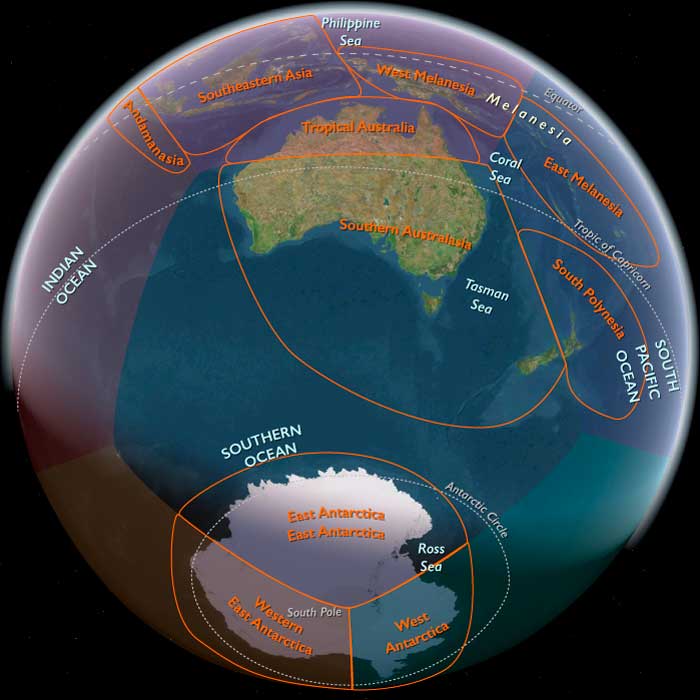
Southern Oceania
View →Related Events
Showing 10 events out of 17 total
John Forrest has been asked to lead an expedition in search of the explorer Ludwig Leichhardt, who had been missing since April 1848.
A few years earlier, a party of Aborigines had told the explorer Charles Hunt of a place where a group of white men had been killed by Aborigines a long time ago, and some time afterwards an Aboriginal tracker named Jemmy Mungaro had corroborated their story and claimed to have personally been to the location.
Since it was thought that these stories might refer to Leichhardt's party, Forrest has been asked to lead a party to the site, with Mungaro as their guide, and there to search for evidence of Leichhardt's fate.
Forrest assembles a party of six, including the Aboriginal trackers Mungaro and Tommy Windich, and they had left Perth on April 15, 1869.
They head in a north-easterly direction, passing through the colony's furthermost sheep station on April 26.
One of ten children of William and Margaret Forrest, who had come out as servants under Dr. John Ferguson in 1842, was born at Picton near Bunbury in the British colony of Western Australia.
Among his seven brothers are Alexander Forrest and David Forrest.
John had attended the government school in Bunbury under John Hislop until the age of twelve, when he had been sent north to Perth to attend the Bishop's Collegiate School, now Hale School, starting there in January 1860.
In November 1863, he had been apprenticed to a government land surveyor named Thomas Carey.
When his term of apprenticeship had ended in November 1865, he had become the first man born and educated in the colony to qualify as a land surveyor; he had then commenced work as a surveyor with the government's Lands and Surveys Department.
The Forrest party had encountered a group of Aborigines on May 6, who had offered to guide the party to a place where there are many skeletons of horses.
Forrest's team had accompanied this group in a more northerly direction, but after a week of traveling, it had become clear that their destination is Poison Rock, where the explorer Robert Austin was known to have left eleven of his horses for dead in 1854.
They now turn once more towards the location indicated by their guide.
The team had arrived in the location to be searched on May 28.
They next spent almost three weeks surveying and searching an area of about fifteen thousand square kilometers in the desert west of the site of the present-day town of Leonora.
Having found no evidence of Leichhardt's fate, and Mungaro having changed his story and admitted that he had not personally visited the site, they decide to push as far eastwards as they can on their remaining supplies.
The Forrest expedition reaches its furthest point east on July 2, near the present-day site of the town of Laverton.
They now turn for home, returning by a more northerly route, and...
...arrives back in Perth on August 6.
The expedition had been absent for one hundred and thirteen days, and had traveled, by Forrest's reckoning, over thirty-six hundred kilometers (twenty-two hundred miles), most of it through uncharted desert.
They had found no sign of Leichhardt, and the country over which they had traveled is useless for farming.
However, Forrest does report that his compass had been affected by the presence of minerals in the ground, and he suggests that the government send geologists to examine the area.
Ultimately, the expedition had achieved very little, but it is of great personal advantage to young Forrest, whose reputation with his superiors, and in the community at large, is greatly enhanced.
John Forrest's new exploring party leaves Perth on March 30, 1870.
Forrest had been selected in the previous year to lead an expedition that will survey a land route along the Great Australian Bight between the colonies of South Australia and Western Australia.
The explorer Edward John Eyre had achieved such a crossing thirty years earlier, but his expedition had been poorly planned and equipped, and Eyre had nearly perished from lack of water.
Forrest's expedition will follow Eyre's route, but it will be thoroughly planned and properly resourced.
Also, the recent discovery of safe anchorages at Israelite Bay and Eucla will permit Forrest's team to be reprovisioned along the way by a chartered schooner, Adur.
Forrest's brief is to provide a proper survey of the route, which might be used in future to establish a telegraph link between the colonies, and also to assess the suitability of the land for pasture.
Forrest's team consists of six men: his brother Alexander, who is second in command, Police constable Hector McLarty, farrier William Osborn, trackers Windich and Billy Noongale, with sixteen horses and a number of dogs.
Forrest and his men arrive at Esperance on April 24.
Heavy rain has fallen for much of the past few weeks.
The Forrest party had left Esperance on May 9 after resting and reprovisioning, and arrived at Israelite Bay nine days later.
They had encountered very little feed for their horses, and no permanent water, but have managed to obtain sufficient rain water from rock water-holes.
After reprovisioning, the team leaves for Eucla on May 30.
The Forrest expedition again encounters very little feed and no permanent water, and this time the water they obtain from rock water-holes is not sufficient.
They are compelled to dash more than two hundred and forty kilometers (one hundred and fifty) to a spot where Eyre had found water in 1841.
Having secured a water source, they rest and explored the area before moving on, eventually reaching Eucla on July 2.
At Eucla they rest and reprovision, also exploring inland, where they find good pasture land.
The Forrest team had started the final leg of their expedition on July 14 through unsettled country: from Eucla to the nearest South Australian station.
During this last leg, almost no water could be found, and the team had been compelled to travel day and night for nearly five days.
They had seen their first signs of civilization on July 18, and eventually reach Adelaide on August 27.
A week hence they will they board ship for Western Australia, ...
...arriving in Perth on September 27.
They are honored at two receptions one by the Perth City Council and a citizens banquet at the Horse and Groom Tavern.
Speaking at the receptions, John Forrest is modest about his own contributions while praising the efforts of the members of the expedition and dividing a government gratuity between them.
Forrest's bight crossing is one of the best organized and managed expeditions of his time.
As a result, his party had successfully completed in five months a journey that had taken Eyre twelve, arriving in good health and without the loss of a single horse.
From that point of view, the expedition must be considered a success.
However, the tangible results are not great.
They had not traveled far from Eyre's track, and although a large area had been surveyed, only one small area of land suitable for pasture had been found.