John Norreys
English soldier
Years: 1547 - 1597
Sir John Norreys (1547?
– 3 July 1597), frequently referred to as John Norris, is an English soldier of a Berkshire family of court gentry, son of Henry Norris, 1st Baron Norreys a lifelong friend of Queen Elizabeth.
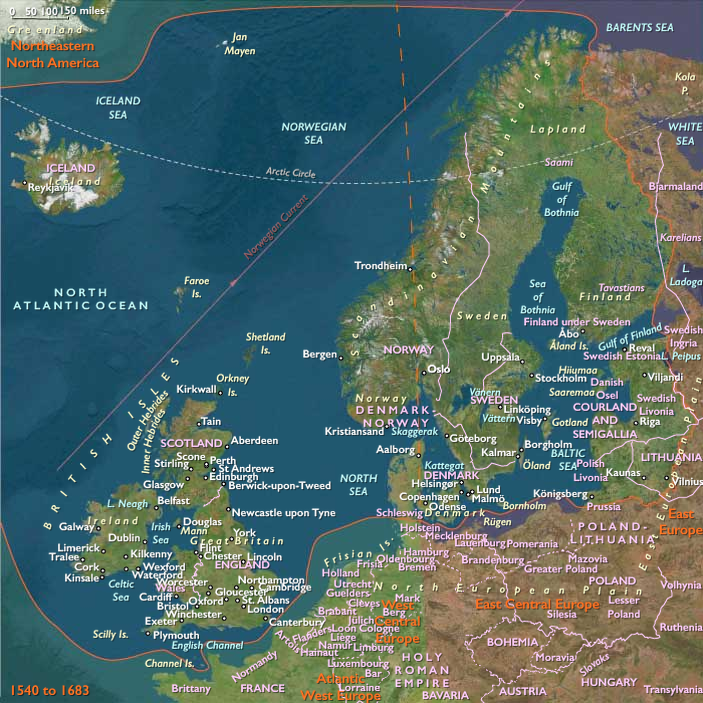
He participates in every Elizabethan theater of war: in the Wars of Religion in France, in Flanders during the Eighty Years' War of Dutch liberation from Spain, in the Anglo-Spanish War, and above all in the Tudor reconquest of Ireland, where he is infamous for the massacre of women and children on the island of Rathlin in 1575.
He is the most acclaimed English soldier of his day.

Related Events
Filter results
Showing 10 events out of 13 total
Among Essex’s captains is John Norreys, whose great uncle had been a guardian to the young princess Elizabeth, who was well acquainted with the family, and had stayed at Yattendon on her way to imprisonment at Woodstock.
Born born at Yattendon, Berkshire, a second son of Henry Norreys and Marjorie Williams, his paternal grandfather had been executed as the lover of Anne Boleyn, the mother of Elizabeth.
His maternal grandfather was Lord Williams of Thame.
The future Queen was a great friend of Norreys' mother, whom she had nicknamed the Black Crow on account of her jet black hair.
Norreys has inherited his mother's hair color and in consequence is known as Black Jack by his troops.
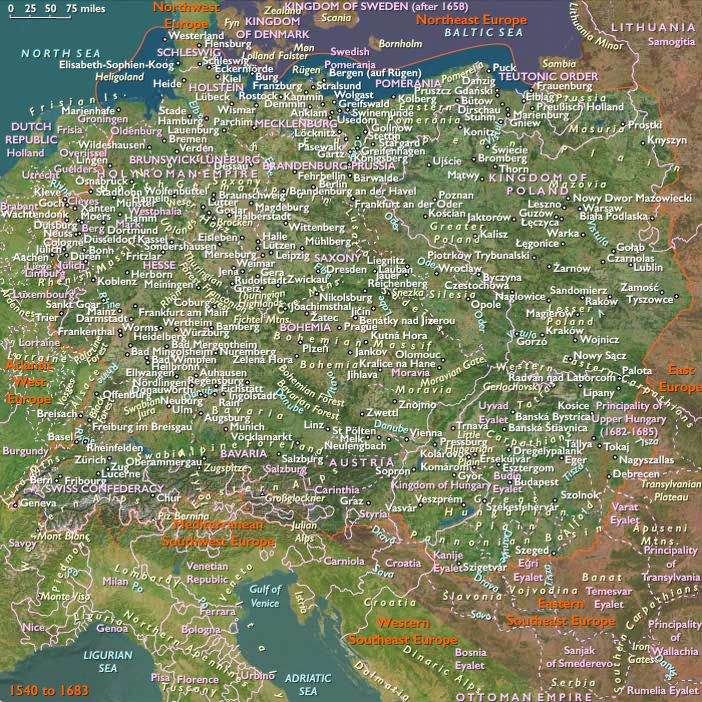
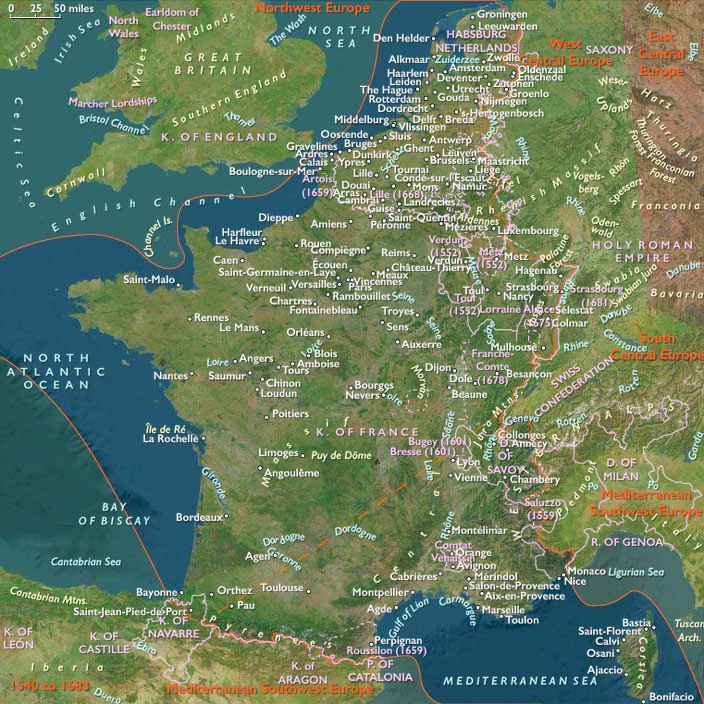
His father had been posted as ambassador to France, and in 1567 John and his elder brother William had witnessed the Battle of St. Denis.
They had drawn a map of the battle which formed part of their father's report to the Queen.
When his father was recalled in January 1571, Norreys had stayed behind in France and developed a relationship with the new ambassador, Francis Walsingham.
Norreys had served in 1571 as a volunteer under Admiral Coligny on the Protestant side in the civil wars in France.
Norreys now supports his elder brother William, in command of a troop of one hundred cavalry that have been recruited by their father, currently serving as Lord Lieutenant of Berkshire.
Elizabeth, on advice from Leicester, commands Essex to “break off his enterprise” in 1575.
Essex now switches tack, having struck a deal with Turlough Luineach O'Neill, and defeats Sorley Boy around Castle Toome, where the Bann flows out of Lough Neagh.
Essex has to withdraw to Carrickfergus for lack of provisions, but he now orders a follow-up operation, with the intention of driving the Scots from Ulster.
Under the commands of John Norreys and Francis Drake, an amphibious strike force of eleven hundred and fifty men in three frigates proceeds by sea from Carrickfergus to ...
...Rathlin Island, where Sorley Boy's children and valuables, together with the families of his principal retainers, have been lodged in the caves for safety.
Drake is in charge of the ships which transport Norreys' troops to Rathlin, commanding a small frigate called Falcon, with a total complement of twenty-five; he is charged with the task of keeping Scottish vessels from bringing reinforcements to the island.
While the chieftain is himself at Ballycastle, within sight of the island, the English break the defenses of the castle, where the retainers have fled, after a four-day siege, and massacre the six or seven hundred women, children, and old men.
A fort is erected on the island, but is evacuated by Norreys, and he is recalled with his troops to Dublin within three months, when it becomes clear that the plantation effort will fail.
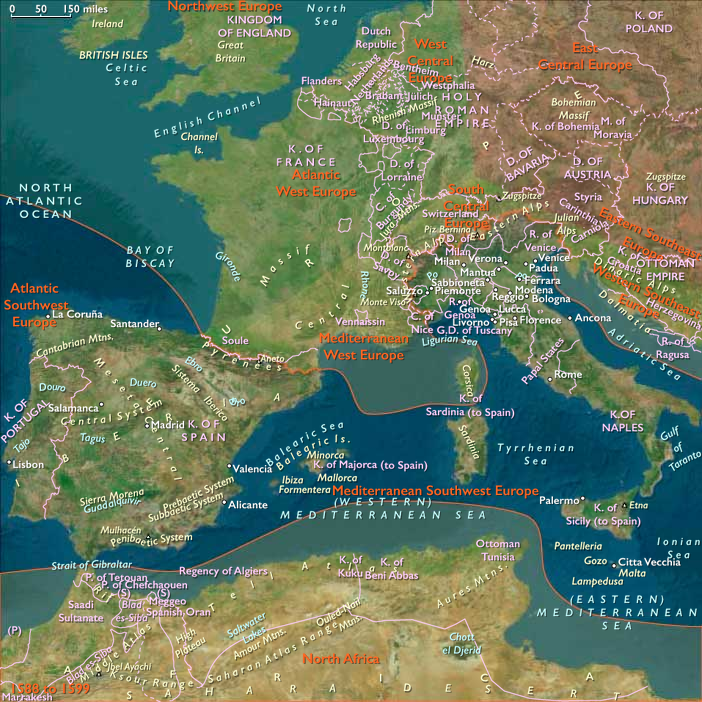
The English Armada (also known as the Counter Armada, or the Drake-Norris Expedition), a fleet of warships sent to the Iberian coast by Elizabeth in 1589, is led by Sir Francis Drake as admiral and Sir John Norreys as general.
Elizabeth's intentions are to capitalize upon Spain's temporary weakness at sea after the successful repulsion of the Spanish Armada and to compel Philip II to sue for peace.
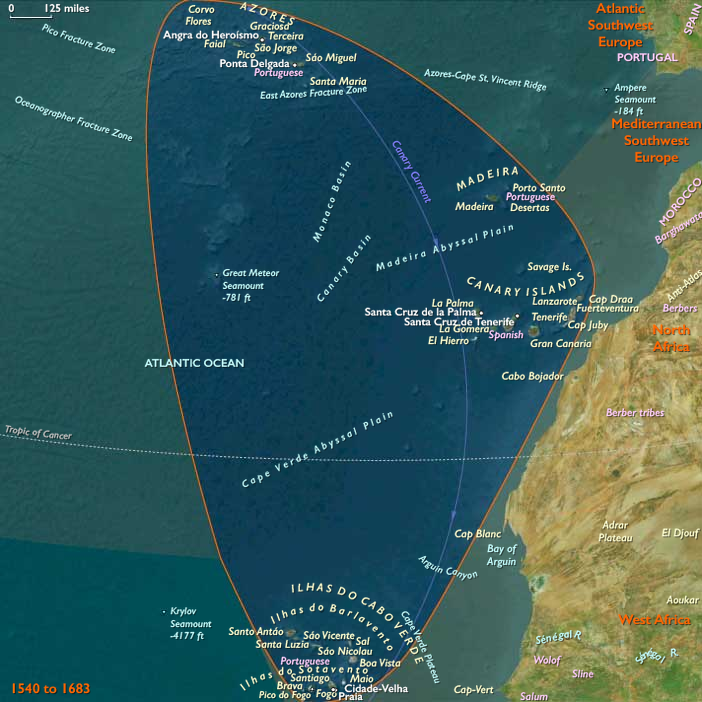
It is not a simple matter, and the expedition has three distinct aims: to burn the Spanish Atlantic fleet, to make a landing at Lisbon and raise a revolt there against Philip II, and then to continue south and establish a permanent base in the Azores.
A further aim is to seize the Spanish treasure fleet as it returns from America to Cadiz, although this depends largely on the success of the Azores campaign.
The complex politics are not the only drawback for the expedition.
Like its Spanish predecessor, the English Armada suffers from overly optimistic planning, based on hopes of repeating Drake's successful raid on Cadiz in 1587.
A critical contradiction lies between the separate plans, each of which is ambitious in its own right.
But the most pressing need is the destruction of the Spanish Atlantic fleet lying at port at La Coruña, San Sebastián and Santander along the north coast of Spain, as directly ordered by the Queen.
The expedition is floated as a joint stock company, with capital of about eighty thousand pounds—one quarter to come from the Queen, and one eighth from the Dutch, the balance to be made up by various noblemen, merchants and guilds.
Concerns over logistics and adverse weather delay the departure of the fleet, and confusion grows as it waits in port.
The Dutch fail to supply their promised warships, a third of the victuals have already been consumed, and the number of veteran soldiers is only eighteen hundred while the ranks of volunteers has increased the planned contingent of troops from ten thousand to nineteen thousand.
The fleet also lacks siege guns and cavalry—items that had been lavishly laid on in the Spanish Armada expedition of the previous year—which raises serious doubts about the intentions of those in charge of the preparations.
When the fleet sails, it is made up of six royal galleons, sixty English armed merchantmen, sixty Dutch flyboats and about twenty pinnaces.
In addition to the troops, there are four thousand sailors and fifteen hundred officers and gentlemen adventurers.
Drake assigns his vessels to five squadrons, led respectively by himself in the Revenge, Sir John Norreys in the Nonpareil, Norreys' brother Edward in the Foresight, Thomas Fenner in the Dreadnought, and Roger Williams in the Swiftsure.
Also sailing with them—against the Queen's express orders—is the Earl of Essex.
The Advance Toward Lisbon (June 1589)
- After a modest victory at Puente de Burgos, Norreys and Drake marched on Lisbon, hoping for a Portuguese revolt against Spain.
- However, despite Lisbon’s garrison being disaffected, no uprising occurred.
- Meanwhile, on June 30, 1589, Drake seized a fleet of Hanseatic ships that had broken the English blockade on Spanish trade by sailing around Scotland.
- This seizure required an official justification, leading to the publication of a Declaration of Causes by the Queen’s printer to defend the action.
Conclusion: A Costly and Failed Expedition
- The 1589 English campaign in Spain was a failure, as:
- The Spanish fleet remained intact, continuing to threaten England.
- The hoped-for Portuguese rebellion never materialized.
- Heavy losses in personnel and resources made the expedition a financial disaster.
- Elizabeth I and her investors, expecting riches, faced significant losses, requiring justification for the failed campaign.
The failed attempt to capitalize on the Armada’s defeat meant that Philip II could rebuild Spain’s naval strength, prolonging Anglo-Spanish hostilities for another decade.
...Porto Santo in Madeira is plundered, his flagship, the Revenge, springs a leak and almost founders as it leads the remainder of the fleet home to Plymouth.
With the opportunity to strike a decisive blow against the weakened Spanish lost, the failure of the expedition further depletes the crown treasury that has been so carefully restored during the long reign of Elizabeth.
It is a crucial turning point in the Anglo-Spanish War.
António had believed that his presence would provoke a general rising against Philip II.
Despite the bravado of Essex, who thrusts a sword in at the gates of the city with a challenge to the defenders, the English cannot take Lisbon.
Essex receives Elizabeth's orders to return to court, and it is decided to concentrate on the third aim of the expedition, the establishment of a permanent base in the Azores.
But the campaign has taken its toll and, having initially caught the Spanish authorities off guard—perhaps mainly by its sheer audacity—Drake's forces suffer increasingly from disease.
It is soon understood that any attempt to land in the Azores is out of the question, and a final attempt to retrieve the mission is made by Drake.
At this point, there are only two thousand men fit to be mustered, and stormy weather has damaged a number of ships.
While Norreys sails for home with the sick and wounded, Drake takes his pick of what is left and sets out with twenty ships to hunt for the treasure fleet.
Even this task is beyond him, as he is struck by another heavy storm, and while ...
Sir John Norreys, leading an English expeditionary force of three thousand troops sent by Elizabeth of England in support of Henry of Navarre, takes the Breton town of Guingamp in May after a brief siege.
Norreys aids Henry IV of France in his struggle with the Catholic League, fighting in 1591 and 1593 for the Protestant cause in Brittany, where he leads three thousand troops.
He had taken Guingamp and defeated the French Catholic League and their Spanish allies at Chateau Laudran.
Some of his troops had transferred to the Earl of Essex's force in Normandy, and Norreys' campaign had proved so indecisive that he had left for England in February 1592; not until September 1593 does he return to Brittany, seizing the great fortress of Crozon outside Brest, defended by two hundred Spanish troops.
This is his most notable military success, but he does lose fifteen hundred men and is himself wounded. (He had also broken the siege of Mechelen.)
His youngest brother, Maximilian, is slain while serving under him in this year.
Norreys, having fallen foul of his French colleagues at the end of 1594, had returned from Brest.
He is in April 1595 selected as the military commander under the new lord deputy of Ireland, Sir William Russell.
The waspish Russell had been governor of Flushing, but the two men are on bad terms.
Sir Robert Devereux, 2nd Earl of Essex, had wanted his men placed as Russell's subordinates, but Norreys rejects this and is issued with a special patent that makes him independent of the lord deputy's authority in Ulster.
It is expected that the terror of the reputation he has gained in combating the Spanish will be sufficient to cause the rebellion to collapse.