John of Lancaster
1st Duke of Bedford
Years: 1389 - 1435
Sir John of Lancaster, 1st Duke of Bedford, KG (20 June 1389 – 14 September 1435), also known as John Plantagenet, is the third surviving son of King Henry IV of England by Mary de Bohun, and acts as Regent of France for his nephew, King Henry VI.

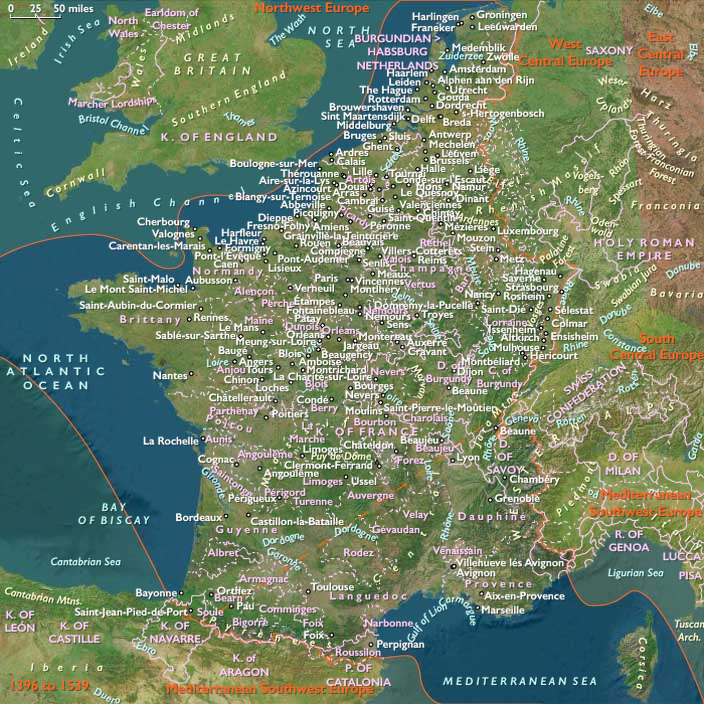

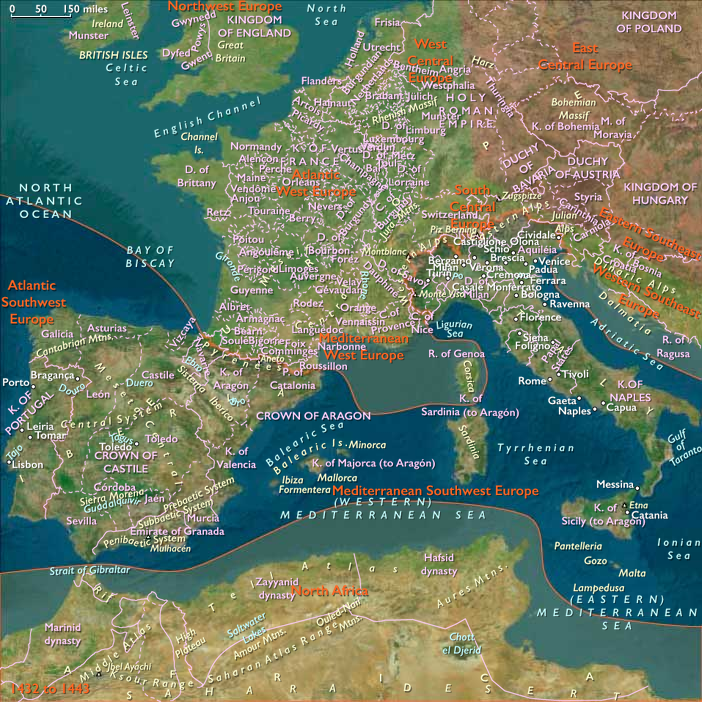



Related Events
Filter results
Showing 10 events out of 25 total
The Hundred Years' War and the Crisis of the French Monarchy (1337–1420)
By 1420, the Hundred Years’ War—which had begun in 1337 as an inheritance dispute over the French throne—had reached a critical stage. England, led by Henry V, had taken full advantage of France’s internal divisions, and the Treaty of Troyes had effectively placed the French crown in English hands. France, devastated by war, civil conflict, and economic ruin, faced its greatest crisis yet.
I. The Devastation of France and the English Advance
- Nearly all the fighting had taken place in France, leading to the widespread destruction of towns, farmlands, and infrastructure.
- The English had used chevauchée tactics—scorched-earth raids designed to economically cripple the French countryside, depriving the enemy of resources.
- The French economy was in tatters:
- The population had never fully recovered from the Black Death (1347–1351).
- Merchants were isolated from foreign trade markets.
- The kingdom was politically fragmented due to the Armagnac-Burgundian Civil War.
II. Civil War: The Armagnacs vs. the Burgundians
- King Charles VI, suffering from bouts of insanity, was frequently unable to rule, leading to a power struggle between two noble factions:
- The Armagnacs, led by Louis, Duke of Orléans, and later by the Count of Armagnac.
- The Burgundians, led by John the Fearless, Duke of Burgundy.
- Their rivalry was intensified by personal accusations:
- Louis of Orléans was rumored to have had an affair with Queen Isabeau of Bavaria.
- John the Fearless was accused of kidnapping the royal children.
- The murder of Louis of Orléans in 1407, ordered by John the Fearless, escalated tensions into all-out civil war.
III. English Intervention and the Victory at Agincourt (1415)
- Seizing the opportunity created by France’s internal divisions, Henry V of England invaded France in 1415.
- His victory at Agincourt (October 25, 1415) was one of the most decisive English victories in the war, leading to:
- The capture of key northern French towns.
- The weakening of the French nobility, many of whom died or were captured in battle.
IV. The Fall of Paris and the Assassination of John the Fearless (1418–1419)
- In 1418, Paris was taken by the Burgundians, who massacred the Count of Armagnac and 2,500 of his followers.
- The future Charles VII, who had assumed the title of Dauphin (heir to the throne) after the deaths of his four older brothers, sought reconciliation with Burgundy.
- However, Armagnac loyalists assassinated John the Fearless during a meeting with the Dauphin in 1419, shattering any hope of unity.
- The new Duke of Burgundy, Philip the Good, blamed Charles for the murder and formally allied himself with England.
V. The Treaty of Troyes (1420) and the Disinheritance of Charles VII
- With the French monarchy in chaos, Queen Isabeau of Bavaria signed the Treaty of Troyes (1420), granting:
- The French throne to Henry V of England and his heirs.
- The disinheritance of the Dauphin Charles, further weakening his claim.
- The treaty revived rumors that Charles VII was illegitimate, stemming from:
- Isabeau’s alleged affair with the late Louis of Orléans.
- The Armagnac-Burgundian propaganda war, which sought to undermine his legitimacy.
VI. Consequences and the Fate of France
- The Treaty of Troyes effectively made Henry V the heir to both the English and French crowns, paving the way for an Anglo-French dual monarchy.
- However, Henry V’s unexpected death in 1422 would complicate English ambitions, as his infant son, Henry VI, would inherit both thrones at just nine months old.
- The Dauphin Charles, though disinherited, refused to concede defeat, retreating to southern France and preparing for resistance—a struggle that would eventually culminate in the rise of Joan of Arc and the reconquest of France.
The Hundred Years’ War, originally an inheritance dispute, had by 1420 evolved into a desperate battle for French sovereignty, with the Treaty of Troyes placing England in control of the French throne—a situation that would soon be challenged by Charles VII and his supporters.
The Bedford Master and the Evolution of Portraiture in Manuscript Illumination (15th Century)
During the early 15th century, actual portraits began appearing in illuminated manuscripts, marking a significant shift in medieval art toward individualized representation. This development can be seen in the works of the Limbourg brothers, particularly in Très Riches Heures du Duc de Berry, and in the Bedford Workshop, named after the illuminations commissioned by John of Lancaster, 1st Duke of Bedford.
The Bedford Master, the principal illuminator of the Bedford Hours (British Library, Add. MS 18850) and the Salisbury Breviary (Bibliothèque nationale de France, MS lat. 17294), was a key figure in this artistic evolution.
I. The Bedford Master and His Workshop
- The Bedford Master was an illuminator active in Paris between 1415 and 1435, producing works for English and French noble patrons.
- His name comes from two major commissions for John, Duke of Bedford, the English regent of France during the Hundred Years’ War:
- The Bedford Hours (before 1422) – A luxurious book of hours featuring portraits within initials.
- The Salisbury Breviary – Another highly detailed manuscript, now housed in the Bibliothèque nationale de France.
- His workshop was a large collaborative enterprise, employing numerous assistants, including the Chief Associate of the Bedford Master.
II. The Evolution of Portraiture in Manuscripts
- The Bedford Hours (executed before 1422) features portraits of donors and noble patrons within decorated initials.
- This trend reflected a new emphasis on individual identity and dynastic representation, coinciding with:
- The rise of personal piety among nobility.
- The growing interest in realism and naturalistic depictions in art.
- The influence of contemporary panel painting and sculpture, which also saw a shift toward individualized portraiture.
III. The Bedford Trend and Later Developments
- Art historians now refer to the "Bedford Workshop" rather than a single "Bedford Master", acknowledging the collaborative nature of manuscript production.
- Millard Meiss (1967) introduced the term "Bedford Trend", recognizing a wider stylistic period leading up to the Bedford manuscripts.
- A "Master of the Bedford Trend" has been proposed for some of the later works.
IV. The Identity of the Bedford Master
- One potential candidate for the Bedford Master is Haincelin of Hagenau, a documented Alsatian illuminator active in Paris between 1403 and 1424.
- His son, Jean Haincelin, was active from at least 1438 to 1449 and may have been the "Dunois Master,"associated with a group of late Bedford-style manuscripts.
V. The Impact of the Bedford Workshop on 15th-Century Art
- The Bedford Workshop’s innovations in portraiture influenced later Netherlandish and French manuscript illumination.
- The trend toward realism and individuality in manuscripts mirrored developments in panel painting, leading toward the Renaissance tradition of portraiture.
The Bedford Master and his workshop played a crucial role in the emergence of individualized portraiture in manuscripts, bridging medieval decorative traditions with the realism of early Renaissance art.
France in Crisis (1422): The Dual Monarchy, Civil War, and the Work of Alain Chartier
By 1422, France was in a state of devastation, still reeling from the disaster at Agincourt (1415) and the subsequent English conquest of Normandy. The civil war between the Armagnacs and the Burgundians showed no sign of resolution, further weakening French resistance.
Following the deaths of both Henry V of England and Charles VI of France within two months of each other in 1422, an infant, Henry VI of England, became the nominal king of both England and France, in accordance with the 1420 Treaty of Troyes. Meanwhile, the Dauphin Charles was recognized in southern France as Charles VII but remained uncrowned and politically weak.
I. The Political Situation in France and England (1422)
- King Charles VI of France died on October 21, 1422, at age fifty-three, leaving his kingdom divided.
- The Treaty of Troyes (1420) had disinherited the Dauphin Charles, granting the French throne to Henry V of England and his heirs.
- However, Henry V had died unexpectedly on August 31, 1422, just two months before Charles VI, leaving his infant son, Henry VI, as the nominal ruler of both England and France.
- John of Lancaster, Duke of Bedford, was declared Regent of France, focused on consolidating English control and ensuring Henry VI's claim to the French throne.
- Meanwhile, Humphrey, Duke of Gloucester, acted as Lord Protector of England, creating a power struggle within the English court.
II. France’s Internal Struggles and the Uncrowned Charles VII
- The Armagnac-Burgundian Civil War continued, preventing a unified French resistance against England.
- The Dauphin Charles VII, though recognized in the south, remained uncrowned, lacking the political and military strength to assert his rule.
- France was in a desperate situation, with large portions of the country occupied by the English and their Burgundian allies.
III. Alain Chartier: A Voice for French Unity and Reform
- Alain Chartier (b. c. 1385 in Bayeux) was a poet, diplomat, and political writer, born into a distinguished family.
- He studied at the University of Paris, as did his elder brother Guillaume Chartier, who later became Bishop of Paris (1447).
- Chartier became a loyal supporter of Charles VII, serving as clerk, notary, and financial secretary.
His Key Works and Their Significance
- Livre des quatre dames (1416) – A poetic lament on the aftermath of Agincourt, told through the voices of four noblewomen affected by the war.
- Débat du reveille-matin (1422–1426?) – A dialogue-based political commentary on France’s struggles.
- La Belle Dame sans Mercy (1424) – A celebrated lyrical poem, influencing later French and English courtly literature.
Le Quadrilogue Invectif (1422): A Call for National Unity
- In 1422, Chartier wrote Le Quadrilogue Invectif, a highly original prose work analyzing France’s political plight during the Anglo-French conflict.
- The dialogue features four interlocutors:
- France herself, personified as a suffering mother.
- The Nobility, accused of selfish ambition and failing to defend the kingdom.
- The Clergy, criticized for corruption and neglect of spiritual duty.
- The Common People, portrayed as the primary victims of war and civil strife.
- Key Themes:
- The abuses of the feudal military system and the suffering of the peasantry.
- The need for unity between warring factions to fight the English invaders.
- The argument that France’s cause, while desperate, was not yet lost—if internal divisions could be resolved.
IV. The Impact of Chartier’s Work
- Chartier’s writings helped shape early French nationalism, calling for an end to factionalism in favor of a united resistance against England.
- His vision of reform influenced the court of Charles VII, especially during the later campaigns of Joan of Arc (1429–1431).
- Le Quadrilogue Invectif remains one of the most important political treatises of the Hundred Years' War, reflecting the despair and hope of early 15th-century France.
V. Conclusion: A Nation in Crisis but Not Yet Defeated
- France’s situation in 1422 seemed dire, with:
- An uncrowned Dauphin, Charles VII.
- English occupation of most of the north.
- Continued civil war between the Armagnacs and Burgundians.
- However, Chartier’s writings argued that France could still be saved, provided its leaders set aside their rivalries and worked toward a common cause.
The Treaty of Troyes and the succession of Henry VI in 1422 marked the height of English ambitions in France, but French resistance, inspired by figures like Chartier, was far from over.
The Scottish-French Alliance and the Prelude to the Battle of Cravant (1423)
By 1423, France was in desperate need of soldiers to resist English and Burgundian advances during the Hundred Years’ War. To reinforce the diminished French army, Scotland—France’s traditional ally—provided critical military aid, forming what became known as the ‘Army of Scotland’.
The first large contingent of Scottish troops, around 6,000 men under John Stewart, 2nd Earl of Buchan, had arrived in 1419, quickly proving their worth by contributing to the French victory at the Battle of Baugé (1421)—England’s first major defeat since Agincourt.
However, the mood of optimism collapsed in the early summer of 1423, as French and Scottish forces prepared for another major confrontation.
I. The French-Scottish Army Assembles to Invade Burgundy (1423)
- In 1423, the French Dauphin Charles assembled an army at Bourges, preparing to invade Burgundian-held territory.
- The army contained a large Scottish contingent, commanded by Sir John Stewart of Darnley, who was given overall command of the combined force.
- The army also included:
- French troops, led by the Comte de Vendôme (second-in-command).
- Spanish (Aragonese) and Lombard mercenaries, supplementing the force.
- The Dauphinist army was numerically superior, outnumbering the Anglo-Burgundian force by two or three to one.
II. The Siege of Cravant and the Anglo-Burgundian Response
- The French-Scottish army laid siege to Cravant, a Burgundian-held town, aiming to secure a foothold in Burgundian territory.
- The garrison of Cravant, under siege, requested help from the Dowager Duchess of Burgundy, who raised troops and sought English assistance.
- The English, allied with the Burgundians, quickly responded, and the two armies united at Auxerre on July 29, 1423.
III. The Anglo-Burgundian War Council and Battle Preparations
- On July 29, 1423, the Anglo-Burgundian commanders gathered at Auxerre Cathedral to plan their strategy.
- Their order of battle was carefully structured, emphasizing:
- A dismounted battle formation, with horses sent to the rear.
- Archers prepared anti-cavalry stakes to counter French and Scottish charges.
- Strict discipline orders to prevent disorder during the engagement.
- That night, the army was ordered to pray for victory, and marching orders were set for the following morning at 10:00 AM.
IV. Forces on the Battlefield
1. The French-Scottish Army (Dauphinist Forces)
- Commander: Sir John Stewart of Darnley
- Second-in-command: Comte de Vendôme
- Composition:
- A majority of the force was Scottish.
- French troops formed a sizable portion.
- Aragonese and Lombard mercenaries provided additional reinforcements.
- Estimated Strength: Two to three times larger than the Anglo-Burgundian army.
2. The Anglo-Burgundian Army
- Composition:
- English troops, led by experienced commanders.
- Burgundian forces, supporting their English allies.
- Strategy:
- A tactically disciplined approach, emphasizing defensive positions and coordinated attacks.
V. Conclusion: The Battle is Set
With the Dauphinist forces numerically superior, yet the Anglo-Burgundians better organized, the stage was set for the Battle of Cravant, which would be one of the most decisive confrontations of 1423.
The outcome of the battle would determine whether the French-Scottish alliance could continue its resurgence against English occupation or whether Anglo-Burgundian forces would maintain dominance in northern France.
The Battle of Cravant (July 31, 1423): An Anglo-Burgundian Victory
The Battle of Cravant, fought on July 31, 1423, marked the first major success of the joint English and Burgundian forces during the Hundred Years' War. Commanded by Thomas Montacute, 4th Earl of Salisbury, with Lord Willoughby as second-in-command, the allied army of 4,000 men decisively defeated the larger Franco-Scottish force, capturing key commanders and forcing the Dauphin’s army to retreat to the Loire.
I. The Anglo-Burgundian Army and Their Advance on Cravant
- The Anglo-Burgundian forces consisted of:
- 1,500 men-at-arms (500 English, 1,000 Burgundian).
- 2,000 English archers.
- Burgundian crossbowmen and pioneers.
- 40 veuglaires (light artillery) manned by citizens of Auxerre.
- On July 30, the allied forces sighted the enemy about four miles from Cravant.
- Finding the Dauphinist position too strong, they crossed the Yonne River to approach Cravant from another route.
II. Standoff at the River and the Start of the Battle
- The Dauphinist forces, primarily Scottish troops under John Stewart of Darnley and French troops under the Comte de Vendôme, repositioned on the opposite bank.
- For three hours, the two armies stared each other down, neither willing to attempt an opposed river crossing.
- Eventually, Scottish archers began shooting into the allied ranks, triggering an exchange of archery fire and artillery bombardment.
III. The Anglo-Burgundian Attack and the Franco-Scottish Defeat
- Salisbury seized the initiative, ordering his forces to wade across the waist-high, 50-meter-wide river under a barrage of English longbow fire.
- Simultaneously, Lord Willoughby launched an attack over a narrow bridge, splitting the Dauphinist forces in two.
- The French forces began withdrawing, but the Scottish troops refused to retreat and fought to the death.
- The Scots suffered heavy losses, with approximately:
- 3,000 killed along the bridgehead and riverbanks.
- 2,000 taken prisoner, including Darnley (who lost an eye) and the Comte de Vendôme.
IV. Aftermath and Strategic Consequences
- The Dauphin’s forces retreated to the Loire, leaving Burgundy secure for the time being.
- On August 2, the allied armies separated:
- The Burgundians marched to Dijon.
- The English withdrew to Montaiguillon.
- Despite the success at Cravant, Anglo-Burgundian cooperation remained rare, as both factions typically operated separately in their respective spheres of influence.
V. The Significance of Cravant
- The battle proved the effectiveness of joint English and Burgundian forces in battle.
- It reaffirmed English dominance in France, maintaining their momentum after Agincourt (1415).
- The heavy Scottish casualties weakened the Franco-Scottish alliance, reducing the effectiveness of future Scottish reinforcements for the Dauphin.
The Battle of Cravant (1423) was a decisive victory for the Anglo-Burgundians, reinforcing English control in France and inflicting devastating losses on the Franco-Scottish forces. However, the uneasy alliance between England and Burgundy remained fragile, and rarely would they fight together in such a coordinated manner again.
Scottish Reinforcements Arrive in France: Buchan and Douglas Strengthen the Dauphin’s Cause (1424)
At the beginning of 1424, John Stewart, Earl of Buchan, returned to France with 6,500 additional Scottish troops to bolster the French Dauphin Charles VII’s forces against the Anglo-Burgundian alliance. Accompanying him was Archibald Douglas, 4th Earl of Douglas, one of Scotland’s most powerful noblemen, bringing military expertise and political weight to the Scottish intervention in France.
I. Composition of the Scottish Reinforcements
- The army totaled 6,500 men, consisting of:
- 2,500 men-at-arms (heavily armored cavalry and foot soldiers).
- 4,000 longbowmen, renowned for their skill in warfare.
- This was a significant reinforcement, as the Scottish-French alliance had already been pivotal at the Battle of Baugé (1421), where the Scots inflicted England’s first major defeat since Agincourt.
II. Arrival at Bourges and the Boost to the Dauphin’s Cause (April 24, 1424)
- On April 24, 1424, the Scottish army entered Bourges, where they were received at the Dauphin’s court.
- Their arrival raised the spirits of Charles VII, who had been struggling to maintain resistance against the English forces led by John of Lancaster, Duke of Bedford.
- The reinforcements gave Charles VII renewed confidence, reinforcing the Franco-Scottish military cooperation.
III. The Importance of Buchan and Douglas in the War
- John Stewart, Earl of Buchan, had already proven himself a capable leader at Baugé, and his return signaled Scotland’s ongoing commitment to the French cause.
- Archibald Douglas, 4th Earl of Douglas, was among the most influential nobles in Scotland, lending prestige and leadership to the campaign.
- Their presence strengthened Franco-Scottish military operations, paving the way for further engagements against the English.
IV. Consequences and the Next Phase of the War
- The Scottish troops would soon engage the English again, leading to the Battle of Verneuil (August 17, 1424)—a brutal confrontation that would test the resilience of the Franco-Scottish alliance.
- The Dauphin’s forces were now reinforced, making him more capable of resisting the English advance.
The arrival of Buchan and Douglas in France in 1424 reinforced Scotland’s commitment to the French cause, giving Charles VII the military support needed to continue his struggle against the English occupation of France.
The Franco-Scottish Army Prepares for Battle: The Campaign Leading to Verneuil (August 1424)
By August 1424, the newly reinforced Franco-Scottish army was ready to take action against the English forces of John of Lancaster, Duke of Bedford. Their initial objective was to relieve the castle of Ivry, near Le Mans, which was under siege by the English. However, before they could arrive, Ivry surrendered, forcing the allied commanders to reconsider their strategy.
I. The Franco-Scottish Army Marches to Relieve Ivry
- The army was led by:
- Archibald Douglas, Earl of Douglas (now Duke of Touraine).
- John Stewart, Earl of Buchan.
- They left Tours on August 4, 1424, aiming to join forces with French commanders:
- John, Duke of Alençon.
- The Viscounts of Narbonne and Aumale.
However, before they could reach Ivry, the castle surrendered to the English, creating uncertainty over their next move.
II. The War Council: A Divided Strategy
- The allied commanders held a council of war, debating their next course of action:
- The Scots and younger French officers were eager to engage the English in battle, hoping for another decisive victory like Baugé (1421).
- The senior French nobility, led by Narbonne, remained cautious, recalling the disastrous French defeat at Agincourt (1415) and fearing another catastrophe.
- As a compromise, the allied leaders decided to target English-held fortresses along the Norman border, instead of directly confronting Bedford’s main army.
III. The Decision to Attack Verneuil
- The first target chosen was Verneuil, a key stronghold in western Normandy.
- The attack on Verneuil was intended to:
- Disrupt English control over Normandy.
- Draw Bedford’s army into a battle on favorable terms for the Franco-Scottish forces.
- This decision would lead directly to the Battle of Verneuil (August 17, 1424), a brutal confrontation that would prove to be one of the most decisive battles of the Hundred Years’ War.
IV. Consequences and the Path to Verneuil
- The decision to march on Verneuil set the stage for one of the bloodiest battles in the conflict, where the fate of the Scottish forces in France would be decided.
- The Franco-Scottish army, emboldened by previous victories, was determined to challenge English supremacy in northern France.
The march to relieve Ivry in August 1424 ended in failure, but the shift to attacking Verneuil led directly to one of the most significant battles of the war, where both Scotland and France would face their greatest test against the English under Bedford.
The Battle of Verneuil (August 17, 1424): A Decisive English Victory
The Battle of Verneuil, fought on August 17, 1424, was one of the bloodiest confrontations of the Hundred Years’ War, often referred to as “a second Agincourt” by the English. The battle saw the destruction of the Franco-Scottish army, leaving thousands dead, including Archibald Douglas, Earl of Douglas, and John Stewart, Earl of Buchan.
Despite their initial success in capturing Verneuil by deception, the Scottish and French forces, commanded by Douglas, Buchan, and the Viscount of Narbonne, suffered a catastrophic defeat at the hands of the English army led by John, Duke of Bedford.
I. The Capture of Verneuil and Bedford’s Response
- Before the battle, Scottish troops used deception to capture Verneuil:
- A group of Scots, leading fellow Scots as "prisoners," claimed to be English soldiers returning from a victory.
- The gates were opened, and Verneuil fell into French hands.
- On August 15, 1424, Bedford received news of Verneuil’s capture and immediately marched to retake the town.
II. The Battlefield and Initial Deployment
-
The Franco-Scottish army, under Sir John Stewart of Darnley, the Duke of Alençon, and the Earl of Douglas, took position a mile north of Verneuil.
-
The army was composed of:
- French troops under Narbonne on the left, supported by Milanese cavalry.
- Scottish troops under Douglas and Buchan on the right, supported by Lombard cavalry.
- Viscount Aumale held overall command.
-
The English army, led by John, Duke of Bedford, was organized in two divisions:
- Bedford commanded the right flank, facing the French forces.
- Sir Thomas Montacute, Earl of Salisbury, led the left flank against the Scots.
- A reserve of 2,000 English archers was placed at the rear to guard the baggage train.
III. The Battle Begins: A Disjointed Franco-Scottish Attack
- As Bedford brought his troops into arrow range, he halted to allow his longbowmen to drive their stakes into the ground—a defensive measure against cavalry.
- However, due to the baked summer ground, the stakes could not be driven in easily.
- Seeing an opportunity, the French cavalry charged prematurely, out of sync with the Scottish forces.
1. The French Charge and Collapse
- The French cavalry on the left broke through the English archers, possibly due to their improved tempered steel armor.
- Instead of pressing the attack, they continued toward the baggage train, hoping to seize loot.
- Meanwhile, Bedford’s men-at-arms counterattacked the French infantry, shattering Narbonne’s division.
- Narbonne and many French commanders were killed or drowned in the moat of Verneuil.
2. The Scots Stand Alone
- With the French defeated, Bedford halted the pursuit and turned back to the battlefield, where Salisbury was still fighting the Scots.
- The Lombard cavalry, hoping for loot, also charged toward the baggage train, but were driven off by Bedford’s reserve archers.
- Seeing the Lombards fleeing, the English reserve force entered the main battle, attacking the Scottish right wing.
IV. The Destruction of the Scots and the English Victory
-
Now almost completely surrounded, the Scots made a last stand, fighting to the last man.
-
The English shouted, "A Clarence! A Clarence!", invoking the death of Thomas, Duke of Clarence at the Battle of Baugé (1421), seeking revenge.
-
Over 4,000 Scots were killed, including:
- Archibald Douglas, Earl of Douglas.
- John Stewart, Earl of Buchan.
- Sir Alexander Buchanan, the man who had killed Clarence at Baugé.
-
English losses were relatively light, with only 1,600 men killed, including two men-at-arms and “a very few archers,” according to Bedford.
V. Aftermath and Consequences
- Verneuil was one of the most devastating defeats for the Franco-Scottish alliance, effectively eliminating Scottish military support for Charles VII.
- The English reestablished dominance in northern France, strengthening their hold over Normandy.
- Bedford’s victory ensured that England remained in control of France’s most economically and strategically vital regions.
The Battle of Verneuil (1424) was one of the bloodiest battles of the Hundred Years' War, delivering a crippling blow to the French and their Scottish allies, and ensuring that English control over northern France remained unchallenged for years.
ftermath of the Battle of Verneuil (1424): The Fate of the Scottish Army and the French Response
Despite suffering devastating losses at the Battle of Verneuil (August 17, 1424), the Army of Scotland was not completely annihilated. However, the defeat significantly weakened its role in future campaigns, as Scottish reinforcements to France drastically declined after this battle.
The Dauphin Charles VII, though devastated by the loss, continued to honor the Scottish survivors, recognizing their sacrifices in the fight against English domination.
I. The Diminished Role of the Scottish Army in France
- While the Franco-Scottish force had suffered enormous casualties, with over 4,000 Scots killed, some survivors remained active in the French cause.
- The battle marked a turning point, as Scotland could no longer provide large-scale military reinforcementsto France.
- The destruction of the Scottish contingent severely weakened Charles VII’s ability to challenge English control in northern France.
II. The Fate of the Captured Commanders
Among the high-ranking prisoners captured by the English were:
- John, Duke of Alençon, a key nobleman in the Dauphin’s army.
- Pierre, the Bastard of Alençon.
- Gilbert Motier de La Fayette, Marshal of France, who had fought alongside the Scots.
Their captivity further disrupted the French war effort, depriving Charles VII of important commanders.
III. Charles VII’s Response and the Recognition of Scottish Survivors
- Charles VII, though greatly saddened by the catastrophe at Verneuil, continued to honor the remaining Scottish troops who had fought for him.
- One such survivor was John Carmichael of Douglasdale, the chaplain to the slain Archibald Douglas, Earl of Douglas.
- In recognition of his service and the sacrifice of the Scottish troops, Carmichael was appointed Bishop of Orléans, a symbolic gesture of gratitude toward Scotland.
IV. Consequences for the Hundred Years' War
- Verneuil marked the effective end of large-scale Scottish involvement in the Hundred Years' War.
- The French were forced to rely more on native troops and diplomacy in their continued resistance against English rule.
- The defeat solidified English control over northern France, making the task of reconquering lost territories even more difficult for Charles VII.
The Battle of Verneuil (1424) was a disaster for the Franco-Scottish alliance, effectively ending Scotland’s ability to send major reinforcements and further weakening Charles VII’s military position. However, the recognition of Scottish survivors, like John Carmichael, showed that their sacrifices were not forgotten, as France continued its long struggle for independence from English rule.
Aftermath of Verneuil (1424): Bedford Secures Normandy and Repels French Resistance
Following his decisive victory at the Battle of Verneuil (August 17, 1424), John, Duke of Bedford, returned in triumph to Paris, further consolidating English control over northern France.
The defeat of the Franco-Scottish forces at Verneuil eliminated much of the Dauphin's offensive capability, allowing the English to tighten their grip on Normandy and repel further French resistance.
I. Bedford’s Triumph and the Securing of Normandy
- After Verneuil, Bedford marched back to Paris, greeted as the defender of Lancastrian rule in France.
- With the French army in retreat, the English captured all border posts surrounding Lancastrian-controlled Normandy, further strengthening their hold on northern France.
- The only exception to English rule in Normandy was Mont Saint-Michel, where the monks continued to resist.
II. The French Withdrawal and the Failure to Retake Rouen
- La Hire, one of the Dauphinist captains, withdrew eastward, avoiding direct confrontation with Bedford’s victorious forces.
- A French plan to retake Rouen by undermining its defenses (mining the walls) was thwarted due to Bedford’s strategic success at Verneuil.
- The English solidified their defenses in key strongholds, ensuring that Rouen and other major cities remained under English control.
III. Consequences and English Dominance in France
- With Normandy firmly in English hands, the Dauphin Charles VII was forced onto the defensive, struggling to maintain his influence south of the Loire.
- The loss at Verneuil and Bedford’s subsequent conquests weakened French morale, delaying any serious counteroffensive against the English for years.
- The continued resistance at Mont Saint-Michel, however, stood as a symbol of defiance against English rule, even though it had little strategic impact.
IV. Conclusion: Bedford’s Position Strengthened
- The victory at Verneuil and the subsequent English consolidation of Normandy marked a high point in Bedford’s rule.
- His return to Paris in triumph reaffirmed English authority, further delaying the possibility of a French resurgence.
- Although French forces, such as those led by La Hire, still remained active, they were largely on the defensive until the later stages of the war.
The English success in securing Normandy after Verneuil (1424) deepened their hold on northern France, reinforcing Bedford’s control and leaving Charles VII struggling to recover lost territory.