John the Fearless
Duke of Burgundy
Years: 1371 - 1419
John the Fearless (French: Jean sans Peur, Dutch: Jan zonder Vrees), also John II, Duke of Burgundy, known as John of Valois and John of Burgundy (28 May 1371 – 10 September 1419), is Duke of Burgundy from 1404 to 1419.
For a period he is regent for his mentally ill first cousin, Charles VI of France; he is a member of the Valois Dynasty.

Related Events
Filter results
Showing 10 events out of 38 total
The Madness of Charles VI and the Struggle for Power (1392–1420)
Between 1388 and 1392, King Charles VI of France implemented governmental reforms and financial economies, seeking to stabilize royal administration after the tumultuous reign of his father, Charles V. However, after 1392, Charles VI began to suffer from recurrent bouts of insanity, rendering him incapable of ruling effectively. His mental decline created a power vacuum, leading to a prolonged struggle for control of the French government between the House of Burgundy and the House of Orléans.
The Rivalry Between Burgundy and Orléans
With the king unable to govern, two factions emerged to fill the void:
- The Burgundians, led by Philip the Bold, Duke of Burgundy (the king’s uncle), and later his son John the Fearless.
- The Armagnacs, led by Louis, Duke of Orléans (the king’s younger brother), and after his assassination in 1407, by his son Charles of Orléans and his allies.
This dynastic struggle eventually erupted into a civil war (1407–1435) that paralyzed France, weakening its financial and military systems and leaving the kingdom vulnerable to English intervention in the later stages of the Hundred Years’ War.
The Disintegration of France’s Military and Financial System
As factional conflicts intensified, the once-strong French military and taxation system—carefully built under Charles V—began to fall apart:
- Royal finances collapsed, as tax revenues were siphoned off by competing factions.
- Mercenary bands, known as the Écorcheurs ("Skinners"), ravaged the countryside as central authority eroded.
- The English renewed their invasion, with Henry V delivering a crushing defeat to the French at Agincourt (1415).
- The Burgundian-Orléanist feud ultimately resulted in John the Fearless' assassination in 1419, leading Burgundy to ally with England and support the Treaty of Troyes (1420), which disinherited the dauphin (future Charles VII) in favor of Henry V of England.
Long-Term Consequences
The mental decline of Charles VI and the subsequent struggle for power not only crippled France’s ability to defend itself, but also paved the way for English dominance in northern France. The kingdom would remain in turmoil until Joan of Arc’s intervention in 1429, which helped turn the tide in favor of the Valois dynasty.
The Armagnac-Burgundian Civil War: France's Internal Struggle Amidst the Hundred Years' War (1407–1435)
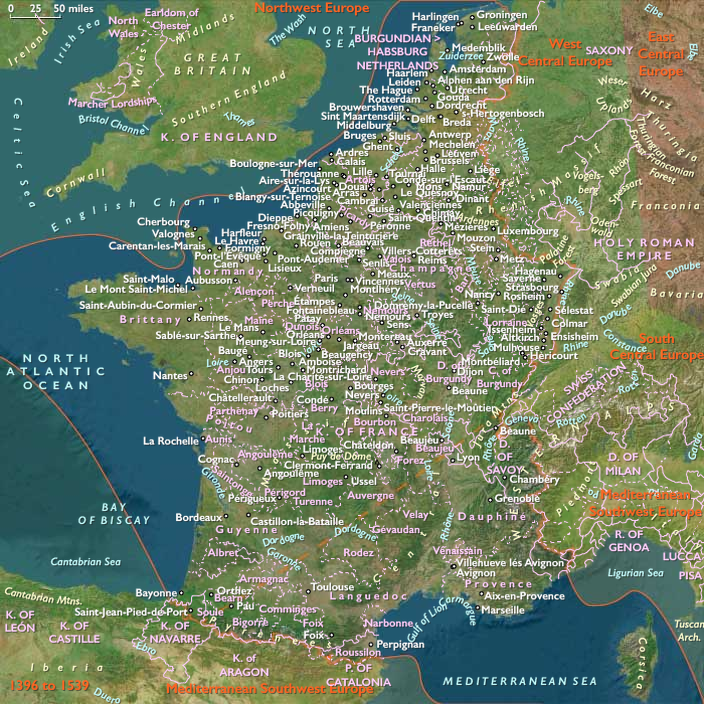
As France was already devastated by the Hundred Years' War (1337–1453) and the conflicts surrounding the Western Schism (1378–1417), a civil war erupted between two rival factions of the French royal family, further weakening the kingdom and inviting English intervention. This conflict, known as the Armagnac-Burgundian Civil War (1407–1435), pitted the House of Orléans (the Armagnacs) against the House of Burgundy, creating internal chaos at a critical moment in France’s history.
I. Origins of the Conflict: The Murder of Louis of Orléans (1407)
- King Charles VI of France suffered from recurring bouts of insanity, rendering him unable to govern effectively.
- This left power in the hands of rival noble factions:
- The Burgundians, led by John the Fearless, Duke of Burgundy, who sought to dominate the French court.
- The Orléanists (later the Armagnacs), led by Louis I, Duke of Orléans, the king’s ambitious younger brother.
- On November 23, 1407, John the Fearless orchestrated the assassination of Louis of Orléans in Paris, triggering open war between the two factions.
II. The Armagnacs vs. The Burgundians
- The Armagnacs, named after Bernard VII, Count of Armagnac, who led the Orléanist faction, were supported by:
- The Dauphin (the future Charles VII).
- Southern and central France.
- Pro-Valois nobles who opposed Burgundian influence.
- The Burgundians, led by John the Fearless, drew support from:
- Northern France, including Paris.
- The powerful Burgundian Netherlands.
- Merchants and factions favoring English alliances.
III. English Involvement and the Treaty of Troyes (1420)
- The conflict further destabilized France, allowing England to expand its conquests.
- In 1419, John the Fearless was assassinated by the Dauphin’s supporters, escalating the war.
- In 1420, the Treaty of Troyes, signed between the Burgundians and the English, disinherited the Dauphin and recognized England’s Henry V as heir to the French throne.
IV. Resolution: The Treaty of Arras (1435)
- The civil war dragged on for years, preventing France from effectively resisting English occupation.
- In 1435, the Burgundians, under Philip the Good, switched sides, signing the Treaty of Arras with Charles VII.
- This allowed France to unite against England, leading to the eventual expulsion of the English from France by 1453.
V. Impact and Legacy
- The Armagnac-Burgundian Civil War (1407–1435) was one of the most destructive internal conflicts in French history, delaying France’s recovery from English invasions.
- It permanently shaped French politics, reinforcing the importance of Burgundian power in European affairs.
- The Burgundian betrayal of the English in 1435 ultimately helped France regain the upper hand in the Hundred Years' War.
This civil war within a war deepened France’s crisis, allowing English expansion, but its resolution in 1435 marked the beginning of France’s resurgence and ultimate victory in the Hundred Years' War.
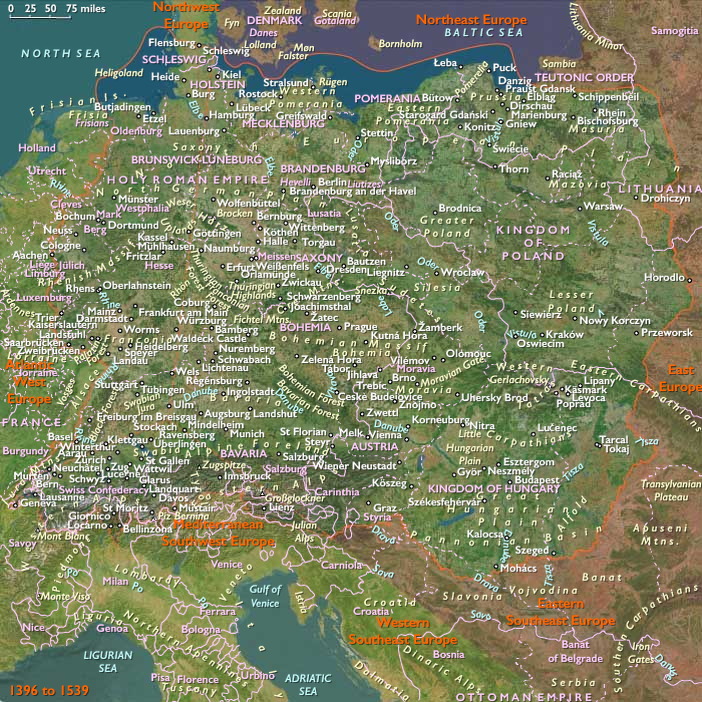
Sigismund of Luxembourg, hereditary elector of Brandenburg and King of Hungary, Croatia, Slavonia and Dalmatia through his 1387 marriage to Hungarian princess Maria, responds to the appeal from Constantinople by organizing a major European crusade against the Ottomans, who had taken advantage of the temporary helplessness of Hungary to extend their dominion to the banks of the Danube.
This crusade, preached by Pope Boniface IX, is very popular in Hungary.
More than ninety thousand men respond, gathering at Buda under Sigismund's banner in July 1396, the thousands of noble respondents reinforced by volunteers from nearly every part of Europe, the most important contingent being that of the French led by John, duke of Nevers, son of Philip II, duke of Burgundy.
Reinforced by a flotilla of seventy galleys, nights from France, Burgundy, England, Germany, and the Netherlands set out first to evict the Turks from the Balkans and then to march through Anatolia and Syria to Jerusalem.
The crusade finally reaches and lays siege to Nicopolis, the main Turkish stronghold on the Danube River.
While they wait for the well-stocked, well-fortified town to submit, Bayezid raises the siege of Constantinople and marches north at the head of one hundred and forty thousand men.
On September 25, the Sultan establishes his army on a hill several miles from Nicopolis.
Although Sigismund urges his allies to maintain a defensive position, the sizable French contingent, led by twenty-five-year-old John of Burgundy and the first cousin of King Charles VI of France, launches a brash charge up the hill, scattering the first lines of the Turkish cavalry and infantry and earning himself the nickname ‘John the Fearless.’ The French knights successfully penetrate the Turkish defenses but are ignorant of the standard Ottoman tactic of sacrificing its vanguard, and now confront a second cavalry contingent reinforced by a Serbian army.
By this time, the heavily armored Western knights are too exhausted to fight effectively.
Sigismund, whose sixteen thousand-strong main army had not participated in the initial attack, tries to rescue the knights, but his Wallachian and Transylvanian contingents unexpectedly desert and his Hungarian force is insufficient.
The Turks soon surround and slaughter most of the crusaders and push the remainder back to the Danube.
Thousands of crusaders perish—slain in battle, cut down in flight, or drowned in the Danube.
Although a small portion of the allied army, including Sigismund and other noble leaders, as well as Mircea and his men, escapes by ship, more than ten thousand battle survivors are captured and executed by Bayezid.
Many of their noble leaders are also taken prisoner (and are later ransomed).
The Rise of John the Fearless and the Intensifying Burgundian-Orléanist Rivalry (1404–1407)
Upon his investment as Duke of Burgundy in 1404, John the Fearless immediately entered open conflict with Louis, Duke of Orléans, the younger brother of the increasingly mad King Charles VI. Both men sought to control France in the absence of a stable monarchy, leading to a deepening power struggle that would soon escalate into full-scale civil war.
I. John the Fearless’ Political Strategy and Alliances
- John, Duke of Burgundy, focused on strengthening his power through marriage diplomacy, political alliances, and economic support.
- He arranged a marriage between his daughter Marguerite and Louis, Dauphin of France, while securing Michelle of Valois as the wife of his heir, Philip the Good.
- He actively courted support from the middle class, merchants, tradesmen, and the University of Paris, knowing that the economic and intellectual elite could serve as a counterbalance to noble opposition.
II. Louis of Orléans and His Courtly Maneuvering
- Louis of Orléans, in contrast, worked to win favor within the royal court, particularly through his close relationship with Queen Isabeau of Bavaria.
- Rumors circulated that Louis had become Isabeau’s lover, further deepening the rift between him and John.
- While John sought urban support, Louis relied on royal patronage and courtly influence to consolidate power.
III. The Role of Charles VI’s Other Uncles
- The other uncles of Charles VI had played less active roles in the regency:
- Louis II, Duke of Anjou, was preoccupied with managing the Kingdom of Naples and had little direct influence in Paris.
- John, Duke of Berry, largely acted as a mediator between the factions, rather than taking a firm stance.
IV. The Road to Civil War
- The rivalry between John of Burgundy and Louis of Orléans intensified bit by bit, as both factions sought dominance over the incapacitated French monarchy.
- Their growing struggle soon transformed into open hostilities, culminating in a true civil war between the Armagnacs (Orléanists) and the Burgundians.
The power vacuum left by Charles VI’s insanity created a battleground for political factions, and John the Fearless’ rivalry with Louis of Orléans would soon lead to one of the most violent internal conflicts in French history, shaping the fate of the Valois dynasty.
The St. Elizabeth’s Flood of 1404: A Catastrophic Inundation in Flanders, Zeeland, and Holland
On November 19, 1404, the St. Elizabeth’s Flood (Sint Elisabethsvloed) struck the coastal regions of Flanders, Zeeland, and Holland, causing widespread destruction. Named after St. Elizabeth, whose feast day falls on the same date, the flood devastated newly settled areas, wiping out entire parishes and villages.
I. Background: The 1375 Flood and the Formation of the Zuudzee
- Twenty-nine years earlier, on October 8, 1375, a massive flood had already reshaped the coastline of Flanders and Zeeland.
- This earlier event created the "Zuudzee", a new inland sea that submerged former land areas.
- Over time, settlers had reclaimed parts of the Zuudzee, establishing new parishes and villages.
- However, the 1404 flood destroyed these settlements once again, mirroring the devastation of 1375.
II. Impact of the 1404 Flood
- Newly settled areas in the Zuudzee were obliterated, forcing survivors to abandon resettlement efforts.
- Previously untouched areas, including the small towns of IJzendijke and Hugevliet, were completely engulfed and destroyed.
- In the County of Flanders, all coastal islands in the mouth of the Westerschelde were washed away, permanently altering the region’s coastline and geography.
III. John the Fearless’ Response: The Graaf Jansdijk
- In the aftermath of the calamity, John the Fearless, Duke of Burgundy (Jan zonder Vrees), took action to prevent future floods.
- He ordered the linking of all existing dikes into a single, continuous defensive structure, running north to south along the Flemish coast.
- This engineering effort resulted in the creation of the "Graaf Jansdijk" (Count John’s Dike), which helped shape the modern, straight Belgian coastline.
- The Graaf Jansdijk remains a testament to medieval flood management efforts, marking one of the earliest large-scale flood defense systems in the Low Countries.
IV. Long-Term Consequences
- The 1404 flood reinforced the necessity of large-scale water management, influencing later Dutch and Flemish engineering projects.
- John the Fearless’ initiative laid the groundwork for future dike-building strategies, which would become a hallmark of Dutch and Flemish flood control.
- The loss of land and settlements led to shifts in population and economic hardship, particularly for coastal communities reliant on agriculture and trade.
The St. Elizabeth’s Flood of 1404 was a defining natural disaster in the history of the Low Countries, reshaping the coastline, destroying settlements, and prompting one of the earliest large-scale flood prevention projects under John the Fearless’ rule.
The Duke of Orléans' Ambitions in Italy and the Anglo-French Truce (1405–1407)
By 1405, Louis, Duke of Orléans, sought to expand his influence in Italy, leveraging his marriage to Valentina Visconti, daughter of Gian Galeazzo Visconti, the late Duke of Milan. Holding titles to largely theoretical fiefs in northern Italy, Louis aimed to persuade King Charles VI of France to intervene militarily on his behalf, potentially bringing France into renewed conflict with Italian states.
At the same time, Louis appeared eager to undermine the Anglo-French truce, going so far as to provoke Henry IV of England to a duel. This was a direct challenge to John the Fearless, Duke of Burgundy, whose economic interests in Flanders depended heavily on continued trade with England.
I. Louis of Orléans and His Italian Ambitions
- As son-in-law of Gian Galeazzo Visconti, Louis claimed fiefdoms in Italy, though these were largely hypothetical.
- He wanted French intervention to secure actual territorial power, possibly drawing France into Italian conflicts.
- His ambitions threatened to divert royal resources from the pressing domestic and English conflicts, something John the Fearless strongly opposed.
II. Threatening the Anglo-French Truce
- The truce between France and England, signed at Leulinghen in 1389, had maintained peace for over a decade, stabilizing trade relations.
- Louis' provocations toward Henry IV, including a possible challenge to a duel, threatened to shatter the fragile truce, potentially reigniting the Hundred Years’ War.
- John the Fearless, concerned about the economic well-being of Flanders, which was heavily reliant on English wool imports, could not allow this.
III. John the Fearless' Economic Concerns
- Flemish industry was entirely dependent on imported English wool, making the region extremely vulnerable to an English embargo.
- If the truce collapsed, Flemish merchants and cloth producers would suffer, creating economic instability in Burgundy’s most valuable territories.
- John, therefore, opposed any aggression toward England, as it would jeopardize the prosperity of Flandersand undermine his own political power.
IV. Escalation of the Burgundian-Orléanist Rivalry
- Louis’ reckless policies heightened tensions with John the Fearless, as the two competed for control over France during Charles VI’s mental instability.
- Their rivalry would soon escalate into outright conflict, culminating in the assassination of Louis of Orléans in 1407, ordered by John the Fearless.
V. Consequences and Legacy
- Louis’ foreign policy and provocations toward England further destabilized France, exacerbating internal divisions within the royal court.
- John the Fearless’ opposition to war with England aligned him with merchants and economic elites, strengthening his support among the bourgeoisie of Paris and Flanders.
- The growing feud between Orléans and Burgundy set the stage for the Armagnac-Burgundian Civil War (1407–1435), a conflict that would cripple France for decades.
The Duke of Orléans’ ambitions in Italy and his reckless hostility toward England in 1405–1407 placed France’s fragile peace at risk, prompting John the Fearless to take drastic measures to protect his economic and political interests, ultimately leading to the assassination of Louis and the outbreak of civil war.
John the Fearless and the Struggle for Power at the French Court (1405)
Following the death of his father, Philip the Bold (1404), John the Fearless, Duke of Burgundy, sought to continue Burgundian dominance at the French royal court, taking advantage of the mental instability of King Charles VI. However, his position was challenged by his rival, Louis of Orléans, the king’s younger brother, who was amassing wealth and influence at Burgundy’s expense.
I. John the Fearless: Duke of Burgundy and Count of Flanders
- In 1405, John became Count of Flanders upon the death of his mother, Marguerite of Flanders, making him the most powerful prince in the Low Countries.
- His new title further strengthened his economic base, as Flanders was one of Europe’s wealthiest regions, but he still needed French royal patronage to maintain his influence.
II. The Financial Disadvantage of Burgundy vs. Orléans
- Unlike his father, John struggled to secure the same financial support from the crown.
- Philip the Bold had received 200,000 livres annually from the royal treasury, but John now had to settle for just 37,000 livres, limiting his ability to fund his political ambitions.
- Meanwhile, Louis of Orléans controlled 90% of his income from royal finances, allowing him to:
- Buy lands and fortresses along the eastern borders of France, a region Burgundy viewed as its natural sphere of influence.
- Expand his influence at court, gaining favor from Queen Isabeau of Bavaria and her allies.
III. The Intensifying Burgundian-Orléanist Rivalry
- John, lacking the charisma and fiery reputation of his father, saw his court influence wane, as the king’s largesse favored Orléans instead.
- With tensions rising, John began seeking alternative ways to reclaim dominance, leading him toward increasingly aggressive tactics.
- This financial and territorial struggle set the stage for open hostilities, culminating in the assassination of Louis of Orléans in 1407, orchestrated by John himself.
IV. Consequences and the Road to Civil War
- The rivalry between Burgundy and Orléans soon escalated into full-scale civil war between the Armagnacs (Orléanist faction) and Burgundians, plunging France into decades of internal strife.
- With John’s control over the royal court weakening, he resorted to direct action, which would ultimately destabilize the entire French monarchy during the ongoing Hundred Years’ War.
By 1405, John the Fearless found himself politically and financially outmaneuvered by Louis of Orléans, forcing him to abandon diplomacy in favor of ruthless power struggles, leading to one of the most destructive civil wars in French history.
The Assassination of Louis of Orléans and the Outbreak of the Armagnac-Burgundian Civil War (1407–1477)
On November 23, 1407, Louis, Duke of Orléans, was brutally assassinated in the streets of Paris, a murder orchestrated by his rival, John the Fearless, Duke of Burgundy. This political killing triggered a civil war between the House of Orléans (later the Armagnacs) and the House of Burgundy, a conflict that would destabilize France for decades and only conclude with the death of John’s grandson, Charles the Bold, in 1477.
I. The Rivalry Between John the Fearless and Louis of Orléans
- The power struggle between John the Fearless and Louis of Orléans escalated as both men vied for control over the French government, taking advantage of King Charles VI’s recurring bouts of insanity.
- After a series of kidnappings and recoveries of the Dauphin, John managed to have himself officially appointed as guardian of the king’s children, further straining relations with Louis.
- The two rivals soon exchanged open threats, as John’s influence over the royal court grew, particularly in Paris, where he had secured the loyalty of the University and the merchants.
II. The Assassination of Louis of Orléans (November 23, 1407)
- On the night of November 23, 1407, Louis of Orléans was attacked by fifteen men on the Rue Vieille du Temple in Paris.
- His arms were literally severed, leaving him defenseless before being killed.
- No one doubted that the order had come from John the Fearless, who boldly took responsibility for the murder.
III. Justification and Political Gain for Burgundy
- Rather than concealing his crime, John publicly justified the assassination.
- He secured the support of the Parisian population and the University of Paris, promising to reintroduce ordinances similar to the Great Ordinance of 1357, which had previously limited royal power in favor of noble and urban governance.
- John commissioned the Sorbonne theologian Jean Petit to write an elegy in praise of tyrannicide, effectively framing the assassination as a righteous act against an alleged "tyrant."
IV. The Outbreak of the Armagnac-Burgundian Civil War (1407–1435)
- The murder of Louis of Orléans plunged France into a bloody civil war between:
- The Burgundians, led by John the Fearless, supported by Parisian merchants and scholars.
- The Orléanists, later known as the Armagnacs, led by Charles, Duke of Orléans (Louis’ son) and supported by the Valois royal family and southern nobility.
- After escaping Paris and engaging in several skirmishes, John was able to reconcile with King Charles VI, but the rivalry between Burgundy and the French royal family deepened.
V. The Long-Term Consequences: Seventy Years of Division
- The Armagnac-Burgundian conflict weakened France, allowing English forces to expand their control during the Hundred Years’ War.
- The feud did not fully end until 1477, with the death of John’s grandson, Charles the Bold, Duke of Burgundy, and the absorption of most of Burgundy’s territories into the French Crown.
The assassination of Louis of Orléans in 1407 was the catalyst for a civil war that divided France for seven decades, shaping French politics and the Hundred Years' War, and ultimately leading to the downfall of the independent Duchy of Burgundy in 1477.
Bernard, Count of Armagnac and the Rise of the Armagnac Faction (1407–1418)
Bernard VII, Count of Armagnac (1360–1418), a Gascon magnate, first gained influence at the French courtthrough his family’s ties to the House of Visconti in Milan. His sister, Béatrice d'Armagnac, married Carlo Visconti, while Louis, Duke of Orléans, married Valentina Visconti, creating a strong political alliance between the Armagnacs and the Orléanists.
After Louis of Orléans was assassinated in 1407 on the orders of John the Fearless, Duke of Burgundy, Bernard became the leader of the anti-Burgundian faction, which soon became known as the Armagnacs.
I. The Assassination of Louis of Orléans and the Formation of the Armagnac Party
- In 1407, John the Fearless had Louis of Orléans murdered, triggering open conflict between Burgundians and Orléanists.
- As a key Orléanist supporter, Bernard assumed leadership of the faction, which began rallying opposition against the Burgundians.
- Over time, the anti-Burgundian coalition became known as the "Armagnacs," named after Bernard’s dominant role in leading the movement.
II. The Armagnacs vs. the Burgundians: Civil War in France
- The rivalry escalated into a full-scale civil war (1407–1435) between:
- The Armagnacs, led by Bernard VII and later by Charles d'Orléans and the Dauphin (future Charles VII).
- The Burgundians, led by John the Fearless and later Philip the Good, supported by Parisian merchants and later allied with the English.
- In 1410, Bernard married his daughter Bonne d'Armagnac to Charles, Duke of Orléans, further strengthening his ties to the Orléanist cause.
III. Bernard’s Leadership and Influence in France
- By 1413, Bernard had secured control of the French government as Constable of France, effectively ruling in the name of the Dauphin (future Charles VII).
- His rule was marked by brutal repression of Burgundian supporters, particularly after the Cabochien Revolt in Paris (1413).
- His leadership ended tragically in 1418, when the Burgundians stormed Paris, massacred Armagnac supporters, and executed Bernard.
IV. Long-Term Impact and Legacy
- Bernard’s leadership cemented the lasting division between the Armagnacs and Burgundians, a rift that destabilized France for decades.
- His violent feud with the Burgundians allowed England to exploit France’s internal chaos, culminating in the Treaty of Troyes (1420), which nearly disinherited the Valois dynasty.
- Even after Bernard’s death, the Armagnac faction remained a powerful force, ultimately leading the resistance against English rule under Charles VII and Joan of Arc.
The rise of Bernard, Count of Armagnac, as leader of the anti-Burgundian faction (1407–1418) was a defining moment in French history, as his conflict with Burgundy fueled civil war and weakened France during the Hundred Years' War.