John VI of Portugal
King of the United Kingdom of Portugal, Brazil, and the Algarves; later King of Portugal and the Algarves
Years: 1767 - 1826
John VI (Portuguese: Dom João VI; 13 May 1767 – 10 March 1826) is King of the United Kingdom of Portugal, Brazil and the Algarves from 1816 to 1822, and, although de facto the United Kingdom over which he rules ceases to exist, he remains so de jure from 1822 to 1825; after the recognition of Brazilian independence under the 1825 Treaty of Rio de Janeiro, he continueds as King of Portugal and the Algarves until his death in 1826.
Under the said Treaty he also remains Titular Emperor of Brazil, while his son, Emperor Pedro I, is both de facto and de jure the monarch of the newly independent country.
Born in Lisbon in 1767, the son of Peter III of Portugal, and Queen Maria I, his full name is João Maria José Francisco Xavier de Paula Luís António Domingos Rafael.
Originally an infante (prince not heir to the throne) of Portugal, he becomes heir to the throne only when his older brother José, Prince of Brazil dies in 1788 of smallpox at the age of 27.
Before his accession to the Portuguese throne, John VI bears the titles of Duke of Braganza and Duke of Beja, as well as the title of Prince of Brazil.
He serves, from 1799, as Prince Regent of Portugal (and later, from 1815, as Prince Regent of the United Kingdom of Portugal, Brazil and the Algarves), due to the mental illness of his mother, the Queen.
Eventually, he succeeds his mother as monarch of the Portuguese Empire, with no real change in his authority, since, as Regent, he already possesses absolute powers.
One of the last representatives of absolutism, he lives during a turbulent period; his reign never sees a lasting peace.
Throughout his period as regent and later king, such major powers as Spain, France and Great Britain (from 1801, the United Kingdom) continually intervene in Portuguese affairs.
Forced to flee to Brazil when Napoleon's troops invade Portugal, he finds himself faced there with liberal revolts that reflect similar events in the metropolis; he is compelled to return to Europe amid new conflicts.
His marriage is no less conflict-ridden, as his wife, Carlota Joaquina of Spain, repeatedly conspires against her husband in favor of personal interests or those of her native Spain.
He loses Brazil when his son Pedro declares independence, and his other son Miguel (later Miguel I of Portugal) leads a rebellion that seeks to depose him.
According to recent research, his death may have been caused by arsenic poisoning.
Notwithstanding these tribulations, he leaves a lasting mark, especially in Brazil, creating numerous institutions and services that lay a foundation for national autonomy, and is considered by many researchers the true mastermind of the modern Brazilian state.
Still, he has been widely (if unjustly) viewed as a cartoonish figure in Luso-Brazilian history, being accused of laziness, lack of political acumen and constant indecision, and often portrayed as physically grotesque.
Related Events
Filter results
Showing 10 events out of 50 total
The Portuguese Inquisition and the Expansion of Portugal’s Global Influence Under John III (1536–1821)
During the reign of King John III of Portugal (r. 1521–1557), Portugal stood as one of the great European powers, alongside England, France, and Spain, wielding economic, political, and cultural influence through its expanding global empire.
While Portugal was not the dominant power in European affairs, it had established itself as a thalassocracy, controlling key maritime trade routes and colonies in Asia, Africa, and the Americas. Under John III, two major institutions—the Jesuits and the Portuguese Inquisition—were instrumental in consolidating Portuguese influence both at home and overseas.
John III and the Evangelization of the Portuguese Empire
- Nicknamed "o Piedoso" ("the Pious"), John III was deeply committed to spreading Catholicism throughout the Portuguese Empire.
- He supported Jesuit missions in the Far East (India, Japan, China) and Brazil, making Catholic evangelization a central part of Portuguese imperial policy.
- His brother, Cardinal Henry, played a key role in bringing the Jesuits to Portugal, ensuring their involvement in both education and missionary work.
The Portuguese Inquisition (1536–1821): A Tool of Religious and Social Control
- The Portuguese Inquisition was formally established in 1536, following John III’s petition to Pope Paul III.
- However, its roots date back to 1497, when Portugal expelled or forcibly converted Sephardic Jews, many of whom had previously fled Spain’s 1492 expulsion under the Alhambra Decree.
Structure and Leadership
- The Inquisition was overseen by the king, but operated under the authority of a Grand Inquisitor (Inquisidor-Geral), nominated by the Pope but personally chosen by the king.
- The first Grand Inquisitor of Portugal was Cardinal Henry, John III’s brother.
- There were four main Inquisitorial Courts in Portugal:
- Lisbon ...
Atlantic Southwest Europe (1684–1827 CE): Port Cities, Iberian Shifts, and the Atlantic Grain–Wine Trade
Geography & Environmental Context
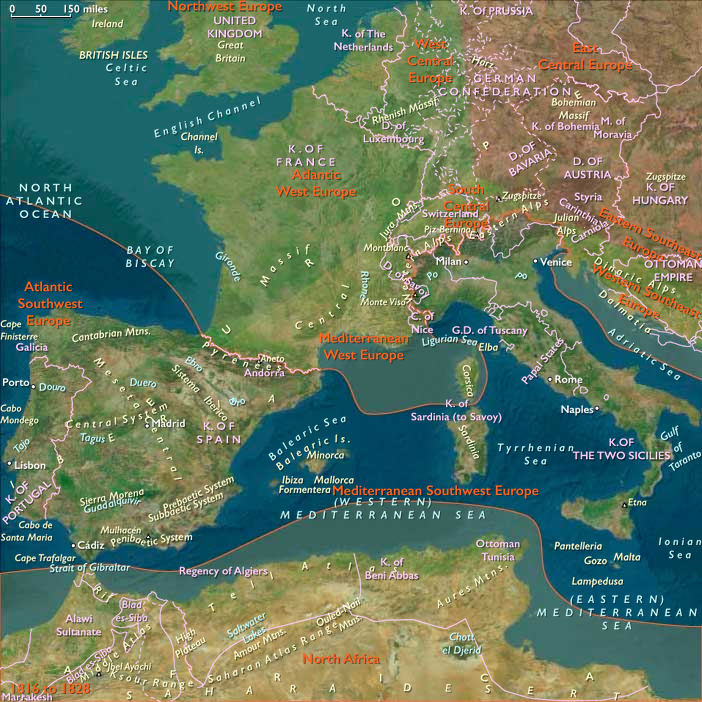
Atlantic Southwest Europe encompasses northern Spain (Galicia, Asturias, Cantabria, and León) and central to northern Portugal, including Lisbon. Anchors include the Galician Rías (Ría de Vigo, A Coruña), the Cantabrian Coast, the Minho and Douro valleys, the Tagus estuary at Lisbon, and the rugged mountains of León and northern Portugal. This is a region of Atlantic-facing coasts, fertile river basins, and upland pastures, with maritime corridors tying Iberia to the broader Atlantic world.
Climate & Environmental Shifts
The tail of the Little Ice Age brought heavy rains and cooler winters. Coastal Asturias and Galicia endured storm surges and erratic fishing seasons. In Portugal, alternating droughts and floods affected the Tagus and Douro, stressing vineyards and grain harvests. The Tambora eruption (1815) caused harvest failures and famines in 1816–1817, driving food shortages and migration. Despite shocks, the region remained buffered by mixed farming and Atlantic fisheries.
Subsistence & Settlement
-
Agriculture: Grain (rye, maize, wheat) dominated northern Spain’s uplands, while vineyards along the Douro Valley produced the famous port wines increasingly exported to Britain. Olive groves and orchards dotted Portugal’s hills.
-
Livestock: Cattle and sheep grazed in León and northern Portugal, supporting cheese and wool exports.
-
Fishing & maritime life: Cod and sardines sustained coasts; Galician fisheries supplied local markets.
-
Urban centers: Lisbon was the linchpin, linking Brazilian sugar, gold, and coffee to Europe; Porto thrived on the wine trade; A Coruña, Santander, Bilbao grew as shipping points for wool, timber, and iron. Rural hamlets persisted in Galicia’s valleys and Portuguese interior, producing subsistence crops and artisanal goods.
Technology & Material Culture
Stone terraces stabilized vineyards in the Douro; irrigation and watermills supported grain processing in León and Galicia. Shipyards along the Tagus and Douro built ocean-going vessels; Portuguese navigational expertise fed the empire. Urban Lisbon rebuilt in grand style after the 1755 earthquake, with wide boulevards and Pombaline architecture. Material culture blended maritime tools, peasant implements, and luxury imports—Brazilian gold funded churches, palaces, and decorative arts.
Movement & Interaction Corridors
-
Transatlantic links: Lisbon was Europe’s primary gateway to Brazil, channeling sugar, gold, diamonds, tobacco, and coffee. The Douro–Porto corridor tied hinterland vineyards to British buyers under the Methuen Treaty (1703), which gave Portuguese wines privileged access to English markets.
-
Spanish Atlantic ports: A Coruña, Bilbao, and Santander shipped wool and iron to northern Europe. Galicia supplied emigrants to the Americas.
-
Inland trade: Mules carried wine, wool, and grain over mountain passes to port cities.
-
War disruptions: During the Peninsular War (1807–1814), French invasions disrupted Portugal and northern Spain, but British naval supremacy kept Lisbon and Porto tied into Atlantic commerce.
Cultural & Symbolic Expressions
-
Religion: Catholicism framed life; pilgrimage routes to Santiago de Compostela remained vital. Monasteries in Galicia and León managed estates and provided poor relief.
-
Urban culture: Lisbon’s intellectual salons and Porto’s mercantile guilds reflected Enlightenment currents; Coimbra University fostered reformist thinkers.
-
Folk traditions: Galician bagpipe (gaita) music, Portuguese fado songs, and rural festivals preserved local identity.
-
Architecture: Baroque churches in Braga, Porto, and Santiago embodied both religious devotion and mercantile prosperity.
Environmental Adaptation & Resilience
-
Diversification: Maize introduction expanded caloric bases in Galicia and Portugal, reducing famine risk.
-
Vineyard specialization: The Douro’s terraced slopes maximized limited arable land, producing high-value exports.
-
Fisheries: Cod and sardine fisheries provided fallback protein during poor harvests.
-
Charitable networks: Monasteries, confraternities, and parish relief assisted during famines and war dislocation.
Transition
From 1684 to 1827, Atlantic Southwest Europe remained both peripheral and central—a rugged agrarian landscape tied to a global empire through Lisbon and Porto. Portuguese fortunes hinged on Brazil until independence (1822), while Porto’s wine trade locked northern Portugal into Britain’s orbit. Northern Spain’s ports grew modestly, sending wool and emigrants to the Atlantic world, while Galicia remained a land of subsistence peasants and pilgrims. Wars, earthquakes, and famines tested resilience, yet the region adapted through maize, wine, fisheries, and Atlantic trade, foreshadowing new realignments in the 19th century as Iberian empires fragmented and Atlantic economies shifted.
Atlantic Southwest Europe (1792–1803): Revolutionary Echoes, Political Upheaval, and Regional Struggles
Between 1792 and 1803, Atlantic Southwest Europe—including northern and central Portugal (Lisbon), Galicia, Asturias, Cantabria, northern León and Castile, northern Navarre, northern Rioja, and the Basque Country—faced dramatic challenges stemming from the French Revolution’s ideological impact, internal political tensions, and shifting international alliances. Revolutionary fervor, growing social unrest, and economic strains reshaped regional dynamics, paving the way for profound political and social transformations in the early nineteenth century.
Political and Military Developments
Influence of Revolutionary France
-
Revolutionary ideas, particularly notions of liberty, equality, and constitutional government emanating from France, spread among intellectual and middle-class circles in Lisbon, Porto, Bilbao, and Valladolid, fueling political debate and demands for reform.
-
Spanish authorities in Galicia, Asturias, and the Basque Country reacted strongly against revolutionary sentiments, intensifying censorship and surveillance while preparing defenses against potential French military incursions.
Portugal’s Political Instability
-
In Portugal, Queen Maria I’s deteriorating mental health after 1792 weakened political stability, creating a power vacuum partly filled by her son, João VI, who governed as regent from 1799.
-
Portuguese authorities grew increasingly wary of French revolutionary influence, tightening censorship, arresting suspected revolutionaries, and aligning closely with Britain to safeguard against French aggression.
Spain: Declining Bourbon Authority
-
Under King Charles IV and his influential minister, Manuel de Godoy, Spain struggled politically and militarily amid growing internal dissatisfaction, particularly pronounced in northern regions that opposed centralizing policies and resented heavy taxation.
-
The Basque Country and northern Navarre, fiercely protective of their fueros, resisted Madrid’s increased demands, asserting regional autonomy and exacerbating tensions between central and regional authorities.
Economic Developments: Maritime Struggles and Fiscal Strain
Trade Disruption and Maritime Challenges
-
Northern Portuguese and Spanish ports—Lisbon, Porto, Bilbao, Santander, and Vigo—suffered trade disruptions due to the Napoleonic Wars (beginning in 1799), naval blockades, and increased piracy, resulting in significant economic hardship.
-
The region’s merchant classes, particularly in Porto and Bilbao, faced declining profitability from disrupted trade with Britain, France, and overseas colonies, compounding local economic struggles.
Inflation and Financial Hardship
-
Inflation, driven by wartime disruptions and fiscal mismanagement, severely impacted local economies in Galicia, Asturias, and northern Castile and León, exacerbating rural poverty and fueling migration to urban areas.
-
Heavy taxation imposed by Madrid and Lisbon to finance military preparedness heightened social tensions, prompting protests and occasional riots in urban areas, notably Bilbao, Lisbon, and Porto.
Religious and Cultural Developments
Continued Catholic Dominance amid Revolutionary Ideas
-
The Catholic Church maintained significant influence in northern Spain and Portugal, reinforcing orthodox beliefs and actively opposing revolutionary secularism, using pulpits and educational institutions to preach against French revolutionary ideals.
-
Church authorities strengthened their alliance with political power, emphasizing loyalty to the monarchy and condemning revolutionary sympathizers, thus deepening societal divisions.
Enlightenment Intellectual Tensions
-
Despite official opposition, intellectual elites in Lisbon, Porto, Valladolid, and Bilbao secretly embraced Enlightenment thought and revolutionary principles, advocating constitutional reforms, representative government, and liberal economic ideas.
-
Universities, particularly Coimbra in Portugal and Valladolid in Spain, became clandestine centers for intellectual debate and reformist ideas, influencing younger generations toward liberalism.
Social and Urban Developments
Social Unrest and Urban Tensions
-
Urban centers like Lisbon, Porto, Bilbao, and Santander experienced growing unrest driven by economic hardship, rising unemployment, and opposition to heavy taxation, reflecting broader discontent with monarchical governance and social inequality.
-
Rising revolutionary sentiments led authorities to increase repression, censorship, and surveillance in urban areas, exacerbating political tensions and alienating middle-class reformers and intellectuals.
Rural Strain and Demographic Pressures
-
Galicia, Asturias, northern León, and Castile faced worsening rural economic conditions due to declining agricultural productivity, forcing significant migration to urban areas or overseas, particularly to the Americas.
-
Rural discontent contributed indirectly to urban instability, as migrants sought relief in crowded cities ill-equipped to manage increased populations, heightening urban poverty and social stress.
Legacy and Significance
The period from 1792 to 1803 profoundly altered Atlantic Southwest Europe's political, economic, and social landscape. Revolutionary ideas from France intensified internal debates and fueled demands for reform, setting the stage for future liberal movements. Economic hardships, coupled with political repression, deepened regional discontent, particularly in Portugal and northern Spain. Heightened tensions between centralized authority and regional autonomy laid groundwork for significant political upheavals, including forthcoming invasions and revolutions that would fundamentally reshape the region throughout the nineteenth century.
Portugal and the French Revolutionary Wars (1792–1794)
The French Revolution and the execution of Louis XVI in 1793 sent shockwaves throughout monarchical Europe. The Terror and the rise of radical republicanism made kings and queens across the continent fear for their own thrones, prompting many to take strong measures against revolutionary propaganda.
Maria I’s Decline and João’s Rise to Power (1792)
Queen Maria I of Portugal, already suffering from mental instability, became increasingly plagued by nightmares and fits of melancholy, convinced that she was damned. Her condition deteriorated significantly, and in 1792, she formally relinquished power to her second son, João, Prince of Brazil.
Though Maria I remained queen in name, João effectively assumed control of the government, marking the beginning of his de facto reign, which would later become official as King João VI.
Portugal Joins the War Against Revolutionary France (1793)
As revolutionary France became more aggressive, Portugal aligned itself with Britain and Spain, signing mutual assistance treaties in 1793. The three monarchies hoped to contain the spread of revolutionary ideas and suppress the French Republic before it could destabilize their own regimes.
- In 1793, a Spanish army, reinforced by 6,000 Portuguese troops, invaded France across the Basque frontier, aiming to overthrow the revolutionary government.
- The campaign initially saw some successes, as Spanish and Portuguese forces pushed into French territory.
The French Counterattack and the Retreat to Spain (1794)
However, by 1794, the French army had reorganized, and under the leadership of energetic revolutionary generals, they launched a major counteroffensive:
- The Spanish-Portuguese forces were driven out of French territory.
- The French advanced southward, crossing into Spain and reaching the Ebro River, a critical line of defense.
- With the French now threatening Madrid, the Spanish-Portuguese alliance found itself on the defensive.
A Precarious Situation for Portugal
Portugal, though a secondary participant in the war, now faced a dangerous reality:
- The French military successes made it clear that Portugal was vulnerable to invasion.
- Its strong alliance with Britain made it a target for French revolutionary forces, who saw Britain as their main enemy.
- The fall of Spain could leave Portugal exposed to a direct French invasion from the north.
As the French Revolution escalated into a European-wide conflict, Portugal's future remained uncertain, and the country would soon be forced to navigate an increasingly volatile political landscape.
The War of the Oranges (1801) – Portugal Caught Between France and Spain
After years of fighting alongside Portugal against Revolutionary France, Spain abruptly changed sides, making a separate peace with France at Basel in 1795 without consulting Portugal. This betrayal marked a major shift in Iberian geopolitics, leaving Portugal increasingly isolated.
By 1800, Spain went even further, signing the secret Treaty of San Ildefonso with France, becoming a full ally of Napoleon. This alliance threatened Portugal’s survival, as France and Spain now viewed it as a British satellite that needed to be neutralized.
The Ultimatum – Franco-Spanish Demands on Portugal (1801)
In February 1801, France and Spain delivered an ultimatum to Prince Regent João (acting on behalf of his mother, Maria I, who was now fully incapacitated by mental illness), demanding that Portugal:
- Abandon its alliance with Britain.
- Close all its ports to British ships and open them exclusively to French and Spanish vessels.
- Hand over one-quarter of Portuguese territory as a guarantee for Spanish territories occupied by Britain.
This ultimatum was effectively a death sentence for Portugal’s sovereignty. João refused to comply, knowing that Portugal’s entire economic survival depended on British trade.
The War of the Oranges – Spain Invades (May 1801)
In May 1801, Spain, with French support, invaded Portugal from the east, launching what became known as the War of the Oranges—so called because Spanish Prime Minister Manuel de Godoy allegedly sent a basket of oranges to Queen Maria Luisa as a token of his victory.
- The Spanish army crossed into the Alentejo, capturing towns including Olivença.
- The Portuguese army, outnumbered and poorly equipped, offered resistance but was quickly overwhelmed.
- After just two weeks of fighting, Portugal was forced to negotiate peace.
The Treaty of Badajoz (June 1801) – Portugal’s Concessions
The war ended with the Treaty of Badajoz on June 6, 1801, in which Portugal was forced to make humiliating concessions:
- Portugal had to close its ports to British ships.
- Commercial privileges were granted to France.
- A large war indemnity was paid to Spain and France.
- Portugal ceded the town of Olivença and its surrounding territory to Spain, marking the only permanent territorial loss in modern Portuguese history.
A Short-Term Peace, A Long-Term Crisis
While the Treaty of Badajoz ended hostilities, it was only a temporary reprieve:
- Portugal had not fully complied with Napoleon’s demands, as it still maintained covert ties with Britain.
- The ceding of Olivença was deeply unpopular in Portugal, and the loss of the territory would remain a source of tension with Spain for centuries.
- The Napoleonic threat did not go away—just a few years later, in 1807, Napoleon would invade Portugal directly, forcing the Portuguese royal family to flee to Brazil.
The War of the Oranges demonstrated Portugal’s vulnerability but also its determination to resist total submission to Napoleonic France. However, greater challenges lay ahead, as the Napoleonic Wars would soon engulf Portugal in full-scale conflict.
Based on the terms of the accord, the Kingdom of Portugal agrees to cede Olivença (along with paying an indemnity to Spain).
Moreover, Portugal is required to close all ports to the British.
On a sidenote, Prince John is forced to sign the accord as a result of the Spanish army (along with a French auxiliary corps) having been dispatched across the Portuguese frontier.
The Franco-Spanish Invasion of Portugal and the Flight of the Royal Family (1807)
With Napoleon crowned Emperor in 1804, his war against Britain resumed with renewed intensity. Britain responded by declaring a naval blockade of France, aiming to cripple French trade and economy. In retaliation, Napoleon ordered all European nations to sever ties with Britain, seeking to isolate it economically.
Portugal’s Neutrality and Napoleon’s Ultimatum
- Portugal, historically allied with Britain, attempted to remain neutral, balancing between French demands and British pressure.
- Napoleon ordered Portugal to close its ports to British ships, but the Portuguese government sought a way to comply without severing ties with its oldest ally.
- This compromise position angered Napoleon, who decided that Portugal must be invaded and partitioned.
The Treaty of Fontainebleau (October 1807) – The Plan to Divide Portugal
In October 1807, Napoleon signed a secret treaty with Spain at Fontainebleau, laying out a plan to invade and partition Portugal:
- One-third of Portugal would go to France.
- One-third would be annexed to Spain.
- One-third would be given to Manuel de Godoy, Spain’s chief minister, as a personal reward for his loyalty to Napoleon.
This agreement cemented Spain’s role as a French ally in the coming invasion.
The Franco-Spanish Invasion (November 1807)
- On November 17, 1807, a Franco-Spanish army under General Andoche Junot crossed the Portuguese border and marched on Lisbon.
- The British, unable to defend their ally, could do little to prevent the fall of Portugal.
- With Lisbon defenseless, Prince Regent João (the future King João VI) and the Portuguese royal family decided to flee to Brazil, ensuring the continuity of the Portuguese monarchy overseas.
- On November 27, 1807, Junot’s army entered Lisbon and took control, marking the first French occupation of Portugal.
The Portuguese Monarchy in Exile – A Unique Response
The flight of the Portuguese royal family to Brazil was unprecedented in European history. Unlike other monarchs who had been toppled by Napoleon, the Portuguese rulers retained their sovereignty by relocating their government to Rio de Janeiro.
This decision not only preserved the Portuguese Empire but also led to the eventual transformation of Brazil into an independent kingdom, shaping the country’s future.
Consequences – The Napoleonic Wars Arrive in Iberia
The occupation of Portugal marked the beginning of the Peninsular War (1807–1814), one of the most brutal and complex conflicts of the Napoleonic Wars. Within months, Napoleon would turn on Spain as well, leading to open rebellion and British intervention, changing the course of the war in Western Europe.
Napoleon believed Portugal had been subdued, but in reality, the war was just beginning.
The Second French Invasion of Portugal (March–May 1809) and Wellington’s Counteroffensive
In March 1809, Marshal Nicolas Soult led a renewed French invasion of Portugal, advancing from Galicia in the north. This marked Napoleon’s second attempt to subjugate Portugal, following the failed occupation of 1807–1808.
The French Advance – Soult Captures Porto
- Soult’s army crossed into Portugal from Galicia, quickly occupying Chaves.
- The French then advanced toward Porto, Portugal’s second-largest city.
- On March 29, 1809, Soult captured Porto, forcing a chaotic Portuguese retreat across the Douro River.
Wellington Returns – The British-Portuguese Counteroffensive
- In April 1809, Sir Arthur Wellesley (later Duke of Wellington) arrived in Portugal to take full command of the British-Portuguese forces.
- Recognizing that Soult’s army was vulnerable, Wellington launched a rapid counteroffensive, forcing the French to retreat northward.
- By May 12, 1809, Wellington executed a brilliant crossing of the Douro River, retaking Porto and sending Soult into full retreat.
- The French, cut off from their supply lines, abandoned much of their artillery and baggage as they fled back into Galicia.
Victory at Talavera and Wellington’s Rise (July 27–28, 1809)
- After driving Soult out of Portugal, Wellington turned his attention to Spanish territory, joining forces with the Spanish army.
- On July 27–28, 1809, the British and Spanish armies defeated Marshal Victor’s French forces at the Battle of Talavera in central Spain.
- Despite suffering heavy casualties, this victory marked Wellington’s first major battlefield success in Spain, solidifying his reputation as the leading Allied general in the Peninsular War.
- In recognition of his achievements, Wellesley was elevated to the rank of Duke of Wellington.
Conclusion – The French Are Driven from Portugal Again
The successful defense of Portugal in 1809 marked a turning point in the Peninsular War:
- Portugal remained secure under British and Portuguese control, despite repeated French invasions.
- The Anglo-Portuguese army was now a disciplined and effective force, ready to support the Spanish resistance.
- Wellington emerged as the dominant Allied commander, setting the stage for future victories against Napoleon’s forces in the Iberian Peninsula.
This campaign reaffirmed Portugal’s resilience and Britain’s commitment to defeating Napoleon in Iberia, leading toward the final liberation of Spain and Portugal in 1813–1814.
Portuguese Rebellion and the Liberation from French Occupation (1808–1809)
The French occupation of Portugal, imposed after Junot’s invasion in 1807, soon sparked widespread rebellion among the Portuguese population. Local provisional juntas were organized in several cities, leading to an armed resistance movement supported by the British.
The Porto Junta and the Organization of Resistance
- The junta in Porto became the leading authority among the various Portuguese resistance groups, with other local juntas pledging allegiance to it.
- With British support, the Porto junta began to assemble an army, preparing to challenge French rule.
Victory at Lourinhã and the Convention of Sintra (August 1808)
- On August 21, 1808, Portuguese and British forces decisively defeated a strong French force at Lourinhã.
- This defeat forced the French to negotiate, leading to the Convention of Sintra, signed in August 1808.
- The treaty provided for the complete evacuation of French forces under General Andoche Junot from Portugal.
- The Portuguese juntas assumed control of the government, restoring local governance in place of French rule.
Reorganizing the Portuguese Army – Beresford’s Appointment (January 1809)
- With Portugal liberated from the first French occupation, the country needed a strong military force to prevent further invasions.
- In January 1809, the prince regent João VI, still governing from Brazil, appointed British officer William Carr Beresford as marshal and commander-in-chief of the Portuguese army.
- Beresford undertook extensive military reforms, transforming the undisciplined and weakened Portuguese forces into an effective fighting force, which would later play a crucial role in defeating Napoleon’s armies in Iberia.
Conclusion – Portugal Resists French Domination
The rebellions against French rule, the victory at Lourinhã, and the intervention of British forces ensured that Portugal remained free of direct French control. However, the war was far from over, and Portugal would soon face another invasion by Napoleon’s armies in 1809, prompting further British and Portuguese military collaboration to defend the nation.
The invasion of the Iberian Peninsula in 1807-08 by Napoleon's forces proves critical to the independence struggle in South America.
The overthrow of the Bourbon Dynasty and the placement of Joseph Bonaparte on the Spanish throne tests the loyalty of the local elites in Upper Peru, who are suddenly confronted with several conflicting authorities.
Most remain loyal to Spain.
Taking a wait-and-see attitude, they suppor the Junta Central (Central Junta) in Spain, a government in the name of the abdicated Ferdinand VII.
Some liberals eagerly welcome the reforms of colonial rule promised by Joseph Bonaparte.
Others support the claims of Carlota, Ferdinand's sister, who governs Brazil with her husband, Prince Regent John of Portugal.
Finally, a number of radical criollos want independence for Upper Peru.
This conflict of authority results in a local power struggle in Upper Peru between 1808 and 1810 and constitutes the first phase of the efforts to achieve independence.
In 1808 the president of the audiencia, Ramon Garcia Leon de Pizarro, demands affiliation with the Junta Central.
The conservative judges of the audiencia are influenced, however, by their autocratic royalist philosophy and refuse to recognize the authority of the junta because they see it as a product of a popular rebellion.
Tensions grow when radical criollos, also refusing to recognize the junta because they want independence, take to the streets on May 25, 1809.
This revolt, one of the first in Latin America, is soon put down by the authorities.