
Julia Domna
Empress of Rome
170 CE to 217 CE
Julia Domna (170–217) is a member of the Severan dynasty of the Roman Empire.
Empress and wife of Roman Emperor Lucius Septimius Severus and mother of Emperors Geta and Caracalla, Julia is among the most important women ever to exercise power behind the throne in the Roman Empire.
World
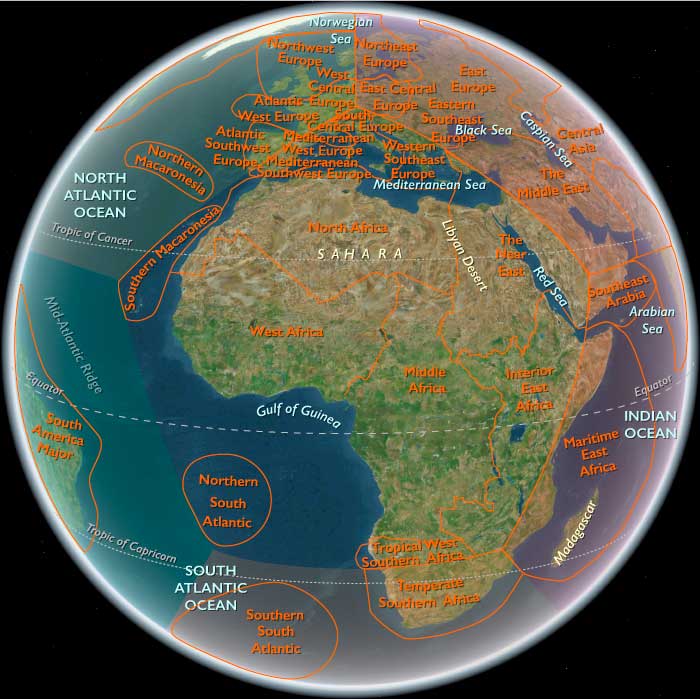
The Middle of The Earth
View →Related Events
Showing 6 events out of 6 total
Severus had fallen heavily under the influence of his Praetorian Prefect, Gaius Fulvius Plautianus, who after 197, according to Cassius Dio, comes to have almost total control of most branches of the imperial administration.
Plautianus's daughter, Publia Fulvia Plautilla, had been married in 202 to Severus's son, Caracalla.
Plautianus has become so powerful that Roman Empress Julia Domna and Caracalla have begun to be concerned.
The marriage between Caracalla and Fulvia Plautilla is not a happy one.
In fact, Caracalla loathes both her and her father, threatening to kill them after becoming sole emperor.
When Plautianus discovers this, he begins to plot to overthrow Severus' family.
His excessive power comes to an end on January 22, 205, after the emperor’s dying elder brother, Publius Septimius Geta, states to Severus that he hates Plautianus and warns him of Plautianus' treachery.
The imperial family summons him to the palace and orders his death.
After his death, Plautianus’ property is confiscated, his son of the same name, daughter and granddaughter are exiled to Sicily and then later to Lipari and his name is erased from public monuments.
Seven years later, his son, daughter and granddaughter will be strangled on Caracalla's orders.
However, the two following praefecti, including the jurist Aemilius Papinianus, will receive even larger powers.
Caracalla, of mixed Punic–Roman–Berber and Syrian descent, was born Lucius Septimius Bassianus in Lugdunum, Gaul (now Lyon, France), the son of the later Emperor Septimius Severus and Julia Domna.
At the age of seven, his name had been changed to Marcus Aurelius Septimius Bassianus Antoninus to create a connection to the family of the philosopher emperor Marcus Aurelius.
He will later be known by the nickname Caracalla, which refers to the Gallic hooded tunic he habitually wears and which he makes fashionable.
Geta, the younger son of Septimius Severus by his second wife Julia Domna, was born in Rome, at a time when his father was only a provincial governor at the service of Emperor Commodus.
Geta has always been always in a place close to his older brother Lucius, the heir later known as Caracalla.
Perhaps due to this, the relations between the two have been difficult from their early years.
Conflicts are constant and often require the mediation of their mother.
To appease his younger son, Septimius Severus gives Geta the title of Augustus in 209.
During the campaign against the Britons of the early third century, the imperial propaganda presents the image of a happy family that shares the responsibilities of rule.
Septimus Severus entrusts his wife Julia Domna as his councilor, his older son as his second in command, and gives administrative and bureaucratic duties to his younger son.
In reality, however, the rivalry and antipathy between the brothers is far from resolved.
The Caledonians are next mentioned in 209, when they are said to have surrendered to Severus after he personally led a military expedition north of Hadrian's Wall, in search of a glorious military victory.
Herodian and Dio wrote only in passing of the campaign but describe the Caledonians ceding territory to Rome as being the result.
Cassius Dio records that the Caledonians inflicted fifty thousand Roman casualties due to attrition and unconventional tactics such as guerrilla warfare.
Dr. Colin Martin has suggested that the Severan campaigns did not seek a battle but instead sought to destroy the fertile agricultural land of eastern Scotland and thereby bring about genocide of the Caledonians through starvation. (British Archaeology, no. 6, July 1995: Features)
According to one story from around this time, when Severus' wife, Julia Domna, criticized the sexual morals of the Caledonian women, the wife of Caledonian chief Argentocoxos replied: "We fulfill the demands of nature in a much better way than do you Roman women; for we consort openly with the best men, whereas you let yourselves be debauched in secret by the vilest".
Cassius Dio's account of the invasion reads
"Severus, accordingly, desiring to subjugate the whole of it, invaded Caledonia.
But as he advanced through the country he experienced countless hardships in cutting down the forests, leveling the heights, filling up the swamps, and bridging the rivers; 2 but he fought no battle and beheld no enemy in battle array.
The enemy purposely put sheep and cattle in front of the soldiers for them to seize, in order that they might be lured on still further until they were worn out; for in fact the water caused great suffering to the Romans, and when they became scattered, they would be attacked.
Then, unable to walk, they would be slain by their own men, in order to avoid capture, so that a full fifty thousand died.
3 But Severus did not desist until he approached the extremity of the island.
Here he observed most accurately the variation of the sun's motion and the length of the days and the nights in summer and winter respectively.
4 Having thus been conveyed through practically the whole of the hostile country (for he actually was conveyed in a covered litter most of the way, on account of his infirmity), he returned to the friendly portion, after he had forced the Britons to come to terms, on the condition that they should abandon a large part of their territory."
Caracalla and Geta, proclaimed joint emperors when Septimius Severus dies in Eboracum (now York) in the beginning of 211, return to Rome.
As both brothers want to be sole ruler, relations between them become increasingly hostile.
When they try to rule the Empire jointly they actually consider dividing it in halves, but are persuaded not to do so by their mother.
The shared throne is not a success: the brothers argue about every decision, from law to political appointments.
Later sources speculate about the desire of the two of splitting the empire in two halves.
By the end of the year, the situation is unbearable.
Caracalla tries to murder Geta during the festival of Saturnalia without success.
Later in December, he arranges a meeting of reconciliation with his brother in his mother's apartments, and has him murdered in her arms by by members of the Praetorian Guard loyal to him.
Following Geta's assassination, Caracalla orders a damnatio memoriae pronounced by the Senate against his brother's memory, his name to be removed from all inscriptions and his images erased.
Geta's image is simply removed from all coinage, paintings and statues, leaving a blank space next to Caracalla's.
The now sole emperor also takes the opportunity to get rid of his political enemies, on the grounds of conspiracy with the deceased.
Cassius Dio states that around twenty thousand persons of both sexes were killed or proscribed during this time.
Among those killed are Caracalla's ex-wife, Fulvia Plautilla, and her brother and other members of the family of his former father-in-law Gaius Fulvius Plautianus.
Plautianus had already been executed for alleged treachery against emperor Severus in 205 and succeeded by Aemilius Papinianus as Prefect Commander of the Praetorian Guard.
Little is known about Papinianus, who was perhaps of Syrian birth and a native of Emesa, for he is said to have been a kinsman of Septimius Severus' second wife, Julia Domna.
One source shows him as a follower of the casuistry of Quintus Cervidius Scaevola, another shows him to have been his pupil.
A concurring (but dubious) passage in the Augustan History claims that he studied law with Severus under Scaevola.
An intimate friend of the emperor Severus, Papinianus had accompanied him to Britain during 207,where he served in "the forum of York" in response to an uprising by Scottish Highlanders.
He was at some time made a master of petitions (requests), magister libellorum, by Severus.
He also served as Treasurer and Captain of the Guard for the Emperor.
Before the emperors' death, he had commended his two sons Caracalla and Geta into the lawyers' charge.
Sharing in the governship of the Roman Empire with Geta proves unsatisfactory for Caracalla, who decides at sometime to usurp his brother.
Papinian’s efforts at keeping peace between the brothers only proves to encourage the hatred of Caracalla, who consequently passes an order to have the lawyer beheaded (Spart.
Caracall.
4), and his body dragged through the streets of Rome.
His death follows the fratricide of Geta, among the general slaughter of his friends and those perceived associated with him.
The author of the 1911 Encyclopædia Britannica article though states that the details of Papinianus' death "are variously related, and have undergone legendary embellishment."
Much of his output has been lost, as what we have is small compared to other jurists such as Ulpian or Paul.
The principal works of Papinianus include: Quaestiones in thirty-seven books (written before 198); nineteen books of Responsa (written sometime between 204 and his death); two books of Definitiones; two books De adulteriis, and other works, the shortest of these being a manual on the duties for commissioner's of streets and bridges.
Papinianus will become one of the most revered of Roman Jurists by the Romans, as third year law students were given the title "Papinianistae" ("they that are worthy to study Papinian").
The Alemanni are first mentioned by Cassius Dio describing the campaign of Emperor Antoninus in 213.
At this time they apparently dwell in the basin of the Main, to the south of the Chatti.
Cassius Dio (78.13.4) portrays the Alemanni as victims of this treacherous emperor.
They had asked for his help, says Dio, but instead he colonized their country, changed their place names and executed their warriors under a pretext of coming to their aid.
When he became ill, the Alemanni claimed to have put a hex on him (78.15.2).
The emperor, it was claimed, tried to counter this influence by invoking his ancestral spirits.
In retribution, Antoninus leads the Legio II Traiana Fortis against the Alemanni.
The Romans do defeat the Alamanni in battle near the river Main, but fail to win a decisive victory over them.
After a peace agreement is brokered and a large bribe payment given to the invaders, the Senate confers upon him the empty title of Germanicus Maximus.
The legion is as a result honored with the name Germanica.
The Gallic hooded tunic the emperor habitually wears while campaigning, and which he makes fashionable, gives him his historical nickname, Caracalla.
The Historia Augusta, Life of Antoninus Caracalla, relates (10.5) that Caracalla then assumed the name Alemannicus, at which Helvius Pertinax jested that he should really be called Geticus Maximus, because in the year before he had murdered his brother, Geta.
Not on good terms with Caracalla, Geta had been invited to a family reconciliation, at which time he was ambushed by centurions in Caracalla's army and slain in his mother Julia's arms.
True or not, Caracalla, pursued by devils of his own, had left Rome, never to return.
Caracalla soon departs for the eastern frontier, where for the rest of his short reign he will be known for his unpredictable and arbitrary operations launched by surprise after a pretext of peace negotiations.
If he had any reasons of state for such actions they remained unknown to his contemporaries.
Whether or not the Alemanni had been previously neutral, they are certainly further influenced by Caracalla to become hereafter notoriously implacable enemies of Rome.
This mutually antagonistic relationship is perhaps the reason why the Roman writers persist in calling the Alemanni barbari, "savages".
The archaeology, however, shows that they were largely Romanized, lived in Roman-style houses and used Roman artifacts, the Alemannic women having adopted the Roman fashion of the tunic even earlier than the men.
Most of the Alemanni are probably at the time in fact resident in or close to the borders of Germania Superior.
Although Dio is the earliest writer to mention them, Ammianus Marcellinus used the name to refer to Germans on the Limes Germanicus in the time of Trajan's governorship of the province shortly after it was formed, circa 98/99.
At that time the entire frontier was being fortified for the first time.
Trees from the earliest fortifications found in Germania Inferior are dated by dendrochronology to 99/100.
Macrinus is confirmed in his new role by the Senate despite his equestrian background.
According to S.N.
Miller, this may have been due to both his background as an accomplished jurist and his deferential treatment of the senatorial class.
(Miller, S.N., "The Army and the Imperial House," The Cambridge Ancient History, Volume XII: The Imperial Crisis and Recovery (A.D. 193–324), S.A. Cook et al.
eds, Cambridge University Press, 1965, pp 50–2.)
He finds it necessary, however, to replace several provincial governors with men of his own choosing.
Caracalla's mother Julia Domna is initially left in peace, but when she starts to conspire with the military he orders her to leave Antioch.
Being at this time in an advanced stage of breast cancer (Cassius Dio) she chooses instead to starve herself to death.
In urgent matters of foreign policy, Macrinus displays a tendency towards conciliation and a reluctance to engage in military conflict.
He averts trouble in the province of Dacia by returning hostages that had been held by Caracalla, and he ends troubles in Armenia by granting that country's throne to Tiridates, whose father had also been imprisoned under Caracalla.
Less easily managed is the problem of Mesopotamia, which has been invaded by the Parthians in the wake of Caracalla's demise.