Liu Cong
Chinese advisor
Years: 180 - 230
Liu Cong is the second son of the warlord Liu Biao during the late Han Dynasty period of Chinese history.
Related Events
Filter results
Showing 10 events out of 14 total
Cao Cao’s army begins a southern campaign in the autumn of 208.
The Yangtze River in the area of Jing Province (covering present-day Hubei and Hunan provinces) is key to the success of this strategy.
If Cao Cao is to have any hope of reuniting the sundered Han empire, he has to achieve naval control of the middle Yangtze and command the strategic naval base at Jiangling as a means of access to the southern region.
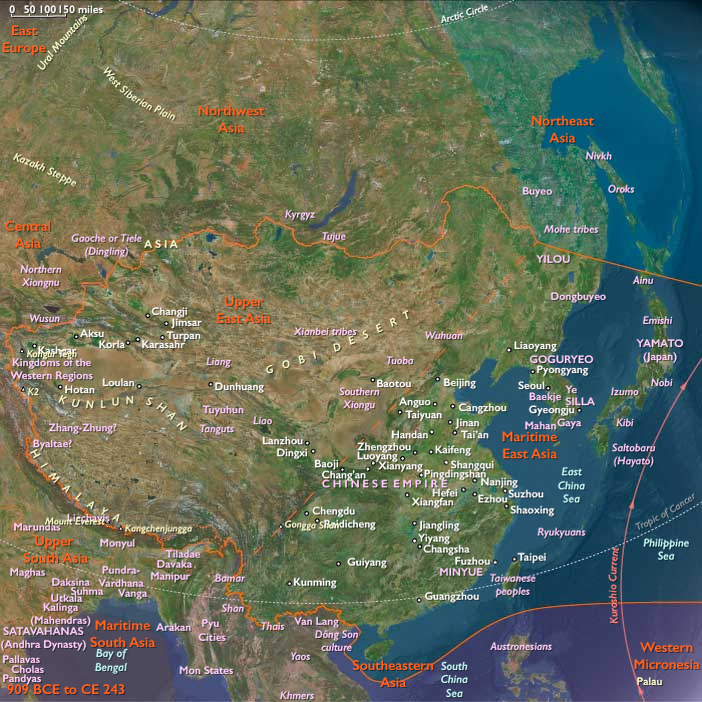
Two warlords control the regions of the Yangtze that are key to Cao Cao's success: Liu Biao, Governor of Jing Province, controls the river west of the mouth of the Han, roughly encompassing the area around the city of Xiakou and all territory south of that region.
Sun Quan controls the river east of the Han and the southeastern territories abutting it.
A third ally, Liu Bei, is living in refuge with Liu Biao at the garrison in Fancheng (present-day Xiangyang), having fled from the northeast to Jing Province following a failed plot to assassinate Cao Cao and restore power to the imperial dynasty.
The initial stages of the campaign are an unqualified success for Cao Cao, as the command of Jing Province had been substantially weakened and the Jing armies exhausted by conflict with Sun Quan to the south.
Factions have arisen supporting either of Liu Biao's two sons in a struggle for succession.
The younger son prevails, and Liu Biao's dispossessed eldest son, Liu Qi, departs to assume a prefecture in Jiangxia (present-day Yunmeng County, Hubei) (de Crespigny 2004:241).
Liu Biao dies of illness only a few weeks later, while Cao Cao is advancing from the north and, under these circumstances, Liu Biao's younger son and successor, Liu Cong, quickly surrenders.
Cao Cao thus captures a sizable fleet and secures the naval base at Jiangling.
This provides him with a key strategic military depot and forward base to harbor his ships.
Liu Bei, accompanied by a refugee population of civilians and soldiers, quickly flees south when Jing Province falls.
This disorganized exodus is pursued by Cao Cao's elite cavalry, and is surrounded and decisively beaten at the Battle of Changban (near present-day Dangyang, Hubei).
Liu Bei escapes, however, and flees further east to Xiakou, where he liaises with Sun Quan's emissary Lu Su.
At this point historical accounts are inconsistent; Lu Su may have successfully encouraged Liu Bei to move even further east, to Fankou.
In either case, Liu Bei is later joined by Liu Qi and levies from Jiangxia.
Liu Bei's main advisor, Zhuge Liang, is sent to Chaisang to negotiate forming a mutual front against Cao Cao with the state of Wu.
By the time Zhuge Liang arrives, Cao Cao has already sent Sun Quan a letter boasting of commanding eight hundred thousand men and demanding Sun Quan's surrender.
The faction led by Sun Quan's Chief Clerk, Zhang Zhao, advocates surrender, citing Cao Cao's overwhelming numerical advantage.
However, on separate occasions, Lu Su, Zhuge Liang, and Sun Quan's chief commander, Zhou Yu, all presented arguments to persuade Sun Quan to agree to the alliance against the northerners.
Sun Quan finally decided upon war.
He then assigns Zhou Yu, Cheng Pu, and Lu Su with thruty thousand men to aid Liu Bei against Cao Cao.
Although Cao Cao has boasted a command of eight hundred thousand men, Zhou Yu estimates Cao Cao's actual troop strength to be closer to two hundred and twenty thousand.
Furthermore, this total includes seventy thousand impressed troops from the armies of the recently deceased Liu Biao, so the loyalty and morale of a large number of Cao Cao's force is uncertain.
With the twenty thousand soldiers that Liu Bei has gathered, the alliance consists of approximately fifty thousand marines who are trained and prepared for battle.
The combined Sun-Liu force sails upstream from either Xiakou or Fankou to Red Cliffs, where they encounter Cao Cao's vanguard force.
Ravaged by disease and low morale due to the series of forced marches they had undertaken on the prolonged southern campaign, Cao Cao's men cannot gain an advantage in the small skirmish which ensues, so Cao Cao retreats to Wulin (north of the Yangtze River) and the allies pull back to the south.
Cao Cao has moored his ships from stem to stern, possibly aiming to reduce seasickness in his navy, which comprises mostly northerners who are not used to living on ships.
Observing this, divisional commander Huang Gai sends Cao Cao a letter feigning surrender and prepares a squadron of capital ships described as mengchong doujian (The exact nature of these vessels is unclear; they are most likely warships clad in a protective coating, possibly leather).
The ships have been converted into fire ships by filling them with bundles of kindling, dry reeds, and fatty oil.
As Huang Gai's "defecting" squadron approaches the midpoint of the river, the sailors ignite the ships before taking to small boats.
The unmanned fire ships, carried by the southeastern wind, speed towards Cao Cao's fleet and set it ablaze.
Within a short time smoke and flames stretch across the sky, and a large number of men and horses either burn to death or drown.
Following the initial shock, Zhou Yu and the allies lead a lightly armed force to capitalize on the assault.
The northern army, thrown into confusion, is utterly defeated.
Seeing the situation is hopeless, Cao Cao issues a general order of retreat and destroys a number of his remaining ships before withdrawing.
The allied counterattack might have vanquished Cao Cao and his forces entirely.
However, the crossing of the Yangtze River dissolves into chaos as the allied armies converge on the riverbank and fight over the limited number of ferries.
To restore order, a detachment led by the allied general Gan Ning establishes a bridgehead in Yiling to the north, and only a staunch rearguard action by Cao Ren prevents further catastrophe.
Cao Cao's army attempts a retreat along Huarong Road, including a long stretch passing through marshlands north of Dongting Lake.
Heavy rains have reduced the track to a thick mire, making the road so treacherous that many of the sick soldiers have to carry bundles of grass on their backs and use them to fill the road, to allow the horsemen to cross.
Many of these soldiers drown in the mud or are trampled to death in the effort.
To the misery of Cao Cao's army, the allies, led by Zhou Yu and Liu Bei, give chase over land and water until they reach Nan prefecture; combined with famine and disease, this decimates Cao Cao's remaining forces.
Cao Cao, later to be famous as the tyrannical founder of the Cao Wei kingdom, is Hua Tuo's best-known patient, and suffers from chronic headaches (possibly caused by a brain tumor).
Cao has ordered Hua to work as his personal physician, which Hua resents.
In order to avoid treating Cao, Hua repeatedly makes excuses that his wife is ill, but Cao discovers the deception and orders Hua's execution.
Xun Yu, an advisor of Cao Cao, petitions on behalf of the physician.
Hua Tuo writes down his medical techniques while awaiting execution, but destroys his Qingnang shu (lit."green bag book", which becomes a Classical Chinese term for "medical practices text").
This loss to traditional Chinese medicine is irreplaceable.
Cao Cao later regrets executing Hua when his son Cao Chong (196-208), a child prodigy who discovered Archimedes' principle, dies from illness.
The Sanguozhi does not specify Hua Tuo's exact date of death, but since Cao Chong dies in 208, Hua Tuo could not have lived past this year.
The Han Dynasty, which has ruled China for almost four centuries (albeit with a sixteen-year interruption, dividing the dynasty into its Western and Eastern periods), is crumbling by the early third century.
Emperor Xian has been a political figurehead since 189, with no control over the actions of the various warlords controlling their respective territories.
One of the most powerful rulers in China is Cao Cao, who, by the year 207, had unified northern China and retained total control of the North China Plain.
He then completed a successful campaign against the Wuhuan in the winter of the same year, thus securing his northern frontier.
Upon his return in 208, he is proclaimed to be the Imperial Chancellor of Han, a position that granted him absolute authority over the entire imperial government.
Cao Cao retreats north to his home base of Ye, ...