Lopo Soares de Albergaria
3rd Governor of Portuguese India
Years: 1460 - 1520
Lopo Soares de Albergaria (Lisbon, c. 1460 – Torres Vedras, c. 1520) is the third Governor of Portuguese India, having reached India in 1515 to supersede governor Afonso de Albuquerque.
Related Events
Filter results
Showing 10 events out of 40 total
The spice trade linking India to Egypt, and thence Venice, had been seriously diminished and prices had shot up following the bombardment of Calicut in 1500–01 by the second Portuguese India Armada under Pedro Cabral.
Arab shipping is also being attacked directly: an Egyptian ship had been robbed and sunk by the Portuguese in 1503 as it was returning from India.
The Mamluk Sultan Qansuh al-Ghurii in 1504 first sends an envoy to the Pope, in the person of the Grand Prior of the Saint Catherine's Monastery, warning that if the Pope does not stop the exactions of the Portuguese against Muslims, he will bring ruin to the Christian Holy Place in the Levant and to the Christians living in his realm.
The Venetians, who share common interests with the Mamluks in the spice trade and desire to eliminate the Portuguese challenge if possible, send envoy Francesco Teldi, posing as a jewel buyer, as envoy to Cairo.
Teldi tries to find a level of cooperation between the two realms, encouraging the Mamluks to block Portuguese maritime movements.
The Venetians claim they cannot intervene directly, and encourage the Mamluk Sultan to take action by getting into contact with Indian princes at Cochin and Cananor to entice them not to trade with the Portuguese, and the Sultans of Calicut and Cambay to fight against them.
Some sort of alliance is thus concluded between the Venetians and the Mamluks against the Portuguese.
There will be claims, voiced during the War of the League of Cambrai, that the Venetians had supplied the Mamluks with weapons and skilled shipwrights.
The cavalry-oriented Mamluks have little inclination for naval operations, but the Portuguese keep blockading the Red Sea, and arresting Muslim merchant ships.
The Sixth Portuguese India Armada (1504): Reinforcing Portugal’s Position in India
In 1504, King Manuel I of Portugal assembled the Sixth India Armada, comprising 13 ships and 1,200 men, under the command of Lopo Soares de Albergaria. The mission was to strengthen Portuguese control over the Indian Ocean trade, protect Portuguese-allied cities, and continue hostilities with the Zamorin of Calicut, following the failures of previous fleets to force him into submission.
Background: Ongoing Conflict with Calicut
- Pedro Álvares Cabral’s Second Armada (1500–1501) initiated hostilities with the Zamorin of Calicut, Portugal’s first major naval conflict in India.
- Vasco da Gama’s Fourth Armada (1502–1503), despite its brutal attacks and blockades, failed to force Calicut into submission.
- The Fifth Armada (1503) under Afonso de Albuquerque managed to defend the Portuguese-allied cities of Cochin and Cannanore, preventing them from falling to the Zamorin.
- The Portuguese realized that more firepower and troops were needed to secure their position and defeat Calicut.
Composition and Leadership of the Sixth Armada (1504)
- Fleet Size: 13 ships
- Nine large naus (carracks) designated to return with spice cargoes.
- Four smaller navetas (caravels), intended to stay in India for coastal defense.
- Commander: Lopo Soares de Albergaria
- A middling noble with strong Almeida family connections.
- Previously served as captain-general of São Jorge da Mina on the Gold Coast (West Africa).
- Private Participation:
- One ship was outfitted by Catarina Dias de Aguiar, a wealthy merchant woman from Lisbon.
Mission Objectives and Strategy
- Protect Portuguese Factories in Cochin and Cannanore
- Defend Portuguese commercial outposts from Zamorin-led attacks.
- Strengthen fortifications and local garrisons.
- Maintain War Against Calicut
- Lopo Soares was under strict orders to refuse peace with the Zamorin.
- His mission was to continue harassing Calicut, weakening its commercial power and naval influence.
- Bolster Portuguese Naval Presence in India
- Unlike previous armadas, some of the fleet’s caravels were instructed to remain in India for coastal patrols.
Departure and Significance
- The Sixth Armada set sail from Lisbon on April 22, 1504, carrying more soldiers and reinforcements than previous fleets.
- This fleet marked a strategic shift in Portuguese policy, recognizing that long-term naval and military presence was required to dominate Indian Ocean trade.
- The Portuguese Crown saw Cochin and Cannanore as critical allies, ensuring that these cities would serve as long-term bases for future expansion.
Conclusion: Setting the Stage for Portuguese Hegemony in India
The Sixth India Armada (1504) was part of Portugal’s growing military commitment to Indian Ocean domination. By reinforcing their allies and maintaining pressure on Calicut, the Portuguese laid the groundwork for later conquests, culminating in the fall of Goa in 1510 under Afonso de Albuquerque and the establishment of Portugal’s Eastern Empire.
The sixth armada, proceeding in good order from Portugal to India, reaches the Cape of Good Hope in mid-June.
The ships of the sixth Portuguese India armada arrive at the first collection point, Cape Verde, on May 2.
Lopo Soares announces that as they had left Lisbon so late, there is no room for error.
He lays down a set of strict sailing instructions, and warns pilots and masters he will dock their pay for every mistake.
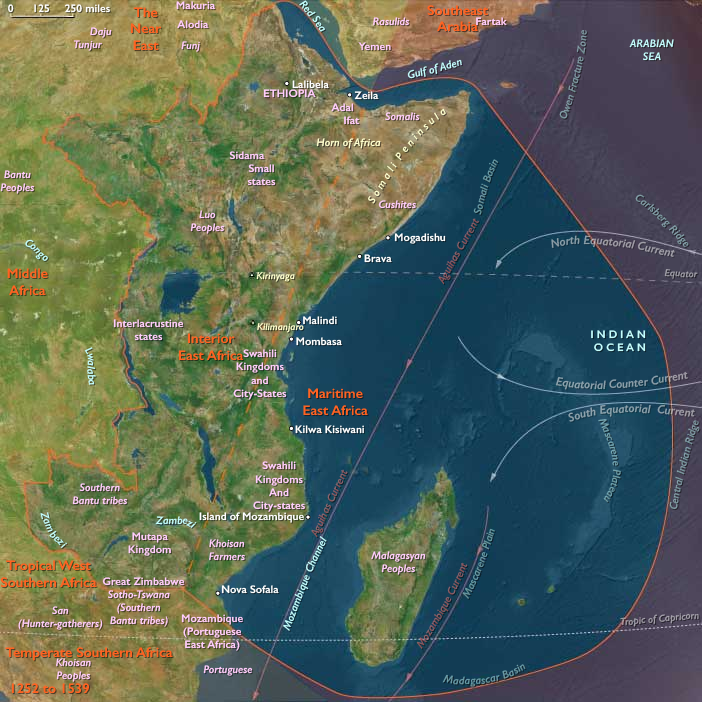
The sixth armada reaches Mozambique Island on June 25.
Here, Lopo Soares finds the testimonial letter left behind by Pêro de Ataíde, the former captain of the India patrol, who had died there in February.
From this missive, Lopo Soares learns of the debacle of the coastal patrol of Vicente Sodré and Calicut's attack on Cochin the previous spring.
Ataide's letter gives Lopo Soares the news of India up until February, 1504.
What Lopo Soares does not know (but probably can guess) is that at this very moment there is a desperate battle going on in Cochin.
The Zamorin of Calicut had launched a massive attack on Cochin in March, intending to capture the city and seize the Portuguese fortress.
He has brought some fifty-seven thousand troops, equipped with Turkish firearms and Venetian cannon.
The tiny Portuguese garrison at Cochin, some one hundred and fifty men under the command of Duarte Pacheco Pereira, by clever positioning, individual heroics and quite some luck, have managed to fend off attack after attack by the Zamorin's army and fleet over the past few months.
The last assault is launched in early July, after which the humiliated Zamorin calls off the invasion.
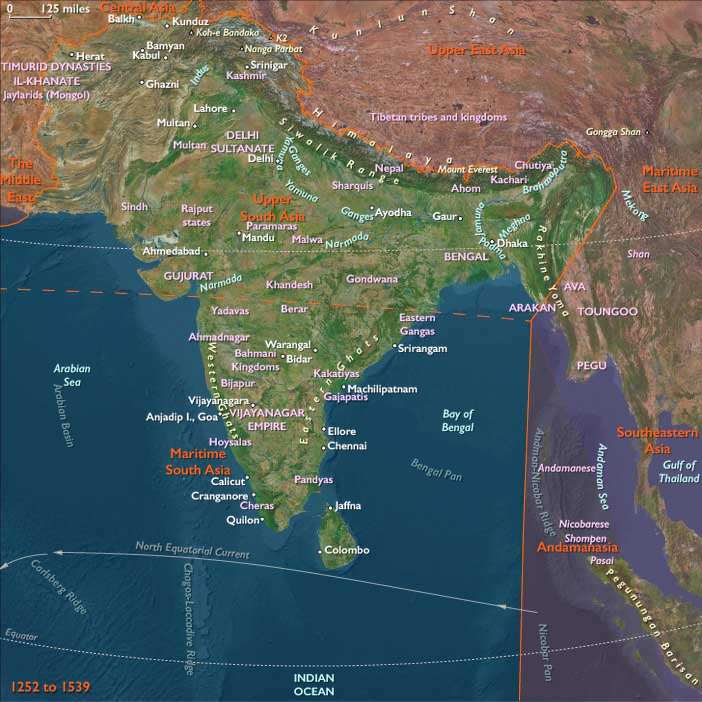
The sixth armada, crossing the Indian Ocean under the command of Lopo Soares de Albergaria, arrives at Anjadip Island, where they find two Portuguese ships repairing: those of António de Saldanha and Rui Lourenço Ravasco.
They had been part of the third squadron of the previous year's armada.
They relate their stoy of becoming lost and separated in Africa, the winter season spent harassing East African ports and Red Sea shipping, and being only able to undertake their Indian Ocean crossing this summer.
They have no idea of the whereabouts of the third ship of their squadron, that of Diogo Fernandes Pereira, having lost track of it nearly a year ago. (As it happens, Diogo Fernandes Pereira had wintered in Socotra by himself and undertaken a solo crossing to India earlier that Spring, arriving in Cochin just in time to help Duarte Pacheco fend off the assaults of the Zamorin.)
Saldanha and Lourenço accompany Lopo Soares' armada down the coast to Cannanore, where Albergaria finally hears more detailed reports from the Cannanore factor Gonçalo Gil Barbosa about the battle of Cochin.
Lopo Soares sets sail towards it at once.
The armada appears before Calicut on September 7.
Lopo Soares dispatches a message to the Zamorin, demanding he hand over any and all Portuguese prisoners to him; moreover, he demands that they also deliver the two Venetian engineers who had been helping the Zamorin build European cannon.
The Zamorin is absent from the city at the moment.
His ministers are willing to release the Portuguese prisoners, but not the Italians.
Lopo Soares subjects Calicut to forty-eight hours of continuous shore bombardment, causing great damage, then proceeds south to Cochin.
Lopo Soares had left Mozambique on August 1.
Although instructed by his regimento to make a stop in Malindi, it is possible he sails for India directly from Mozambique.
Damião de Góis reports the sixth armada did stop at Malindi, and was (as usual) well received by the Sultan of Malindi.
Góis asserts the Sultan of Malindi not only resupplied the ships, but provided Lopo Soares with a Muslim pilot named 'Debucar'.
He also handed over sixteen Portuguese shipwrecked sailors, survivors of Ataíde's capsized ship, who had been collected by Malindi boats earlier that year.
The sixth armada remains in Malindi only two days, before setting off on their Indian Ocean crossing.