Louis William, Margrave of Baden
ruler of Baden and chief commander of the Imperial army
Years: 1655 - 1707
Louis William, Margrave of Baden (April 8, 1655 –January 4, 1707) is the ruler of Baden in Germany and chief commander of the Imperial army.
He is also known as Türkenlouis (Turk Louis).
At his death in 1707, his wife Sibylle of Saxe-Lauenburg acts as regent of Baden-Baden.
Related Events
Filter results
Showing 10 events out of 14 total
Breisach, the "key" to Southern Germany, falls into enemy hands together with many supplies, guns and ammunition.
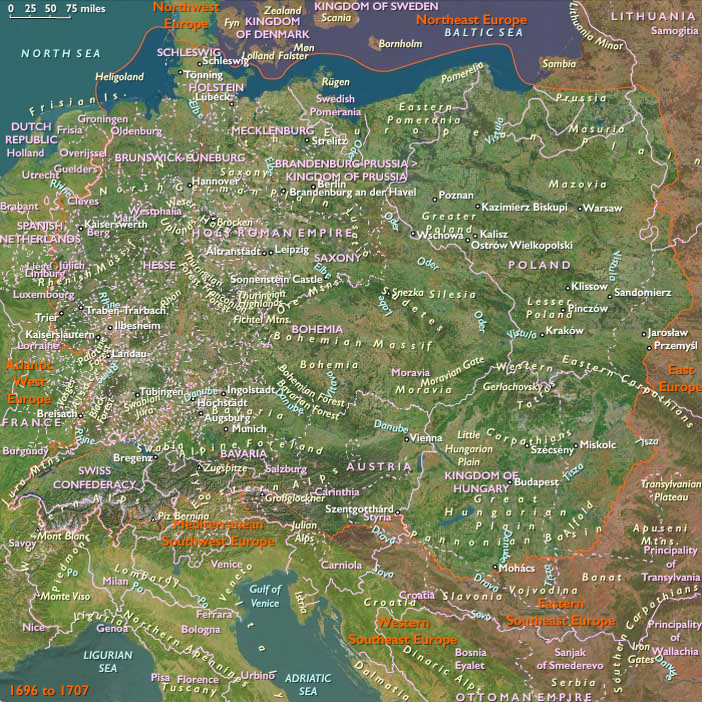
Situated along the Rhine, Breisach had been integrated into the French state in the course of the politics of Reunions from 1670, but had in 1697 under the Treaty of Ryswick been returned to the Holy Roman Empire.
Johann Phiipp D'Arco, born in Arco, Trentino, already has thirty years distinguished service when he is ordered by Louis William, Margrave of Baden-Baden in 1703, to defend Breisach to the last man against a French attack under Villars.
The city is well defended and d'Arco disposed of sufficient soldiers to hold the city for a considerable time, but he capitulates on September 6 after only thirteen days of siege.
D'arco is charged with treason for surrendering Breisach, and beheaded on February 18, 1704, at Bregenz.
His second in command Luigi Ferdinando Marsigli is stripped of all honors and his sword is broken over him.
The remnants of the Elector of Bavaria's and Marshal Marsin's wing limp back to Strasbourg, losing another seven thousand men through desertion.
The Elector, despite being offered the chance to remain as ruler of Bavaria (under strict terms of an alliance with Austria), leaves his country and family in order to continue the war against the Allies from the Spanish Netherlands where he still holds the post of governor-general.
Their commander-in-chief at Blenheim, Marshal Tallard—who, unlike his subordinates, has not been ransomed or exchanged, is taken to England and will be housed on parole in Nottingham until his release in 1711. (The writer Daniel Defoe will report that his “small, but beautiful parterre, after the French fashion was one of the beauties of Nottingham”.)
The 1704 campaign lasts considerably longer than usual as the Allies seek to wring out maximum advantage.
Realizing that France is too powerful to be forced to make peace by a single victory, however, Eugene, Marlborough and Baden meet to plan their next moves.
For the following year, the Duke proposes a campaign along the valley of the River Moselle to carry the war deep into France.
This requires the capture of the major fortress of Landau that guards the Rhine, and the towns of Trier and Trarbach on the Moselle itself.
Trier is taken on October 26.
Bavaria is placed under Austrian military rule by the Treaty of Ilbersheim, signed November 7, 1704, allowing the Habsburgs to utilize its resources for the rest of the conflict.
Landau falls on November 23 to the Margrave of Baden and Prince Eugene; ...
Marlborough and Eugene had separated again, following the Battle of Blenheim, with the former going to the Low Countries, and the latter to Italy.
Little progress is made in 1705 by either France or the Allies in any theater.
While Marlborough's attempted invasion of France down the Moselle comes to naught, and although he manages to wrong-foot Villeroy and break through the Lines of Brabant, he is unable to bring the French commander to battle.
Villars and Louis of Baden maneuver indecisively on the Rhine, and the story is much the same for Vendôme and Eugene in Italy.
The stalemate is broken in 1706, as Marlborough drives the French out of most of the Spanish Netherlands, decisively defeating troops under Villeroy in the Battle of Ramillies in May and following up with the conquest of Antwerp and Dunkirk.
Prince Eugene also meets with success; in September, following the departure of Vendôme to shore up the shattered army in the Netherlands, he and the Duke of Savoy inflict a heavy loss on the French under Orleans and Marsin at the Battle of Turin, driving them out of Italy by the end of the year.
The Earl of Galway leads another attempt on Madrid in 1707, but Berwick roundly defeats him at the Battle of Almansa on April 25.
In another attempt on Madrid, his army is severely defeated by the Marquis de Bay at the Battle of La Gudina, being forced to withdraw its troops from Spain.
The war in Spain settles hereafter nto indecisive skirmishing from which it would not subsequently emerge.
England is in 1707 united with the Kingdom of Scotland to form Great Britain, negotiations having started the previous year.
Great Britain therefore replaces England as a party to the war.
Also in 1707, the War briefly intersects with the Great Northern War, which is being fought simultaneously in Northern Europe.
A Swedish army under Charles XII arrives in Saxony, where he had just finished chastising the Elector Augustus II and forcing him to renounce his claims to the Polish throne.
Both the French and the Allies send envoys to Charles's camp, and the French hope to encourage him to turn his troops against the Emperor Joseph I, who Charles feels had slighted him by his support for Augustus.
However, Charles, who likes to see himself as a champion of Protestant Europe, greatly dislikes Louis XIV for his treatment of the Huguenots, and is generally uninterested in the western war.
He turns his attention instead to Russia, ending the possibility of Swedish intervention.
Prince Eugene leads an allied invasion of southern France from Italy later in 1707, but is stalled by the French army.
Marlborough, in the meantime, remains in the Low Countries, where he is caught up in capturing an endless succession of fortresses.

The Battle of Almanza (April 25, 1707) and the Nueva Planta Decrees
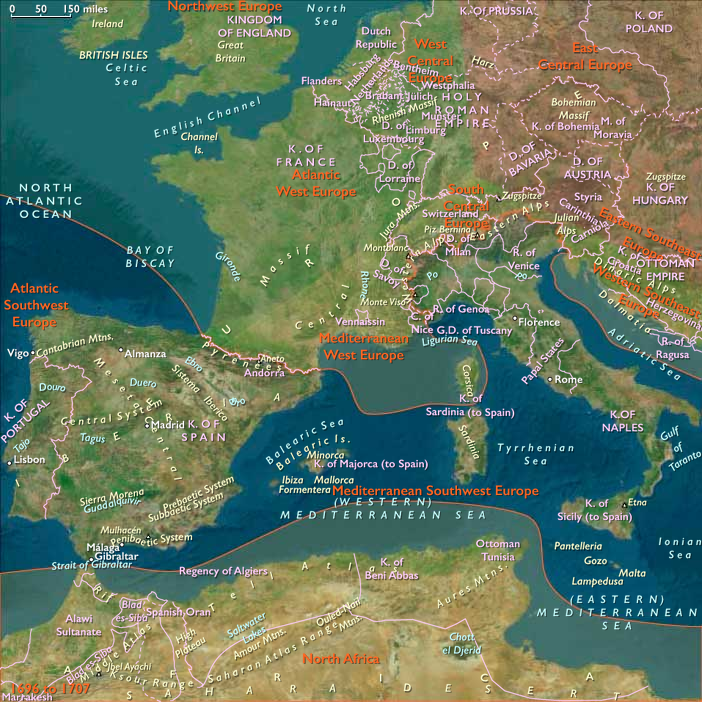
The Battle of Almanza (April 25, 1707) was a decisive Bourbon victory in the War of the Spanish Succession (1701–1714). The defeat of the Allied army (England, Portugal, and the Dutch Republic) by the French-Spanish Bourbon forces secured Philip V’s control over Spain and led to the first of the Nueva Planta decrees, which centralized Spain under Castilian rule.
The Battle of Almanza (1707): A Pivotal Moment in the War
- The battle was fought in Almanza, eastern Spain, between:
- The Allied army, composed of English, Portuguese, Dutch, and Austrian troops.
- The Bourbon army, led by James FitzJames, Duke of Berwick, an illegitimate son of James II of England serving France and Spain.
- The Bourbons decisively defeated the Allies, ensuring:
- The permanent control of Philip V over Aragon and Valencia.
- The decline of Habsburg and Allied influence in Spain.
The Nueva Planta Decrees (1707–1716): Centralization Under Castile
- Following the Bourbon victory at Almanza, Philip V issued the first Nueva Planta decree, which:
- Abolished the fueros (regional privileges) of the Kingdoms of Valencia and Aragon.
- Brought these regions under Castilian law, eliminating their traditional autonomy.
- Ended the Aragonese institutions, integrating them into a centralized Spanish state under Bourbon rule.
- Later Nueva Planta decrees (1714) extended these policies to Catalonia and the Balearic Islands, completing Philip V’s centralization of Spain.
Consequences of Almanza and the Nueva Planta Reforms
✔ Philip V secured control over Spain, solidifying Bourbon rule.
✔ The Crown of Aragon lost its autonomy, marking a shift toward a centralized Spanish monarchy.
✔ Castilian law and administration became dominant, reshaping Spain’s governance.
✔ Portugal and Britain lost influence in the war, while France and Spain strengthened their alliance.
Conclusion: The War’s Turning Point and the Rise of Bourbon Spain
The Battle of Almanza (1707) cemented Bourbon control over Spain, while the Nueva Planta decrees marked the end of regional autonomy, making Castile the political center of the Spanish monarchy. These events reshaped Spanish governance and reinforced the authority of Philip V, setting the foundation for Bourbon rule in Spain well into the 18th century.