
Manuel Belgrano
Argentine economist, lawyer, politician, and military leader
1778 CE to 1842 CE
Manuel José Joaquín del Corazón de Jesús Belgrano (3 June 1770 – 20 June 1820), usually referred to as Manuel Belgrano, is an Argentine economist, lawyer, politician, and military leader.
He takes part in the Argentine Wars of Independence and creates the Flag of Argentina.
He is regarded as one of the main Libertadores of the country.
Belgrano was born in Buenos Aires, the fourth child of Italian businessman Domingo Belgrano y Peri and Josefa Casero.
He comes into contact with the ideas of the Age of Enlightenment while at university in Spain around the time of the French Revolution.
Upon his return to the Viceroyalty of the Río de la Plata, where he becomes a notable member of the criollo population of Buenos Aires, he tries to promote some of the new political and economic ideals, but finds severe resistance from local peninsulars.
This rejection leads him to work towards a greater autonomy for his country from the Spanish colonial regime.
At first, he unsuccessfully promotes the aspirations of Carlota Joaquina to become a regent ruler for the Viceroyalty during the period the Spanish King Ferdinand VII is imprisoned during the Peninsular War (1807–1814).
He favors the May Revolution, which removes the viceroy Baltasar Hidalgo de Cisneros from power on 25 May, 1810.
He is elected as a voting member of the Primera Junta that takes power after the ouster.
As a delegate for the Junta, he leads the ill-fated Paraguay campaign.
His troops are defeated by Bernardo Velazco at the battles of Campichuelo and Paraguarí.
Though he is defeated, the campaign initiates the chain of events that leads to the Independence of Paraguay in May 1811.
He retreats to the vicinity of Rosario to fortify it against a possible royalist attack from the Eastern Band of the Uruguay River.
While there, he creates the flag of Argentina.
The First Triumvirate does not approve the flag, but because of slow communications, Belgrano will only learn of that many weeks later, while reinforcing the Army of the North at Jujuy.
There, knowing he is at a strategic disadvantage against the royalist armies coming from Upper Peru, Belgrano orders the Jujuy Exodus, which evacuates the entire population of Jujuy Province to San Miguel de Tucumán.
His counteroffensive at the Battle of Tucumán results in a key strategic victory, and it is soon followed by a complete victory over the royalist army of Pío Tristán at the Battle of Salta.
However, his deeper incursions into Upper Perú lead to defeats at Vilcapugio and Ayohuma, leading the Second Triumvirate to order his replacement as Commander of the Army of the North by the newly arrived José de San Martín.
By this time, the Asamblea del Año XIII has approved the use of Belgrano's flag as the national war flag.
Belgrano then goes on a diplomatic mission to Europe along with Bernardino Rivadavia to seek support for the revolutionary government.
He returns in time to take part in the Congress of Tucumán, which declares Argentine Independence (1816).
He promotes the Inca plan to create a constitutional monarchy with an Inca descendant as Head of State.
This proposal has the support of San Martín, Martín Miguel de Güemes, and many provincial delegates, but is strongly rejected by the delegates from Buenos Aires.
The Congress of Tucumán approves the use of his flag as the national flag.
After this, Belgrano again takes command of the Army of the North, but his mission is limited to protecting San Miguel de Tucumán from royalist advances while San Martín prepares the Army of the Andes for an alternate offensive across the Andes.
When Buenos Aires is about to be invaded by José Gervasio Artigas and Estanislao López, he moves the Army southwards, but his troops mutiny in January 1820.
Belgrano dies of dropsy on 20 June 1820.
His last words reportedly are: "¡Ay, Patria mía!"
("Oh, my country!
).
World
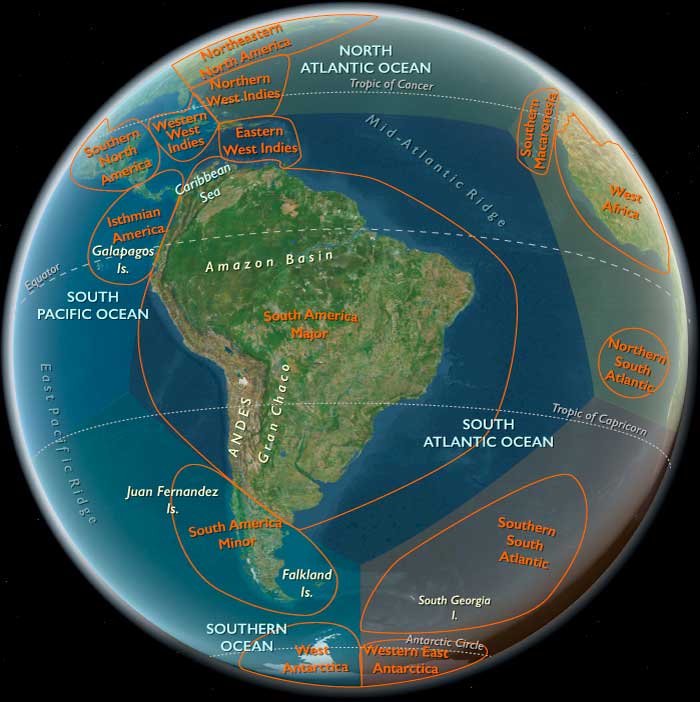
South America and The Eastern Isles
View →Related Events
Showing 10 events out of 26 total
But no matter how grave the offenses of the ancien regime may have been, they are far less rankling to the proud Paraguayans than the indignity of being told to take orders from the porteños.
After all, Paraguay had been a thriving, established colony when Buenos Aires was only a squalid settlement on the edge of the empty pampas.
Espínola is "perhaps the most hated Paraguayan of his era," in the words of historian John Hoyt Williams.
Espínola's reception in Asuncion is less than cordial, partly because he is closely linked to rapacious policies of the ex-governor, Lazaro de Rivera, who had arbitrarily shot hundreds of his citizens until he was forced from office in 1805.
Barely escaping a term of exile in Paraguay's far north, Espínola flees back to Buenos Aires and lies about the extent of porteño support in Paraguay, causing the Buenos Aires cabildo to make an equally disastrous move.
In a bid to settle the issue by force, the cabildo sends eleven hundred troops under General Manuel Belgrano to subdue Asuncion.
Paraguayan troops soundly thrash the porteños at Paraguan and Tacuan.
Officers from both armies, however, fraternize openly during the campaign.
From these contacts the Paraguayans come to realize that Spanish dominance in South America is coming to an end, and that they, and not the Spaniards, hold the real power.
Believing that the Paraguayan officers who had whipped the porteños pose a direct threat to his rule, Governor Bernardo de Velasco disperses and disarms the forces under his command and sends most of the soldiers home without paying them for their eight months of service.
Velasco previously had lost face when he fled the battlefield at Paraguan, thinking Belgrano would win.
Discontent spreads, and the last straw is the request by the Asunción cabildo for Portuguese military support against Belgrano's forces, who are encamped just over the border in present-day Argentina.
Far from bolstering the cabildo's position, this move instantly ignites an uprising and the overthrow of Spanish authority in Paraguay on May 14 and 15, 1811.
Independence is declared on May 17.
The military conflict in Spain has worsened by 1810.
The city of Seville has been invaded by French armies, which are already dominating most of the Iberian Peninsula.
The Junta of Seville has disestablished, and several members have fled to Cádiz, the last portion of Spain still resisting.
They have established a Council of Regency, with political tendencies closer to absolutism than the former Junta. This begins the May Revolution in Buenos Aires, as soon as the news is known.
The territory of modern Argentina is part of the Spanish Viceroyalty of the Río de la Plata, with its capital city in Buenos Aires, seat of government of the Spanish viceroy.
Modern Uruguay, Paraguay and Bolivia are also part of the viceroyalty, and begin their push for autonomy during the conflict, becoming independent states afterwards.
The vast area of the territory and slow communications have led most populated areas to become isolated from each other.
The wealthiest regions of the viceroyalty are in Upper Peru, (modern-day Bolivia).
Salta and Córdoba have closer ties with Upper Peru than with Buenos Aires.
Similarly, Mendoza in the west has closer ties with the Captaincy General of Chile, although the Andes mountain range is a natural barrier.
Buenos Aires and Montevideo, who have a local rivalry, located in the La Plata Basin, have naval communications allowing them to be more in contact with European ideas and economic advances than the inland populations.
Paraguay is isolated from all other regions.
In the political structure, most authoritative positions are filled by people designated by the Spanish monarchy, most of them Spanish people from Europe, also known as peninsulares, without strong compromises for American problems or interests.
This has reated a growing rivalry between the Criollos, white people born in Latin America, and the peninsulares, Spanish people who arrived from Europe (the term "Criollo" is usually translated to English as "Creole", despite being unrelated to most other Creole peoples).
Despite the fact that all of them are considered Spanish, and that there is no legal distinction between Criollos and Peninsulares, most Criollos think that Peninsulares have undue weight in political matters.
The ideas of the American and French Revolutions, and the Age of Enlightenment, promote desires of social change among the criollos.
The full prohibition imposed by Spain to trade with other nations is also seen as damaging to the viceroyalty's economy.
The population of Buenos Aires had been highly militarized during the British invasions of the Río de la Plata, part of the Anglo-Spanish War.
Buenos Aires had been captured in 1806, then liberated by Santiago de Liniers with forces from Montevideo.[
Fearing a counter-attack, all the population of Buenos Aires capable of bearing arms had been arranged in military bodies, including slaves.
A new British attack in 1807 had captured Montevideo, but was defeated in Buenos Aires, and forced to leave the viceroyalty.
The viceroy Rafael de Sobremonte had beenb successfully deposed by the criollos during the conflict, and the Regiment of Patricians has become a highly influential force in local politics, even after the end of the British threat.
The transfer of the Portuguese Court to Brazil has generated military concern.
It is feared that the British will launch a third attack, this time allied with Portugal.
However, no military conflict takes place, as when the Peninsular War started, Britain and Portugal had become allies of Spain against France.
When the Spanish king Ferdinand VII is captured, his sister Carlota Joaquina seeks to rule in the Americas as regent, but nothing comes out of it because of the lack of support from both the Spanish Americans and the British.
Javier de Elío creates a Junta in Montevideo and Martín de Álzaga seeks to make a similar move by organizing a mutiny in Buenos Aires, but the local military forces intervene and thwart it.
Spain appoints a new viceroy, Baltasar Hidalgo de Cisneros, and Liniers hands the government to him without resistance, despite the proposals of the military to reject him.
Several citizens think that Cisneros, appointed by the disestablished Junta, does not have the right to rule anymore, and requests the convening of an open cabildo to discuss the fate of the local government.
The military gives their support to the request, forcing Cisneros to accept.
The discussion rules the removal of viceroy Cisneros and his replacement with a government junta, but the cabildo attempts to keep Cisneros in power by appointing him president of such junta.
Further demonstrations ensue, and the Junta is forced to resign immediately.
It is replaced by a new one, the Primera Junta.
Buenos Aires requests the other cities in the viceroyalty to acknowledge the new Junta and send deputies.
The precise purpose of these deputies, join the Junta or create a congress, is unclear at the time and generated political disputes later.
The Junta is initially resisted by all the main locations around Buenos Aires: Córdoba, Montevideo, Paraguay and the Upper Peru.
Santiago de Liniers comes out of his retirement in Córdoba and organizes an army to capture Buenos Aires, Montevideo had naval supremacy over the city, and Vicente Nieto organizes the actions at the Upper Peru.
Nieto proposes to José Fernando de Abascal y Sousa, viceroy of the Viceroyalty of Peru at the North, to annex the Upper Peru to it.
He thinks that the revolution can be easily contained in Buenos Aires, before launching a definitive attack.
The victories and defeats of the military conflict delimit the areas of influence of the new United Provinces of the Río de la Plata.
With the non-aggression pact arranged with Paraguay early on, most of the initial conflict will take place in the north, in Upper Peru, and in the east, in the Banda Oriental.
In the second half of the decade, with the capture of Montevideo and the stalemate in Upper Peru, the conflict will move to the west, to Chile.
A movement for full independence led by Manuel Belgrano, a patriot junta member, quickly gathers steam in Buenos Aires.
In the so-called May Revolution from May 18–May 25, armed citizens of Buenos Aires expel the Viceroy and establish a provincial government for Argentina (the Primera Junta) to rule in the name of Spain’s deposed King Ferdinand VII.g
However, the improvised army gathered by Liniers at Cordoba deserts him before battle, so the former Viceroy attempts to flee to Upper Peru, expecting to join the royalist army sent from the Viceroyalty of Peru to suffocate the revolution at Buenos Aires.
Colonel Francisco Ortiz de Ocampo, who leads the patriot army, captures Liniers and the other leaders of the Cordoba counter-revolution on August 6, 1810, but, instead of executing them as he has been instructed, he sends them back to Buenos Aires as prisoners.
As a result, Ocampo is demoted and Juan José Castelli is appointed as the political head of the army.
On August 26, Castelli executes the Cordoba prisoners and leads the Army of the North towards Upper Peru.
Cabildo also announces mobilization and Velasco leaves with troops for the Yaguarón to establish defensive positions.
The political future of Paraguay will be decided by conflicts between three groups, each of which hasd different plans for the future: gachupines (born in Spain), porteños (inhabitants of Buenos Aires) and the local Paraguayan-born Creole elite, which is led by Fulgencio Yegros and Pedro Juan Caballero.
An earlier rebellion in Upper Peru during 1809 had been crushed by Royalist forces under the command of Generals Vicente Nieto and José de Córdoba y Rojas, leaving the region firmly under Spanish control.
After the 1810 May Revolution, the Republicans send an expeditionary army, led by Antonio González Balcarce, to Upper Peru with the mission of conducting a reconnaissance of the region.
Departing from Buenos Aires, its ranks swell en route as volunteers join the march.
Among these is a group of gauchos led by Martín Miguel de Güemes, who will go on to play a key role in the southern revolution.
By the time the expedition reaches Upper Peru, it is six hundred men strong with ten field pieces.