Maurice de Saxe
Count of Saxony; Marshal General of France
Years: 1696 - 1750
Maurice, Count of Saxony (German: Graf Hermann Moritz von Sachsen; French: Maurice de Saxe) (October 28, 1696 – November 20, 1750) is a Franco-Saxon soldier in French service who becomes a Marshal and later also Marshal General of France.

Related Events
Filter results
Showing 10 events out of 31 total
Sporadic fighting in the Americas has broken down into a stalemate.
A separate war has broken out on continental Europe regarding the Austrian Succession in which Britain and Spain are also on opposite sides and in which France remains initially neutral.
It is clear to many in both countries that war between them cannot be far off, and the British have been particularly alarmed by extensive fortifications in the French port of Dunkirk.
British and French troops have already fought in Europe at battles such as Dettingen and by late 1743 the two countries were in a state of de facto war.
The French King Louis XV in January 1744 formally declares war on Britain.
His ministers, convinced that a strong, immediate strike is needed against Britain, begin advocating an invasion of the British Isles.
British financial subsidies are essential to keeping its continental allies Austria, Hanover and the Dutch Republic afloat.
France believes that by invading Britain and knocking them out of the war, they can pave the way to an easy victory over their enemies to the east.
Preparations for the invasion had been ongoing for some time before the declaration of war and Minister of the Marine Count Maurepas had detailed his trusted and highly competent First Commissioner Joseph Pellerin to prepare for it.
Many flat-bottomed troop ships have been built and provisioned in the northern ports under the Pellerin's direction.
The King had strongly approved this plan.
The experienced Marshal Saxe has been given command of French land forces for the invasion.
The French plan to install the Jacobite James Edward Stuart in London as James III, who will end Britain's involvement in the war and turn Britain into a client state of Louis XV's government.
The Anglo-Austrian Alliance will be terminated, as will Britain's alliance with the Dutch, thereby reversing Britain's past successful policy of forming Grand Alliances against France on the continent through military support and financial subsidies.
James, who is living in exile in a French palace in Paris, has been made aware of these plans.
It is hoped that Jacobite supporters in the British navy and army will assist the French.
In some cases this proves wildly optimistic, as the officers listed as being committed Jacobites are often not or have already dies.
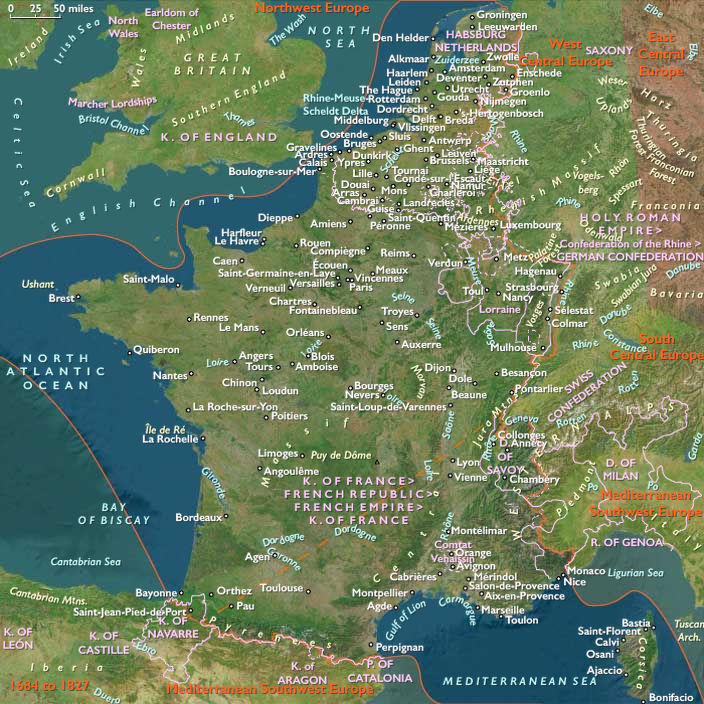
France now gathers a force estimated at somewhere between six thousand to fifteen thousand in size at Dunkirk under the command of Marshal Saxe.
Britain has been expecting a French invasion since as far back as 1740, when there had been an invasion scare, but the country is wary of the concept of standing armies and has limited regular forces to defend Great Britain.
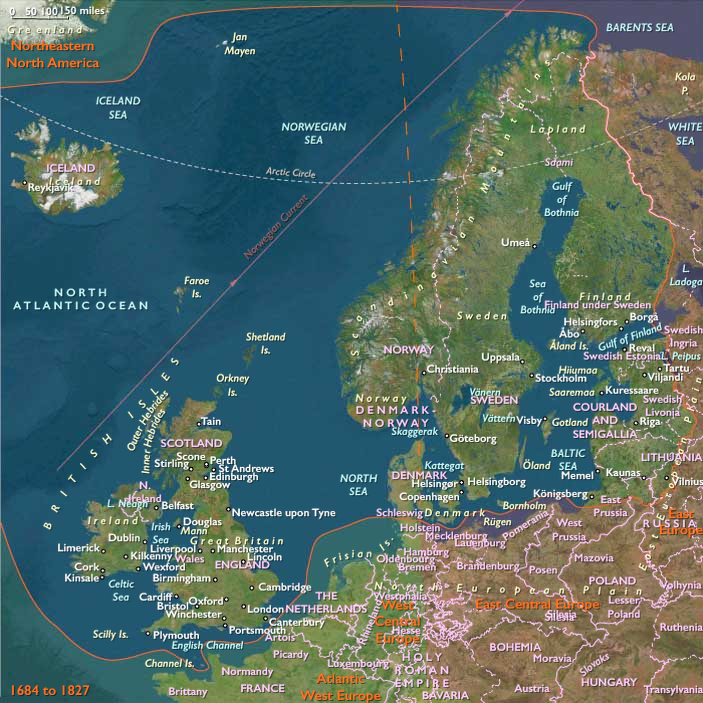
The French plans for a landing at Maldon in Essex.
A squadron under Jacques Aymar, comte de Roquefeuil, will sail from Brest, checking that the Channel between Dunkirk and the English coast is clear of the British fleet.
A message will then be sent to Saxe's invasion force at Dunkirk, informing them that the crossing is feasible.
Of the ten thousand active troops in Britain, seven thousand are deployed to defend London and South East England.
A declaration is drawn up for Maurice declaring that Louis XV has no territorial designs on England and has imposed no conditions on King James.
The rivalry between France and England is due only to the Elector of Hanover and is not in the interests of England.
Furthermore, Maurice's troops will be withdrawn as soon as a Stuart restoration occurs and commerce will bring mutual prosperity.
However, François de Bussy, a senior clerk in the French Foreign Office, informs the Duke of Newcastle (in a coded message) of the plans in return for two thousand pounds.
The message is decoded on February 14 and Bussy has named the Duke of Beaufort, Lord Barrymore, Wynn and Cotton.
This expedition had soon run into a fierce storm.
Twelve French transport ships had been sunk, seven of which went down with all hands.
The others had been severely damaged and forced to limp back into Dunkirk.
The French had made a mistake, believing that Norris's larger British fleet is currently in Portsmouth when it is in fact sitting off The Downs.
When Rocquefeuil arrives off Dungeness on February 24, he spots Norris' fleet and hastily retreats.
Norris pursues, but a violent storm suddenly descends—saving Rocquefeuil's squadron, which manages to avoid total destruction, although it is caught in the middle of the worst of the storm.
The British ships had been able to run swiftly into nearby harbors, and had escaped the storms' worst damages.
The French government cannot see any immediate prospect of a successful second attempt, and the troops are badly needed elsewhere.
Saxe's forces are removed from the expedition, and instead march into Flanders to fight the Dutch and Hanoverians.
Many are happy to return to what they see as a more conventional form of soldiering, after the terrors of their seaborne voyage.
Wade eventually advances towards Lille, but he does little more than bicker with the Austrians about the cost of moving his siege train from Antwerp.
Maurice de Saxe, Marshal of France, is able to maintain his position at Courtrai and along the lines of the Lys, and remain relatively untroubled throughout.
The risible results of the Allied campaign in the Low Countries have led in part to the fall of the Carteret government in Britain, leading to a new administration led by Henry Pelham and his brother, the Duke of Newcastle.
Elsewhere, the Pragmatic Allies in late 1744 score considerable success.
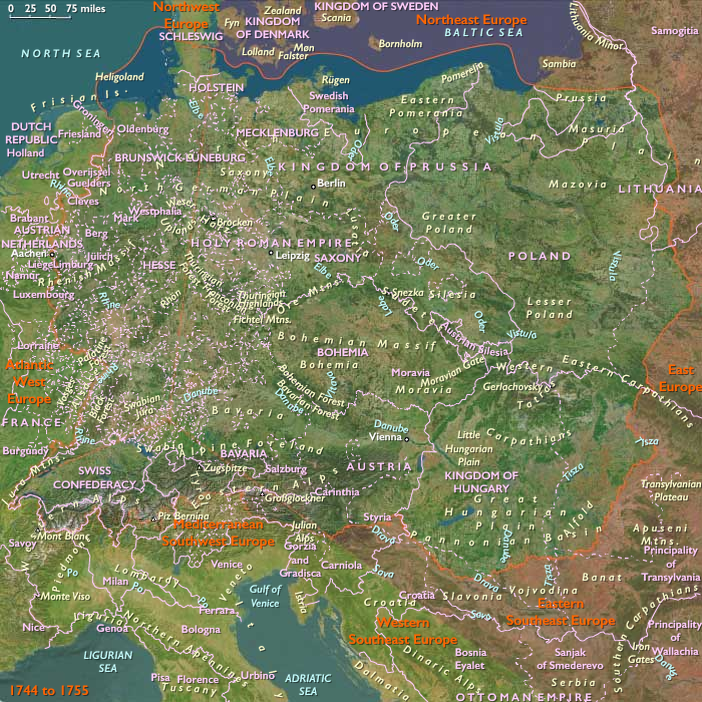
A joint Austro-Saxon force under Charles of Lorraine and Count Traun drives the Prussian army of Frederick II from Bohemia; and Piedmont-Sardinia expels the Bourbons from northern Italy.
The Battle off the Berlangas (May 8, 1744) and the War of the Austrian Succession
By the early 1740s, Britain and France were locked in an escalating struggle for maritime supremacy as part of the War of the Austrian Succession (1740–1748). The conflict had begun as a dispute over the Habsburg succession following the death of Holy Roman Emperor Charles VI, but it quickly evolved into a broader European war, with Britain, Austria, and the Dutch Republic opposing France, Spain, and Prussia. The war extended beyond continental battlefields, fueling a fierce naval rivalry between Britain and the Bourbon allies, France and Spain.
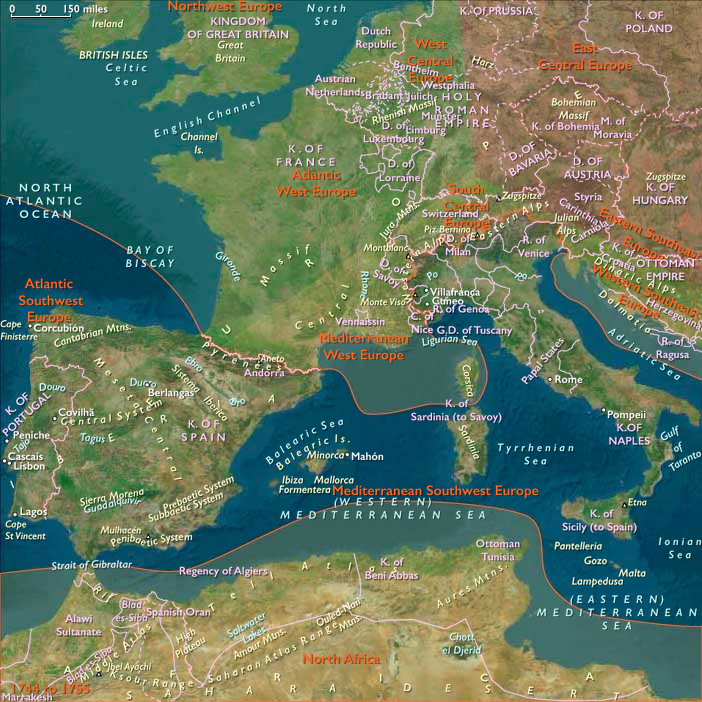
In this volatile environment, British naval squadrons patrolled European waters to counter French and Spanish movements. One such squadron, commanded by Sir Charles Hardy, was operating off the Berlangas, a small Portuguese archipelago west of Peniche, when it encountered an enemy sail on May 8, 1744. The Northumberland, a seventy-gun British ship of the line, was dispatched to investigate.
As it closed the distance, the Northumberland identified the vessel as the Mars, a sixty-four-gun French warship, accompanied by two other ships: the sixty-gun Content and a sixth-rate frigate. Despite the numerical disadvantage, Captain Thomas Watson—a man of unquestioned bravery but questionable tactical judgment—chose not to signal their presence to Vice-Admiral Hardy. Instead, he pressed forward under full sail, isolating himself from British support.
The French ships were widely dispersed, and by 5 PM, the Northumberland reached the Mars, engaging in a running battle. As the two exchanged volleys, Watson attempted to close the distance on the Content as well, intensifying the engagement into a multi-ship action. The Northumberland fought fiercely for nine hours, but under sustained French fire, she became unmanageable, her wheel shattered and her rigging severely damaged.
Amidst the chaos, Captain Watson was mortally wounded, and command fell into disorder. With the ship adrift and incapable of maneuvering, the Northumberland’s master—later court-martialed for surrendering without sufficient cause—struck the British colors, handing victory to the French.
Implications and Aftermath
The loss of the Northumberland was a serious blow to British naval prestige, demonstrating the risks of overzealous command decisions in isolated engagements. The event also underscored the increasing strategic importance of Portugal, a traditional British ally, whose coastline had become a contested zone in the Anglo-French naval struggle.
More broadly, this action reflected the larger challenges Britain faced in the early years of the War of the Austrian Succession. French naval forces were becoming bolder, and Britain’s reliance on isolated squadrons left them vulnerable to well-coordinated counterattacks. The defeat further motivated British naval strategists to strengthen squadron coordination and intelligence-sharing to avoid similar disasters.
By 1747, Britain had recovered from early setbacks, delivering decisive blows to the French navy at the First and Second Battles of Cape Finisterre, reinforcing British control of Atlantic trade routes. However, the events off the Berlangas in 1744 served as an important reminder of the perils of independent action and the enduring challenge of maritime warfare in the 18th century.