Oliver Cromwell
1st Lord Protector of the Commonwealth of England, Scotland and Ireland
Years: 1599 - 1658
Oliver Cromwell (25 April 1599 – 3 September 1658) is an English military and political leader best known in England for his involvement in making England into a republican Commonwealth and for his later role as Lord Protector of England, Scotland and Ireland.
Events that occur during his reign and his politics are a cause of animosity between Ireland and the UK.
He is one of the commanders of the New Model Army which defeats the royalists in the English Civil War.
After the execution of King Charles I in 1649, Cromwell dominates the short-lived Commonwealth of England, conquers Ireland and Scotland, and rules as Lord Protector from 1653 until his death from malaria in 1658.
Cromwell was born into the ranks of the middle gentry, and remained relatively obscure for the first 40 years of his life.
At times his lifestyle resembled that of a yeoman farmer until his finances were boosted thanks to an inheritance from his uncle.
After undergoing a religious conversion during the same decade, he made an Independent style of Puritanism an essential part of his life.
Cromwell is elected Member of Parliament for Cambridge in the Short (1640) and Long (1640–49) Parliaments, and later enters the English Civil War on the side of the "Roundheads" or Parliamentarians.
As a soldier, he is more than capable (nicknamed "Old Ironsides") and is quickly promoted from leading a single cavalry troop to command of the entire army.
Cromwell is one of the signatories of Charles I's death warrant in 1649 and is a member of the Rump Parliament (1649–1653), being chosen by the Rump to take command of the English campaign in Ireland during 1649–50.
He then leads a campaign against the Scottish army between 1650 and 1651.
On 20 April 1653 he dismisses the Rump Parliament by force, setting up a short-lived nominated assembly known as the Barebones Parliament before being made Lord Protector of England, Wales, Scotland and Ireland on 16 December 1653.
He is buried in Westminster Abbey, but when the Royalists return to power his corpse is dug up, hung in chains, and beheaded.
Cromwell has been a controversial figure in the history of the British Isles—a regicidal dictator to some historians (such as David Hume and Christopher Hill) and a hero of liberty to others (such as Thomas Carlyle and Samuel Rawson Gardiner).
In Britain he was elected as one of the Top 10 Britons of all time in a 2002 BBC poll.
His measures against Irish Catholics have been characterized as genocidal or near-genocidal, and in Ireland itself he is widely hated.
Related Events
Filter results
Showing 10 events out of 77 total
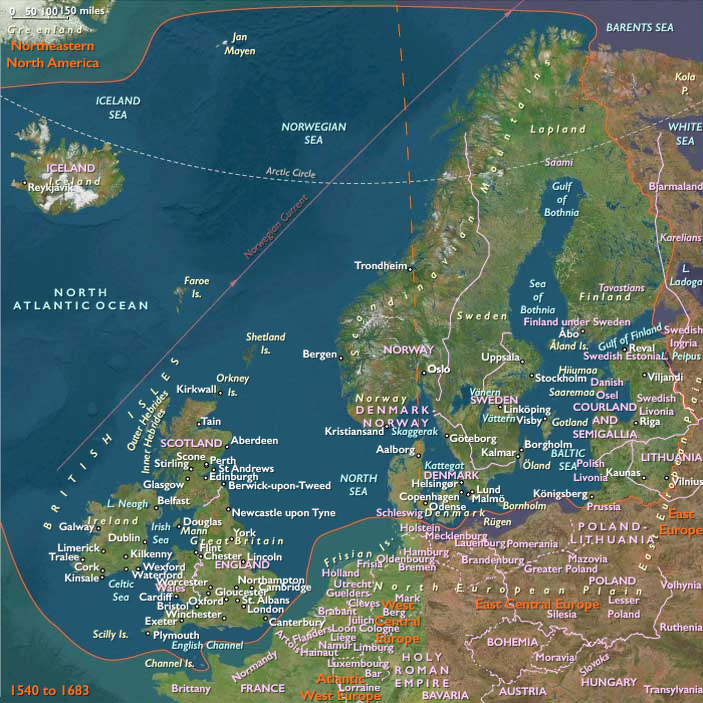
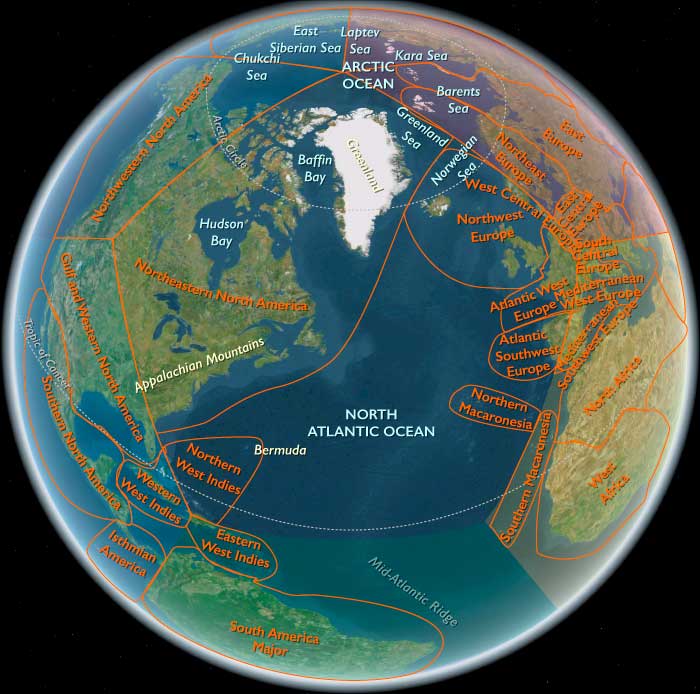
Northwest Europe (1540–1683 CE): Religious Turmoil, Colonial Expansion, and Political Transformation
Religious Turmoil and Conflicts
Between 1540 and 1683 CE, Northwest Europe was profoundly shaped by religious upheavals stemming from the Reformation. England experienced significant turbulence under Edward VI, Mary I, and Elizabeth I. Mary's Catholic restoration saw persecution of Protestants, earning her the title "Bloody Mary," marked notably by the burning of two hundred and seventy-four Protestants. Elizabeth I's moderate Anglican settlement established relative stability but intensified tensions with Catholic Spain, climaxing in the defeat of the Spanish Armada (1588). Scotland faced similar religious strife, culminating in the establishment of Presbyterianism under the influence of John Knox. Denmark became officially Lutheran around 1550 under King Christian III, solidifying Lutheranism's dominance throughout Scandinavia.
The English Civil War and Revolution
Political and religious tensions erupted in the English Civil War (1642–1651) between Royalists (Cavaliers) and Parliamentarians (Roundheads), ending with the execution of King Charles I and the establishment of a brief republican Commonwealth under Oliver Cromwell. Cromwell's subsequent military campaigns in Ireland (1649–1653) resulted in catastrophic losses, significantly reshaping Irish society. The monarchy was restored under Charles II in 1660, followed by political and religious instability under James II, culminating in the peaceful Glorious Revolution (1688), solidifying parliamentary authority and Protestant ascendancy.
Ireland: Conflict and Colonization
English colonization intensified significantly, notably through the Plantation of Ulster (1609) and the Tudor conquest initiated by Henry VIII's re-creation of the title King of Ireland in 1542. Irish resistance culminated in the Nine Years' War (1593–1603) and the consequential Flight of the Earls (1607). The Wars of the Three Kingdoms, particularly Cromwell’s conquest, inflicted severe demographic losses, including approximately two hundred thousand civilian deaths from famine, disease, and conflict-related displacement, and the forced indenture of fifty thousand to the West Indies.
Scottish Union and Cultural Renaissance
Scotland underwent significant religious and political upheaval leading to the Union of the Crowns (1603) under James VI of Scotland (later James I of England). Cultural and educational achievements flourished during the Scottish Renaissance, significantly enhancing Scottish literary and intellectual contributions.
Economic Expansion and Colonial Ventures
Economic transformations accelerated through colonial expansion, highlighted by English settlements such as Jamestown (1607) in North America, initiating extensive colonial activity. English immigration, particularly indentured servants, became prominent, with approximately seventy percent of arrivals between 1630–1660 as indentured labor. Trading companies, notably the East India Company (1600) and the Dutch East India Company (VOC, 1602), expanded global commerce, with London, Amsterdam, and Bristol emerging as key international trade hubs.
Scientific Revolution and Intellectual Growth
The era witnessed significant scientific breakthroughs and intellectual advancements. Figures like Francis Bacon, Robert Boyle, and Isaac Newton revolutionized natural philosophy, laying foundations for modern science. Institutions such as the Royal Society (1660) systematically promoted scientific inquiry and innovation.
Cultural Flourishing and Artistic Achievements
Cultural developments flourished significantly during this period. England’s literary scene was dominated by figures like William Shakespeare, contributing profoundly to drama and literature during the Elizabethan era, a period often regarded as England's golden age. Artistic accomplishments, notably by Dutch Golden Age painters like Rembrandt van Rijn and Johannes Vermeer, significantly influenced European art.
Norse Territories and Scandinavian Shifts
Iceland, under Danish-Norwegian control, formally adopted Lutheranism by 1550 following the execution of Catholic Bishop Jón Arason. The island continued facing severe economic and climatic challenges, significantly affecting societal structures and stability.
Environmental Challenges and the Little Ice Age
The Little Ice Age continued to exert considerable environmental pressures, severely impacting agricultural productivity across Northwest Europe. Societies adapted by diversifying economies, enhancing trade networks, and developing technological innovations to mitigate these stresses.
Social Unrest and Economic Pressures
Socio-economic disparities intensified, exacerbating rural and urban tensions, leading to frequent local uprisings and unrest. Economic shifts, agricultural crises, and urbanization pressures contributed significantly to social instability, prompting governmental interventions and reforms.
Legacy of the Age
By 1683 CE, Northwest Europe had experienced profound religious conflicts, political transformations, economic expansions, and cultural achievements. These dynamic developments deeply influenced regional identities, governance structures, economic conditions, and cultural traditions, firmly establishing frameworks that shaped modern Europe.

This control is further consolidated during the wars and conflicts of the seventeenth century, which witnesses English and Scottish colonization in the Plantations of Ireland, the Wars of the Three Kingdoms and the Williamite War.
Irish losses during the Wars of the Three Kingdoms (which, in Ireland, include the Irish Confederacy and the Cromwellian conquest of Ireland) are estimated to include twenty thousand battlefield casualties.
Two hundred thousand civilians are estimated to have died as a result of a combination of war-related famine, displacement, guerrilla activity and pestilence over the duration of the war.
A further fifty thousand are sent into indentured servitude in the West Indies.
Some historians estimate that as much as half of the pre-war population of Ireland may have died as a result of the conflict.
The defeat of the Royalist army by the New Model Army of Parliament at the Battle of Naseby in June 1645 effectively destroys the king's forces.
Charles surrenders to the Scottish army at Newark.
He is eventually handed over to the English Parliament in early 1647.
He escapes, and the Second English Civil War begins, although it is a short conflict, with the New Model Army quickly securing the country.
The capture and subsequent trial of Charles leads to his beheading in January 1649 at Whitehall Gate in London, making England a republic.
The trial and execution of Charles by his own subjects shocks the rest of Europe (the king had argued to the end that only God could judge him) and is a precursor of sorts to the beheading of Louis XVI one hundred and forty-five years later.
The New Model Army, under the command of Oliver Cromwell, now scores decisive victories against Royalist armies in Ireland and Scotland.
Cromwell is given the title Lord Protector in 1653, making him 'king in all but name' to his critics.
After he dies in 1658, his son Richard Cromwell succeeds him in the office but he is forced to abdicate within a year.
For a while it looks as if a new civil war will begin as the New Model Army splits into factions.
Troops stationed in Scotland under the command of George Monck eventually march on London to restore order.
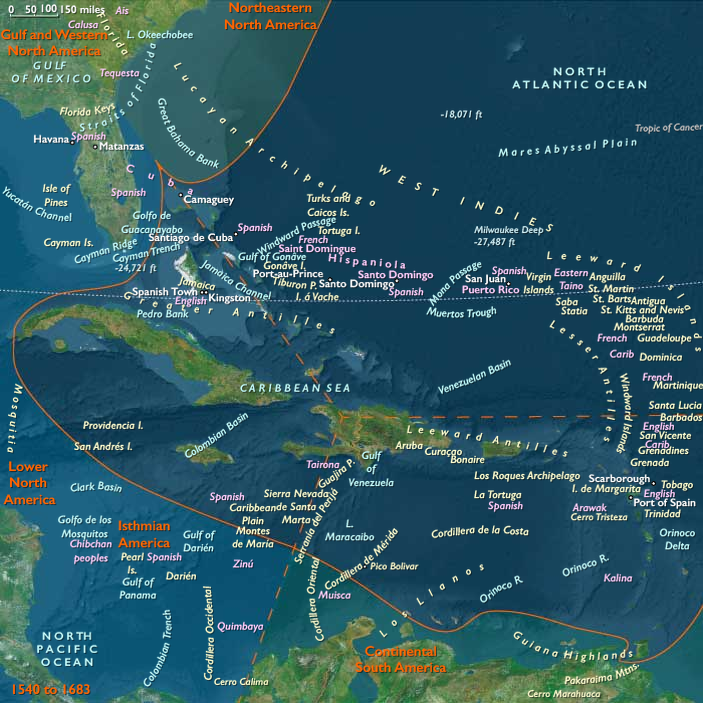
Eastern West Indies (1540–1683 CE): Consolidation, Resistance, and Maritime Corridors
Geographic & Environmental Context
The subregion of Eastern West Indies includes Trinidad, Saint Lucia, Barbados, most of Haiti, most of the Dominican Republic, Puerto Rico, and the Virgin Islands. Anchors included the Orinoco–Trinidad seaway, the Cordillera Central of Hispaniola, the karst valleys of Puerto Rico, and the volcanic arc from Saint Lucia through the northern Lesser Antilles. Coral reefs, fertile valleys, and hurricane-exposed coasts structured settlement and strategy.
Climate & Environmental Shifts
The Little Ice Age persisted with cooler decades and heightened hurricane frequency (notably mid-1600s). Drought cycles struck leeward islands; windward slopes on volcanic islands retained higher rainfall. Floods alternated with dry spells on Hispaniola’s north, shaping ranching and smallholder agriculture.
Subsistence & Settlement
-
Spanish Hispaniola and Puerto Rico: After demographic collapse, Spanish society reorganized around cattle hatós (ranches), small farms, and coastal towns. Enslaved Africans and their descendants worked ranches, mines (declining), and ports; free Afro-descended communities grew in rural zones.
-
Trinidad & the Lesser Antilles: Kalinago (Carib) communities maintained shifting cultivation, fishing, and canoe raiding/trading networks; Spanish footholds remained tenuous outside main towns.
-
Barbados (from 1627, English): Rapid plantation shift to sugar with enslaved African labor; small farms gave way to estates, and the island became a key English sugar hub.
-
Virgin Islands & northern Lesser Antilles: Intermittent Spanish presence met rising French and English settlements (mid-17th century), while Kalinago resistance persisted from strongholds on mountainous isles.
Technology & Material Culture
Spanish towns displayed masonry churches, plazas, and coastal forts; ranching technologies (lasso, corral, brand) dominated Hispaniola’s interior. English Barbados installed wind-powered sugar mills, boiling houses, and curing facilities; plantation house forms and stone/brick windmills dotted ridges. Afro-Caribbean craft, music, and cuisine expanded—ironwork, basketry, drum traditions—blending with European and surviving Taíno elements. Kalinago weaponry (bow, lance) and seaworthy canoes underpinned mobility and defense.
Movement & Interaction Corridors
-
Treasure-fleet and convoy routes funneled through the Windward Passage and past Puerto Rico; Havana remained the principal rally point, but Hispaniola’s north and Puerto Rico supplied cattle, hides, and timber.
-
Barbados–England–North America circuits exported sugar and imported provisions, enslaved people, and equipment.
-
Kalinago canoe corridors linked Saint Lucia, Dominica, Guadeloupe, and the Virgin Islands for trade/raids, intercepting colonial shipping.
-
Smuggling networks connected Hispaniola’s north with Tortuga and Saint-Domingue (French) for hides, tobacco, and textiles.
Cultural & Symbolic Expressions
Spanish Catholicism structured public ritual on Hispaniola and Puerto Rico, while Afro-descended confraternities and cabildos nurtured mutual aid and syncretic devotion. On Barbados, Anglican worship anchored planters’ identity; African ritual life persisted covertly in quarters and nighttime gatherings. Kalinago spirituality—ancestor veneration, warrior rites, and healing—remained central to island autonomy. Music, drum/dance, and festival cycles expressed memory and power across all societies.
Environmental Adaptation & Resilience
Hurricane rebuilding fostered stone foundations, buttressed churches, and wind-smart siting. On Hispaniola, mixed herding–cropping buffered drought; free and enslaved Afro-descended farmers sustained provision grounds (cassava, plantains, yams). Barbados shifted soils under cane; provision plots and inter-island provisioning mitigated food shortfalls. Kalinago mobility and upland refuges enabled long resistance amid encroaching colonies.
Transition
By 1683 CE, the Eastern West Indies had polarized: Spanish Hispaniola and Puerto Rico stabilized as provisioning and ranching nodes; Barbados rose as England’s sugar powerhouse; Kalinago strongholds still contested the Lesser Antilles even as French and English settlements multiplied. The subregion’s future would pivot on sugar-driven slavery, imperial rivalry, and the endurance of Afro-Caribbean and Indigenous lifeways.
The stagnation that will prevail in Santo Domingo until the end of the nineteenth century is interrupted on several occasions by armed engagements, as the French and British attempt to weaken Spain's economic and political dominance in the New World.
The British admiral, Sir Francis Drake, captures the city of Santo Domingo in 1586 and collects a ransom for its return to Spanish control.
Oliver Cromwell dispatches a British fleet commanded by Sir William Penn to take Santo Domingo in 1655.
After meeting heavy resistance, the British sail farther west and take Jamaica instead.
Jamaica at this time as a population of about three thousand, equally divided between Spaniards and their slaves—the native population having been eliminated.
Although Jamaica is a disappointing consolation for the failure to capture either of the major colonies of Hispaniola or Cuba, the island is retained in the Treaty of Madrid in 1670, thereby more than doubling the land area for potential English colonization in the Caribbean.
Jamaica will be the most important of Britain's Caribbean colonies by 1750, having eclipsed Barbados in economic significance.
Northwest Europe (1636–1647 CE): Civil Strife, Colonial Expansion, and Intellectual Achievement
England: Civil War and Turmoil
The tensions between Charles I and Parliament culminated in open conflict with the outbreak of the English Civil War in 1642. The king's authoritarian policies, religious controversies, and resistance to parliamentary authority led to a brutal struggle between Royalists (supporters of the monarchy) and Parliamentarians (advocates of parliamentary governance). Prominent leaders such as Oliver Cromwell emerged, significantly influencing the Parliamentarian cause. Battles such as Edgehill (1642), Marston Moor (1644), and Naseby (1645) were pivotal, ultimately resulting in Charles's defeat and subsequent imprisonment.
Ireland: Rebellion and Conflict
In 1641, Ireland erupted into rebellion as the Catholic Gaelic and Old English populations sought to reverse decades of plantation policies and Protestant domination. This uprising swiftly escalated into the Irish Confederate Wars, intertwining with the broader conflicts across Britain and Ireland, further complicating the turbulent political landscape.
Scotland: Covenanters and Wars of the Three Kingdoms
Scotland, deeply affected by Charles I's religious policies, witnessed the outbreak of the Bishops' Wars in 1639 and 1640, driven by Presbyterian Covenanters resisting Anglican influence. By 1643, Scotland allied formally with the English Parliamentarians through the Solemn League and Covenant, playing a critical role in shaping the outcome of the civil wars across the British Isles.
Scandinavia: Denmark-Norway’s Continuing Struggles
Christian IV struggled to restore Danish influence following earlier military defeats. Although he pursued internal reforms and fortifications, Denmark-Norway remained politically weakened, grappling with ongoing economic and military setbacks that constrained its ambitions in European affairs.
Maritime and Colonial Developments
The English East India Company expanded its commercial presence in India significantly during this period. The hospitality initially extended by the Mughal emperor Jahangir was further consolidated under his successor Shah Jahan, resulting in increased English influence and the expansion of trade networks, particularly in commodities like cotton, silk, indigo, and tea. Concurrently, English colonial ventures in North America continued to flourish, with Massachusetts Bay Colony and other New England settlements experiencing substantial growth, laying foundational structures for future American colonial expansion.
Scientific and Intellectual Advances
The period remained intellectually vibrant, marked by ongoing developments in natural philosophy and science. The legacy of Francis Bacon’s inductive methods continued to inspire researchers, while significant strides were made in mathematics and astronomy. In 1637, René Descartes published Discourse on Method, greatly influencing European thought, including intellectual circles in Northwest Europe.
Cultural Flourishing Amidst Conflict
Despite political upheaval, cultural life in Northwest Europe persisted robustly. Literature thrived, with the emergence of works such as John Milton’s early poetry, reflecting the intense religious and political debates of the era. Music and theater continued to evolve, capturing the complexities and turbulence of contemporary society.
Legacy of the Era
By 1647 CE, Northwest Europe was profoundly transformed. England stood on the precipice of a republic as Charles I awaited trial and the balance of power shifted decisively toward Parliament. Ireland and Scotland remained entangled in complex conflicts tied to broader struggles across the British Isles. Meanwhile, the region's cultural and intellectual advancements set the stage for future developments, marking the era as one of profound transition.
Strafford, who had become the immediate target of the Parliamentarians, stands trial for high treason in March 1641.
The incident provides a new departure for Irish politics whereby Old English, Gaelic Irish and New English settlers join together in a legal body to present evidence against Strafford.
The Lords are opposed, however, to the severity of the sentence of death imposed upon Strafford on the 22nd of March, and the evidence supplied by Vale in relation to Strafford's alleged improper use and threat to England via the Irish army is not upheld by another witness, and the case consequently begins to flounder.
Moreover, Strafford's life ultimately lies in Charles' hands as his execution cannot go ahead unless the king signs the Bill of Attainder.
Yet, increased tensions and an attempted coup by the army in favor of Strafford begin to sway the issue.
In the Commons the Bill goes virtually unopposed (two hundred and four in favor, fifty-nine opposed, two hundred and fifty abstained), the Lords acquiesced, and Charles, fearing for the safety of his family, signs on May 10.
The Earl of Strafford is beheaded two days later.
Charles, in a development even more far-reaching than the Triennial Act, assents in May to an Act which provides that Parliament cannot be dissolved without its own consent.
The Root and Branch Petition forms the basis of the Root and Branch Bill, which is drawn up by Oliver St. John and in May introduced in Parliament by Henry Vane the Younger and Oliver Cromwell.
Oliver Cromwell reorganizes Parliament’s armies, on February 15, 1645, founding the New Model Army.
The nuncio considers himself the virtual head of the Confederate Catholic party in Ireland.
The Supreme Council of the Confederates has come to an agreement with Ormonde, signed March 28, 1646.
Under its terms, Catholics will be allowed to serve in public office and find schools; there are also verbal promises of future concessions on religious toleration.
There is an amnesty for acts committed in the Rebellion of 1641 and a guarantee against further seizure of Irish Catholic land.
The Supreme Council also puts great hope in a secret treaty they have concluded with the Earl of Glamorgan on the King's behalf, which promises further concessions to Irish Catholics in the future.
However, there is no reversal of Poynings Law which subordinates the Irish Parliament to the English one, no reversal of the Protestant domination of Parliament and no reversal of the main plantations, or colonization, in Ulster and Munster.
Moreover, regarding the religious articles of the treaty, all churches taken over by Catholics in the war will have to be returned to Protestant hands and public practice of Catholicism is not guaranteed.
In return for the concessions that are made, Irish troops are to be sent to England to fight for the royalists in the English Civil War.
However, the terms agreed are not acceptable to either the Catholic clergy, the Irish military commanders—notably Owen Roe O'Neill and Thomas Preston—or the majority of the General Assembly.
Nor is Rinuccini the papal nuncio party to the treaty, which leaves untouched the objects of his mission; he had induced nine of the Irish bishops to sign a protest against any arrangement with Ormonde or the king that will not guarantee the maintenance of the Catholic religion.