Philip II of France
King of France
Years: 1165 - 1223
Philip II Augustus (French: Philippe Auguste; 21 August 1165 – 14 July 1223) is the King of France from 1180 until his death.
A member of the House of Capet, Philip Augustus was born at Gonesse in the Val-d'Oise, the son of Louis VII and his third wife, Adela of Champagne.
He was originally nicknamed Dieudonné—the God-given—as he was the first son of Louis VII late in his father's life.
Philip is one of the most successful mediaeval French monarchs in expanding the royal demesne and the influence of the monarchy.
He breaks up the great Angevin Empire and defeats a coalition of his rivals (German, Flemish and English) at the Battle of Bouvines in 1214.
He reorganizes the government, bringing financial stability to the country and thus making possible a sharp increase in prosperity.
His reign is popular with ordinary people because he checks the power of the nobles and passes some of it on to the growing middle class.


Related Events
Filter results
Showing 10 events out of 147 total
French knights make up the bulk of the steady flow of reinforcements throughout the two-hundred-year span of the Crusades, in such a fashion that the Arabs uniformly refer to the crusaders as Franj caring little whether they really come from France.
The French Crusaders also import the French language into the Levant, making French the base of the lingua franca (lit. "Frankish language") of the Crusader states.
French knights also comprise the majority in both the Hospital and the Temple orders.
The latter, in particular, hold numerous properties throughout France and by the thirteenth century were the principal bankers for the French crown, until Philip IV annihilates the order in 1307.
The Albigensian Crusade is launched in 1209 to eliminate the heretical Cathars in the southwestern area of modern-day France.
In the end, the Cathars are exterminated and the autonomous County of Toulouse is annexed into the kingdom of France.
Later French kings expand their domain to cover over half of modern continental France, including most of the north, center and west of France.
Meanwhile, the royal authority become more and more assertive, centered on a hierarchically conceived society distinguishing nobility, clergy, and commoners.
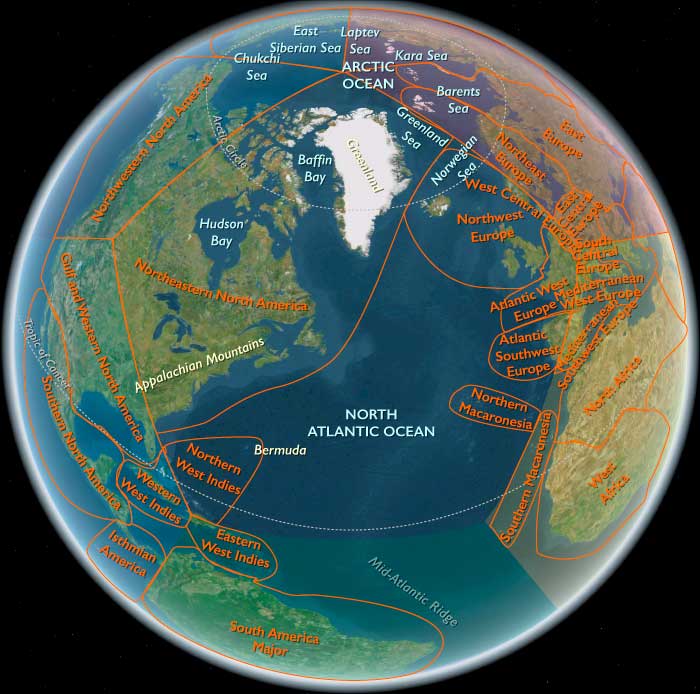
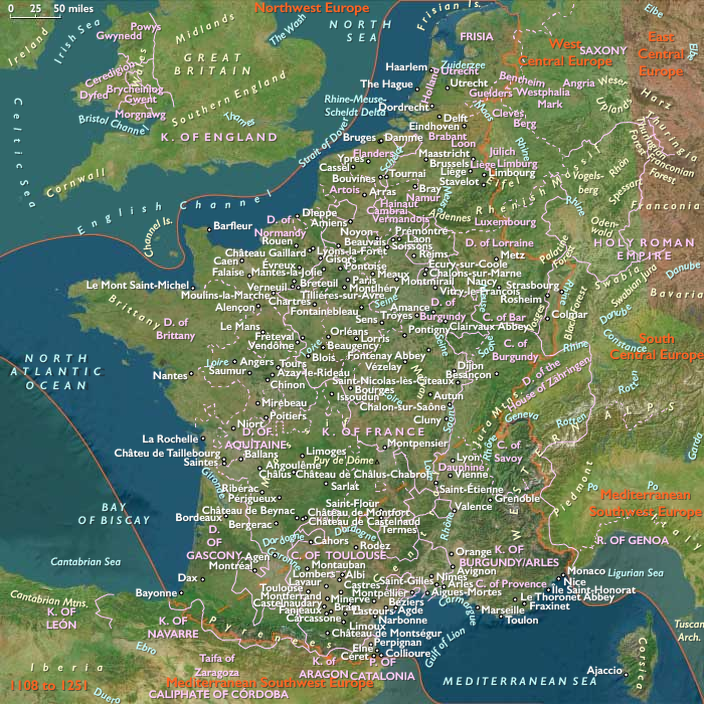
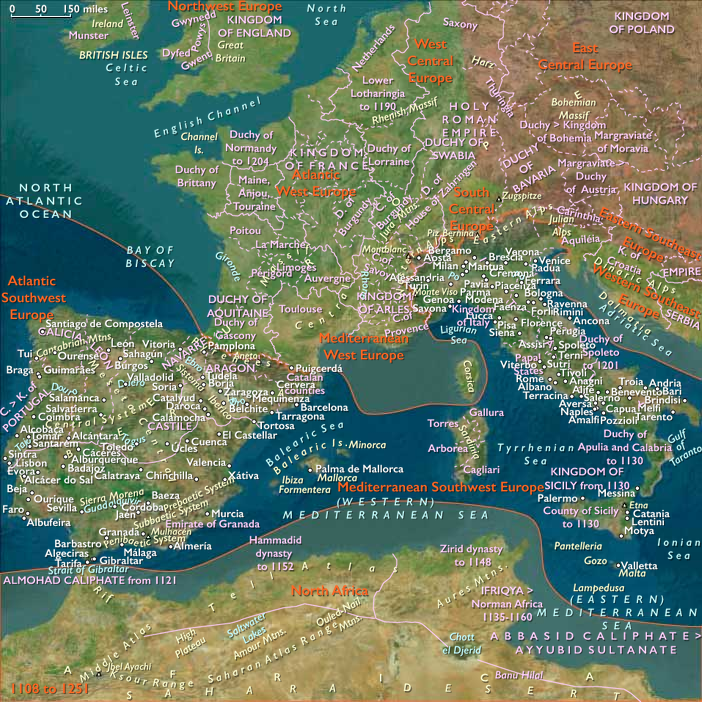
Atlantic West Europe (1108 – 1251 CE): The Angevin Empire, Champagne–Flanders Circuits, and Aquitaine under the English Crown
Geographic and Environmental Context
Atlantic West Europe spans northern France and the Low Countries.
-
Anchors: Paris–Seine–Reims, Upper Loire (Orléans–Blois–Tours), Anjou/Angers–Maine–Le Mans, Poitou/Poitiers–La Rochelle–Saintes, Bordeaux–Gironde–Bayonne, Flanders/Bruges–Ghent–Ypres, Low Countries delta.
Climate and Environmental Shifts
-
High-medieval peak supported population and urbanization; river improvements eased up-country grain and wine traffic.
Societies and Political Developments
-
Eleanor of Aquitaine married Louis VII (1137), annulled (1152), then married Henry II Plantagenet (1152)—creating the Angevin Empire (from Anjou/Normandy to Aquitaine).
-
Capetian–Angevin rivalry dominated: Philip II conquered Normandy (1204), but Aquitaine/Guyenne largely remained under English suzerainty; La Rochelle and Bordeaux became Angevin pillars.
-
Flanders and Champagne fairs integrated Mediterranean–northern circuits; communes of Bruges, Ghent, Ypres asserted charters.
-
Brittany navigated between Plantagenets and Capetians.
Economy and Trade
-
Bordeaux claret exports to England boomed; La Rochelle shipped salt and wine; Nantes handled salt fish and grain.
-
Flanders/Champagne fairs: Italian capital met northern cloth; Bruges emerged as a banking mart.
-
Upper Loire and Anjou–Touraine supplied wine/grain to Paris and ports.
Belief and Symbolism
-
Gothic beginnings in Chartres, Paris; pilgrimage roads of Poitou–Bordeaux remained crowded.
Long-Term Significance
By 1251, Aquitaine was England’s continental anchor; Flanders the cloth workshop; Paris–Loire the Capetian core—poised for 13th–14th-century contests.
Broad Overview of High Medieval Atlantic West Europe (1108–1251 CE): Northern & Western France and the Low Countries
From 1108 to 1251, Atlantic West Europe—which includes northern and western France as well as the Low Countries (modern Netherlands, Belgium, and Luxembourg)—underwent profound transformations in political power, economic expansion, military conflicts, and cultural development.
This period saw:
- The consolidation of Capetian power in France, particularly under Philip II Augustus (r. 1180–1223) and Louis IX (r. 1226–1270).
- The decline of Plantagenet (Angevin) control in western France, culminating in the loss of Normandy, Anjou, and Poitou to the French Crown (1204–1259).
- The economic rise of the Low Countries, especially in Flanders, Brabant, and Holland, as centers of textile production and trade.
- The growing power of Burgundy, Champagne, and Lorraine, balancing between French royal authority and the Holy Roman Empire.
1. Political and Military Developments
The Capetian Expansion and the Decline of the Angevin Empire
- Philip II Augustus (r. 1180–1223) decisively defeated John of England, reclaiming Normandy, Anjou, Maine, and Poitou (1204).
- The Battle of Bouvines (1214), where Philip defeated an English-Flemish-Imperial coalition, solidified French dominance in the north.
- The Battle of Taillebourg (1242) further weakened English influence in Gascony and Poitou.
- Despite these victories, Gascony remained under English control, leading to ongoing Franco-English tensions.
The Low Countries: A Political and Economic Powerhouse
- Flanders and Brabant became crucial economic hubs, balancing alliances between France, England, and the Holy Roman Empire.
- The War of the Succession of Flanders (1185–1206) saw French intervention, culminating in Philip II’s victory over Count Baldwin IX of Flanders.
- Burgundy, Champagne, and Lorraine remained contested borderlands between France and the Empire, with frequent feudal conflicts.
- The Stedinger Crusade (1232–1234) in northwestern Germany saw the suppression of Frisian settlers resisting noble authority.
2. Economic and Urban Expansion
The Low Countries: The Rise of a Commercial Power
- Flanders, Brabant, and Holland became leading trade and textile centers, with major cities such as:
- Bruges and Ghent (Flanders) – Textile production and trade hubs.
- Brussels and Antwerp (Brabant) – Growing financial centers.
- Dordrecht and Haarlem (Holland) – Maritime and fishing economies.
- The Hanseatic League began expanding into Dutch and Flemish waters, increasing Baltic-North Sea trade links.
France: Regional Economic Growth
- Champagne Fairs (held in cities like Troyes and Provins) became key international trade markets, connecting merchants from Italy, Spain, and the Low Countries.
- Bordeaux and La Rochelle emerged as maritime trade centers, linking France to England and the Mediterranean.
- Wine production flourished in Gascony and Burgundy, fueling export economies.
3. Religious and Cultural Developments
Gothic Architecture and the High Middle Ages Cultural Boom
- Major cathedrals were constructed across the region, marking the height of French High Gothic and Rayonnant styles:
- Notre-Dame de Paris (begun 1163, completed c. 1240s)
- Reims Cathedral (begun 1211) – Coronation site of French kings.
- Amiens Cathedral (begun 1220) – Tallest of the High Gothic cathedrals.
- Sainte-Chapelle (1246–1248) – Built by Louis IX to house relics from Constantinople, showcasing the height of Rayonnant Gothic.
The Inquisition and Religious Tensions
- The Albigensian Crusade (1209–1229) led to the fall of the Cathar heresy in Languedoc, strengthening Capetian control over southern France.
- Pope Gregory IX formally established the Papal Inquisition in 1231, appointing Robert le Bougre ("Hammer of Heretics") as an inquisitor in Burgundy.
- In 1242, Christian zealots burned 24 cartloads of Talmud manuscripts in Paris, marking a period of increasing institutionalized anti-Jewish policies.
The Rise of Universities and Intellectual Thought
- The University of Paris became a leading center of Scholasticism, with thinkers like:
- Alexander of Hales, who introduced Aristotelian logic into theology.
- William of Auvergne, who worked to reconcile Augustine with Aristotle.
- The University of Orléans emerged around 1230, as a center of legal studies, focusing on Roman and canon law.
- Johannes de Sacrobosco’s Tractatus de Sphaera (c. 1230) became the leading astronomical text of the era.
4. The Strengthening of Monarchical Authority
France: The Rise of a Centralized State
- Philip II Augustus expanded royal justice, limiting noble autonomy.
- Louis IX (Saint Louis) sent enquêteurs (royal commissioners) in 1247 to investigate local governance, ensuring administrative accountability.
- The French monarchy increased control over taxation and trade, strengthening its financial power.
Burgundy, Champagne, and Lorraine: Balancing Between France and the Empire
- Burgundy remained a semi-independent duchy, balancing feudal allegiances between France and the Holy Roman Empire.
- The War of the Succession of Champagne (1216–1222) highlighted tensions between French royal influence and regional autonomy.
- In Lorraine, Theobald I’s rebellion against Frederick II (1218) led to a brief imperial occupation and restructuring of local power.
The Low Countries: Increasing Autonomy
- The Counts of Flanders and Holland navigated a delicate balance between England and France, using their economic power to resist complete subjugation.
- Haarlem (1245) and Delft (1246) received city rights, reflecting the increasing urban autonomy and self-governance of Dutch cities.
Conclusion: The Transformation of Atlantic West Europe by 1251
By 1251, northern and western France and the Low Countries had undergone profound transformations:
- Capetian France had become the dominant power, solidifying control over Normandy, Anjou, and Poitou while increasing royal administration.
- England had lost most of its continental holdings, retaining only Gascony, leading to a shift in its focus toward maritime power and internal governance.
- The Low Countries had risen as economic centers, with cities like Bruges, Ghent, and Antwerp becoming major trading hubs.
- Burgundy, Champagne, and Lorraine remained contested border regions, balancing imperial and French influences.
- Religious, architectural, and intellectual advancements flourished, positioning the region at the heart of medieval European culture and governance.
These changes set the stage for the Late Middle Ages, shaping the Hundred Years’ War, the continued growth of urban economies, and the increasing centralization of power in France and the Low Countries.
Philip II and the Collapse of the Angevin Empire (1180–1223)
The ascension of Philip II Augustus in 1180 marked a turning point in the balance of power. Unlike his predecessors, Philip II aggressively pursued policies aimed at dismantling Angevin dominance. Through careful diplomacy and military campaigns, he exploited the internal divisions among Henry II's heirs, particularly after Richard I’s death in 1199 and the succession crisis involving John of England.
Philip’s decisive victory at the Battle of Bouvines in 1214 crushed Anglo-Angevin ambitions in Normandy, permanently integrating it into the French crown. The subsequent loss of Anjou, Maine, and Touraine weakened English influence on the continent, leaving Aquitaine as the last major English holding in Atlantic West Europe.
Philip's reign also saw the expansion of royal institutions, including the bailliage system, which increased the crown’s control over provincial administration, laying the foundation for a centralized French monarchy.
His successor, his younger brother John, loses much of those territories including Normandy following the disastrous Battle of Bouvines in 1214, despite having in 1212 made the Kingdom of England a tribute-paying vassal of the Holy See, which it will remain until the fourteenth century when the Kingdom rejected the overlordship of the Holy See and re-establishes its sovereignty.
The Anglo-French Rivalry Over Berry and the 1177 Nonaggression Treaty
The peace agreement of 1174 between Henry II of England and Louis VII of France had failed to resolve their long-standing territorial disputes. By the late 1170s, tensions resurfaced as the two kings began to compete for control of Berry, a prosperous and strategically important region in central France.
Henry II’s Claim to Berry and His Political Maneuvering (1176–1177)
- Henry II had some rights to western Berry, but in 1176, he made a far-reaching claim that in 1169, he had agreed to give Berry to Alice (Alys), daughter of Louis VII, as part of her marriage settlement to Richard the Lionheart.
- If Louis VII accepted this claim, it would imply that Berry had already been under Henry’s control, giving Henry the right to occupy the province on Richard’s behalf.
- This move was designed to undermine Louis’ authority while allowing Henry to legitimately expand his influence in central France.
- In response, Henry mobilized his armies, preparing for war to force Louis to recognize his claim.
The Papal Intervention and the September 1177 Nonaggression Treaty
-
As hostilities loomed, the Papacy intervened, urging the two kings to seek a peaceful resolution.
-
Likely as Henry had anticipated, the Papal mediators encouraged Henry and Louis to sign a nonaggression treaty in September 1177, which:
- Committed both kings to peace.
- Promised joint participation in a Crusade, aligning them with Papal interests.
-
This diplomatic agreement temporarily de-escalated tensions and allowed Henry to pursue his territorial ambitions through arbitration rather than war.
Henry II’s Diplomatic Victory: Control Over Berry and La Marche
- The dispute over Berry and the Auvergne was submitted to an arbitration panel, which ruled in Henry’s favor.
- Strengthened by this success, Henry followed up by purchasing La Marche from the local count, further expanding his Angevin holdings.
The Fragility of the Peace and Its Consequences
- While Henry’s diplomatic maneuvering allowed him to expand his power without military conflict, his gains directly threatened French security.
- The expansion of the Angevin Empire into central France once again unsettled Capetian authority, putting the fragile peace at risk.
- This ongoing territorial competition set the stage for continued conflict between the Plantagenets and the Capetians, tensions that would eventually lead to the rise of Philip Augustus and the erosion of Angevin dominance in France.
Henry’s 1177 territorial gains in Berry and La Marche were a major success, but they also ensured that the rivalry between the Angevins and Capetians would continue to define medieval European politics.
Atlantic West Europe (1180–1191): Capetian Revival, Angevin Strains, and Cultural Dynamism
Between 1180 and 1191, Atlantic West Europe—including the Low Countries, Brittany, Normandy, Aquitaine, Burgundy, central France, Alsace, and Franche-Comté—experienced a significant shift in regional dynamics, marked by a Capetian revival under Philip II Augustus, growing strains within the Angevin Empire, vibrant cultural and economic activity, and intensified crusading zeal.
Political and Military Developments
-
Capetian Revival under Philip II Augustus
- Philip II Augustus (r. 1180–1223) ascended the French throne, inaugurating an era of renewed royal strength, asserting Capetian authority by actively challenging Angevin dominance.
- Philip skillfully exploited internal Angevin rivalries to reclaim territories, significantly strengthening royal authority and centralization in France.
-
Internal Strife within the Angevin Empire
- Henry II (r. 1154–1189) faced escalating internal revolts led by his sons, including Richard (the future Richard I "the Lionheart") and John, with support from Queen Eleanor and external backing from the Capetian crown.
- Persistent revolts weakened Angevin cohesion, culminating in the defeat and subsequent death of Henry II (1189), and the accession of Richard I (r. 1189–1199).
-
Brittany and Normandy Amid Shifting Alliances
- Brittany’s ducal authority was increasingly tied to the Angevin family through the marriage of Geoffrey Plantagenet and Duchess Constance (1181), integrating Brittany deeper into Angevin politics and struggles.
- Normandy remained an Angevin stronghold, though increasingly contested by Philip Augustus.
-
Burgundy and the Low Countries: Stability and Growth
- Hugh III of Burgundy (r. 1162–1192) successfully navigated regional rivalries, maintaining stability through diplomatic neutrality and economic prosperity.
- The Low Countries, particularly Flanders, thrived economically despite minor conflicts and remained politically stable.
Economic and Social Developments
-
Economic Prosperity and Urban Growth
- Rapid expansion of trade networks supported prosperity in Flanders (Bruges, Ghent, Ypres), Normandy (Rouen, Caen), and Champagne.
- Increased urbanization supported communal institutions and early civic self-government, particularly in towns of northern France and the Low Countries.
-
Rural Development and Agricultural Innovation
- Advances in agricultural methods facilitated population growth and supported the expansion of market-oriented farming, especially in the fertile regions of northern and central France.
Cultural and Intellectual Developments
-
Gothic Architecture and Artistic Patronage
- Gothic architecture flourished dramatically, notably through continued construction at Notre-Dame de Paris and the cathedrals of Chartres and Laon, marking a golden era for architectural innovation and artistic achievement.
-
Literary and Courtly Culture
- Troubadour poetry and courtly literature thrived, heavily influenced by Eleanor of Aquitaine’s patronage and the aristocratic courts of Aquitaine and Normandy.
- Chrétien de Troyes produced his most influential Arthurian romances during this period, profoundly impacting European literary culture.
-
Intellectual Expansion
- The University of Paris attracted leading scholars, solidifying its place as Europe's intellectual capital, advancing scholastic theology, philosophy, and canon law.
Religious Developments
-
Third Crusade (1189–1192) and Regional Impact
- The fall of Jerusalem (1187) to Saladin triggered widespread religious fervor, influencing significant crusading participation from the region, notably by Philip II Augustus and Richard I.
-
Monastic Influence and Spiritual Movements
- Cistercian monasteries continued their rapid expansion, promoting monastic reforms, educational development, and agricultural innovations across Atlantic West Europe.
Legacy and Significance
The period 1180 to 1191 was transformative, characterized by a Capetian resurgence under Philip Augustus, internal Angevin turmoil, and vibrant cultural activity. This era laid crucial foundations for the enduring rivalry between Capetian France and the Angevin territories, shaped regional political alignments, and saw significant cultural achievements—especially in Gothic architecture and literature—that defined Atlantic West Europe's trajectory into the thirteenth century.
The Establishment of Artois as a Territorial Principality (1180 CE)
Artois, originally a Carolingian lordship (comitatus) in West Francia, has a history tracing back to Roman and early medieval times. It was once part of the Roman provinces of Belgica and Germania Inferior, inhabited first by Celtic tribes and later by Germanic peoples as the Roman Empire declined.
Early History and Integration into Flanders
- The lordship of Artois was established by Counts Odalric and Ecfrid.
- From 898 onward, it was gradually absorbed into the County of Flanders by Count Baldwin II, a process completed under his son, Count Arnulf I.
- As part of Flanders, Artois became a strategic region due to its wealth, fertile lands, and important trade routes.
The Creation of Artois as a Separate Principality (1180)
- In 1180, Philip of Alsace, Count of Flanders, granted Artois as a dowry to his niece, Isabelle of Hainaut, upon her marriage to King Philip II of France.
- This effectively divided Flanders, creating a new territorial principality of Artois, now under Capetian influence.
- This division weakened Flemish control over northern France while strengthening the French monarchy, further shifting the balance of power in the region.
Significance of the 1180 Division
- Artois became a Capetian possession, marking the beginning of France’s territorial expansion into former Flemish lands.
- It remained a strategically valuable region, later playing a key role in Capetian-Plantagenet conflicts and the Hundred Years’ War.
- The marriage of Isabelle of Hainaut to Philip II not only secured French claims to Artois but also reinforced the Capetian dynasty’s growing dominance in France.
The creation of Artois as a separate principality in 1180 was a pivotal moment in medieval French history, marking a shift in power from Flanders to the Capetian monarchy, a pattern that would continue over the following centuries.
The Early Reign of Philip II of France (1179–1180): His Rise to Power
Philip II, the son of Louis VII and Adela of Champagne, was born in Gonesse on August 21, 1165. From an early age, his father intended for him to share the throne, ensuring a stable succession for the Capetian dynasty. However, his coronation was delayed due to a near-fatal incident in 1179, which would ultimately accelerate his rise to power.
Philip’s Near-Death Experience and Louis VII’s Decline
- At the age of thirteen, Philip became lost in the Forest of Compiègne during a royal hunt, separated from his companions.
- He wandered throughout the night, struggling against cold, hunger, and exhaustion, before being found by a peasant with a charcoal burner.
- The ordeal left him severely ill, developing a high fever that threatened his life.
- His father, Louis VII, went on pilgrimage to the Shrine of Thomas Becket in Canterbury, praying for his son’s recovery.
- While Philip did recover, Louis suffered a stroke on his way back to Paris, leaving him in rapidly declining health.
Philip’s Coronation as Co-King (November 1, 1179)
- Due to Louis VII’s failing health, Philip was crowned co-king and anointed at Reims Cathedral on November 1, 1179, by Archbishop William Whitehands.
- Although Louis VII remained king in name, real power passed to Philip, who now effectively ruled France.
Philip’s Arrest and Ransom of the Jews (January 1180)
- While Louis VII had attempted to protect the Jewish population, Philip took a more aggressive stance.
- On January 9, 1180, he ordered the mass arrest of Jews found in Parisian synagogues on the Sabbath.
- He agreed to release them for a ransom of fifteen thousand silver marks, using Jewish wealth to strengthen the royal treasury.
- This action was one of many anti-Jewish policies that Philip would later implement.
Marriage to Isabelle of Hainaut and Conflict with the Nobles (April 28, 1180)
- Philip married Isabelle of Hainaut on April 28, 1180.
- Her dowry included the County of Artois, expanding royal control in northern France.
- His marriage displeased many nobles, particularly his mother and uncles, who saw it as a threat to their own influence at court.
Death of Louis VII and Philip’s Sole Rule (September 18, 1180)
- Louis VII died on September 18, 1180, leaving Philip II as the sole King of France.
- Louis left behind a stronger and more respected monarchy than he had inherited, paving the way for Philip’s ambitions.
Philip II’s Initial Actions as King
- Philip quickly ended hostilities with England, likely to consolidate his power at home before resuming conflicts later.
- He turned his attention to wars against rebellious French barons, seeking to expand and strengthen the Capetian domain.
Philip’s early reign demonstrated his political shrewdness, ruthlessness, and determination to centralize royal power, setting the stage for his later victories against the Angevin Empire and his transformation of the French monarchy.
The Establishment of Artois as a Principality (1180 CE)
Artois, originally a Carolingian lordship (comitatus) in West Francia, has a long and complex history, shaped by Roman, Germanic, and medieval feudal influences.
Early History of Artois
- In Roman times, Artois was part of the provinces of Belgica and Germania Inferior, inhabited by Celtic tribes until Germanic groups settled in the region as the Roman Empire declined.
- By the 9th century, it was an established Carolingian lordship, ruled by Counts Odalric and Ecfrid of Artois.
- In 898, Count Baldwin II of Flanders began integrating Artois into his domain, a process completed under his successor, Count Arnulf I, making it a permanent part of the County of Flanders.
The Creation of Artois as a Separate Principality (1180)
- In 1180, Philip of Alsace, Count of Flanders, granted Artois as a dowry to his niece, Isabelle of Hainaut, when she married King Philip II of France.
- This division of Flanders effectively created a new territorial principality of Artois, now under Capetian control.
- The marriage significantly strengthened Capetian influence in northern France, challenging Flemish authority in the region.
Significance of the 1180 Division
- Artois became a Capetian possession, marking the first major French territorial gain in the Low Countries.
- It weakened Flanders, ensuring that the Capetian monarchy could challenge Flemish dominance.
- The division set the stage for future French expansion into Flanders, playing a key role in Capetian-Plantagenet and Franco-Flemish conflicts.
The creation of Artois as an independent principality in 1180 marked a pivotal moment in medieval French history, as the region transitioned from Flemish control to Capetian rule, reshaping the balance of power in northern France.