
Phillip Parker King
Australian explorer
1791 CE to 1856 CE
Admiral Phillip Parker King, FRS, RN (13 December 1791 – 26 February 1856) is an early explorer of the Australian and Patagonian coasts.
World
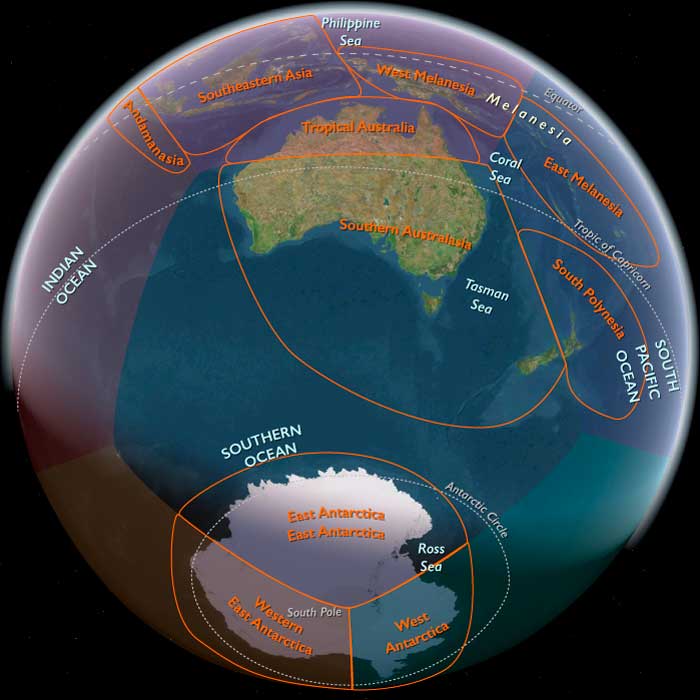
Southern Oceania
View →Related Events
Showing 7 events out of 7 total
King, while in England, had married Anna Josepha Coombe (his first cousin) on March 11, 1791 and returned shortly after on HMS Gorgon to take up his post as Lieutenant-Governor of Norfolk Island, at an annual salary of two hundred and fifty pounds.
King's first legitimate offspring, Phillip Parker King, is born here in December 1791; and four daughters will follow.
Phillip Parker King, assigned to survey the parts of the Australian coast not already examined by Matthew Flinders, will make four voyages between December 1817 and April 1822.
Among the nineteen-man crew are Allan Cunningham (botanist), John Septimus Roe and the aborigine Bungaree.
The first three trips are in the seventy-six-ton cutter HMS Mermaid.
The Admiralty has instructed King to discover whether there is any river 'likely to lead to an interior navigation into this great continent'.
The Colonial Office had given instructions to collect information about topography, fauna, timber, minerals, climate, and the natives and the prospects of developing trade with them.
King was born on Norfolk Island, to Philip Gidley King and Anna Josepha King née Coombe, and named after his father's mentor, Arthur Phillip, which explains the difference in spelling of his and his father's first names.
He had been sent to England for education in 1796, and had joined the Royal Naval Academy, Portsmouth, in 1802.
King had entered the Royal Navy in 1807, where he was commissioned lieutenant in 1814.
King names another nearby island after Henry Bathurst, 3rd Earl Bathurst (who, like Viscount Melville, is also commemorated by a Canadian island).
Phillip Parker King meets many Aboriginals and Malay proas in n surveying Australia’s northern coast as far as Van Diemen Gulf from February to June 1818.
King discovers Melville Island in 1818, and names it for Robert Dundas, 2nd Viscount Melville, first lord of the Admiralty, who is also commemorated by the much larger Melville Island in the Canadian arctic.
The British will make the first attempt to settle Australia's north coast soon after this, at the short-lived Fort Dundas.
The Mermaid had visited Timor in June, then returned to Sydney, arriving on July 29.
Phillip Parker King had surveyed the recently discovered Macquarie Harbour in Van Diemen's Land in December 1818 and January 1819, and sails in May 1819 for Torres Strait.
He had taken John Oxley as far as the Hastings River, and had continued on to survey the coast between Cape Wessel and Admiralty Gulf.
King returns to Sydney on January 12, 1820.
The Mermaid had been grounded in 1820.
Philip Parker King's fourth voyage is undertaken in the one hundred and fifty-four-ton sloop HMS Bathurst.
The ship heads north, through Torres Strait and to the northwest coast of the continent.
Further survey of the west coast is made after a visit to Mauritius.
Valuable contributions have been made to the exploration of Australia.